Ⅰ.根据汉语或首字母提示写出单词
1. Walking along the path after rain will make us feel
2. He had some unusual
3. The Belt and Road Initiative will be a
4. As good friends, we should always s
5. Don't always be so p
6. In order to see the blackboard c
7. I want to buy a copy of that novel, but there is n
1. Walking along the path after rain will make us feel
relaxed
(放松的).2. He had some unusual
experiences
(经历) while he was travelling in the desert.3. The Belt and Road Initiative will be a
chance
(机会) to help some countries to develop, so more and more countries want to catch it.4. As good friends, we should always s
support
each other and help each other.5. Don't always be so p
proud
of yourself. You still have a long way to go.6. In order to see the blackboard c
clearly
, she wears glasses every day.7. I want to buy a copy of that novel, but there is n
none
left in the bookshop.答案:1. relaxed 2. experiences 3. chance 4. support
5. proud 6. clearly 7. none
易错提醒 none, no one, nothing 的区别
1. 指代对象
no one:仅指代“人”,无范围限制。
nothing:仅指代“物、事情、抽象概念”,无范围限制。
none:可指代“人”或“物”,但必须对应前文提及的特定范围。
2. 介词搭配
no one/nothing:不与“of”连用。
none:可以独立使用;说明所指范围时可用 none of+名词/代词。
3. 谓语动词
no one/nothing:始终接单数动词。
none:指代可数名词复数时,单复数动词均可;指代不可数名词时,接单数动词。
4. 回答问句
答“Who ... ?”(问人)→ no one。
答“What ... ?”(问物/事)→ nothing。
答“How many/much ... ?”(问数量,有范围)→ none。
Ⅱ.用方框中所给单词或短语的正确形式填空
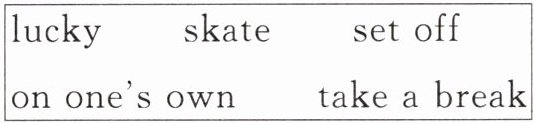
1. It's raining outside.
2. He
3. —Would you like
—Yes, but not now. I want to finish the work first.
4. —Can you finish the work
—I'm not sure. I'm afraid I need some help.
5. The girl
1. It's raining outside.
Unluckily
, no one brings an umbrella.2. He
set off
for home, but there was a great storm on his way home.3. —Would you like
to take a break
?—Yes, but not now. I want to finish the work first.
4. —Can you finish the work
on your own
, Peter?—I'm not sure. I'm afraid I need some help.
5. The girl
skated
every winter before she left her hometown. But now she can hardly see any snow in winter.答案:1. Unluckily 解析:句意:外面在下雨。不幸的是,没人带伞。此处修饰整个句子,应用副词“unluckily”,意为“不幸的是”,句首首字母大写。
2. set off 解析:句意:他出发回家,但在回家路上遇到了暴风雨。根据“was”可知时态为一般过去时,“set off”的过去式仍为“set off”。
3. to take a break 解析:“would like to do sth”为固定用法,意为“想要做某事”,此处应用动词不定式“to take a break”。
4. on your own 解析:句意:——彼得,你能独自完成这项工作吗?——我不确定。恐怕我需要一些帮助。“on one's own”为固定短语,意为“独自”,对应“on your own”。
5. skated 解析:根据“before she left her hometown”可知时态为一般过去时,“skate”的过去式为“skated”。
1. Which of the following underlined parts has a different sound from the others?
A.played
B.lived
C.finished
D.burned
答案: C 解析:A项“played”中“ed”发 /d/;B项“lived”中“ed”发 /d/;C项“finished”中“ed”发 /t/;D项“burned”中“ed”发 /d/。故选 C。
2. Jimmy could not sleep at first. He finally fell
midnight.
A.awake
B.asleep
C.sleeping
D.sleepy
asleep
when the rainstorm stopped atmidnight.
A.awake
B.asleep
C.sleeping
D.sleepy
答案:2. B 解析:句意:吉米一开始睡不着。在午夜,大暴雨停了,他终于睡着了。“fall asleep”为固定搭配,意为“入睡”,符合语境;“awake”意为“醒着的”;“sleeping”意为“正在睡觉的”;“sleepy”意为“困倦的”。结合语境,选 B。
3. To cross the road
A.safety; safely
B.safely; safe
C.safe; safety
D.safely; safety
safely
, we should know something about road safety
.A.safety; safely
B.safely; safe
C.safe; safety
D.safely; safety
答案:3. D 解析:句意:为了安全地过马路,我们应该了解一些道路安全知识。第一空修饰动词“cross”,应用副词“safely”;第二空“road safety”意为“道路安全”,应用名词“safety”。结合语境,选 D。
4. —I am sorry you lost the singing competition.
—We missed some beats(节拍)and didn't
A.find
B.face
C.follow
D.make
—We missed some beats(节拍)and didn't
follow
the music.A.find
B.face
C.follow
D.make
答案:4. C 解析:句意:——很抱歉你们输掉了歌唱比赛。——我们错过了一些节拍,没有跟上音乐。“follow”意为“跟上”,符合语境;“find”意为“找到”;“face”意为“面对”;“make”意为“制作”。结合语境,选 C。
5. —Your speech was wonderful! Didn't you feel nervous?
—Yes. I was a little nervous
A.at last
B.at the same time
C.at first
D.at the moment
—Yes. I was a little nervous
at first
, but I felt relaxed a few minutes later.A.at last
B.at the same time
C.at first
D.at the moment
答案:5. C 解析:句意:——你的演讲太棒了!你不觉得紧张吗?——是的。一开始我有点紧张,但几分钟后我就放松了。“at first”意为“一开始”,符合语境;“at the same time”意为“同时”;“at last”意为“最后”;“at the moment”意为“此刻”。结合语境,选 C。
6. —What did you do last Saturday, Tina?
—I
A.go
B.went
C.will go
D.was going
—I
went
to the nursing home and worked as a volunteer there.A.go
B.went
C.will go
D.was going
答案:6. B 解析:句意:——蒂娜,你上周六做什么了?——我去了养老院,在那里当志愿者。根据“last Saturday”可知时态为一般过去时,应用“went”。结合语境,选 B。
Ⅳ.阅读理解
(扬州中考改编)Think about how much time you spent outside last week. Really "outside". Walking from the car into the mall doesn't count.
Now think about how much time you spent indoors—on the Internet or playing video games or watching TV.
You may say, "I play inside more than outside and I like to play games on the computer."
If so, it's likely that you spent more time inside four walls than outside in fresh air. Kids today spend two fewer hours per week on sports and outdoor activities than kids did 20 years ago. That's according to a University of Michigan study. Non-moving activities are more popular. "The costs include overweight, greater stress, higher rates(比率)of physical and emotional illness and less joy ..." says Richard Louv, writer of Last Child in the Woods : Saving Our Children from Nature-Deficit Disorder.
Play is important, even for adults. ▲
Outdoor activity betters your senses. The next time you sit down to message your friends, take note of your senses during and after your texting. Then do the same experiment after you've done something outside. You will find being outdoors brings the senses to life. "Hiking, exploring, and fishing help hone all of your senses," says Betsy Keller. She's a professor of exercise and sports science at Ithaca College in New York. "Smell, sight ... all of your senses are in use when you're outside."
Outdoor play frees your mind. Are you stressed out? Having trouble focusing your mind on what you're doing? Too much time indoors—away from the natural world—may be a reason. Louv uses a term to describe(描述)the set of problems caused by too much time indoors: nature-deficit disorder. He says, "I use it to describe the price we pay for being so separated from nature."
Spending time outdoors brings you closer to the environment. When you're out, breathe in fresh air, hear the leaves crackle underfoot and search for cool birds and plants in the woods. It can help you feel more connected to the natural world. No woods nearby? Nature can be found right outside your back door or in your local park.
So the next time you sit down to spend quality time with a video game, think about treating yourself to a little outdoor play instead.
1. 新考法 写作手法 How does the writer first introduce the topic(话题)of outdoor play?
A. By showing the results of a recent study.
B. By introducing different kinds of outdoor play.
C. By inviting the readers to think about their own case.
D. By telling the readers outdoor play is good for body and mind.
2. 新考法 补全文章 Which sentence should go in the "▲" in Paragraph 5?
A. Outdoor play helps form relationships.
B. Just getting outdoors does wonders.
C. Nature can make us think of life beyond our worries.
D. The outdoors is the best place to practise physical skills.
3. Which of the following is closest to the meaning of "hone" in Paragraph 6?
A. Make sth better.
B. Make sth smaller.
C. Create more things.
D. Make sth in order.
4. Which of the following is a good way to enjoy outdoor play?
A. Walking from your car into the mall.
B. Spending your quality time with TV drama series.
C. Playing a video game of making sandcastles by the beach.
D. Watching in your local park how fast the clouds are moving.
答案:1. C 2. B 3. A 4. D
【语篇解读】本文是一篇说明文,主要介绍了户外运动的好处。
1. C 解析:写作手法题。根据“Think about how much time you spent outside last week.”可知作者通过让读者思考自己上周在户外待了多长时间来引出户外运动这个话题。故选 C。
2. B 解析:补全文章题。根据“Play is important, even for adults.”以及“Outdoor activity betters your senses.”并结合下文内容可知玩很重要,所以此处引出户外运动对人们的好处,选项 B“只是到户外就有神奇的效果。”符合语境。故选 B。
3. A 解析:词义猜测题。根据“You will find being outdoors brings the senses to life. 'Hiking, exploring, and fishing help hone all of your senses'”可知户外活动调动了感官,徒步旅行、探险和钓鱼有助于磨练你的所有感官,故推测此处画线部分意为“磨练”,A 项与之词义相近。故选 A。
4. D 解析:推理判断题。根据“Nature can be found right outside your back door or in your local park.”可知大自然就在你的后门外或者你当地的公园里,所以推断在你当地的公园里观察云朵移动的速度有多快,是享受户外活动的一种好方式。故选 D。