Ⅰ.根据首字母提示写出单词
1. Last night, a terrible rainstorm h
2. Of the two travel plans, I'd like this one because its price is l
3. I couldn't get into the room because the door was l
4. The careless driver didn't n
1. Last night, a terrible rainstorm h
hit
our town. The strong wind and heavy rain made a lot of noise.2. Of the two travel plans, I'd like this one because its price is l
lower
than that of the other one.3. I couldn't get into the room because the door was l
locked
. I had to find the key to the llock
.4. The careless driver didn't n
notice
the traffic lights. It's dangerous!答案:1. hit 2. lower 3. locked; lock 4. notice
Ⅱ.用括号中所给单词的正确形式填空
1. She
2. I saw an old man
3. I'd like to tell you a story about a girl
4. Jenny didn't want to push
1. She
heard
(hear) a strange big sound last night but she didn't go out to check it.2. I saw an old man
lying
(lie) on the road when I arrived at my school.3. I'd like to tell you a story about a girl
named
(name) Alice.4. Jenny didn't want to push
herself
(her) too hard, so she cut out some of her plans.答案:1. heard 解析:根据“last night”(昨晚),可知用一般过去时,“hear”的过去式为“heard”。
2. lying 解析:固定用法“see sb doing sth”(看见某人正在做某事),“lie”的现在分词为“lying”。
3. named 解析:“a girl”与“name”之间为被动关系,用过去分词“named”作后置定语,表示“名叫 Alice 的女孩”。
4. herself 解析:主语为“Jenny”,宾语与主语一致,用反身代词“herself”。
2. lying 解析:固定用法“see sb doing sth”(看见某人正在做某事),“lie”的现在分词为“lying”。
3. named 解析:“a girl”与“name”之间为被动关系,用过去分词“named”作后置定语,表示“名叫 Alice 的女孩”。
4. herself 解析:主语为“Jenny”,宾语与主语一致,用反身代词“herself”。
1. —
—Yes, I did. I
A.Did; made
B.Do; make
C.Will; make
D.Would; made
Did
you make this cake last night?—Yes, I did. I
made
it for you.A.Did; made
B.Do; make
C.Will; make
D.Would; made
答案:1. A 解析:根据“last night”(昨晚),可知用一般过去时,助动词用“Did”,答语中用过去式“made”,故选 A。
2. —
—Yeah. You can't imagine it if you don't experience it yourself.
A.What a; How
B.What; How
C.How a; What
D.How; What
What
great fun it is to go hiking in this season!—Yeah. You can't imagine it if you don't experience it yourself.
How
interesting it is!A.What a; How
B.What; How
C.How a; What
D.How; What
答案:2. B 解析:感叹句结构:“What+形容词+不可数名词+主谓!”“How+形容词+主谓!”第一空“fun”为不可数名词,用“What”;第二空“interesting”为形容词,用“How”,故选 B。
3.
A.None; no one
B.No one; each
C.No one; none
D.Each; none
No one
can work out the problems because none
of the problems is easy.A.None; no one
B.No one; each
C.No one; none
D.Each; none
答案:3. C 解析:“no one”指人,“none”可指人或物,常与“of”连用。第一空“没人能解决问题”,用“no one”;第二空“没有一个问题是简单的”,与“of”连用用“none”,故选 C。
4. —Your little brother
—Yes, but he
A.can; could
B.could; couldn't
C.can; couldn't
D.can't; couldn't
can
ride a bike very well now.—Yes, but he
couldn't
do it last year.A.can; could
B.could; couldn't
C.can; couldn't
D.can't; couldn't
答案:4. C 解析:第一空“now”(现在)用“can”;第二空“last year”(去年)用过去式,根据“but”表转折,用“couldn't”,故选 C。
5. —In summer, it is very cool to go
A.through; across
B.across; through
C.across; cross
D.through; through
through
the forest. —That is right. But I like to swim across
the river in the afternoon.A.through; across
B.across; through
C.across; cross
D.through; through
答案:5. A 解析:“go through the forest”(穿过森林),“swim across the river”(游过河流),故选 A。
归纳总结 介词用法:through/across
through:从物体“内部”穿过,如“go through the forest”(穿过森林)、“look through the window”(透过窗户看)。
across:从物体“表面”穿过,如“swim across the river”(游过河流)、“walk across the street”(过马路)。
归纳总结 介词用法:through/across
through:从物体“内部”穿过,如“go through the forest”(穿过森林)、“look through the window”(透过窗户看)。
across:从物体“表面”穿过,如“swim across the river”(游过河流)、“walk across the street”(过马路)。
6. Her red silk blouse
A.matches; fit
B.match; fit
C.fits; matches
D.fits; match
matches
her blue jeans very well and they also fit
her very well.A.matches; fit
B.match; fit
C.fits; matches
D.fits; match
答案:6. A 解析:“match”表示“搭配”,主语为物;“fit”表示“合身”,主语为人或物。第一空“衬衫搭配牛仔裤”用“matches”;第二空“它们很合身”用“fit”,故选 A。
7. There were lots of people at the street corner when the accident(意外)
A.happened to
B.happened
C.held
D.was taken place
happened
. So many people saw it and went to help.A.happened to
B.happened
C.held
D.was taken place
答案:7. B 解析:“happen”表示“发生”,无被动语态;“happen to”后接宾语;“hold”(举行);“take place”(发生)无被动语态。此处“事故发生”用“happened”,故选 B。
易错提醒 happen, take place 两者均无被动语态,如“事故发生”需说“The accident happened”,不可说成“The accident was happened”。
易错提醒 happen, take place 两者均无被动语态,如“事故发生”需说“The accident happened”,不可说成“The accident was happened”。
8. —Could you tell me how to get to the nearest bookstore?
—Sure. Go along this street until you
A.pass by
B.set up
C.walk into
D.look for
—Sure. Go along this street until you
pass by
a bank. The bookstore is next to it.A.pass by
B.set up
C.walk into
D.look for
答案:8. A 解析:选项 A“pass by”(经过);B“set up”(建立);C“walk into”(走进);D“look for”(寻找)。句意:沿着这条街走直到你经过一家银行,书店就在旁边。“pass by”符合句意。
9. Mike found
A.he
B.his
C.him
D.himself
himself
in a very dangerous situation when climbing last year.A.he
B.his
C.him
D.himself
答案:9. D 解析:固定用法“find oneself in ...”(发现自己处于……境地),主语为 Mike,用反身代词“himself”,故选 D。
10. What can we know from the picture?
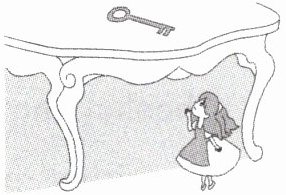
A.Alice is too fat to reach the key on the table.
B.Alice is too short to reach the key on the table.
C.Alice is tall enough to reach the key on the table.
D.Alice is strong enough to reach the key on the table.
A.Alice is too fat to reach the key on the table.
B.Alice is too short to reach the key on the table.
C.Alice is tall enough to reach the key on the table.
D.Alice is strong enough to reach the key on the table.
答案: B 解析:图片暗示 Alice 个子太矮够不到桌上的钥匙,结合选项,“too short to reach”(太矮而够不到)符合语境,故选 B。