1. Thanks to the new education policy(政策), students
A.must
B.can
C.could
D.should
can
have more time to do sports and sleep now.A.must
B.can
C.could
D.should
答案:1. B 解析:Thanks to the new education policy 和 now 说明新政策为学生创造了现实条件,使他们现在“能够”有更多时间运动和睡觉;can 表示现在的能力或客观可能。A 项 must 表示“必须”,强调义务;C 项 could 通常表示过去的能力、假设或较弱的可能;D 项 should 表示“应该”或按理预期,不如 can 直接说明政策带来的现实条件,故选 B。
2. —Sir,
—Sorry, I am afraid you
A.could; can't
B.can; needn't
C.need; can't
D.must; couldn't
could
I feed the bears at Nantong Forest Safari Park?—Sorry, I am afraid you
can't
.A.could; can't
B.can; needn't
C.need; can't
D.must; couldn't
答案:2. A 解析:根据问句中的 Sir 和答语 Sorry 可知,说话者礼貌地请求许可,对方表示不允许;could 可用于委婉请求,can't 表示不允许。needn't 表示不必,不能表达此处的拒绝,故选 A。
3. —Li Hua, the view on the top of Wolf Hill is so beautiful! Look! Is that a fishing boat over there? —No, it
A.can
B.can't
C.must
D.mustn't
can't
be because fishing is not allowed. We must protect the Yangtze River now.A.can
B.can't
C.must
D.mustn't
答案:3. B 解析:答语 No 和“禁止捕鱼”表明说话者认为那不可能是渔船,can't be 表示有依据的否定推测。A 项 can be 表示可能,与 No 冲突;C 项 must be 表示肯定推测;D 项 mustn't be 表示“禁止成为”,不是对身份的否定推测,故选 B。
4. We never know what
A.must
B.might
C.shall
D.should
might
happen in the future, but we can prepare for the worst and hope for the best.A.must
B.might
C.shall
D.should
答案:4. B 解析:“in the future”(未来)表示不确定,“might”(可能)符合语境,“must”表“必须”,“shall”表“将要”(第一人称),“should”表“应该”,故选 B。
5. —My father seldom sleeps well at night.
—That's bad. He had better
A.drink
B.not to drink
C.not drink
D.drinking
—That's bad. He had better
not drink
much coffee.A.drink
B.not to drink
C.not drink
D.drinking
答案:5. C 解析:“had better not do sth”为固定搭配(最好不做某事),故选 C。
Ⅱ.用正确的情态动词填空
1. I left my wallet at home.
2. Don't throw away things such as old clothes and books. You
3. Don't take photos at the zoo. You
4. I
5. Anna
1. I left my wallet at home.
Could/Can/Would/Will
you please lend me some money?2. Don't throw away things such as old clothes and books. You
can/should/could
collect them and give them away.3. Don't take photos at the zoo. You
may/might/can/could
scare the animals.4. I
can't
stand watching soap operas because they are too boring.5. Anna
couldn't
ice-skate before, so she didn't like winter.答案:1. Could/Can/Would/Will 解析:前句说明说话者把钱包落在家里,后句是在礼貌地请求对方借钱;Could you please do sth? 是委婉请求的常用句型,Can、Would 或 Will 也都可用于提出这一请求,语气有所不同,故填 Could/Can/Would/Will。
2. can/should/could 解析:前句劝人不要扔掉旧衣服和书,后句提出一种可行的处理方式;can 表示“可以”,说明可以收集这些物品并捐出,should 可表示“应该”,could 可表示委婉建议,在现有语境中也都可以成立,故填 can/should/could。
3. may/might/can/could 解析:拍照可能惊吓动物,空格需要表示不确定的可能性;may 意为“可能”,后接动词原形 scare,might、could 以及表示一般可能性的 can 也可成立,故填 may/might/can/could。
4. can't 解析:can't stand doing sth 是固定搭配,意为“不能忍受做某事”;后文 because they are too boring 说明说话者无法忍受看肥皂剧,句子叙述现在的一般感受,故填 can't。
5. couldn't 解析:before 和 so she didn't like winter 共同构成过去语境,且 ice-skate 表示一种技能;couldn't 表示过去“不具备某种能力”,说明 Anna 以前不会滑冰,故填 couldn't。
Part 4 时态专练
答案 D68
答案:
1. —Susan, what did you do yesterday?
—I
A.visit
B.visited
C.am visiting
D.will visit
—I
B
the history museum with my friends.A.visit
B.visited
C.am visiting
D.will visit
答案:1. B 解析:根据“yesterday”(昨天)可知时态为一般过去时,“visit”的过去式为“visited”,故选 B。
2. —Jim, what's your plan for this weekend?
—I
A.am watching
B.watch
C.watched
D.am going to watch
—I
D
a film with my dad.A.am watching
B.watch
C.watched
D.am going to watch
答案:2. D 解析:根据“this weekend”(这个周末)可知时态为一般将来时,“be going to watch”表示计划做某事,故选 D。
3. Unluckily, my younger sister
A.fell; hurt
B.felt; hurted
C.felt; hurt
D.falled; hurted
A
off a bike and A
her leg.A.fell; hurt
B.felt; hurted
C.felt; hurt
D.falled; hurted
答案:3. A 解析:“fall off”(摔倒),fall 的过去式为“fell”,“hurt”(受伤)的过去式为“hurt”,“felt”为“feel”的过去式(感觉),不符合语境,故选 A。
4. Tom and his friends visited Hongze Lake Wetland
A.next week
B.every Sunday
C.the other day
D.tomorrow
C
.A.next week
B.every Sunday
C.the other day
D.tomorrow
答案:4. C 解析:“visited”为一般过去时,“the other day”(前几天)用于过去时,“next week/tomorrow”用于将来时,“every Sunday”用于一般现在时,故选 C。
5. —What are you going to do next weekend?
—There
A.will be
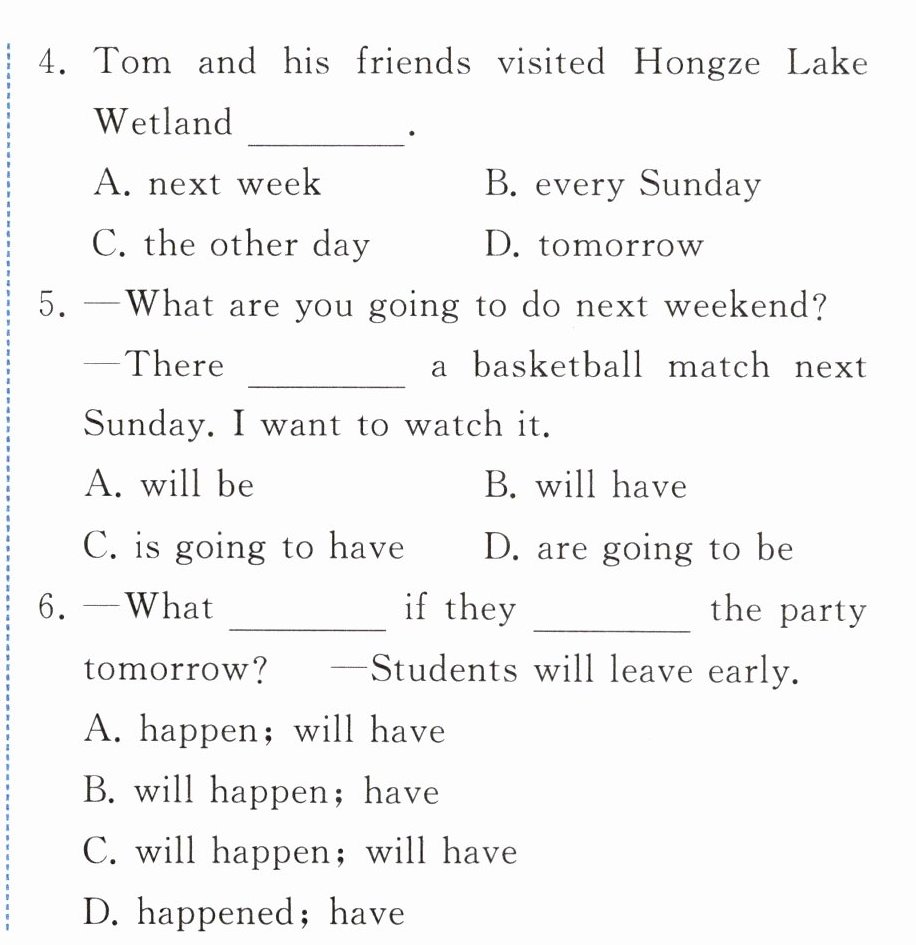
B.will have
C.is going to have
D.are going to be
—There
A
a basketball match next Sunday. I want to watch it.A.will be
B.will have
C.is going to have
D.are going to be
答案:5. A 解析:“next Sunday”(下周日)表示将来,“there be”句型的将来时为“there will be”或“there is/are going to be”,“a basketball match”为单数,排除 D 项;“there have”为错误表达,故选 A。
6. —What
A.happen; will have
B.will happen; have
C.will happen; will have
D.happened; have
B
if they B
the party tomorrow? —Students will leave early.A.happen; will have
B.will happen; have
C.will happen; will have
D.happened; have
答案:6. B 解析:“if”引导的条件状语从句,遵循“主将从现”,主句用“will happen”,从句用“have”,故选 B。