1. —Look at the sky!
A.What a
B.What
C.How a
D.How
D
colourful the rainbow makes the sky of Rugao! —That's right. This is my first time to see a rainbow!A.What a
B.What
C.How a
D.How
答案:1. D 解析:感叹句中,形容词“colourful”后无名词,用“How”引导,结构为“How+形容词+主谓!”,故选 D。
2.
A.Two-fifths
B.Two-fifth
C.Second-five
D.Two-five
A
of the students in our class would like to visit Yulong Snow Mountain.A.Two-fifths
B.Two-fifth
C.Second-five
D.Two-five
答案:2. A 解析:分数表达法为“分子基数词+分母序数词”,分子大于1时分母用复数,“五分之二”为“two-fifths”,故选 A。
3. —Be careful when you eat the fish! There might be small bones in it.
—Ouch! I just felt
A.something
B.anything
C.everything
D.nothing
—Ouch! I just felt
A
hard in my mouth. I think I had a bone. It's hurting ...A.something
B.anything
C.everything
D.nothing
答案:3. A 解析:句意:我正好感觉到嘴里有硬东西。“something”(某物)用于肯定句,“anything”用于否定/疑问句,“everything”意为“一切”,“nothing”意为“没有东西”,故选 A。
4. With modern AI technology, people in old photos seem to be
A.lively
B.living
C.alive
D.lovely
C
as if they could step out of the pictures any time.A.lively
B.living
C.alive
D.lovely
答案:4. C 解析:句意:老照片中的人似乎栩栩如生。“alive”(活着的,栩栩如生的)符合语境,“lively”意为“活泼的”,“living”意为“现存的”,“lovely”意为“可爱的”,故选 C。
5. Grandma Wang often
A.takes in
B.gives away
C.holds up
D.deals with
B
home-grown vegetables to neighbours. She always says sharing makes everyone happy.A.takes in
B.gives away
C.holds up
D.deals with
答案:5. B 解析:根据“sharing makes everyone happy”(分享使人快乐)可知“赠送蔬菜”,“gives away”(赠送)符合语境,故选 B。
知识拓展 give相关短语:①“give up”放弃;②“give in”屈服,投降;③“give out”分发;耗尽;④“give back”归还
知识拓展 give相关短语:①“give up”放弃;②“give in”屈服,投降;③“give out”分发;耗尽;④“give back”归还
6. To find the treasure, you should swim
forest.
A.across
B.through
C.past
D.below
A
a big river and then get through theforest.
A.across
B.through
C.past
D.below
答案:6. A 解析:“swim across a river”为固定搭配(游过河流),“through”指穿过内部,“past”指从旁边经过,“below”指在下方,故选 A。
7. The journey to Jiuzhaigou is a great
A.chance
B.task
C.taste
D.tool
A
for Millie to learn more about the magic places that she has known from books and pictures.A.chance
B.task
C.taste
D.tool
答案:7. A 解析:句意:九寨沟之旅是米莉更多地了解那些她从书和图片中得知的神奇地方的一个好机会。“chance”(机会)符合语境,“task”意为“任务”,“taste”意为“味道”,“tool”意为“工具”,故选 A。
8. —I hear that our school
—Wow! I can't wait to talk to the new teacher!
A.introduced
B.introduces
C.is introducing
D.will introduce
D
an AI teacher next week!—Wow! I can't wait to talk to the new teacher!
A.introduced
B.introduces
C.is introducing
D.will introduce
答案:8. D 解析:根据“next week”(下周)可知时态为一般将来时,故填“will introduce”,选 D。
9. Why does the poet say "West Lake is like Xi Shi" according to the poem below?
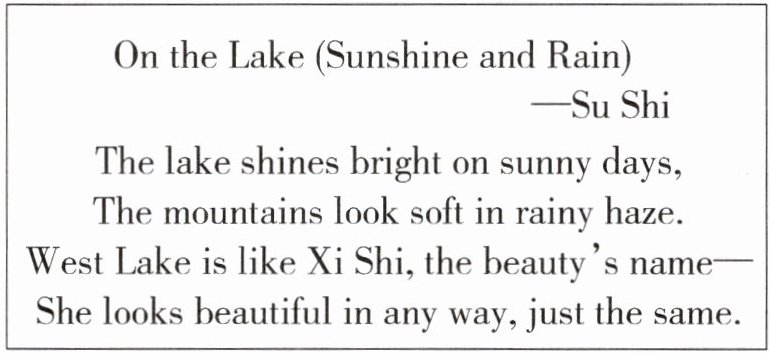
A.Because it's blue like her dress.
B.Because it's very sunny.
C.Because it's beautiful in all weather.
D.Because it's big and wide.
A.Because it's blue like her dress.
B.Because it's very sunny.
C.Because it's beautiful in all weather.
D.Because it's big and wide.
答案: C 解析:诗句“淡妆浓抹总相宜”表明西湖在任何天气下都很美,与西施相似,故选 C。
10. —I can't decide which laptop to buy for college. —
A.By the way
B.Tell you what
C.Hang on
D.Go on
B
, let's check the reviews together and compare them carefully.A.By the way
B.Tell you what
C.Hang on
D.Go on
答案:10. B 解析:By the way 顺便说一下;Tell you what 你听我说;Hang on 稍等;Go on 继续。根据“let's check the reviews together and compare them carefully”可知,此处是提出一个建议,即一起查看评论并仔细比较,所以应用“Tell you what”来引出这个建议,故选 B。
Ⅱ.完形填空(每小题1分,满分15分)
When I had a fever last winter, everything felt dark and quiet. My body hurt and my throat burned. Even my favourite cartoons, which usually made me 1, now seemed boring. The blanket felt too hot, and the silence in the room felt heavy. I just stayed in bed, feeling sad and thinking about 2 but my pain.
Then I heard a soft knock on the door. It was Grandma! She walked in with a big smile, holding a bowl of 3. "I made this for you," she said. The porridge looked 4 but inviting. The plain white rice was mixed with small pieces of ginger(姜), fresh green onions, and a little sesame oil. As soon as I 5 the wonderful mix of ginger and herbs, my nose seemed to open a bit.
"You need to eat 6, dear. It's hot," she said, sitting beside me. She blew on a spoonful of porridge and then handed it to me. For the first try, I took a small bite 7 the ginger was too spicy(辣的) and I made a face. Grandma laughed and started telling me stories about her childhood. She said when she was my age, she got lost in the snow one day. It was a bowl of hot rice porridge that 8 her. "I was freezing cold, but then a bowl of porridge 9 me like a fire in my belly," she said with her eyes shining with memories. Listening to her stories, I found myself taking another bite, and this time, the porridge tasted much 10.
As I ate, she wiped my forehead with a cool towel. She told me how she hated 11 but always looked forward to having porridge when she was sick as a little girl. "Medicine treats your body," she said, "but food cures your heart."
With each spoonful, I felt warmer and better. The ginger made my sore throat less painful, and the soft rice made me feel 12. When Grandma added a little honey to the porridge, the sweet taste made me 13 all about being sick.
Finally, I finished the whole bowl. To my surprise, my headache was gone immediately! "See? Food isn't just something to fill your stomach. It's 14 that you can taste," Grandma said.
That night, as I closed my eyes to sleep, I noticed the room didn't seem so 15 any more. Thanks to Grandma and her magical porridge, I felt loved and happy again.
1. A. think B. laugh C. study D. cry
2. A. nothing B. anything
C. everything D. something
3. A. milk B. juice
C. rice D. porridge
4. A. healthy B. simple
C. delicious D. rich
5. A. tasted B. smelt C. saw D. heard
6. A. quickly B. quietly
C. closely D. slowly
7. A. but B. so
C. before D. till
8. A. hurt B. saved
C. found D. burnt
9. A. light B. hurt
C. interested D. warmed
10. A. cooler B. hotter
C. better D. spicier
11. A. medicine B. sugar
C. water D. honey
12. A. nervous B. worried
C. excited D. comfortable
13. A. know B. forget
C. hate D. remember
14. A. illness B. story
C. love D. pain
15. A. hot B. dark
C. bright D. small
Ⅲ.阅读理解(每小题2.5分,满分20分)
A
跨学科 生物 (苏州一模改编)Water is one of the most important substances(物质) on earth. Without water, humans, animals and even plants would die. About 70 per cent of our body weight is water. People could live for a month or more without food, but we could live for only three or four days without water.
How much water do animals and plants need? A human may need 2 litres(升) per day, a cow needs 135 litres per day and a large tree requires 20,000 litres a day.
How do we people use water? We drink water. We wash our bodies, our clothes and many other things with water. The foods we eat have water in them, and all our drinks are largely water. We use water to cook much of our food, and we use water for different activities, such as boating, swimming and fishing.
Plants need water to live just like we do. Plants use their roots to take up water from the soil. The crops that farmers grow as food need water to grow. In some places where there is little rain and the land is dry, farmers bring water from rivers, lakes and wells to their fields. It's called irrigation(灌溉). Some crops need more water to grow than others. Rice and cotton, for example, need lots of water, while olives and oranges need only a little.
Animals also need water to live. The animals that provide us with meat, milk and eggs need large amounts of clean water to drink. Water is also home to millions of plants and animals, including the fish we eat.
Some industries use water to cool hot substances or the moving parts of machines. Water is also used to produce electricity in hydroelectric power stations(水电站). The water of fast-flowing rivers is used to turn the machines that produce electricity.
Water is used to make many kinds of foods and many of the things we see or use every day.
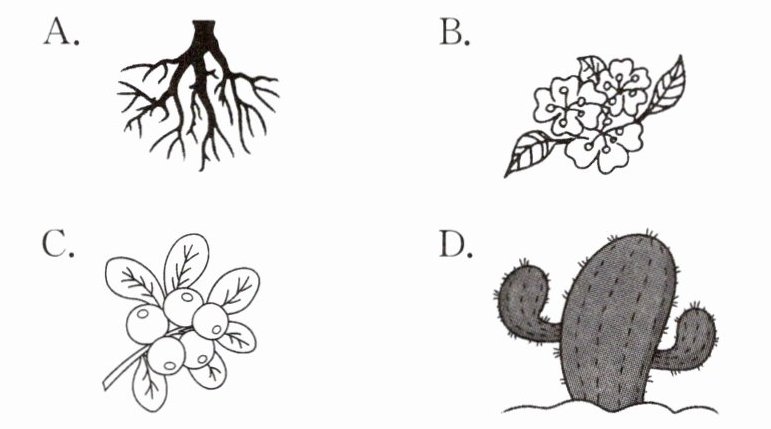
1. 新考法 图示理解 Which of the following can be called "roots"?
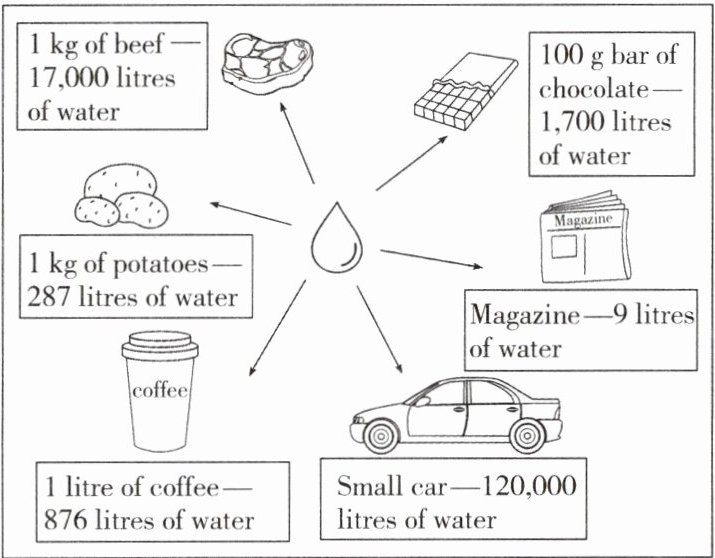
2. What does the picture in the passage want to tell us?
A. Water is seriously polluted.
B. Water is needed everywhere.
C. Water is limited on our earth.
D. Water is used in industry.
3. What can we know about water according to the passage?
A. Animals can live longer than humans without water.
B. Different kinds of plants need the same amount of water.
C. Irrigation gives farmers chances to grow crops in dry places.
D. Hydro-electric power stations can be seen in many countries.
4. 语言能力 归纳能力 What's the main idea of the passage?
A. The qualities of water.
B. The background of water.
C. The uses of water.
D. The production of water.
B
When I had a fever last winter, everything felt dark and quiet. My body hurt and my throat burned. Even my favourite cartoons, which usually made me 1, now seemed boring. The blanket felt too hot, and the silence in the room felt heavy. I just stayed in bed, feeling sad and thinking about 2 but my pain.
Then I heard a soft knock on the door. It was Grandma! She walked in with a big smile, holding a bowl of 3. "I made this for you," she said. The porridge looked 4 but inviting. The plain white rice was mixed with small pieces of ginger(姜), fresh green onions, and a little sesame oil. As soon as I 5 the wonderful mix of ginger and herbs, my nose seemed to open a bit.
"You need to eat 6, dear. It's hot," she said, sitting beside me. She blew on a spoonful of porridge and then handed it to me. For the first try, I took a small bite 7 the ginger was too spicy(辣的) and I made a face. Grandma laughed and started telling me stories about her childhood. She said when she was my age, she got lost in the snow one day. It was a bowl of hot rice porridge that 8 her. "I was freezing cold, but then a bowl of porridge 9 me like a fire in my belly," she said with her eyes shining with memories. Listening to her stories, I found myself taking another bite, and this time, the porridge tasted much 10.
As I ate, she wiped my forehead with a cool towel. She told me how she hated 11 but always looked forward to having porridge when she was sick as a little girl. "Medicine treats your body," she said, "but food cures your heart."
With each spoonful, I felt warmer and better. The ginger made my sore throat less painful, and the soft rice made me feel 12. When Grandma added a little honey to the porridge, the sweet taste made me 13 all about being sick.
Finally, I finished the whole bowl. To my surprise, my headache was gone immediately! "See? Food isn't just something to fill your stomach. It's 14 that you can taste," Grandma said.
That night, as I closed my eyes to sleep, I noticed the room didn't seem so 15 any more. Thanks to Grandma and her magical porridge, I felt loved and happy again.
1. A. think B. laugh C. study D. cry
2. A. nothing B. anything
C. everything D. something
3. A. milk B. juice
C. rice D. porridge
4. A. healthy B. simple
C. delicious D. rich
5. A. tasted B. smelt C. saw D. heard
6. A. quickly B. quietly
C. closely D. slowly
7. A. but B. so
C. before D. till
8. A. hurt B. saved
C. found D. burnt
9. A. light B. hurt
C. interested D. warmed
10. A. cooler B. hotter
C. better D. spicier
11. A. medicine B. sugar
C. water D. honey
12. A. nervous B. worried
C. excited D. comfortable
13. A. know B. forget
C. hate D. remember
14. A. illness B. story
C. love D. pain
15. A. hot B. dark
C. bright D. small
Ⅲ.阅读理解(每小题2.5分,满分20分)
A
跨学科 生物 (苏州一模改编)Water is one of the most important substances(物质) on earth. Without water, humans, animals and even plants would die. About 70 per cent of our body weight is water. People could live for a month or more without food, but we could live for only three or four days without water.
How much water do animals and plants need? A human may need 2 litres(升) per day, a cow needs 135 litres per day and a large tree requires 20,000 litres a day.
How do we people use water? We drink water. We wash our bodies, our clothes and many other things with water. The foods we eat have water in them, and all our drinks are largely water. We use water to cook much of our food, and we use water for different activities, such as boating, swimming and fishing.
Plants need water to live just like we do. Plants use their roots to take up water from the soil. The crops that farmers grow as food need water to grow. In some places where there is little rain and the land is dry, farmers bring water from rivers, lakes and wells to their fields. It's called irrigation(灌溉). Some crops need more water to grow than others. Rice and cotton, for example, need lots of water, while olives and oranges need only a little.
Animals also need water to live. The animals that provide us with meat, milk and eggs need large amounts of clean water to drink. Water is also home to millions of plants and animals, including the fish we eat.
Some industries use water to cool hot substances or the moving parts of machines. Water is also used to produce electricity in hydroelectric power stations(水电站). The water of fast-flowing rivers is used to turn the machines that produce electricity.
Water is used to make many kinds of foods and many of the things we see or use every day.
1. 新考法 图示理解 Which of the following can be called "roots"?
2. What does the picture in the passage want to tell us?
A. Water is seriously polluted.
B. Water is needed everywhere.
C. Water is limited on our earth.
D. Water is used in industry.
3. What can we know about water according to the passage?
A. Animals can live longer than humans without water.
B. Different kinds of plants need the same amount of water.
C. Irrigation gives farmers chances to grow crops in dry places.
D. Hydro-electric power stations can be seen in many countries.
4. 语言能力 归纳能力 What's the main idea of the passage?
A. The qualities of water.
B. The background of water.
C. The uses of water.
D. The production of water.
B
答案:Ⅱ.1.B 2.A 3.D 4.B 5.B 6.D 7.A 8.B 9.D 10.C 11.A 12.D 13.B 14.C 15.B
【语篇解读】本文是一篇记叙文。文章讲述了去年冬天作者生病,奶奶给他煮粥,并给他讲故事,让他感受到了爱和快乐的事。
1. B 解析:根据“now seemed boring”可知,发烧的时候即使喜欢的卡通也变得无聊了,因此这些卡通平时是有趣的,会让“我”笑。故选 B。
2. A 解析:根据“My body hurt and my throat burned.”以及“thinking about ... but my pain”可知,因为发烧,无法思考事情,精神只集中于疼痛。故选 A。
3. D 解析:根据“The porridge looked ... but inviting.”可知,是拿了一碗粥。故选 D。
4. B 解析:根据“but inviting”可知,粥看起来简单但是很诱人。故选 B。
5. B 解析:根据“my nose seemed to open a bit”可知,是鼻子闻到这种味道。故选 B。
6. D 解析:根据“It's hot”可知,是指慢点吃。故选 D。
7. A 解析:根据句意可知,“我”咬了一小口,但姜太辣了,“我”做了个鬼脸,前后表示转折,用 but。so 表示“因此”,填入后会使“吃了一小口”成为“姜太辣”的原因,因果关系不合理;before 和 till 也不符合这里尝到后觉得辣的情节。故选 A。
8. B 解析:根据“I was freezing cold, but then a bowl of porridge ... me like a fire in my belly”可知,是粥救了她。故选 B。
9. D 解析:根据“I was freezing cold”可知,在寒冷的时候需要热的食物来取暖。故选 D。
10. C 解析:根据“the ginger was too spicy and I made a face”可知,这次尝起来好多了。故选 C。
11. A 解析:根据“when she was sick”以及“Medicine treats your body”可知,是生病的时候讨厌吃药。故选 A。
12. D 解析:根据“With each spoonful, I felt warmer and better.”可知,“我”感到舒服。故选 D。
13. B 解析:根据“When Grandma added a little honey to the porridge”可知,甜味的粥让人忘记生病的痛苦。故选 B。
14. C 解析:根据“Thanks to Grandma and her magical porridge, I felt loved and happy again.”可知,食物是你可以品尝到的爱。故选 C。
15. B 解析:根据第一段“everything felt dark”可知,吃完充满爱的粥后,感觉房间不再那么黑了。故选 B。
Ⅲ.1.A 2.B 3.C 4.C
A
【语篇解读】本文是一篇说明文,介绍了水在日常生活、农业、工业等方面的多种用途,并强调了水资源的广泛需求和重要性。
1. A 解析:图示理解题。根据“Plants use ... from the soil.”并结合常识可知,植物吸收水分的部位是根,图 A 所示的分叉状地下部分是“根”。故选 A。
2. B 解析:推理判断题。根据文中插图列举了制造不同产品所需的水量可知,人类日常所用、所吃的几乎所有东西都需要用到水。故选 B。
3. C 解析:细节理解题。根据“In some places ... irrigation.”可知,在干旱地区,农民通过从河流、湖泊、井等处引水进行灌溉,从而能在缺水地区种庄稼,所以灌溉给了农民在干旱地区种植作物的机会。故选 C。
4. C 解析:主旨大意题。通读全文可知,文章主要讨论了水在人类、动物、植物、农业、工业等多个领域的用途,主旨应是“水的用途”。故选 C。