7. If you don't know how to
A.deal with
B.do with
C.catch up with
D.get on with
A
the problem, please ask your classmates for help.A.deal with
B.do with
C.catch up with
D.get on with
答案:7. A 解析:“deal with”与“how”搭配,“do with”与“what”搭配,根据“how”可知选A。
知识拓展 How to deal with it? = What to do with it?
知识拓展 How to deal with it? = What to do with it?
8. —Our school club is organising a visit to the Children's Hospital this Sunday.
—That's meaningful! We should do more for those
A.in need
B.in order
C.in surprise
D.in time
—That's meaningful! We should do more for those
A
like kids who are sick or lonely.A.in need
B.in order
C.in surprise
D.in time
答案:8. A 解析:A. 需要帮助的;B. 整齐的;C. 惊讶的;D. 及时的。根据“kids who are sick or lonely”可知是需要帮助的人,故选A。
9. —What are you saving money for?
—Father's Day is around the corner. I
A.was buying
B.have bought
C.bought
D.am going to buy
—Father's Day is around the corner. I
D
a gift for my father.A.was buying
B.have bought
C.bought
D.am going to buy
答案:9. D 解析:根据“Father's Day is around the corner.”可知用一般将来时,“be going to buy”表计划,故选D。
Ⅳ.句子翻译
1. 我喉咙痛,现在说不出话来。
I
2. 小爱丽丝现在独自打扫房间有困难。
Little Alice
3. 如果你的电话有问题,他会帮助你。
4. 我将卖掉我的旧衣服来筹钱种菜。
1. 我喉咙痛,现在说不出话来。
I
have a sore throat
and I can't speak now.2. 小爱丽丝现在独自打扫房间有困难。
Little Alice
has trouble/problems/difficulty cleaning the room
on her own now.3. 如果你的电话有问题,他会帮助你。
If you have a problem with your phone
, he will help you.4. 我将卖掉我的旧衣服来筹钱种菜。
I will sell my old clothes to raise money for
growing vegetables.答案:1. have a sore throat
2. has trouble/problems/difficulty cleaning the room
3. If you have a problem with your phone
4. I will sell my old clothes to raise money for
2. has trouble/problems/difficulty cleaning the room
3. If you have a problem with your phone
4. I will sell my old clothes to raise money for
Ⅴ.阅读理解
In small towns, people are used to saying hello to their neighbours in stores, on the streets and in front of their homes. In today's city life, people may feel uncomfortable talking to neighbours they don't know well at the supermarket. However, greeting your neighbours is actually good for you, especially if you say hello to six people, according to a recent survey.
Saying hello to people increases well-being, but "six" is the magic number. As the number of neighbours greeted increases from zero to six, the well-being score increases. After six, there are no further increases. These results are from a survey. The survey(调查) was based on the answers from 4,556 Americans. It covered social well-being, physical well-being, community well-being and more. People who said they didn't say hello to anyone in their neighbourhood scored 51.5. People who greeted six neighbours had a score of 64.1.
You might think that saying hello to neighbours is only about social well-being. In fact, regular(经常的) greetings also improve a person's physical well-being and community well-being. That's because all of these are connected. You will be more likely to speak to people if you think your community is safe. Your physical well-being can improve if you are getting out and walking around your neighbourhood.
We don't require that you know the person well; just stop and talk to him. But the more people you say hello to, the more likely you are to start a conversation.
While this is just a survey for now, saying hello regularly is a good way to improve your own well-being.
1. 语言能力 归纳能力 What does the writer show us in Paragraph 1?
A. City people like talking to neighbours.
B. People should have six neighbours.
C. Town people often greet neighbours.
D. City people dislike going shopping.
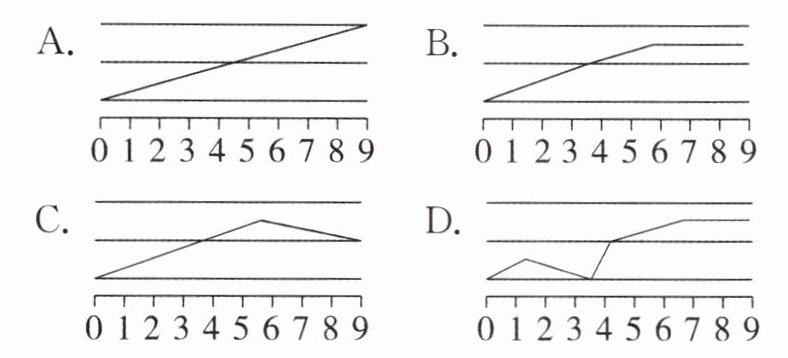
2. 跨学科 数学 Which of the following may show the change in the well-being score?
3. Which of the following is the right order of the passage?
A. Introduction-Survey Results-Reason Analysis-Practical Suggestions(实用建议)
B. Introduction-Reason Analysis-Survey Results-Practical Suggestions
C. Introduction-Practical Suggestions-Survey Results-Reason Analysis
D. Introduction-Survey Results-Practical Suggestions-Reason Analysis
4. What does the writer encourage us to do?
A. Know about our neighbours well.
B. Speak to people if the community is safe.
C. Get out to improve our physical well-being.
D. Greet others even if we don't know them well.
In small towns, people are used to saying hello to their neighbours in stores, on the streets and in front of their homes. In today's city life, people may feel uncomfortable talking to neighbours they don't know well at the supermarket. However, greeting your neighbours is actually good for you, especially if you say hello to six people, according to a recent survey.
Saying hello to people increases well-being, but "six" is the magic number. As the number of neighbours greeted increases from zero to six, the well-being score increases. After six, there are no further increases. These results are from a survey. The survey(调查) was based on the answers from 4,556 Americans. It covered social well-being, physical well-being, community well-being and more. People who said they didn't say hello to anyone in their neighbourhood scored 51.5. People who greeted six neighbours had a score of 64.1.
You might think that saying hello to neighbours is only about social well-being. In fact, regular(经常的) greetings also improve a person's physical well-being and community well-being. That's because all of these are connected. You will be more likely to speak to people if you think your community is safe. Your physical well-being can improve if you are getting out and walking around your neighbourhood.
We don't require that you know the person well; just stop and talk to him. But the more people you say hello to, the more likely you are to start a conversation.
While this is just a survey for now, saying hello regularly is a good way to improve your own well-being.
1. 语言能力 归纳能力 What does the writer show us in Paragraph 1?
A. City people like talking to neighbours.
B. People should have six neighbours.
C. Town people often greet neighbours.
D. City people dislike going shopping.
2. 跨学科 数学 Which of the following may show the change in the well-being score?
3. Which of the following is the right order of the passage?
A. Introduction-Survey Results-Reason Analysis-Practical Suggestions(实用建议)
B. Introduction-Reason Analysis-Survey Results-Practical Suggestions
C. Introduction-Practical Suggestions-Survey Results-Reason Analysis
D. Introduction-Survey Results-Practical Suggestions-Reason Analysis
4. What does the writer encourage us to do?
A. Know about our neighbours well.
B. Speak to people if the community is safe.
C. Get out to improve our physical well-being.
D. Greet others even if we don't know them well.
答案:1. C 解析:细节理解题。根据题干关键词“Paragraph 1”,可定位到“people are used to saying hello to their neighbours”以及“In small towns”。这说明小城镇居民常向邻居问好,与C项对应;A项与文中“city life”中人们可能不愿同陌生邻居交谈的描述相反,故选C。
2. B 解析:图示理解题。根据第二段关键句:“the well-being score increases. After six, there are no further increases.”说明幸福感分数从0到6递增,之后持平。图B显示曲线在0-6上升,6之后保持水平,完全匹配该描述。故选B。
3. A 解析:篇章结构题。第一段从城镇与城市生活引出话题;第二段给出调查数据和结果;第三段分析问好与多方面幸福感的关系;第四、五段提出主动问候邻居的实际建议。因此文章结构为“Introduction—Survey Results—Reason Analysis—Practical Suggestions”,故选A。
4. D 解析:写作意图题。根据“We don't require that you know the person well; just stop and talk to him.”可知,作者认为不必与对方很熟,也可以主动停下来交谈、问好。D项与此完全对应,故选D。
易错提醒 第4题易误选C项,因为文中确实说外出散步有助于身体健康,但这只是“问候邻居”带来的一个原因,不是作者最后想鼓励读者采取的核心行动。抓住“just stop and talk to him”及末段“saying hello regularly”的呼吁,才能选出D项。