8. The trip to Shanghai
A.takes; costs
B.spends; costs
C.takes; spends
D.spends; takes
takes
only three days but costs
about 5,000 yuan.A.takes; costs
B.spends; costs
C.takes; spends
D.spends; takes
答案:8. A 解析:主语“The trip”(物),第一个空指时间,用“takes”;第二个空指金钱,用“costs”,故选 A。
归纳总结 “take”表示“花费时间”,主语为物;“cost”表示“花费金钱”,主语为物;“spend”主语为人。
9. —Can you give me some advice on learning English? —I think you can practise it
A.every day; everyday
B.every day; every day
C.everyday; every day
D.everyday; everyday
every day
to know more everyday
English.A.every day; everyday
B.every day; every day
C.everyday; every day
D.everyday; everyday
答案:9. A 解析:第一个空修饰动词 practise,表示“每天练习”,应用表示频率的副词性短语 every day;第二个空修饰名词 English,表示“日常英语”,应用形容词 everyday。every day 由两个词构成,意为“每天”;everyday 是一个词,意为“日常的”,故选 A。
10. Which of the following sentences shows the topic of Chinese folk art?
A.Home is where the heart is.
B.What belongs to the nation is a gift to the world.
C.Close neighbours are better than distant relatives.
D.No matter how far you may fly, never forget where you come from.
答案: B 解析:题干要求选择能够体现“中国民间艺术”主题的句子。B 项“What belongs to the nation is a gift to the world.”强调民族文化既属于本民族,也能成为世界共享的文化财富,与传承和传播中国民间艺术的主题最吻合。A 项围绕家与归属,C 项围绕邻里关系,D 项强调不忘根源,均不能像 B 项一样直接体现民族艺术的世界价值,故选 B。
11. In the 1980s, the film Shaolin Temple(少林寺) made many young people interested in
A.Chinese opera
B.Chinese paper-cutting
C.Chinese kung fu
D.Chinese knots
C
overnight(一夜之间).A.Chinese opera
B.Chinese paper-cutting
C.Chinese kung fu
D.Chinese knots
答案:11. C 解析:电影《少林寺》以少林武术为核心内容,使许多年轻人迅速对中国功夫产生兴趣;Chinese kung fu 意为“中国功夫”,与影片主题直接对应。Chinese opera、Chinese paper-cutting 和 Chinese knots 均不是该影片所展现的核心文化内容,故选 C。
Ⅳ.句子翻译
1. 他所有的模具都是手工制作的。
All his
2. 首先,请仔细看看这些高大的松树。
First, please
3. 徽州墨深受人们的欢迎,以其设计而闻名。
The Huizhou inkstick is
people and is
4. 手工艺者制作手工艺品很困难。
It's difficult
5. 我去一个地方旅行时,会买一些具有浓厚地方特色的东西。
I will buy
when I travel to a place.
1. 他所有的模具都是手工制作的。
All his
moulds are made by hand
.2. 首先,请仔细看看这些高大的松树。
First, please
have a close look at these tall pines
.3. 徽州墨深受人们的欢迎,以其设计而闻名。
The Huizhou inkstick is
popular with/among
people and is
famous for its design
.4. 手工艺者制作手工艺品很困难。
It's difficult
for craftspeople to make the handicrafts
.5. 我去一个地方旅行时,会买一些具有浓厚地方特色的东西。
I will buy
things with strong local colour
when I travel to a place.
答案:1. moulds are made by hand
2. have a close look at these tall pines
3. popular with/among; famous for its design
4. for craftspeople to make the handicrafts
5. things with strong local colour
Ⅴ.阅读理解
In Tongren City, Guizhou [图]
Province, there is a special embroidery
called leaf-vein embroidery(叶脉绣).
This beautiful art is one of the main types of
embroidery in China.
Leaf-vein embroidery has a history from the
Song Dynasty(960-1279). It was first used for
communication among people in different areas.
Making leaf-vein embroidery is not easy. It
takes a lot of steps. First, choosing the right
leaves is important. The leaves from local trees
with harder veins serve as the best materials.
Second, put leaves in clean water for two days
to make them soft. Third, brush the leaves
gently. Then, it takes three to five days to make
them fully dry. Finally, you can create the
patterns on the leaves.
Yang Li, a master of leaf-vein embroidery,
notes that only about 20 people in Tongren have
been able to finish the whole steps by
themselves in the last ten years, so it's
challenging to keep this traditional skill alive.
"I have introduced this art in colleges,
communities and villages, but very few people
wanted to learn it because it was very difficult,"
Yang said.
In 2011, she started a leaf-vein embroidery
workshop, creating jobs for more than 500
women, including women from villages with
disabilities. "In my lifetime, it's my duty to
improve and pass on leaf-vein embroidery," she
said. After that, she also used social media to
show these traditional skills and got many fans.
"Leaf-vein embroidery is a treasure. I
decide to save and inherit this skill and hope
more young people will return to their
hometown to learn it," Yang said.
1. What was the purpose of leaf-vein embroidery
at first in history?
A. To make clothes beautiful.
B. To communicate with people.
C. To trade with foreign countries.
D. To celebrate festivals.
2. 新考法 创新设问 Which is the RIGHT order
of making leaf-vein embroidery?
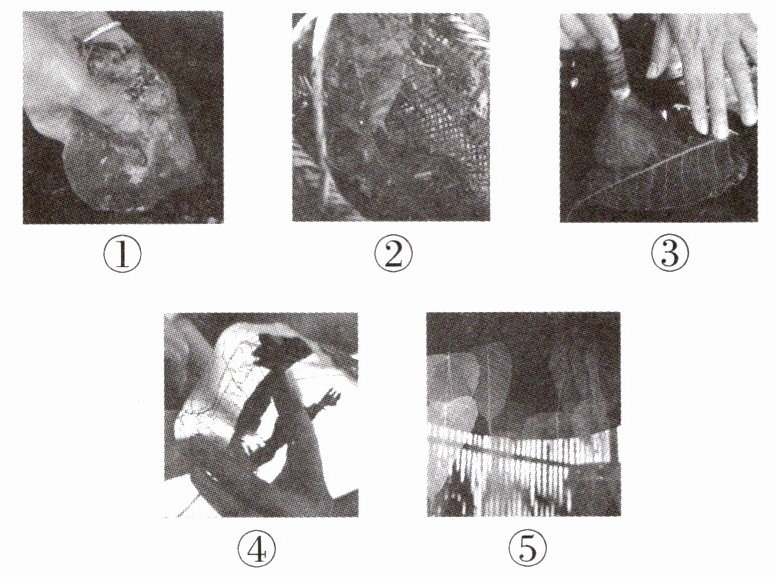
A. ②①③⑤④
B. ②①④③⑤
C. ①③②⑤④
D. ①③②④⑤
3. What does the underlined word "it" in
Paragraph 5 refer to?
A. A workshop.
B. Leaf-vein embroidery.
C. A local tree.
D. A challenge.
4. What is the best title for this passage?
A. The History of Chinese Embroidery
B. How to Make Beautiful Leaf-Vein Embroidery
C. Saving the Art of Leaf-Vein Embroidery
D. Yang Li-A Famous Chinese Artist
Ⅵ.阅读与回答问题
根据短文内容,回答下列问题。
What's the first thing that comes into your
mind when you think of wheat straw(稻草)?
Most people would probably see it as a pile of
waste in a farmer's field. However, Wu Cui, an
intangible cultural inheritor(非遗传承人), can
turn the straw into beautiful artworks.
The earliest straw-weaving(编织) works
were found at Hemudu Cultural Ruins, a
Neolithic cultural site in Zhejiang Province. This
discovery means a lot to traditional Chinese
culture.The Book of Rites also records that
there were already mats(垫子) made of grass
and professional straw-weaving craftsmen
during the Zhou Dynasty.
Straw weaving is a method of making daily
items or artworks. It was listed as a national
intangible cultural heritage in 2008.
Wu explains the process of straw weaving:
choosing from materials is the first step of a
process that may take several weeks, or even
months to complete. You need to draw the piece
on paper, which requires drawing skills. Next
comes weaving, shaping and preserving(保存)
of the work. Even by finishing that process, it
does not mean that you will always create a good
piece of work, and the hardest part is to make it
lifelike.
In the past, straw items could be found in
almost every family in the countryside, in the
form of straw hats and straw shoes, because
they were practical in everyday life. But with the
development of industry, many of these
products are made in factories. This makes
people gain little money, and there are only
about 100 people joining in the work across the
country.
Wu says to a news reporter that more
craftsmen should work together to make a
difference to the spread of the traditional
culture.
1. Who is an intangible cultural inheritor in the
article?
2. When was straw weaving listed as a national
intangible cultural heritage?
3. What comes next after drawing the piece on
paper?
4. Why do people make little money?
5. What can we do to help the art form?
In Tongren City, Guizhou [图]
Province, there is a special embroidery
called leaf-vein embroidery(叶脉绣).
This beautiful art is one of the main types of
embroidery in China.
Leaf-vein embroidery has a history from the
Song Dynasty(960-1279). It was first used for
communication among people in different areas.
Making leaf-vein embroidery is not easy. It
takes a lot of steps. First, choosing the right
leaves is important. The leaves from local trees
with harder veins serve as the best materials.
Second, put leaves in clean water for two days
to make them soft. Third, brush the leaves
gently. Then, it takes three to five days to make
them fully dry. Finally, you can create the
patterns on the leaves.
Yang Li, a master of leaf-vein embroidery,
notes that only about 20 people in Tongren have
been able to finish the whole steps by
themselves in the last ten years, so it's
challenging to keep this traditional skill alive.
"I have introduced this art in colleges,
communities and villages, but very few people
wanted to learn it because it was very difficult,"
Yang said.
In 2011, she started a leaf-vein embroidery
workshop, creating jobs for more than 500
women, including women from villages with
disabilities. "In my lifetime, it's my duty to
improve and pass on leaf-vein embroidery," she
said. After that, she also used social media to
show these traditional skills and got many fans.
"Leaf-vein embroidery is a treasure. I
decide to save and inherit this skill and hope
more young people will return to their
hometown to learn it," Yang said.
1. What was the purpose of leaf-vein embroidery
at first in history?
A. To make clothes beautiful.
B. To communicate with people.
C. To trade with foreign countries.
D. To celebrate festivals.
2. 新考法 创新设问 Which is the RIGHT order
of making leaf-vein embroidery?
A. ②①③⑤④
B. ②①④③⑤
C. ①③②⑤④
D. ①③②④⑤
3. What does the underlined word "it" in
Paragraph 5 refer to?
A. A workshop.
B. Leaf-vein embroidery.
C. A local tree.
D. A challenge.
4. What is the best title for this passage?
A. The History of Chinese Embroidery
B. How to Make Beautiful Leaf-Vein Embroidery
C. Saving the Art of Leaf-Vein Embroidery
D. Yang Li-A Famous Chinese Artist
Ⅵ.阅读与回答问题
根据短文内容,回答下列问题。
What's the first thing that comes into your
mind when you think of wheat straw(稻草)?
Most people would probably see it as a pile of
waste in a farmer's field. However, Wu Cui, an
intangible cultural inheritor(非遗传承人), can
turn the straw into beautiful artworks.
The earliest straw-weaving(编织) works
were found at Hemudu Cultural Ruins, a
Neolithic cultural site in Zhejiang Province. This
discovery means a lot to traditional Chinese
culture.
there were already mats(垫子) made of grass
and professional straw-weaving craftsmen
during the Zhou Dynasty.
Straw weaving is a method of making daily
items or artworks. It was listed as a national
intangible cultural heritage in 2008.
Wu explains the process of straw weaving:
choosing from materials is the first step of a
process that may take several weeks, or even
months to complete. You need to draw the piece
on paper, which requires drawing skills. Next
comes weaving, shaping and preserving(保存)
of the work. Even by finishing that process, it
does not mean that you will always create a good
piece of work, and the hardest part is to make it
lifelike.
In the past, straw items could be found in
almost every family in the countryside, in the
form of straw hats and straw shoes, because
they were practical in everyday life. But with the
development of industry, many of these
products are made in factories. This makes
people gain little money, and there are only
about 100 people joining in the work across the
country.
Wu says to a news reporter that more
craftsmen should work together to make a
difference to the spread of the traditional
culture.
1. Who is an intangible cultural inheritor in the
article?
Wu Cui.
2. When was straw weaving listed as a national
intangible cultural heritage?
In 2008.
3. What comes next after drawing the piece on
paper?
Weaving, shaping and preserving of the work.
4. Why do people make little money?
Because many straw products are made in factories.
5. What can we do to help the art form?
We can learn and promote straw weaving.
答案:V. 1.B 2.A 3.B 4.C
【语篇解读】本文是一篇说明文,主要介绍了贵州铜仁的特色刺绣——叶脉绣的历史、制作工艺以及传承人杨丽为保护和传承这门传统技艺所做的努力。
1. B 解析:细节理解题。根据文章第二段“It was first used for communication among people in different areas.”可知,叶脉绣最初用于不同地区人们之间的交流。故选 B。
2. A 解析:事件排序题。根据文章第三段制作步骤:选择合适的叶子;浸泡叶子两天使其软化;轻柔地刷叶子;三至五天晾干叶子;在叶子上创作图案。正确顺序为②①③⑤④。故选 A。
3. B 解析:代词指代题。根据文章第五段杨丽的话“very few people wanted to learn it because it was very difficult”并结合上下文可知,“it”指代前文提到的叶脉绣技艺。故选 B。
4. C 解析:标题归纳题。全文围绕叶脉绣的工艺难点、传承困境及保护措施展开,重点体现对这一传统技艺的挽救。选项 C“拯救叶脉绣艺术”最贴合主旨。故选 C。
VI.【语篇解读】本文是一篇说明文,主要介绍中国草编的悠久历史、制作流程、发展困境以及非遗传承人吴翠对传承草编艺术的期待。
1. Wu Cui. 2. In 2008.
3. Weaving, shaping and preserving of the work.
4. Because many straw products are made in factories.
5. We can learn and promote straw weaving.