1. 如图,以$△ ABC$的边$AB$,$AC$为边,向外作等边三角形$ABD$和等边三角形$ACE$,连接$BE$,$CD$,相交于点$F$.
(1)求证:$△ DAC≌△ BAE$;
(2)求证:$BE=DC$;
(3)求$∠ DFE$的度数.
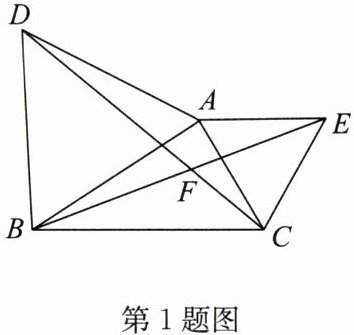
(1)求证:$△ DAC≌△ BAE$;
(2)求证:$BE=DC$;
(3)求$∠ DFE$的度数.
答案:(1)证明:$\because △ ABD$和$△ ACE$都为等边三角形,
$\therefore AD=AB,AE=AC,∠ DAB=∠ EAC=60°$,
$\therefore ∠ DAB+∠ BAC=∠ EAC+∠ BAC$,
即$∠ DAC=∠ BAE$.
在$△ DAC$和$△ BAE$中,$\begin{cases} AD=AB,\\ ∠ DAC=∠ BAE,\\ AC=AE, \end{cases}$
$\therefore △ DAC≌△ BAE(\mathrm{SAS})$.
(2)证明:由(1)知$△ DAC≌△ BAE$,$\therefore BE=DC$.
(3)解:由(1)知$△ DAC≌△ BAE$,$\therefore ∠ ACD=∠ AEB$,
则$∠ DFE=∠ FEC+∠ FCE=∠ FEC+∠ ACD+∠ ACE=∠ FEC+∠ AEB+∠ ACE=∠ AEC+∠ ACE=120°$.
$\therefore AD=AB,AE=AC,∠ DAB=∠ EAC=60°$,
$\therefore ∠ DAB+∠ BAC=∠ EAC+∠ BAC$,
即$∠ DAC=∠ BAE$.
在$△ DAC$和$△ BAE$中,$\begin{cases} AD=AB,\\ ∠ DAC=∠ BAE,\\ AC=AE, \end{cases}$
$\therefore △ DAC≌△ BAE(\mathrm{SAS})$.
(2)证明:由(1)知$△ DAC≌△ BAE$,$\therefore BE=DC$.
(3)解:由(1)知$△ DAC≌△ BAE$,$\therefore ∠ ACD=∠ AEB$,
则$∠ DFE=∠ FEC+∠ FCE=∠ FEC+∠ ACD+∠ ACE=∠ FEC+∠ AEB+∠ ACE=∠ AEC+∠ ACE=120°$.
2.(1)如图①,△ABC为等边三角形,D为边BC上一动点(不与点B,C重合),以AD为边向右侧作等边三角形ADE,连接CE,求证:△ABD≌△ACE;
(2)如图②,若点D在边BC的延长线上,随着动点D的位置不同,猜想并证明AB与CE的位置关系及线段EC,AC,CD之间的数量关系。
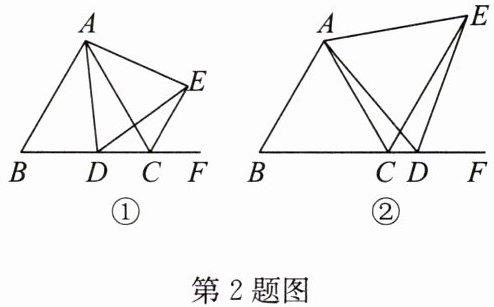
(2)如图②,若点D在边BC的延长线上,随着动点D的位置不同,猜想并证明AB与CE的位置关系及线段EC,AC,CD之间的数量关系。
答案:(1)证明:$\because △ ABC$和$△ ADE$是等边三角形,
$\therefore AB=AC,AD=AE,∠ BAC=∠ DAE=60°$,
$\therefore ∠ BAC-∠ DAC=∠ DAE-∠ DAC$,即$∠ BAD=∠ CAE$.
在$△ ABD$和$△ ACE$中,$\begin{cases} AB=AC,\\ ∠ BAD=∠ CAE,\\ AD=AE, \end{cases}$
$\therefore △ ABD≌△ ACE(\mathrm{SAS})$.
(2)解:$AB// CE$,$EC=AC+CD$.证明如下:
由(1)得$△ ABD≌△ ACE$,
$\therefore ∠ B=∠ ACE=60°$,$CE=BD$.
$\because ∠ B=∠ BAC$,$\therefore ∠ BAC=∠ ACE$,$\therefore AB// CE$.
$\because CE=BD$,$AC=BC$,
$\therefore CE=BD=BC+CD=AC+CD$.
$\therefore AB=AC,AD=AE,∠ BAC=∠ DAE=60°$,
$\therefore ∠ BAC-∠ DAC=∠ DAE-∠ DAC$,即$∠ BAD=∠ CAE$.
在$△ ABD$和$△ ACE$中,$\begin{cases} AB=AC,\\ ∠ BAD=∠ CAE,\\ AD=AE, \end{cases}$
$\therefore △ ABD≌△ ACE(\mathrm{SAS})$.
(2)解:$AB// CE$,$EC=AC+CD$.证明如下:
由(1)得$△ ABD≌△ ACE$,
$\therefore ∠ B=∠ ACE=60°$,$CE=BD$.
$\because ∠ B=∠ BAC$,$\therefore ∠ BAC=∠ ACE$,$\therefore AB// CE$.
$\because CE=BD$,$AC=BC$,
$\therefore CE=BD=BC+CD=AC+CD$.
3.如图,分别以$△ ABC$的边$AB$,$AC$为边向外作等腰直角三角形$ABD$和等腰直角三角形$ACE$,$∠ BAD=∠ CAE=90°$。
(1)如图①,连接$BE$,$CD$,求证:$BE=CD$;
(2)如图②,连接$DE$,求证:$S_{△ ABC}=S_{△ ADE}$。
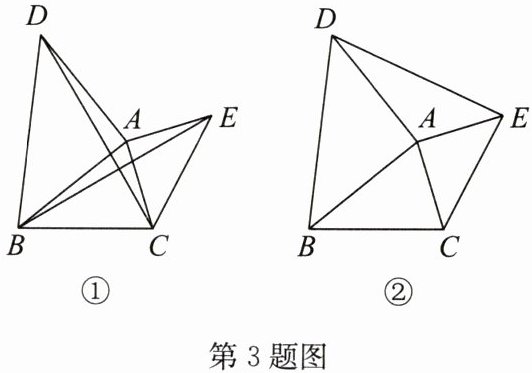
(1)如图①,连接$BE$,$CD$,求证:$BE=CD$;
(2)如图②,连接$DE$,求证:$S_{△ ABC}=S_{△ ADE}$。
答案:
(1)证明:$\because △ ABD$和$△ ACE$都是等腰直角三角形,
$\therefore AB=AD,AC=AE,∠ BAD=∠ CAE=90°$,
$\therefore ∠ BAD+∠ BAC=∠ CAE+∠ BAC$,即$∠ CAD=∠ EAB$.
在$△ CAD$和$△ EAB$中,$\begin{cases} AC=AE,\\ ∠ CAD=∠ EAB,\\ AD=AB, \end{cases}$
$\therefore △ CAD≌△ EAB(\mathrm{SAS})$,$\therefore BE=CD$.
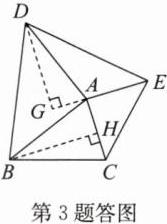
(2)如答图,作$DG⊥ EA$交$EA$的延长线于点$G$,$BH⊥ AC$于点$H$,则$∠ AGD=∠ AHB=90°$.
$\because ∠ CAE=90°$,$\therefore ∠ CAG=90°=∠ BAD$,
$\therefore ∠ DAG=∠ BAH$.
在$△ ADG$和$△ ABH$中,$\begin{cases} ∠ AGD=∠ AHB,\\ ∠ DAG=∠ BAH,\\ AD=AB, \end{cases}$
$\therefore △ ADG≌△ ABH(\mathrm{AAS})$,$\therefore DG=BH$.
$\because S_{△ ABC}=\frac{1}{2}AC· BH$,$S_{△ ADE}=\frac{1}{2}AE· DG$,
$\therefore S_{△ ABC}=S_{△ ADE}$.
(1)证明:$\because △ ABD$和$△ ACE$都是等腰直角三角形,
$\therefore AB=AD,AC=AE,∠ BAD=∠ CAE=90°$,
$\therefore ∠ BAD+∠ BAC=∠ CAE+∠ BAC$,即$∠ CAD=∠ EAB$.
在$△ CAD$和$△ EAB$中,$\begin{cases} AC=AE,\\ ∠ CAD=∠ EAB,\\ AD=AB, \end{cases}$
$\therefore △ CAD≌△ EAB(\mathrm{SAS})$,$\therefore BE=CD$.
(2)如答图,作$DG⊥ EA$交$EA$的延长线于点$G$,$BH⊥ AC$于点$H$,则$∠ AGD=∠ AHB=90°$.
$\because ∠ CAE=90°$,$\therefore ∠ CAG=90°=∠ BAD$,
$\therefore ∠ DAG=∠ BAH$.
在$△ ADG$和$△ ABH$中,$\begin{cases} ∠ AGD=∠ AHB,\\ ∠ DAG=∠ BAH,\\ AD=AB, \end{cases}$
$\therefore △ ADG≌△ ABH(\mathrm{AAS})$,$\therefore DG=BH$.
$\because S_{△ ABC}=\frac{1}{2}AC· BH$,$S_{△ ADE}=\frac{1}{2}AE· DG$,
$\therefore S_{△ ABC}=S_{△ ADE}$.