三、阅读理解(16分)
A
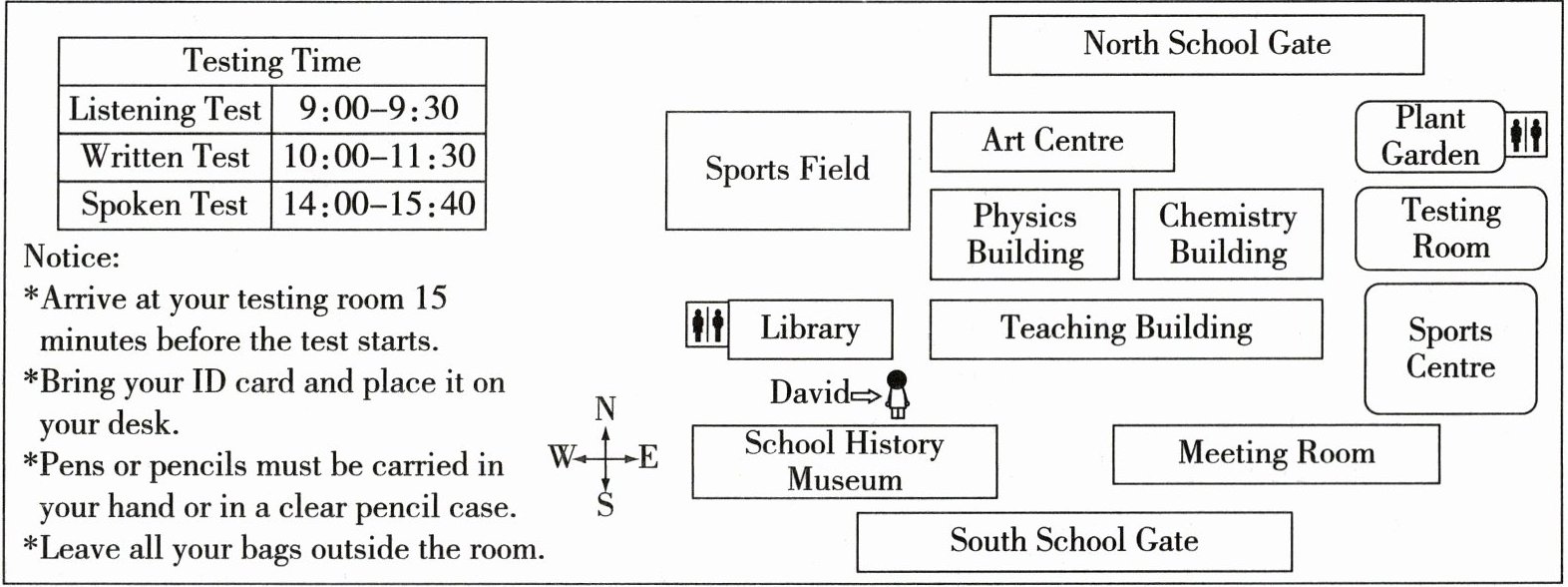
(
A. turn left and walk along the school library
B. go straight on and turn right at the first crossing
C. go south and walk into the school history museum
D. turn right and keep on walking to the sports centre
(
A. 8:45
B. 9:00
C. 9:30
D. 10:00
(
A. pens
B. bags
C. ID cards
D. pencil cases
(
A. Chemistry.
B. PE.
C. History.
D. English.
A
(
A
)1. David is facing north. He wants to go to the nearest bathroom. He can .A. turn left and walk along the school library
B. go straight on and turn right at the first crossing
C. go south and walk into the school history museum
D. turn right and keep on walking to the sports centre
(
A
)2. You have to arrive at the testing room before to take the listening test.A. 8:45
B. 9:00
C. 9:30
D. 10:00
(
B
)3. Students CANNOT bring into the testing room.A. pens
B. bags
C. ID cards
D. pencil cases
(
D
)4. What subject’s tests will they probably be?A. Chemistry.
B. PE.
C. History.
D. English.
答案:1. A
2. A
3. B
4. D
2. A
3. B
4. D
解析:
【分析】
首先逐题梳理解题思路:
1. 第1题:需结合地图方位和题目条件判断。题目说明David面朝北,根据地图方向标(上北下南左西右东),面朝北时左侧为西、右侧为东。要找最近的卫生间,地图中Library旁的卫生间距离最近,对应选项A的描述。
2. 第2题:细节查找题,通知明确听力测试9:00开始,要求提前15分钟到达考场,计算得9:00减15分钟为8:45,对应选项A。
3. 第3题:细节理解题,通知规定“Leave all your bags outside the room”,即禁止携带包进入考场,对应选项B。
4. 第4题:推理判断题,测试包含听力、笔试、口语,这些是英语学科的典型测试类型,对应选项D。
【解析】
1. 第1题:根据地图方位规则(上北下南左西右东),David面朝北时左转(西向),可到达最近的Library旁卫生间,故选A。
2. 第2题:听力测试开始时间为9:00,需提前15分钟到达,9:00-15分钟=8:45,故选A。
3. 第3题:通知要求将所有包留在考场外,因此不能带包进入,故选B。
4. 第4题:测试包含听力、笔试、口语,符合英语学科的测试形式,故选D。
【答案】
1. A 2. A 3. B 4. D
【知识点】
阅读理解、方位判断、细节理解
【点评】
本题结合地图与通知信息,考查学生的信息提取、方位判断及细节推理能力,题目难度适中,需仔细梳理地图方位和通知要求。
【难度系数】
0.6
首先逐题梳理解题思路:
1. 第1题:需结合地图方位和题目条件判断。题目说明David面朝北,根据地图方向标(上北下南左西右东),面朝北时左侧为西、右侧为东。要找最近的卫生间,地图中Library旁的卫生间距离最近,对应选项A的描述。
2. 第2题:细节查找题,通知明确听力测试9:00开始,要求提前15分钟到达考场,计算得9:00减15分钟为8:45,对应选项A。
3. 第3题:细节理解题,通知规定“Leave all your bags outside the room”,即禁止携带包进入考场,对应选项B。
4. 第4题:推理判断题,测试包含听力、笔试、口语,这些是英语学科的典型测试类型,对应选项D。
【解析】
1. 第1题:根据地图方位规则(上北下南左西右东),David面朝北时左转(西向),可到达最近的Library旁卫生间,故选A。
2. 第2题:听力测试开始时间为9:00,需提前15分钟到达,9:00-15分钟=8:45,故选A。
3. 第3题:通知要求将所有包留在考场外,因此不能带包进入,故选B。
4. 第4题:测试包含听力、笔试、口语,符合英语学科的测试形式,故选D。
【答案】
1. A 2. A 3. B 4. D
【知识点】
阅读理解、方位判断、细节理解
【点评】
本题结合地图与通知信息,考查学生的信息提取、方位判断及细节推理能力,题目难度适中,需仔细梳理地图方位和通知要求。
【难度系数】
0.6
B
Sweden's primary schools will be focusing more on reading, writing and maths, said its government (政府). And that means there will be less focus on play-based learning. From 2028, children will also begin primary school a year earlier—at the age of 6.
The country's government wants to go back to basics to make sure that all children have the basic skills they need. Swedish minister (大臣) Jakob Forssmed supported and said that young students' skills are being influenced (影响) because they spend too much time on electronic (电子的) tools. The change may make the first year of primary school a little more formal. And it may also mean students will spend more time with pencils and paper, and less time with electronic tools. Teachers believe traditional methods can build a stronger foundation (基础) for learning.
But not everyone likes the idea. Some think play-based learning helps the development of young children.
Some experts say play-based learning helps children develop problem-solving (解决问题的) skills as well as curiosity (好奇心) and creativity. Usually, primary school students don't learn so much from books like high school students. Instead, they take part in activities that look and feel a lot more like playing. And in these activities, children are their own teachers. The activities might include "free play", in which children move the activities forward by themselves and the teacher plays a passive role; or "teacher-led play", with an educator guiding children in an activity. Supporters of play-based learning believe it helps develop well-rounded (全面发展的) children.
(
A. To make students more relaxed. B. To develop students' creativity.
C. To improve students' basic skills. D. To teach students to use electronic tools.
(
A. He's not sure of its results. B. He's worried.
C. He supports it. D. He is against it.
(
A. carefully B. actively C. quietly D. quickly
(
(①=Paragraph 1; ②=Paragraph 2, …)

Sweden's primary schools will be focusing more on reading, writing and maths, said its government (政府). And that means there will be less focus on play-based learning. From 2028, children will also begin primary school a year earlier—at the age of 6.
The country's government wants to go back to basics to make sure that all children have the basic skills they need. Swedish minister (大臣) Jakob Forssmed supported and said that young students' skills are being influenced (影响) because they spend too much time on electronic (电子的) tools. The change may make the first year of primary school a little more formal. And it may also mean students will spend more time with pencils and paper, and less time with electronic tools. Teachers believe traditional methods can build a stronger foundation (基础) for learning.
But not everyone likes the idea. Some think play-based learning helps the development of young children.
Some experts say play-based learning helps children develop problem-solving (解决问题的) skills as well as curiosity (好奇心) and creativity. Usually, primary school students don't learn so much from books like high school students. Instead, they take part in activities that look and feel a lot more like playing. And in these activities, children are their own teachers. The activities might include "free play", in which children move the activities forward by themselves and the teacher plays a passive role; or "teacher-led play", with an educator guiding children in an activity. Supporters of play-based learning believe it helps develop well-rounded (全面发展的) children.
(
C
)5. Why did Sweden make this plan?A. To make students more relaxed. B. To develop students' creativity.
C. To improve students' basic skills. D. To teach students to use electronic tools.
(
C
)6. What is Jakob's attitude (态度) to the new change?A. He's not sure of its results. B. He's worried.
C. He supports it. D. He is against it.
(
B
)7. If someone "plays a passive role" in an activity, he doesn't do things .A. carefully B. actively C. quietly D. quickly
(
A
)8. Which of the following is the structure of the passage?(①=Paragraph 1; ②=Paragraph 2, …)
答案:5. C
6. C
7. B
8. A
6. C
7. B
8. A
解析:
【分析】
本题为英语阅读理解题,需根据原文内容逐一分析各题:
1. 第5题(细节理解题):题干问瑞典制定该计划的原因,需定位原文相关信息。
2. 第6题(细节理解题):题干问Jakob对新变化的态度,直接找原文中关于他态度的表述。
3. 第7题(词义猜测题):需结合上下文理解“passive role”的含义,推测其对应选项。
4. 第8题(文章结构题):需梳理各段落核心内容,判断文章的结构划分。
【解析】
5. 细节理解题:根据原文第二段第一句“The country's government wants to go back to basics to make sure that all children have the basic skills they need.”可知,瑞典制定该计划是为了提高学生的基本技能,对应选项C。
6. 细节理解题:根据原文第二段“Swedish minister Jakob Forssmed supported and said that...”可知,Jakob支持这一新变化,对应选项C。
7. 词义猜测题:“passive”意为“被动的”,其反义词是“active(积极的)”,所以“plays a passive role”指不积极做事,对应选项B。
8. 文章结构题:原文段落核心:①段介绍瑞典的教育新计划;②段说明政府目的及支持者理由;③段转折说明并非所有人赞同;④段阐述游戏式学习的好处。对应选项A的结构,故答案为A。
【答案】
5. C;6. C;7. B;8. A
【知识点】
英语阅读理解;细节理解题;词义猜测题;文章结构题
【点评】
本题围绕瑞典教育改革展开,考查学生对英语阅读中细节信息查找、词义猜测及文章结构分析的能力,题目难度适中,需学生仔细研读原文定位关键信息。
【难度系数】
0.6
本题为英语阅读理解题,需根据原文内容逐一分析各题:
1. 第5题(细节理解题):题干问瑞典制定该计划的原因,需定位原文相关信息。
2. 第6题(细节理解题):题干问Jakob对新变化的态度,直接找原文中关于他态度的表述。
3. 第7题(词义猜测题):需结合上下文理解“passive role”的含义,推测其对应选项。
4. 第8题(文章结构题):需梳理各段落核心内容,判断文章的结构划分。
【解析】
5. 细节理解题:根据原文第二段第一句“The country's government wants to go back to basics to make sure that all children have the basic skills they need.”可知,瑞典制定该计划是为了提高学生的基本技能,对应选项C。
6. 细节理解题:根据原文第二段“Swedish minister Jakob Forssmed supported and said that...”可知,Jakob支持这一新变化,对应选项C。
7. 词义猜测题:“passive”意为“被动的”,其反义词是“active(积极的)”,所以“plays a passive role”指不积极做事,对应选项B。
8. 文章结构题:原文段落核心:①段介绍瑞典的教育新计划;②段说明政府目的及支持者理由;③段转折说明并非所有人赞同;④段阐述游戏式学习的好处。对应选项A的结构,故答案为A。
【答案】
5. C;6. C;7. B;8. A
【知识点】
英语阅读理解;细节理解题;词义猜测题;文章结构题
【点评】
本题围绕瑞典教育改革展开,考查学生对英语阅读中细节信息查找、词义猜测及文章结构分析的能力,题目难度适中,需学生仔细研读原文定位关键信息。
【难度系数】
0.6