三、阅读理解(16分)
A
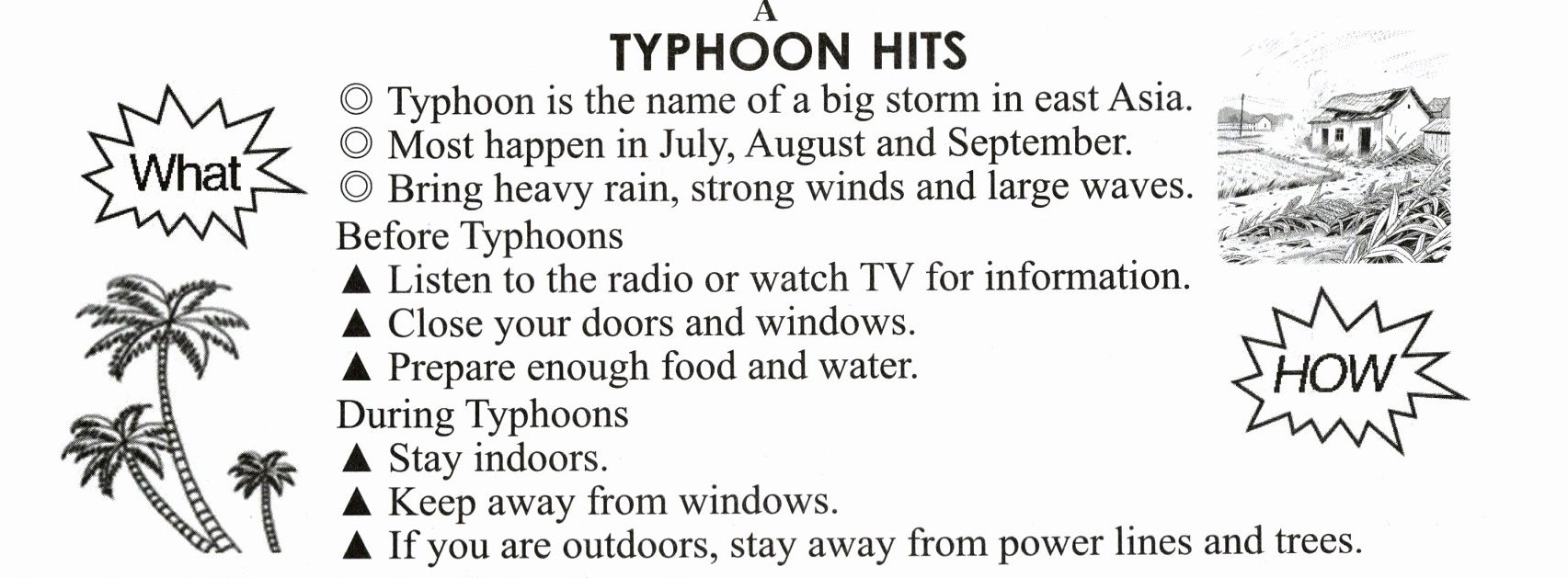
(
A. America B. England C. Japan D. Spain
(
A. in the hot season B. in autumn C. in spring D. in the cold season
(
A. watch the winds B. stay at home
C. hide close to high buildings D. stand in an open space
(
A. Culture B. Travel C. Health D. Safety
A
(
C
)1. A big storm is called typhoon in .A. America B. England C. Japan D. Spain
(
A
)2. Typhoons often happen .A. in the hot season B. in autumn C. in spring D. in the cold season
(
B
)3. When typhoons come, we should .A. watch the winds B. stay at home
C. hide close to high buildings D. stand in an open space
(
D
)4. The poster is probably from the column (栏目) of in a newspaper.A. Culture B. Travel C. Health D. Safety
答案:1. C 2. A 3. B 4. D
解析:
【分析】
本题是关于台风安全知识的阅读理解题,解题思路为:1. 先通读海报内容,明确各部分(台风定义、发生时间、台风前后注意事项)的核心信息;2. 逐个分析题目,根据题干关键词定位海报中的对应内容;3. 对比选项与原文信息,选出正确答案。
【解析】
1. 题干问“在哪个地方大风暴被称为台风”,定位原文“What”部分第一句“Typhoon is the name of a big storm in east Asia.”,选项中Japan(日本)属于东亚,故选C。
2. 题干问“台风经常发生在什么时候”,定位原文“What”部分第二句“Most happen in July, August and September.”,这三个月属于北半球的夏季(hot season),故选A。
3. 题干问“台风来临时我们应该做什么”,定位原文“During Typhoons”部分第一点“Stay indoors.”,即待在家里,对应选项B,故选B。
4. 题干问“海报可能来自报纸的哪个栏目”,海报内容是台风来临前后的安全注意事项,属于安全相关内容,对应Safety栏目,故选D。
【答案】
1. C 2. A 3. B 4. D
【知识点】
英语阅读理解;安全常识
【点评】
本题结合生活中的台风安全知识,考查学生从海报中提取关键信息的能力,贴近实际生活,难度适中。
【难度系数】
0.6
本题是关于台风安全知识的阅读理解题,解题思路为:1. 先通读海报内容,明确各部分(台风定义、发生时间、台风前后注意事项)的核心信息;2. 逐个分析题目,根据题干关键词定位海报中的对应内容;3. 对比选项与原文信息,选出正确答案。
【解析】
1. 题干问“在哪个地方大风暴被称为台风”,定位原文“What”部分第一句“Typhoon is the name of a big storm in east Asia.”,选项中Japan(日本)属于东亚,故选C。
2. 题干问“台风经常发生在什么时候”,定位原文“What”部分第二句“Most happen in July, August and September.”,这三个月属于北半球的夏季(hot season),故选A。
3. 题干问“台风来临时我们应该做什么”,定位原文“During Typhoons”部分第一点“Stay indoors.”,即待在家里,对应选项B,故选B。
4. 题干问“海报可能来自报纸的哪个栏目”,海报内容是台风来临前后的安全注意事项,属于安全相关内容,对应Safety栏目,故选D。
【答案】
1. C 2. A 3. B 4. D
【知识点】
英语阅读理解;安全常识
【点评】
本题结合生活中的台风安全知识,考查学生从海报中提取关键信息的能力,贴近实际生活,难度适中。
【难度系数】
0.6
B
One Saturday Maria and I had a 30-mile bike ride. It seemed perfect. We started at 7:00 a.m. in beautiful spring weather. At 10:30 a.m., when we stopped for a rest, we both felt wonderful. And then a strong wind came. That was when our perfect day began to change.
By noon, we knew a serious thunderstorm was blowing our way. Dark clouds rolled up out of the south-west. A strong wind burned our faces. There was no way to stay out of the storm. We would have to wait it out, but where?
Then ▲. The temperature dropped suddenly. I looked up and saw the sky now turned dark green. Trees and crops were bent(弯曲)over by the wind. No animals were in sight.
Then a blue car stopped beside our bikes. The driver shouted, “Get in!” She looked afraid, and so did we. We did as she said. That was when the hail(冰雹)started. Ice, the size of golf balls, hit the windows of the car.
She drove fast to the north. Maria and I looked back at the black sky. Maria shouted, “Tornado(龙卷风)!” It was so close that I could see trees, doors and all kinds of other things that this monster swallowed(吞).
My heart moved up to my throat and was beating so hard. I had never been so afraid. We would never run faster than the tornado! The driver turned to us and said calmly, “There’s an overpass(立交桥)ahead. We’ll stay under it for protection.”
When we stopped the car, we jumped out of it and ran to the wall of the overpass. Before I could count to 20, there came a loud noise. Then, suddenly, it was over. We made it.
Soon we were all laughing with relief(轻松). We were still shaking. But what an excellent story I would have to tell at school!
(
A. Dark clouds rolled up.
B. The hail came suddenly.
C. The temperature dropped.
D. Animals ran out of sight.
(
A. it seemed to get better
B. the storm stopped
C. we all felt good
D. things went from bad to worse
(
① The woman drove to the overpass.
② Maria and I had a bike ride.
③ A thunderstorm was blowing our way.
④ Ice hit the windows of the car.
⑤ We got into a woman's car.
A. ②-③-①-④-⑤
B. ②-③-⑤-④-①
C. ③-①-②-⑤-④
D. ③-②-①-④-⑤
(
A. Tired and nervous.
B. Afraid but excited.
C. Worried but lucky.
D. Sad and surprised.
One Saturday Maria and I had a 30-mile bike ride. It seemed perfect. We started at 7:00 a.m. in beautiful spring weather. At 10:30 a.m., when we stopped for a rest, we both felt wonderful. And then a strong wind came. That was when our perfect day began to change.
By noon, we knew a serious thunderstorm was blowing our way. Dark clouds rolled up out of the south-west. A strong wind burned our faces. There was no way to stay out of the storm. We would have to wait it out, but where?
Then ▲. The temperature dropped suddenly. I looked up and saw the sky now turned dark green. Trees and crops were bent(弯曲)over by the wind. No animals were in sight.
Then a blue car stopped beside our bikes. The driver shouted, “Get in!” She looked afraid, and so did we. We did as she said. That was when the hail(冰雹)started. Ice, the size of golf balls, hit the windows of the car.
She drove fast to the north. Maria and I looked back at the black sky. Maria shouted, “Tornado(龙卷风)!” It was so close that I could see trees, doors and all kinds of other things that this monster swallowed(吞).
My heart moved up to my throat and was beating so hard. I had never been so afraid. We would never run faster than the tornado! The driver turned to us and said calmly, “There’s an overpass(立交桥)ahead. We’ll stay under it for protection.”
When we stopped the car, we jumped out of it and ran to the wall of the overpass. Before I could count to 20, there came a loud noise. Then, suddenly, it was over. We made it.
Soon we were all laughing with relief(轻松). We were still shaking. But what an excellent story I would have to tell at school!
(
A
)5. What happened first when the tornado began?A. Dark clouds rolled up.
B. The hail came suddenly.
C. The temperature dropped.
D. Animals ran out of sight.
(
D
)6. Which of the following is suitable for “▲”?A. it seemed to get better
B. the storm stopped
C. we all felt good
D. things went from bad to worse
(
B
)7. What is the right order of the story?① The woman drove to the overpass.
② Maria and I had a bike ride.
③ A thunderstorm was blowing our way.
④ Ice hit the windows of the car.
⑤ We got into a woman's car.
A. ②-③-①-④-⑤
B. ②-③-⑤-④-①
C. ③-①-②-⑤-④
D. ③-②-①-④-⑤
(
B
)8. How did the writer feel when the tornado was all over?A. Tired and nervous.
B. Afraid but excited.
C. Worried but lucky.
D. Sad and surprised.
答案:5. A 6. D 7. B 8. B
解析:
【分析】
先通读全文,把握作者与Maria骑行时遭遇恶劣天气最终脱险的故事脉络。针对每道题,需定位原文对应内容,结合题干要求分析选项:1. 第5题需找龙卷风开始时最先发生的事件;2. 第6题需结合上下文逻辑判断空缺处的句子;3. 第7题需梳理故事发展的先后顺序;4. 第8题需推断龙卷风结束后作者的情感。
【解析】
5. 细节理解题:根据原文第二段“Dark clouds rolled up out of the south-west.”可知,龙卷风开始时首先出现的是乌云,对应选项A。B选项冰雹是上车后发生的,C选项温度下降在乌云之后,D选项动物不见是后续现象,均不符合,故选A。
6. 句子还原题:前文提到遭遇雷暴,后文描述温度骤降、天空变绿、树木被吹弯等更严重的天气状况,说明情况进一步恶化,D选项“事情变得更糟”符合上下文逻辑,故选D。A选项“情况变好”、B选项“风暴停止”、C选项“我们都感觉很好”均与语境不符,排除。
7. 信息排序题:梳理原文事件顺序:②作者和Maria骑行(开头)→③遭遇雷暴(第二段)→⑤上了女士的车(第四段)→④冰雹砸车窗(第四段)→①开车去立交桥(第六段),正确顺序为②-③-⑤-④-①,对应选项B,故选B。
8. 情感推断题:根据原文最后一段“Soon we were all laughing with relief... But what an excellent story I would have to tell at school!”可知,龙卷风结束后作者虽害怕但因脱险且有精彩故事而兴奋,对应选项B。A选项“疲惫紧张”、C选项“担忧但幸运”、D选项“悲伤惊讶”均不符合,故选B。
【答案】
5.A 6.D 7.B 8.B
【知识点】
英语阅读理解、细节理解题、信息排序题
【点评】
本题为记叙文类阅读理解,主要考查学生对文章细节信息、逻辑顺序及人物情感的把握,难度适中,需学生仔细定位原文,理清故事发展脉络即可正确作答。
【难度系数】
0.5
先通读全文,把握作者与Maria骑行时遭遇恶劣天气最终脱险的故事脉络。针对每道题,需定位原文对应内容,结合题干要求分析选项:1. 第5题需找龙卷风开始时最先发生的事件;2. 第6题需结合上下文逻辑判断空缺处的句子;3. 第7题需梳理故事发展的先后顺序;4. 第8题需推断龙卷风结束后作者的情感。
【解析】
5. 细节理解题:根据原文第二段“Dark clouds rolled up out of the south-west.”可知,龙卷风开始时首先出现的是乌云,对应选项A。B选项冰雹是上车后发生的,C选项温度下降在乌云之后,D选项动物不见是后续现象,均不符合,故选A。
6. 句子还原题:前文提到遭遇雷暴,后文描述温度骤降、天空变绿、树木被吹弯等更严重的天气状况,说明情况进一步恶化,D选项“事情变得更糟”符合上下文逻辑,故选D。A选项“情况变好”、B选项“风暴停止”、C选项“我们都感觉很好”均与语境不符,排除。
7. 信息排序题:梳理原文事件顺序:②作者和Maria骑行(开头)→③遭遇雷暴(第二段)→⑤上了女士的车(第四段)→④冰雹砸车窗(第四段)→①开车去立交桥(第六段),正确顺序为②-③-⑤-④-①,对应选项B,故选B。
8. 情感推断题:根据原文最后一段“Soon we were all laughing with relief... But what an excellent story I would have to tell at school!”可知,龙卷风结束后作者虽害怕但因脱险且有精彩故事而兴奋,对应选项B。A选项“疲惫紧张”、C选项“担忧但幸运”、D选项“悲伤惊讶”均不符合,故选B。
【答案】
5.A 6.D 7.B 8.B
【知识点】
英语阅读理解、细节理解题、信息排序题
【点评】
本题为记叙文类阅读理解,主要考查学生对文章细节信息、逻辑顺序及人物情感的把握,难度适中,需学生仔细定位原文,理清故事发展脉络即可正确作答。
【难度系数】
0.5