三、阅读理解(16分)
A
FROM THE FARM TO THE TABLE: FIVE STEPS OF FOOD WASTE
Step 1 on the farm
• Throw away food of wrong shapes or sizes
• Grow more food than the market needs
Step 2 on the road
• Do not have fridges to keep food fresh
• Some food falls off the truck
Step 3 at factories
• Do not have enough machines to make, keep and pack(包装)food
• Throw away food of wrong shapes or sizes
Step 4 at stores
• Throw away food that does not look fresh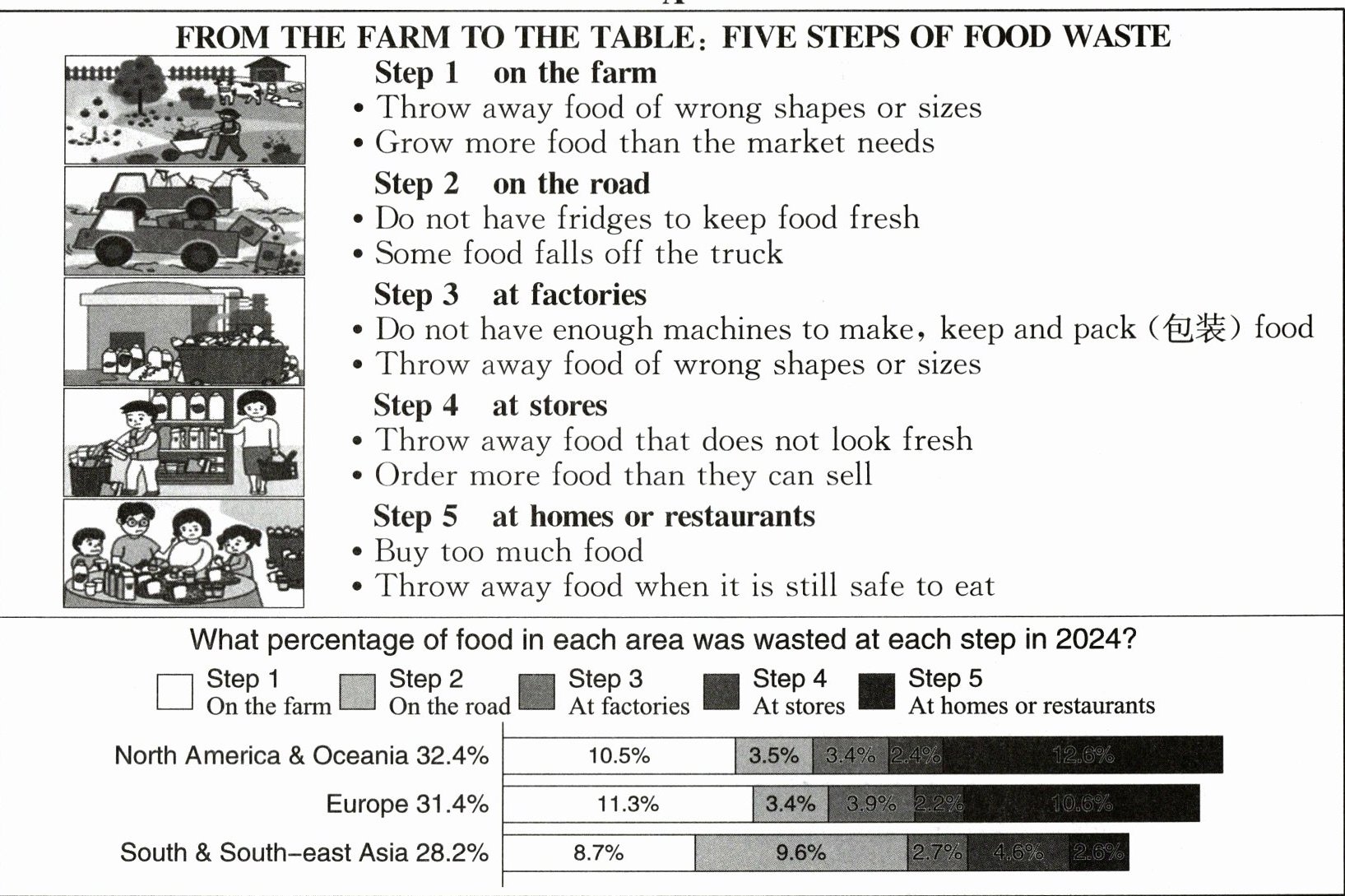
• Order more food than they can sell
Step 5 at homes or restaurants
• Buy too much food
• Throw away food when it is still safe to eat
What percentage of food in each area was wasted at each step in 2024?
Step 1 On the farm Step 2 On the road Step 3 At factories Step 4 At stores ■ Step 5 At homes or restaurants
North America & Oceania 32.4% 10.5% 3.5% 3.4% 2.4% 12.6%
Europe 31.4% 11.3% 3.4% 3.9% 2.2% 10.6%
South & South-east Asia 28.2% 8.7% 9.6% 2.7% 4.6% 2.6%
(
A. a magazine about life B. a magazine about recycling(回收)
C. the nature part of a website D. the culture part of a website
(
A. It gets washed again. B. It becomes smaller.
C. It becomes more expensive. D. It gets broken or goes bad.
(
A. Step 1. B. Step 2. C. Step 3. D. Step 4.
(
A. Most waste happens on the farms. B. All food reaches buyers.
C. Different areas have different waste patterns. D. Factory preparation never causes waste.
A
FROM THE FARM TO THE TABLE: FIVE STEPS OF FOOD WASTE
Step 1 on the farm
• Throw away food of wrong shapes or sizes
• Grow more food than the market needs
Step 2 on the road
• Do not have fridges to keep food fresh
• Some food falls off the truck
Step 3 at factories
• Do not have enough machines to make, keep and pack(包装)food
• Throw away food of wrong shapes or sizes
Step 4 at stores
• Throw away food that does not look fresh
• Order more food than they can sell
Step 5 at homes or restaurants
• Buy too much food
• Throw away food when it is still safe to eat
What percentage of food in each area was wasted at each step in 2024?
Step 1 On the farm Step 2 On the road Step 3 At factories Step 4 At stores ■ Step 5 At homes or restaurants
North America & Oceania 32.4% 10.5% 3.5% 3.4% 2.4% 12.6%
Europe 31.4% 11.3% 3.4% 3.9% 2.2% 10.6%
South & South-east Asia 28.2% 8.7% 9.6% 2.7% 4.6% 2.6%
(
A
)1. We might find the material in .A. a magazine about life B. a magazine about recycling(回收)
C. the nature part of a website D. the culture part of a website
(
D
)2. What often happens to food when it moves from farms to stores?A. It gets washed again. B. It becomes smaller.
C. It becomes more expensive. D. It gets broken or goes bad.
(
B
)3. In which step does South and South-east Asia waste most food?A. Step 1. B. Step 2. C. Step 3. D. Step 4.
(
C
)4. What can we learn from the picture about food waste?A. Most waste happens on the farms. B. All food reaches buyers.
C. Different areas have different waste patterns. D. Factory preparation never causes waste.
答案:1. A
2. D
3. B
4. C
2. D
3. B
4. C
解析:
【分析】
本题为阅读理解题,包含文字说明与数据图表,解题思路为:先通读全文及图表,掌握食物浪费的五个步骤及各地区各步骤的浪费占比;再针对每个问题定位原文/图表对应信息;最后逐一分析选项,排除错误项确定答案。
【解析】
1. 题干问材料可能的出处。材料围绕食物浪费的生活相关话题展开,A选项“生活杂志”符合主题;B选项“回收杂志”、C选项“网站自然板块”、D选项“网站文化板块”均与主题不符,故选A。
2. 题干问食物从农场到商店过程中常发生的情况。对应Step2(on the road)内容:“无冰箱保鲜”“食物从卡车掉落”,即食物会变质或破损,对应D选项,故选D。
3. 题干问东南亚浪费最多的步骤。查看图表中东南亚各步骤占比:Step1(8.7%)、Step2(9.6%)、Step3(2.7%)、Step4(4.6%)、Step5(2.6%),最高为Step2,故选B。
4. 题干问从图中能学到的内容。A选项:北美Step5浪费占比高于Step1,并非农场最多,错误;B选项:存在食物浪费,并非都到消费者手中,错误;C选项:不同地区浪费模式不同(如北美Step5占比高,东南亚Step2占比高),正确;D选项:工厂存在食物浪费,错误,故选C。
【答案】
1.A 2.D 3.B 4.C
【知识点】
阅读理解、图表信息提取、细节理解
【点评】
本题结合文字与图表考查食物浪费的相关知识,需学生精准定位信息,区分不同地区的浪费特点,是典型的信息类阅读理解题,难度适中。
【难度系数】
0.6
本题为阅读理解题,包含文字说明与数据图表,解题思路为:先通读全文及图表,掌握食物浪费的五个步骤及各地区各步骤的浪费占比;再针对每个问题定位原文/图表对应信息;最后逐一分析选项,排除错误项确定答案。
【解析】
1. 题干问材料可能的出处。材料围绕食物浪费的生活相关话题展开,A选项“生活杂志”符合主题;B选项“回收杂志”、C选项“网站自然板块”、D选项“网站文化板块”均与主题不符,故选A。
2. 题干问食物从农场到商店过程中常发生的情况。对应Step2(on the road)内容:“无冰箱保鲜”“食物从卡车掉落”,即食物会变质或破损,对应D选项,故选D。
3. 题干问东南亚浪费最多的步骤。查看图表中东南亚各步骤占比:Step1(8.7%)、Step2(9.6%)、Step3(2.7%)、Step4(4.6%)、Step5(2.6%),最高为Step2,故选B。
4. 题干问从图中能学到的内容。A选项:北美Step5浪费占比高于Step1,并非农场最多,错误;B选项:存在食物浪费,并非都到消费者手中,错误;C选项:不同地区浪费模式不同(如北美Step5占比高,东南亚Step2占比高),正确;D选项:工厂存在食物浪费,错误,故选C。
【答案】
1.A 2.D 3.B 4.C
【知识点】
阅读理解、图表信息提取、细节理解
【点评】
本题结合文字与图表考查食物浪费的相关知识,需学生精准定位信息,区分不同地区的浪费特点,是典型的信息类阅读理解题,难度适中。
【难度系数】
0.6
B
Every summer, about three billion birds migrate(迁徙)from North Africa to Europe and Asia. In winter, they return to Africa. As they travel from one place to another, they use the sun, stars, smells, and landforms to find the way.
The migration is long and difficult, and some of the animals die during each trip. However, it is not this twice-a-year journey that poses the greatest risk for these animals. The main danger to the birds comes from hunters all over the Mediterranean(地中海地区). Millions of migratory birds are killed every year. As a result, their number is falling.
In countries along the Mediterranean, many migratory birds are illegally(非法地)trapped or killed. Besides traps, hunters also use machines to make bird sounds to catch the birds’ attention. Some hunters also use nets(网)to catch birds. “There are no birds,” said one local man. “We walk for hours without seeing any. It’s really scary.”
Birds are in danger, and many countries are working to solve this problem. In the European Union, hunting migratory birds is against the law in some countries, while in others, there are special laws—the birds can only be hunted at a certain time of year. This has been successful in many places. For example, Sicily, an island(岛)of Italy, was once a place where illegal bird hunting was usual. Today, it has eliminated(消除)bird hunting, and as a result, birdwatching is becoming popular there.
Wildlife organizations around the Mediterranean are helping to bring about change. “Hunting bans(禁令)are working,” said Martin Schneider, a scientist. “But there’s still more to do. We hope to stop hunting and protect birds’ living areas all over the Mediterranean. If this can be done, their number will increase. There’s a long way to go, but there is hope.”
(
A. connects B. fights C. causes D. reduces
(
A. Nobody hunts birds in Sicily now. B. Some rare birds can be seen in Sicily.
C. Hunters begin to feed more birds. D. The weather has become more pleasant.
(
A. There should be more laws to protect baby birds.
B. It’s possible that the the number of the birds will fall.
C. The only useful way to protect birds is to stop people from hunting them.
D. More countries should work together to increase the number of the birds.
(
A. problems caused by migratory birds B. why migratory birds are hunted
C. the situation of migratory birds and the efforts to protect them
D. how pollution causes a drop in the number of the migratory birds
Every summer, about three billion birds migrate(迁徙)from North Africa to Europe and Asia. In winter, they return to Africa. As they travel from one place to another, they use the sun, stars, smells, and landforms to find the way.
The migration is long and difficult, and some of the animals die during each trip. However, it is not this twice-a-year journey that poses the greatest risk for these animals. The main danger to the birds comes from hunters all over the Mediterranean(地中海地区). Millions of migratory birds are killed every year. As a result, their number is falling.
In countries along the Mediterranean, many migratory birds are illegally(非法地)trapped or killed. Besides traps, hunters also use machines to make bird sounds to catch the birds’ attention. Some hunters also use nets(网)to catch birds. “There are no birds,” said one local man. “We walk for hours without seeing any. It’s really scary.”
Birds are in danger, and many countries are working to solve this problem. In the European Union, hunting migratory birds is against the law in some countries, while in others, there are special laws—the birds can only be hunted at a certain time of year. This has been successful in many places. For example, Sicily, an island(岛)of Italy, was once a place where illegal bird hunting was usual. Today, it has eliminated(消除)bird hunting, and as a result, birdwatching is becoming popular there.
Wildlife organizations around the Mediterranean are helping to bring about change. “Hunting bans(禁令)are working,” said Martin Schneider, a scientist. “But there’s still more to do. We hope to stop hunting and protect birds’ living areas all over the Mediterranean. If this can be done, their number will increase. There’s a long way to go, but there is hope.”
(
C
) 5. The underlined word “poses” in Paragraph 2 probably means “”.A. connects B. fights C. causes D. reduces
(
A
) 6. What change has taken place in Sicily?A. Nobody hunts birds in Sicily now. B. Some rare birds can be seen in Sicily.
C. Hunters begin to feed more birds. D. The weather has become more pleasant.
(
D
) 7. Which of the following would Martin Schneider agree with the most?A. There should be more laws to protect baby birds.
B. It’s possible that the the number of the birds will fall.
C. The only useful way to protect birds is to stop people from hunting them.
D. More countries should work together to increase the number of the birds.
(
C
) 8. The passage is mainly about .A. problems caused by migratory birds B. why migratory birds are hunted
C. the situation of migratory birds and the efforts to protect them
D. how pollution causes a drop in the number of the migratory birds
答案:5. C
6. A
7. D
8. C
6. A
7. D
8. C
解析:
【分析】本题为阅读理解题,包含词义猜测、细节理解、推理判断、主旨大意四类题型。解题思路:1. 词义猜测题需结合上下文语境推断划线词含义;2. 细节理解题需定位原文对应段落,比对选项与原文信息;3. 推理判断题需结合作者或人物的观点,排除不符合的选项;4. 主旨大意题需梳理全文核心内容,确定文章主题。
【解析】
5. 词义猜测题:定位至第二段“it is not this twice-a-year journey that poses the greatest risk for these animals. The main danger to the birds comes from hunters...”,可知poses所在句意为“不是每年两次的迁徙旅程带来最大风险”,poses表示“造成”,对应选项C(causes)。
6. 细节理解题:定位至第四段“Sicily...was once a place where illegal bird hunting was usual. Today, it has eliminated bird hunting”,可知如今西西里已消除捕鸟行为,对应选项A。
7. 推理判断题:定位至最后一段Martin Schneider的观点,他提到“stop hunting and protect birds’ living areas all over the Mediterranean. If this can be done, their number will increase”,可知他认为需多国合作保护以增加候鸟数量,对应选项D;A未提及保护幼鸟,B与“数量会增加”相悖,C“唯一方法”表述错误,排除。
8. 主旨大意题:文章先介绍候鸟面临的被猎杀问题,再讲述各国、组织为保护候鸟所做的努力,核心是候鸟的处境及保护措施,对应选项C。
【答案】5.C 6.A 7.D 8.C
【知识点】词义猜测题、细节理解题、主旨大意题
【点评】本题围绕候鸟保护展开,题型常规,需学生精准提取原文信息,结合语境和人物观点判断,整体难度适中,只要认真阅读文本即可正确作答。
【难度系数】0.7
【解析】
5. 词义猜测题:定位至第二段“it is not this twice-a-year journey that poses the greatest risk for these animals. The main danger to the birds comes from hunters...”,可知poses所在句意为“不是每年两次的迁徙旅程带来最大风险”,poses表示“造成”,对应选项C(causes)。
6. 细节理解题:定位至第四段“Sicily...was once a place where illegal bird hunting was usual. Today, it has eliminated bird hunting”,可知如今西西里已消除捕鸟行为,对应选项A。
7. 推理判断题:定位至最后一段Martin Schneider的观点,他提到“stop hunting and protect birds’ living areas all over the Mediterranean. If this can be done, their number will increase”,可知他认为需多国合作保护以增加候鸟数量,对应选项D;A未提及保护幼鸟,B与“数量会增加”相悖,C“唯一方法”表述错误,排除。
8. 主旨大意题:文章先介绍候鸟面临的被猎杀问题,再讲述各国、组织为保护候鸟所做的努力,核心是候鸟的处境及保护措施,对应选项C。
【答案】5.C 6.A 7.D 8.C
【知识点】词义猜测题、细节理解题、主旨大意题
【点评】本题围绕候鸟保护展开,题型常规,需学生精准提取原文信息,结合语境和人物观点判断,整体难度适中,只要认真阅读文本即可正确作答。
【难度系数】0.7