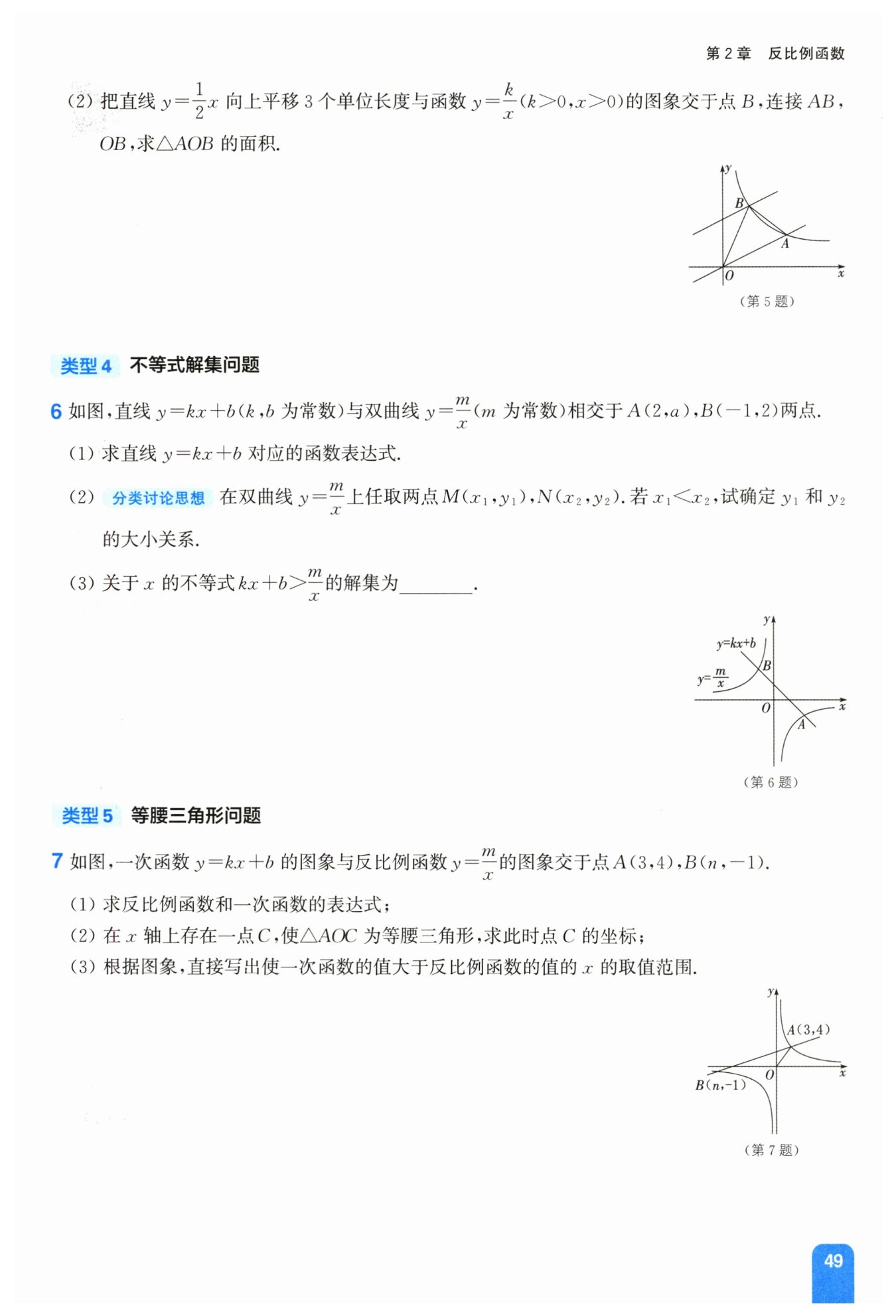
解:
(1) 把 $(3,4)$ 代入 $y=\frac{m}{x},$得 $m=12,$
$\therefore$ 反比例函数的表达式为 $y=\frac{12}{x}。$
把 $(n,-1)$ 代入 $y=\frac{12}{x},$得 $n=-12,$即 $B(-12,-1)。$
把 $(3,4),(-12,-1)$ 代入 $y=kx+b,$得
$\begin{cases} 3k+b=4 \\ -12k+b=-1 \end{cases},$
解得 $\begin{cases} k=\frac{1}{3} \\ b=3 \end{cases},$
$\therefore$ 一次函数的表达式为 $y=\frac{1}{3}x+3。$
(2) 过点 $A$ 作 $AD⊥ x$ 轴,垂足为 $D。$
由题意得 $OD=3,AD=4,$$\therefore OA=\sqrt{3^2+4^2}=5。$
$\because △ AOC$ 为等腰三角形,分三种情况讨论:
① 当 $OA=OC$ 时,$OC=5,$此时点 $C$ 的坐标为 $(5,0)$ 或 $(-5,0)。$
② 当 $AO=AC$ 时,$\because AD⊥ OC,$$\therefore OD=CD=3,$$\therefore OC=6,$此时点 $C$ 的坐标为 $(6,0)。$
③ 当 $CA=CO$ 时,设 $OC=t,$则 $AC=t,$$CD=|t-3|。$
在 $\mathrm{Rt}△ ACD$ 中,$4^2+|t-3|^2=t^2,$解得 $t=\frac{25}{6},$此时点 $C$ 的坐标为 $(\frac{25}{6},0)。$
综上所述,点 $C$ 的坐标为 $(5,0)$ 或 $(-5,0)$ 或 $(6,0)$ 或 $(\frac{25}{6},0)。$
(3) 使一次函数的值大于反比例函数的值的 $x$ 的取值范围是 $-12<x<0$ 或 $x>3。$