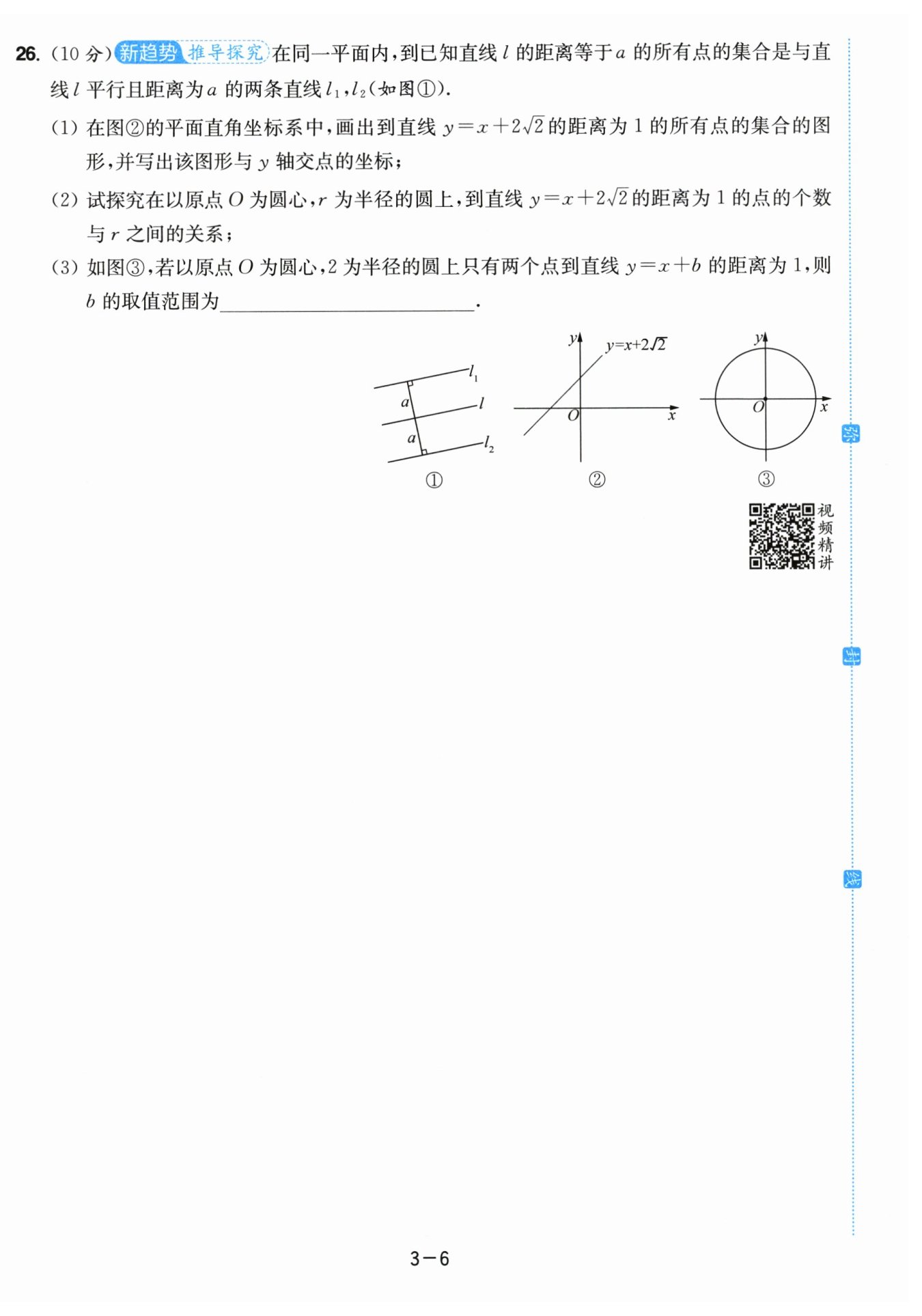
解:$(1) $到直线$y=x+2\sqrt {2}$的距离为$1$的所有点的集合是两条平行于$y=x+2\sqrt {2}$的直线$l_1,l_2$。
$ $在直线$y=x+2\sqrt {2}$中,令$x=0$得$y=2\sqrt {2}$,令$y=0$得$x=-2\sqrt {2}$,
$ $因此直线与坐标轴交点为$A(-2\sqrt {2},0)$,$B(0,2\sqrt {2})$,$OA=OB=2\sqrt {2}$,$△ ABO$是等腰直角三角形。
$ $将直线$y=x+2\sqrt {2}$向上、向下平移$1$个单位$($沿垂直于直线的方向$)$,可得两条平行线:
$ $向上平移后与$y$轴交点为$(0,3\sqrt {2})$,向下平移后与$y$轴交点为$(0,\sqrt {2})$。
$ $因此该图形与$y$轴交点的坐标是$(0,3\sqrt {2})$和$(0,\sqrt {2})$。
$ (2) $原点$O$到直线$y=x+2\sqrt {2}$的距离为$d=\frac {|0-0+2\sqrt {2}|}{\sqrt {1^2+1^2}}=2$。$ $
当$0<r<2-1$即$0<r<1$时,$\odot O$上到直线$y=x+2\sqrt {2}$的距离为$1$的点有$0$个;$ $
当$r=1$时,$\odot O$上到直线$y=x+2\sqrt {2}$的距离为$1$的点有$1$个;$ $
当$1<r<2+1$即$1<r<3$时,$\odot O$上到直线$y=x+2\sqrt {2}$的距离为$1$的点有$2$个;
当$r=3$时,$\odot O$上到直线$y=x+2\sqrt {2}$的距离为$1$的点有$3$个;$ $
当$r>3$时,$\odot O$上到直线$y=x+2\sqrt {2}$的距离为$1$的点有$4$个。