(
—Yes, it customers' needs so much that people were with the service.
A.satisfying; satisfying
B.satisfied; satisfied
C.satisfied; satisfy
D.satisfy; satisfied
B
)12. (2023·宿迁市泗阳二模)—Many people went to the beautiful restaurant in Wuyue Plaza last year.—Yes, it customers' needs so much that people were with the service.
A.satisfying; satisfying
B.satisfied; satisfied
C.satisfied; satisfy
D.satisfy; satisfied
答案:12.B
(
—Yes. The Old Man and the Sea.
A.how to read
B.which to read
C.when to read
D.where to read
B
)13. —Mr Wu has recommended many books. Have you decided first?—Yes. The Old Man and the Sea.
A.how to read
B.which to read
C.when to read
D.where to read
答案:13.B
(
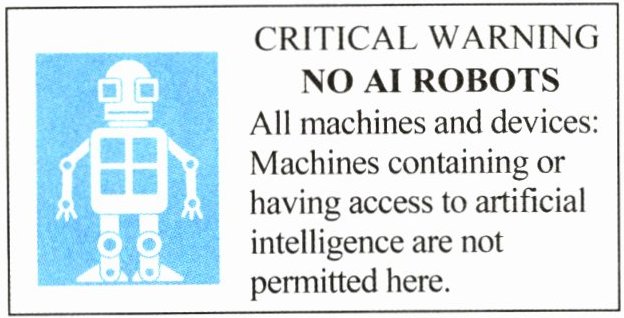
A.All machines and devices are not allowed here.
B.AI robots are widely used everywhere except here.
C.Robots with artificial intelligence are not allowed here.
D.None of the robots are allowed here except AI robots.
C
)14. (2024·南京市南师大附中树人学校模拟)Which is TRUE about the sign on the right?A.All machines and devices are not allowed here.
B.AI robots are widely used everywhere except here.
C.Robots with artificial intelligence are not allowed here.
D.None of the robots are allowed here except AI robots.
答案:14. C 【解析】根据图片中“NO AI ROBOTS”和“Machines containing or having access to artificial intelligence are not permitted here.”可知,所有包含人工智能或可访问人工智能的机器在这里都不被允许使用。
(
—! Cool products were shown at it, like a robot that makes coffee in just 90 seconds!
A.That depends
B.What a pity
C.Don't mention it
D.I can't believe it
B
)15. (2025·南京市建邺区二模)—I didn't attend the World Intelligent Manufacturing Conference in Nanjing.—! Cool products were shown at it, like a robot that makes coffee in just 90 seconds!
A.That depends
B.What a pity
C.Don't mention it
D.I can't believe it
答案:15. B 【解析】根据后句“Cool products were shown at it, like a robot that makes coffee in just 90 seconds!”可推知,答者对对方没有去参加世界智能制造大会感到遗憾。What a pity 意为“太遗憾了”,符合语境。
三、(2025·扬州市树人学校三模)完形填空。(15分)
With over 220 million people aged 65 or older in 2024, our country faces big
The robots come in different

Experts believe, with 5G and AI technology, future robots will improve significantly.
(
(
(
(
(
(
(
(
(
(
(
(
(
(
(
With over 220 million people aged 65 or older in 2024, our country faces big
challenges
1 in elderly care. We're developing special robots to help take care of the growing population
2. These robots can do many useful things like reminding
3 the elderly to take medicine, helping them walk safely
4, bringing meals, and even
5 recognizing their emotions through facial recognition technology.The robots come in different
types
6. Some are physical helper robots that look like Metal Suits to help weak elderly people move around. Others are companion(陪伴) robots designed to talk and keep lonely
7 elderly people company. Chinese companies in cities like Shanghai and Shenzhen are leading the development of these technologies. The government has also created the world's first international standard
8 for such robots to make sure they are safe and reliable.However
9, there are still several problems that need to be solved. The robots are currently too expensive
10 for most families, often costing between ¥100,000 and ¥500,000. They also struggle with complex situations and can't fully take the place of
11 human caregivers. Privacy(隐私) is another problem since
12 the robots collect health information about the elderly people they assist.Experts believe, with 5G and AI technology, future robots will improve significantly.
They
13 may become more affordable, smarter, and better at understanding human feelings. The government is working on more policies(政策) to support
14 this technology while protecting people's privacy. Meanwhile, some universities are also involved in it.In general
15, these robots provide important help with daily tasks. The development of these robots shows how China is using innovation to solve social problems, though there are still challenges to overcome before they can be widely used in ordinary families across the country.(
C
)1. A. chances B. choices C. challenges D. changes(
B
)2. A. price B. population C. problem D. pain(
D
)3. A. teaching B. advising C. ordering D. reminding(
A
)4. A. safely B. quickly C. quietly D. bravely(
C
)5. A. still B. already C. even D. almost(
D
)6. A. costs B. sizes C. times D. types(
A
)7. A. lonely B. lazy C. happy D. sporty(
C
)8. A. study B. service C. standard D. skill(
A
)9. A. However B. Therefore C. Instead D. Anyway(
B
)10. A. old B. expensive C. heavy D. strange(
C
)11. A. catch up with B. depend on C. take the place of D. belong to(
D
)12. A. otherwise B. though C. unless D. since(
A
)13. A. They B. It C. We D. You(
D
)14. A. control B. design C. create D. support(
B
)15. A. In fact B. In general C. After all D. Above all答案:1. C 【解析】根据空前的“over 220 million people aged 65 or older”可知,此处是指人口老龄化带来的挑战(challenges)。
2. B 3. D 4. A
5. C 【解析】空后的“recognizing their emotions”是进一步说明机器人的功能,表示内容上的递进,应用 even。
6. D 【解析】根据下文中“Some are physical helper robots... Others are companion robots...”可知,机器人有不同的类型(types)。
7. A
8. C 【解析】根据空后的“make sure they are safe and reliable”可知,政府制定国际标准(standard),确保这些机器人安全可靠。
9. A 10. B
11. C 【解析】根据空前的“They also struggle with complex situations”可知,机器人无法处理复杂的事情,所以它们无法完全取代人类。take the place of 意为“取代……”,符合语境。
12. D 【解析】空后的“the robots collect health information about the elderly people they assist”是解释前半句存在隐私问题的原因,所以此处应用 since,表示“由于”。
13. A
14. D 【解析】根据空前的“The government is working on more policies”可知,政府出台政策是为了支持(support)技术的发展。
15. B 【解析】空后的内容是总结全文,说明机器人整体上的积极作用,所以空处应用 in general,意为“总的来说”,起到总结的作用。
2. B 3. D 4. A
5. C 【解析】空后的“recognizing their emotions”是进一步说明机器人的功能,表示内容上的递进,应用 even。
6. D 【解析】根据下文中“Some are physical helper robots... Others are companion robots...”可知,机器人有不同的类型(types)。
7. A
8. C 【解析】根据空后的“make sure they are safe and reliable”可知,政府制定国际标准(standard),确保这些机器人安全可靠。
9. A 10. B
11. C 【解析】根据空前的“They also struggle with complex situations”可知,机器人无法处理复杂的事情,所以它们无法完全取代人类。take the place of 意为“取代……”,符合语境。
12. D 【解析】空后的“the robots collect health information about the elderly people they assist”是解释前半句存在隐私问题的原因,所以此处应用 since,表示“由于”。
13. A
14. D 【解析】根据空前的“The government is working on more policies”可知,政府出台政策是为了支持(support)技术的发展。
15. B 【解析】空后的内容是总结全文,说明机器人整体上的积极作用,所以空处应用 in general,意为“总的来说”,起到总结的作用。