四、阅读理解。(24分)
A(2025·苏州)
新素养 技术应用 A medical breakthrough in China is giving new hope to people with spinal cord injuries(脊髓损伤). Scientists have created a brain-spinal chip(芯片) that allows paralyzed(瘫痪的) patients to move their legs, and even walk again.
The chip, only 1 mm wide, is designed to be fitted into the brain and spinal cord. If the natural communication between the brain and muscles(肌肉) is lost, this chip becomes the bridge. When the chips work, they create a direct connection between the brain and muscles.
The results have been amazing. A 34-year-old man, paralyzed after a fall, could move his legs just one day after the operation on January 8, 2025. Two weeks later, he walked five metres with help. Three other patients had similar operation in February and March, all getting
better within weeks. Even though the patients' nervous systems were damaged(受损的), the chips helped them walk again. This marks a big step in China's progress in medical science and it brings hope for over 3.7 million people in China.
"This is just the beginning," Jia, the lead researcher, says. "With the technology, these people may one day leave wheelchairs behind after 3 to 5 years of training."
Behind this achievement is a long journey of careful research and bold thinking. It took the researchers over 10 years to develop the chip. They tested it on animals first, and then on people. They faced many challenges, yet they never gave up. Step by step, they developed a system to reconnect the mind and body in ways once appearing in science fiction.
As the chip continues to improve, it lights a new path forward—one built on science, shaped by care, and aimed toward a brighter future.
()1. What do we know about the chips mentioned in the passage?
A. They are only as wide as 2 mm. B. They are fitted into the man's arms.
C. They help the patient walk again. D. They improve the patients' memory.
()2. 新考法 词义猜测 Which of the following meanings is suitable for the underlined word "bold"?
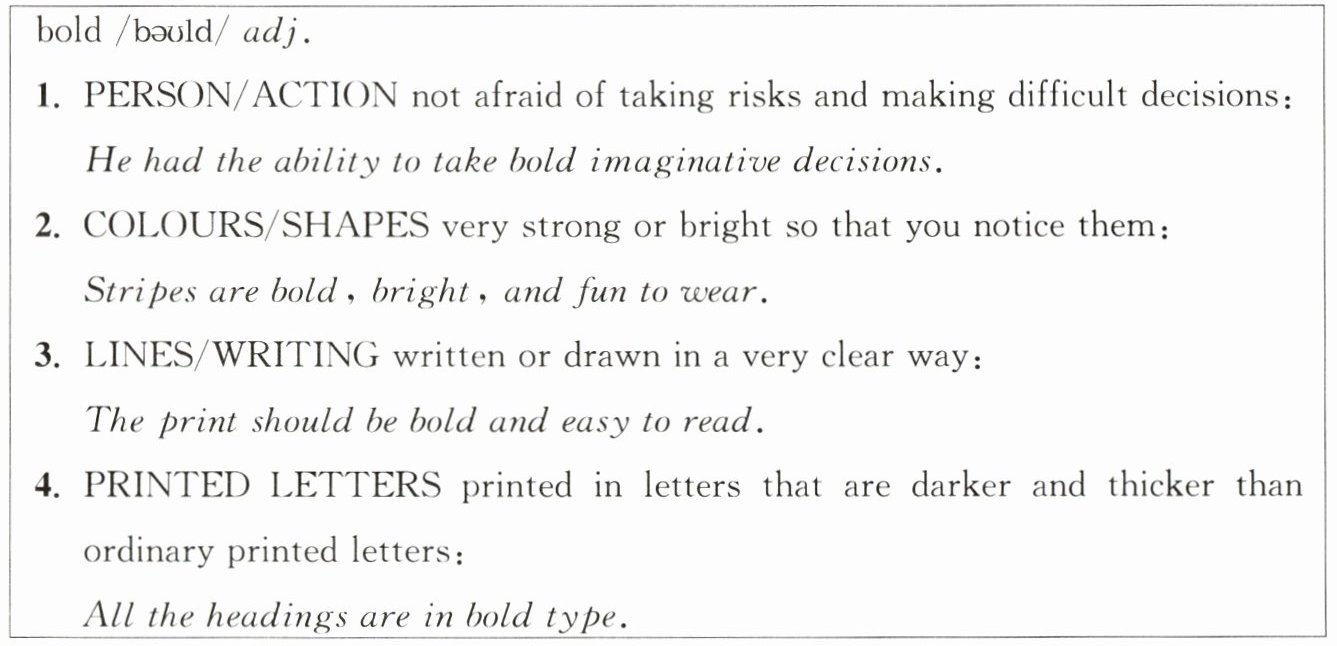
(from the dictionary)
A. 1 B. 2 C. 3 D. 4
()3. 新考法 写作意图 What is the writer's main reason for writing this passage?
A. To recommend a science story.
B. To report a pioneer doctor in medicine.
C. To compare different treatments.
D. To introduce a new medical success.
()4. What would be the best title of this passage?
A. China's Chips Bring New Hope B. Future of China's Medical Science
C. Science Fiction Changes Our Lives D. Challenges for Chinese Scientists
新素养 创新意识 We are getting used to having robots in our homes, stores, and factories. What about on stage? In fact, the word "robot" comes from a 1920 science-fiction play. In Rossum's Universal Robots, people performed as the machine-like creatures. Recently, some directors and artists have invited actual robots to share the stage in dances and other performances. Catie Cuan is one of them. "Robots are for everyone," she says.
Cuan began her career as a dancer and choreographer(编舞者)—a person who maps out the movements of dancers. But she fell in love with robots and has pioneered a new field called robot choreography. Today, she's studying robotics at Stanford University in Northern California.
You might imagine robots would dance like machines. After all, that's how the popular dance "the robot" looks. Most robots today, however, can move in a more lifelike manner. It takes time and effort to programme robots to do the movements Cuan wants. But she says, "The results will surprise you."
At first, Cuan knew little about robot choreography. In 2022, she wrote, choreographed and performed the stage show In Her Prime. She danced with two other women and two Boston Dynamics Spot robots. In the dance, the robots stayed behind a screen so the audience only saw their shadows. Cuan says that cave paintings inspired her.
"In the media," Cuan says, "robots are often described negatively(负面地)." They may seem alien, cold, or scary. Seeing a robot dance may make the technology seem fun, attractive, or friendly instead. Sometimes after her performances, audience tell her that the dance changes the way they think about robots.
Robots may seem like they're all about maths and engineering. But, as Cuan suggests, they belong in art too. "We as humans have been making art a lot longer than we've been doing maths," she says. She points out that we use art and dance to make sense of the world. Cuan thinks that performances like hers will help people feel more at home with robots. "We need to dance with robots to make sense of them," she says.
()5. Why did Catie Cuan use a screen in her dance In Her Prime with robots?
A. To show the robots' shadows.
B. To display cave paintings.
C. To hide the robots' movements.
D. To catch the attention of the audience.
()6. Which one has the closest meaning to "inspired her"?
A. offered her chances B. brought her success
C. sent her messages D. gave her ideas
( )7. 新考法 句子回填 The following sentences would best be placed at the beginning of ______ .
This is only one of many dances Cuan has performed with robots. Her goal is to show people new ways to relate to these machines.
A. Paragraph 2 B. Paragraph 4 C. Paragraph 5 D. Paragraph 6
()8. What can we learn from the article?
A. The word "robot" comes from In Her Prime.
B. Dancing with robots can help us understand them better.
C. The audience will develop an interest in robotics engineering.
D. Some students in Stanford University enjoy studying robotics.
A(2025·苏州)
新素养 技术应用 A medical breakthrough in China is giving new hope to people with spinal cord injuries(脊髓损伤). Scientists have created a brain-spinal chip(芯片) that allows paralyzed(瘫痪的) patients to move their legs, and even walk again.
The chip, only 1 mm wide, is designed to be fitted into the brain and spinal cord. If the natural communication between the brain and muscles(肌肉) is lost, this chip becomes the bridge. When the chips work, they create a direct connection between the brain and muscles.
The results have been amazing. A 34-year-old man, paralyzed after a fall, could move his legs just one day after the operation on January 8, 2025. Two weeks later, he walked five metres with help. Three other patients had similar operation in February and March, all getting
better within weeks. Even though the patients' nervous systems were damaged(受损的), the chips helped them walk again. This marks a big step in China's progress in medical science and it brings hope for over 3.7 million people in China.
"This is just the beginning," Jia, the lead researcher, says. "With the technology, these people may one day leave wheelchairs behind after 3 to 5 years of training."
Behind this achievement is a long journey of careful research and bold thinking. It took the researchers over 10 years to develop the chip. They tested it on animals first, and then on people. They faced many challenges, yet they never gave up. Step by step, they developed a system to reconnect the mind and body in ways once appearing in science fiction.
As the chip continues to improve, it lights a new path forward—one built on science, shaped by care, and aimed toward a brighter future.
()1. What do we know about the chips mentioned in the passage?
A. They are only as wide as 2 mm. B. They are fitted into the man's arms.
C. They help the patient walk again. D. They improve the patients' memory.
()2. 新考法 词义猜测 Which of the following meanings is suitable for the underlined word "bold"?
(from the dictionary)
A. 1 B. 2 C. 3 D. 4
()3. 新考法 写作意图 What is the writer's main reason for writing this passage?
A. To recommend a science story.
B. To report a pioneer doctor in medicine.
C. To compare different treatments.
D. To introduce a new medical success.
()4. What would be the best title of this passage?
A. China's Chips Bring New Hope B. Future of China's Medical Science
C. Science Fiction Changes Our Lives D. Challenges for Chinese Scientists
新素养 创新意识 We are getting used to having robots in our homes, stores, and factories. What about on stage? In fact, the word "robot" comes from a 1920 science-fiction play. In Rossum's Universal Robots, people performed as the machine-like creatures. Recently, some directors and artists have invited actual robots to share the stage in dances and other performances. Catie Cuan is one of them. "Robots are for everyone," she says.
Cuan began her career as a dancer and choreographer(编舞者)—a person who maps out the movements of dancers. But she fell in love with robots and has pioneered a new field called robot choreography. Today, she's studying robotics at Stanford University in Northern California.
You might imagine robots would dance like machines. After all, that's how the popular dance "the robot" looks. Most robots today, however, can move in a more lifelike manner. It takes time and effort to programme robots to do the movements Cuan wants. But she says, "The results will surprise you."
At first, Cuan knew little about robot choreography. In 2022, she wrote, choreographed and performed the stage show In Her Prime. She danced with two other women and two Boston Dynamics Spot robots. In the dance, the robots stayed behind a screen so the audience only saw their shadows. Cuan says that cave paintings inspired her.
"In the media," Cuan says, "robots are often described negatively(负面地)." They may seem alien, cold, or scary. Seeing a robot dance may make the technology seem fun, attractive, or friendly instead. Sometimes after her performances, audience tell her that the dance changes the way they think about robots.
Robots may seem like they're all about maths and engineering. But, as Cuan suggests, they belong in art too. "We as humans have been making art a lot longer than we've been doing maths," she says. She points out that we use art and dance to make sense of the world. Cuan thinks that performances like hers will help people feel more at home with robots. "We need to dance with robots to make sense of them," she says.
()5. Why did Catie Cuan use a screen in her dance In Her Prime with robots?
A. To show the robots' shadows.
B. To display cave paintings.
C. To hide the robots' movements.
D. To catch the attention of the audience.
()6. Which one has the closest meaning to "inspired her"?
A. offered her chances B. brought her success
C. sent her messages D. gave her ideas
( )7. 新考法 句子回填 The following sentences would best be placed at the beginning of ______ .
This is only one of many dances Cuan has performed with robots. Her goal is to show people new ways to relate to these machines.
A. Paragraph 2 B. Paragraph 4 C. Paragraph 5 D. Paragraph 6
()8. What can we learn from the article?
A. The word "robot" comes from In Her Prime.
B. Dancing with robots can help us understand them better.
C. The audience will develop an interest in robotics engineering.
D. Some students in Stanford University enjoy studying robotics.
答案:A
1. C
2. A 【解析】根据画线词所在句“Behind this achievement is a long journey of careful research and bold thinking.”可知,“bold thinking”与“careful research”为并列关系,描述研究历程。根据词典中的第一条释义可知,bold 意为“敢于冒险和制定困难的决策”,这与研究者十年攻坚、突破常规的背景匹配。
3. D 【解析】根据第一段内容可知,文章首段点明主题,即医学上的突破,后续聚焦芯片原理、疗效及意义,末段展望未来。因此,作者的写作意图应是介绍一项新的医疗成果。
4. A 【解析】通读全文可知,本文介绍了中国科学家研发的一种脑脊髓芯片如何帮助脊髓损伤患者恢复行走能力,标志着中国在医学科学领域的重大进步,并为数百万患者带来希望。因此 A 项“中国芯片带来新的希望”作为标题最为合适。
B
5. A
6. D 【解析】根据第四段内容可知,Catie Cuan在舞蹈中之所以会让机器人待在屏幕后面,是因为洞穴壁画给了她灵感,也就是给了她一些想法,所以 D 项最符合画线短语的意思。
7. C 【解析】第四段介绍了 Catie Cuan 与机器人共舞的情况,而第五段则是介绍通过舞蹈改变人们对机器人的看法。由此可推知,题干中所给的句子适合放在第五段前。
8. B
1. C
2. A 【解析】根据画线词所在句“Behind this achievement is a long journey of careful research and bold thinking.”可知,“bold thinking”与“careful research”为并列关系,描述研究历程。根据词典中的第一条释义可知,bold 意为“敢于冒险和制定困难的决策”,这与研究者十年攻坚、突破常规的背景匹配。
3. D 【解析】根据第一段内容可知,文章首段点明主题,即医学上的突破,后续聚焦芯片原理、疗效及意义,末段展望未来。因此,作者的写作意图应是介绍一项新的医疗成果。
4. A 【解析】通读全文可知,本文介绍了中国科学家研发的一种脑脊髓芯片如何帮助脊髓损伤患者恢复行走能力,标志着中国在医学科学领域的重大进步,并为数百万患者带来希望。因此 A 项“中国芯片带来新的希望”作为标题最为合适。
B
5. A
6. D 【解析】根据第四段内容可知,Catie Cuan在舞蹈中之所以会让机器人待在屏幕后面,是因为洞穴壁画给了她灵感,也就是给了她一些想法,所以 D 项最符合画线短语的意思。
7. C 【解析】第四段介绍了 Catie Cuan 与机器人共舞的情况,而第五段则是介绍通过舞蹈改变人们对机器人的看法。由此可推知,题干中所给的句子适合放在第五段前。
8. B