12. (数形结合思想)如图①,在$\triangle ABC$中,$\angle C = 90°$,$BC = a$,$AC = b$,$AB = c$,且$b > a$,将$\triangle ABC$绕一点按逆时针方向旋转到$\triangle BDE$的位置,点$A$,$B$,$C$的对应点分别为$B$,$D$,$E$,其中点$B$,$C$,$E$在同一条直线上,连接$AD$.
(1)求$\angle ABD$的度数.
(2)用不同的方法计算梯形$ACED$的面积,并以此说明$a$,$b$,$c$之间的数量关系.
(3)如图②,在图①的基础上,取$AD$的中点$P$,将梯形$ACED$分别沿直线$PC$,$PE$翻折,点$A$,$D$同时落在$CE$上的点$F$处.若$EF · BE = BF^2$,则$\frac{\triangle CPE的面积}{\triangle ABD的面积}$是否为定值?若是,请求出这个定值;若不是,请说明理由.
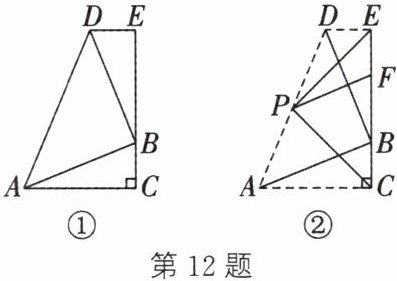
(1)求$\angle ABD$的度数.
(2)用不同的方法计算梯形$ACED$的面积,并以此说明$a$,$b$,$c$之间的数量关系.
(3)如图②,在图①的基础上,取$AD$的中点$P$,将梯形$ACED$分别沿直线$PC$,$PE$翻折,点$A$,$D$同时落在$CE$上的点$F$处.若$EF · BE = BF^2$,则$\frac{\triangle CPE的面积}{\triangle ABD的面积}$是否为定值?若是,请求出这个定值;若不是,请说明理由.
答案:12.(1) 由旋转,可得 $\angle DBE = \angle BAC$。$\because \angle C = 90°$,$\therefore \angle BAC + \angle ABC = 90°$,$\therefore \angle DBE + \angle ABC = 90°$。$\because$ 点 $B$,$C$,$E$ 在同一条直线上,$\therefore \angle ABD = 180° - \angle DBE - \angle CBA = 180° - 90° = 90°$ (2) 由旋转,可得 $DE = BC = a$,$BE = AC = b$,$BD = AB = c$。方法一:梯形 $ACED$ 的面积 $= \frac{1}{2}(DE + AC) · EC = \frac{1}{2}(a + b)(a + b)$。方法二:由旋转,得 $S_{\triangle ABC} = S_{\triangle BDE} = \frac{1}{2}ab$。由(1)知,$\angle ABD = 90°$,$\therefore S_{\triangle ABD} = \frac{1}{2}AB · BD = \frac{1}{2}c^2$,$\therefore$ 梯形 $ACED$ 的面积 $= S_{\triangle ABC} + S_{\triangle BDE} + S_{\triangle ABD} = 2 × \frac{1}{2}ab + \frac{1}{2}c^2 = ab + \frac{1}{2}c^2$。$\therefore \frac{1}{2}(a + b)(a + b) = ab + \frac{1}{2}c^2$,$\therefore a^2 + 2ab + b^2 = 2ab + c^2$,$\therefore a^2 + b^2 = c^2$ (3) $\frac{\triangle CPE的面积}{\triangle ABD的面积}$ 是定值
由翻折,得 $FE = DE = a$,$FC = AC = b$,$\therefore BF = FC - BC = b - a$。$\because EF · BE = BF^2$,$\therefore ab = (b - a)^2$,$\therefore 3ab = a^2 + b^2$,$\therefore 2ab = \frac{2}{3}(a^2 + b^2)$。$\because P$ 为 $AD$ 的中点,$\therefore$ 易得 $S_{\triangle CPE} = \frac{1}{2}S_{梯形ACED} = \frac{1}{4}(a + b)^2$,又由(2)知,$S_{\triangle ABD} = \frac{1}{2}c^2 = \frac{1}{2}(a^2 + b^2)$,$\therefore \frac{\triangle CPE的面积}{\triangle ABD的面积} = \frac{\frac{1}{4}(a + b)^2}{\frac{a^2 + 2ab + b^2}{2c^2}} = \frac{\frac{a^2 + 2ab + b^2}{4}}{\frac{2c^2}{2(a^2 + b^2)}} = \frac{5}{6}$
由翻折,得 $FE = DE = a$,$FC = AC = b$,$\therefore BF = FC - BC = b - a$。$\because EF · BE = BF^2$,$\therefore ab = (b - a)^2$,$\therefore 3ab = a^2 + b^2$,$\therefore 2ab = \frac{2}{3}(a^2 + b^2)$。$\because P$ 为 $AD$ 的中点,$\therefore$ 易得 $S_{\triangle CPE} = \frac{1}{2}S_{梯形ACED} = \frac{1}{4}(a + b)^2$,又由(2)知,$S_{\triangle ABD} = \frac{1}{2}c^2 = \frac{1}{2}(a^2 + b^2)$,$\therefore \frac{\triangle CPE的面积}{\triangle ABD的面积} = \frac{\frac{1}{4}(a + b)^2}{\frac{a^2 + 2ab + b^2}{2c^2}} = \frac{\frac{a^2 + 2ab + b^2}{4}}{\frac{2c^2}{2(a^2 + b^2)}} = \frac{5}{6}$
13. (新考法·过程性学习)【问题提出】已知$(3x - 1)^7 = a_7x^7 + a_6x^6 + a_5x^5 + a_4x^4 + ··· + a_1x + a_0$对任意数$x$均成立,求$a_7 + a_6 + a_5 + ··· + a_1 + a_0$的值.
解:当$x = 1$时,$(3 × 1 - 1)^7 = a_7 × 1 + a_6 × 1 + ··· + a_1 × 1 + a_0$,即$128 = a_7 + a_6 + a_5 + ··· + a_1 + a_0$.$\therefore$原式$= 128$.
从这一题可以看出,在处理某些求代数式的值的题目时,我们可以使用特殊值法将问题简化,从而解决问题.请借助“特殊值法”,解决下列问题.
【问题解决】
(1)若$(2x + 1)^5 = ax^5 + bx^4 + cx^3 + dx^2 + ex + f$对任意数$x$均成立,求$a - b + c - d + e - f$的值;
(2)若$(x^2 - x - 2)^6 = a_{12}x^{12} + a_{11}x^{11} + a_{10}x^{10} + ··· + a_1x + a_0$对任意数$x$均成立,求代数式$a_{12} + a_{10} + a_8 + a_6 + a_4 + a_2$的值;
(3)将$(x^{10} + x^9 + x^8 + ··· + x + 1)(x^{10} - x^9 + x^8 - x^7 + ··· - x + 1)$展开并合并同类项后,求奇数次项系数之和;
(4)将多项式$(1 - 3x + 2x^2)^{2025} × (1 + 3x - 2x^2)^{2025} × (x^2 + x + 1)^{2025}$展开并合并同类项,则各项系数之和为多少?
解:当$x = 1$时,$(3 × 1 - 1)^7 = a_7 × 1 + a_6 × 1 + ··· + a_1 × 1 + a_0$,即$128 = a_7 + a_6 + a_5 + ··· + a_1 + a_0$.$\therefore$原式$= 128$.
从这一题可以看出,在处理某些求代数式的值的题目时,我们可以使用特殊值法将问题简化,从而解决问题.请借助“特殊值法”,解决下列问题.
【问题解决】
(1)若$(2x + 1)^5 = ax^5 + bx^4 + cx^3 + dx^2 + ex + f$对任意数$x$均成立,求$a - b + c - d + e - f$的值;
(2)若$(x^2 - x - 2)^6 = a_{12}x^{12} + a_{11}x^{11} + a_{10}x^{10} + ··· + a_1x + a_0$对任意数$x$均成立,求代数式$a_{12} + a_{10} + a_8 + a_6 + a_4 + a_2$的值;
(3)将$(x^{10} + x^9 + x^8 + ··· + x + 1)(x^{10} - x^9 + x^8 - x^7 + ··· - x + 1)$展开并合并同类项后,求奇数次项系数之和;
(4)将多项式$(1 - 3x + 2x^2)^{2025} × (1 + 3x - 2x^2)^{2025} × (x^2 + x + 1)^{2025}$展开并合并同类项,则各项系数之和为多少?
答案:13.(1) 当 $x = -1$ 时,$(-2 + 1)^5 = -(a - b + c - d + e - f)$,$\therefore a - b + c - d + e - f = 1$ (2) 当 $x = 1$ 时,$(-2)^6 = a_{12} + a_{11} + ··· + a_1 + a_0$,当 $x = -1$ 时,$0 = a_{12} - a_{11} + a_{10} - ··· - a_1 + a_0$,$\therefore$ 两式相加,得 $64 = 2(a_{12} + a_{10} + a_8 + a_6 + a_4 + a_2 + a_0)$,$\therefore a_{12} + a_{10} + a_8 + a_6 + a_4 + a_2 + a_0 = 32$。当 $x = 0$ 时,$a_0 = 64$,$\therefore a_{12} + a_{10} + a_8 + a_6 + a_4 + a_2 = -32$ (3) 设 $(x^{10} + x^9 + x^8 + ··· + x + 1)(x^{10} - x^9 + x^8 - x^7 + ··· - x + 1) = m$,当 $x = 1$ 时,$m = 11 × 1 = 11$,当 $x = -1$ 时,$m = 1 × 11 = 11$,$\therefore$ 由(2),易得奇数次项系数之和 $= \frac{11 - 11}{2} = 0$ (4) 设 $(1 - 3x + 2x^2)^{2025} × (1 + 3x - 2x^2)^{2025} × (x^2 + x + 1)^{2025} = n$,当 $x = 1$ 时,$n = (1 - 3 + 2)^{2025} × (1 + 3 - 2)^{2025} × (1 + 1 + 1)^{2025} = 0$,$\therefore$ 各项系数之和为 $0$
解析:
(1)当$x=-1$时,$(2×(-1)+1)^5=a×(-1)^5+b×(-1)^4+c×(-1)^3+d×(-1)^2+e×(-1)+f$,即$(-1)^5=-a+b-c+d-e+f$,$-1=-(a-b+c-d+e-f)$,$\therefore a-b+c-d+e-f=1$。
(2)当$x=1$时,$(1^2-1-2)^6=a_{12}+a_{11}+···+a_1+a_0$,即$(-2)^6=64=a_{12}+a_{11}+···+a_1+a_0$;当$x=-1$时,$((-1)^2-(-1)-2)^6=a_{12}-a_{11}+a_{10}-···-a_1+a_0$,即$(1+1-2)^6=0=a_{12}-a_{11}+a_{10}-···-a_1+a_0$。两式相加得$64+0=2(a_{12}+a_{10}+···+a_2+a_0)$,$\therefore a_{12}+a_{10}+···+a_2+a_0=32$。当$x=0$时,$(0-0-2)^6=a_0$,即$a_0=64$,$\therefore a_{12}+a_{10}+a_8+a_6+a_4+a_2=32 - 64=-32$。
(3)设原式$=A$,当$x=1$时,$A=(1+1+···+1)(1-1+1-···+1)=11×1=11$;当$x=-1$时,$A=(-1+1-···+1)(1+1+1+···+1)=1×11=11$。设奇数次项系数之和为$S$,偶数次项系数之和为$T$,则$T+S=11$,$T - S=11$,两式相减得$2S=0$,$\therefore S=0$。
(4)设原式$=B$,当$x=1$时,$B=(1 - 3 + 2)^{2025}×(1 + 3 - 2)^{2025}×(1 + 1 + 1)^{2025}=0^{2025}×2^{2025}×3^{2025}=0$,$\therefore$各项系数之和为$0$。
(2)当$x=1$时,$(1^2-1-2)^6=a_{12}+a_{11}+···+a_1+a_0$,即$(-2)^6=64=a_{12}+a_{11}+···+a_1+a_0$;当$x=-1$时,$((-1)^2-(-1)-2)^6=a_{12}-a_{11}+a_{10}-···-a_1+a_0$,即$(1+1-2)^6=0=a_{12}-a_{11}+a_{10}-···-a_1+a_0$。两式相加得$64+0=2(a_{12}+a_{10}+···+a_2+a_0)$,$\therefore a_{12}+a_{10}+···+a_2+a_0=32$。当$x=0$时,$(0-0-2)^6=a_0$,即$a_0=64$,$\therefore a_{12}+a_{10}+a_8+a_6+a_4+a_2=32 - 64=-32$。
(3)设原式$=A$,当$x=1$时,$A=(1+1+···+1)(1-1+1-···+1)=11×1=11$;当$x=-1$时,$A=(-1+1-···+1)(1+1+1+···+1)=1×11=11$。设奇数次项系数之和为$S$,偶数次项系数之和为$T$,则$T+S=11$,$T - S=11$,两式相减得$2S=0$,$\therefore S=0$。
(4)设原式$=B$,当$x=1$时,$B=(1 - 3 + 2)^{2025}×(1 + 3 - 2)^{2025}×(1 + 1 + 1)^{2025}=0^{2025}×2^{2025}×3^{2025}=0$,$\therefore$各项系数之和为$0$。