一、(2025 徐州期中)根据所给信息,选择正确的选项。
新语篇·线路地图
建议用时:6 分钟
难度:★★★☆
(
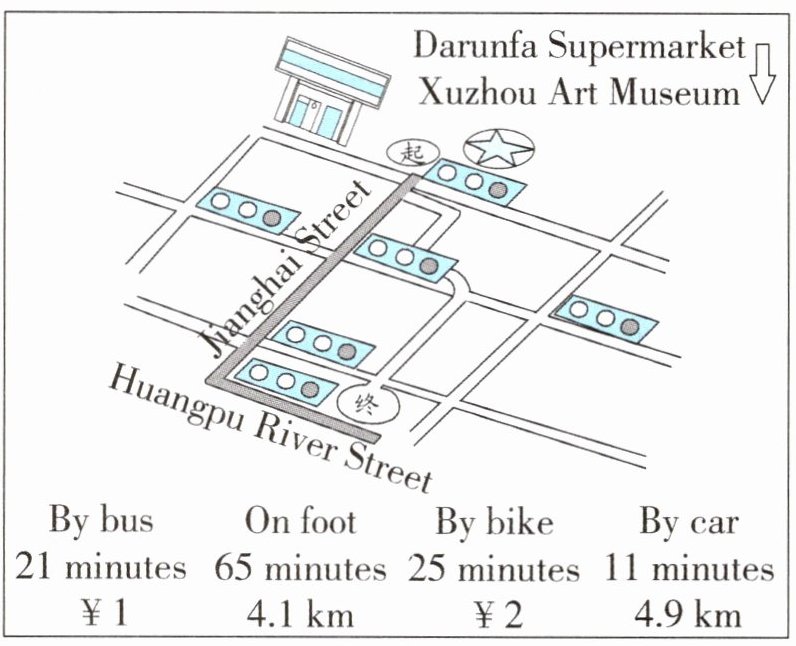
A. six
B. five
C. four
(
A. by car
B. by bike
C. on foot
(
A. Jianghai Street; left
B. Jianghai Street; right
C. Huangpu River Street; right
(
A. buy things in the supermarket
B. watch an art show
C. show the way
新语篇·线路地图
建议用时:6 分钟
难度:★★★☆
(
C
)1. From Darunfa Supermarket to Xuzhou Art Museum, we can see traffic lights.A. six
B. five
C. four
(
B
)2. We leave Darunfa Supermarket at 9:00 and get to Xuzhou Art Museum at 9:25. We may go there .A. by car
B. by bike
C. on foot
(
A
)3. To get to Xuzhou Art Museum, we should go along , and then turn .A. Jianghai Street; left
B. Jianghai Street; right
C. Huangpu River Street; right
(
C
)4. We can use this APP to .A. buy things in the supermarket
B. watch an art show
C. show the way
答案:1. C 2. B 3. A 4. C
解析:
【分析】
这是一道结合地图信息的英语情景应用题,解题思路如下:1. 第1题需要沿着从起点到终点的规划路线,数路线上途经的交通信号灯数量,排除不在路线上的信号灯;2. 第2题先计算出行用时,再对照图下方不同出行方式的耗时匹配对应选项;3. 第3题对照地图上的街道名称和行进方向,判断路线的走向和转向;4. 第4题结合整个界面的导航属性,判断该应用的功能,排除不符合的选项。
【解析】
1. 沿着从Darunfa Supermarket到Xuzhou Art Museum的路线行进,途经的交通信号灯一共4个,其余信号灯不在该路线上,因此选C。
2. 9:00出发,9:25到达,总用时为25分钟,对照图中给出的出行时长:by car耗时11分钟,by bike耗时25分钟,on foot耗时65分钟,匹配by bike,因此选B。
3. 观察地图路线:首先沿着Jianghai Street向南行进,之后左转进入Huangpu River Street即可到达终点,对应选项A,因此选A。
4. 该界面展示了两地之间的路线、不同出行方式的耗时和费用,属于导航指路的功能,A选项“在超市购物”、B选项“看艺术展”均不符合界面属性,因此选C。
【答案】
1. C 2. B 3. A 4. C
【知识点】
图文信息提取,出行方式表达,路线描述
【点评】
本题结合真实生活中的导航地图场景命题,将英语知识和生活实际应用结合,既考察学生的细节观察能力,也引导学生学会用英语解决日常出行相关的实际问题,只要仔细核对图中的文字和地图细节就可以顺利得出答案。
【难度系数】
0.7
这是一道结合地图信息的英语情景应用题,解题思路如下:1. 第1题需要沿着从起点到终点的规划路线,数路线上途经的交通信号灯数量,排除不在路线上的信号灯;2. 第2题先计算出行用时,再对照图下方不同出行方式的耗时匹配对应选项;3. 第3题对照地图上的街道名称和行进方向,判断路线的走向和转向;4. 第4题结合整个界面的导航属性,判断该应用的功能,排除不符合的选项。
【解析】
1. 沿着从Darunfa Supermarket到Xuzhou Art Museum的路线行进,途经的交通信号灯一共4个,其余信号灯不在该路线上,因此选C。
2. 9:00出发,9:25到达,总用时为25分钟,对照图中给出的出行时长:by car耗时11分钟,by bike耗时25分钟,on foot耗时65分钟,匹配by bike,因此选B。
3. 观察地图路线:首先沿着Jianghai Street向南行进,之后左转进入Huangpu River Street即可到达终点,对应选项A,因此选A。
4. 该界面展示了两地之间的路线、不同出行方式的耗时和费用,属于导航指路的功能,A选项“在超市购物”、B选项“看艺术展”均不符合界面属性,因此选C。
【答案】
1. C 2. B 3. A 4. C
【知识点】
图文信息提取,出行方式表达,路线描述
【点评】
本题结合真实生活中的导航地图场景命题,将英语知识和生活实际应用结合,既考察学生的细节观察能力,也引导学生学会用英语解决日常出行相关的实际问题,只要仔细核对图中的文字和地图细节就可以顺利得出答案。
【难度系数】
0.7
二、(2025 南京期中)阅读短文内容,完成下列任务。
新素养·文化意识
建议用时:12 分钟
难度:★★★★★
I travel a lot and I find out different “styles” of directions(指路) every time I ask “How can I get to the post office?”
Foreign travellers are often confused in Japan because most streets there don’t have names. In Japan, people use landmarks in their directions instead of street names. For example, the Japanese will say to travellers, “Go straight down to the corner. Turn left at the big hotel. The post office is next to the bus stop.”
In the countryside of the American Midwest, there are not many landmarks. There are no mountains, so the land is very flat. In many places there are no towns or buildings within miles. Instead of landmarks, people will tell you directions(方向) and distances. For example, people will say, “Go north two miles. Turn east, and then go another mile.”
People in Los Angeles, California, have no idea of distance on the map. They measure distance in time, not miles. “How far is the post office?”, you ask. They answer, “It’s about five minutes from here.” You say, “Yes, but how many miles away is it?” They don’t know.
任务一:阅读短文,选择正确的答案。
(
A. use landmarks
B. show him or her a map
C. tell him or her the distance
(
A. The US.
B. Japan.
C. The UK.
(
A. happy
B. confused
C. afraid
(
A. Two.
B. Three.
C. Four.
(
A. It’s useful for travellers to know how to ask the way properly.
B. People have similar understandings of directions.
C. It’s important for travellers to understand cultural differences.
任务二:根据短文内容填空,每空一词。
There are different
新素养·文化意识
建议用时:12 分钟
难度:★★★★★
I travel a lot and I find out different “styles” of directions(指路) every time I ask “How can I get to the post office?”
Foreign travellers are often confused in Japan because most streets there don’t have names. In Japan, people use landmarks in their directions instead of street names. For example, the Japanese will say to travellers, “Go straight down to the corner. Turn left at the big hotel. The post office is next to the bus stop.”
In the countryside of the American Midwest, there are not many landmarks. There are no mountains, so the land is very flat. In many places there are no towns or buildings within miles. Instead of landmarks, people will tell you directions(方向) and distances. For example, people will say, “Go north two miles. Turn east, and then go another mile.”
People in Los Angeles, California, have no idea of distance on the map. They measure distance in time, not miles. “How far is the post office?”, you ask. They answer, “It’s about five minutes from here.” You say, “Yes, but how many miles away is it?” They don’t know.
任务一:阅读短文,选择正确的答案。
(
A
)1. When a traveller asks the Japanese the way to a place, they usually .A. use landmarks
B. show him or her a map
C. tell him or her the distance
(
A
)2. In which country do some people use the distance to tell the way?A. The US.
B. Japan.
C. The UK.
(
B
)3. Travellers in Japan are often because most streets don’t have names.A. happy
B. confused
C. afraid
(
B
)4. How many styles of directions are mentioned in the passage?A. Two.
B. Three.
C. Four.
(
C
)5. What can we learn from the passage?A. It’s useful for travellers to know how to ask the way properly.
B. People have similar understandings of directions.
C. It’s important for travellers to understand cultural differences.
任务二:根据短文内容填空,每空一词。
There are different
styles
of directions in different countries. Japanese use landmarks
in their directions instead of street
names. In the countryside of the American Midwest, there are no towns
or buildings within miles. Americans tell you directions
and distances. In some places of America, people measure distance in time
, not miles.答案:任务一:1. A 2. A 3. B 4. B 5. C
任务二:styles;landmarks;street;towns;directions;time
任务二:styles;landmarks;street;towns;directions;time
解析:
【分析】
这是一篇介绍不同地域指路文化的阅读理解题,解题思路如下:1. 先快速通读全文,梳理出文章分别介绍了日本、美国中西部、美国洛杉矶三种不同的指路方式,明确核心主题是不同地区的指路文化差异。2. 完成任务一的选择题时,每道题都带着题干关键词回原文定位,找到对应语句即可直接匹配答案,不需要额外复杂推理。3. 完成任务二的填空题时,严格按照“每空一词”的要求,在原文中找到和题干句式匹配的原句,提取对应的词汇即可,注意名词单复数的正确形式。
【解析】
任务一 选择题
1. 定位原文第二段第二句"In Japan, people use landmarks in their directions instead of street names.",可知日本人指路时通常使用地标,选A。
2. 定位原文第三段内容,美国中西部乡村的人们会通过告知方向和距离来指路,对应国家是美国,选A。
3. 定位原文第二段第一句"Foreign travellers are often confused in Japan because most streets there don't have names.",可知游客在日本经常会感到困惑,选B。
4. 全文共提到3种指路风格:①日本用地标指路;②美国中西部用方向+距离指路;③美国洛杉矶用时间计量距离指路,共3种,选B。
5. 全文介绍了不同地区完全不同的指路习惯,核心是传递“游客理解不同地域的文化差异十分重要”的主旨,A选项文中未提及正确问路的方法,B选项和原文表意相反,选C。
任务二 填空题
1. 对应原文首句"I travel a lot and I find out different 'styles' of directions",填styles;
2. 对应原文第二段"In Japan, people use landmarks in their directions instead of street names",填landmarks;
3. 同上句,填street;
4. 对应原文第三段"In many places there are no towns or buildings within miles.",填towns;
5. 对应原文第三段"people will tell you directions and distances",填directions;
6. 对应原文第四段"They measure distance in time, not miles.",填time。
【答案】
任务一:1. A 2. A 3. B 4. B 5. C
任务二:styles;landmarks;street;towns;directions;time
【知识点】
英语阅读细节定位,跨文化交际常识
【点评】
本题贴合新课标文化意识的培养要求,所有题目考点均依托原文细节设置,既考察学生快速查找文本信息的阅读能力,也通过不同地区的指路文化介绍,引导学生理解不同地域的文化差异,难度梯度平缓,适合巩固细节类阅读题的解题方法。
【难度系数】
0.7
这是一篇介绍不同地域指路文化的阅读理解题,解题思路如下:1. 先快速通读全文,梳理出文章分别介绍了日本、美国中西部、美国洛杉矶三种不同的指路方式,明确核心主题是不同地区的指路文化差异。2. 完成任务一的选择题时,每道题都带着题干关键词回原文定位,找到对应语句即可直接匹配答案,不需要额外复杂推理。3. 完成任务二的填空题时,严格按照“每空一词”的要求,在原文中找到和题干句式匹配的原句,提取对应的词汇即可,注意名词单复数的正确形式。
【解析】
任务一 选择题
1. 定位原文第二段第二句"In Japan, people use landmarks in their directions instead of street names.",可知日本人指路时通常使用地标,选A。
2. 定位原文第三段内容,美国中西部乡村的人们会通过告知方向和距离来指路,对应国家是美国,选A。
3. 定位原文第二段第一句"Foreign travellers are often confused in Japan because most streets there don't have names.",可知游客在日本经常会感到困惑,选B。
4. 全文共提到3种指路风格:①日本用地标指路;②美国中西部用方向+距离指路;③美国洛杉矶用时间计量距离指路,共3种,选B。
5. 全文介绍了不同地区完全不同的指路习惯,核心是传递“游客理解不同地域的文化差异十分重要”的主旨,A选项文中未提及正确问路的方法,B选项和原文表意相反,选C。
任务二 填空题
1. 对应原文首句"I travel a lot and I find out different 'styles' of directions",填styles;
2. 对应原文第二段"In Japan, people use landmarks in their directions instead of street names",填landmarks;
3. 同上句,填street;
4. 对应原文第三段"In many places there are no towns or buildings within miles.",填towns;
5. 对应原文第三段"people will tell you directions and distances",填directions;
6. 对应原文第四段"They measure distance in time, not miles.",填time。
【答案】
任务一:1. A 2. A 3. B 4. B 5. C
任务二:styles;landmarks;street;towns;directions;time
【知识点】
英语阅读细节定位,跨文化交际常识
【点评】
本题贴合新课标文化意识的培养要求,所有题目考点均依托原文细节设置,既考察学生快速查找文本信息的阅读能力,也通过不同地区的指路文化介绍,引导学生理解不同地域的文化差异,难度梯度平缓,适合巩固细节类阅读题的解题方法。
【难度系数】
0.7