一、根据句意和首字母提示填空。
1. 生活运用There are 28 or 29 days in F
2. It's the last month of a year. It's usually cold. It's D
3. This month starts with an “M”. It has five letters. It's M
4. I'm very excited because J
5. 文化意识We c
1. 生活运用There are 28 or 29 days in F
ebruary
.2. It's the last month of a year. It's usually cold. It's D
ecember
.3. This month starts with an “M”. It has five letters. It's M
arch
.4. I'm very excited because J
uly
is coming and summer holiday will start.5. 文化意识We c
all
Kunming the “Spring City” because it's warm there all year round.答案:1. February 2. December 3. March 4. July 5. call
解析:
【分析】
这是首字母提示类的句意补全题,解题思路是先通读每句话提取核心线索,结合给出的首字母提示,匹配对应的符合语境的英语词汇:首先优先抓取句中的常识类提示信息,比如月份的天数、一年的月份排序、暑假的时间节点等,再结合单词的字母数量、语义搭配要求,确定正确的单词,同时注意专有名词的大小写规范。
【解析】
1. 句中提示该月份有28或29天,首字母为F,结合生活常识,只有二月的天数是28或29天,对应单词February。
2. 句中提示是一年的最后一个月、天气寒冷,首字母为D,一年的最后一个月是十二月,对应单词December。
3. 句中提示该单词是月份、以M开头、一共5个字母,符合要求的月份单词是March(三月,共5个字母)。
4. 句中提示该时间到来后暑假就要开始,首字母为J,暑假开启对应的月份是七月,对应单词July。
5. 句中语义是我们把昆明称作“春城”,首字母为c,搭配call sth sth表示“把某物称作…”,主语是we,一般现在时用动词原形call。
【答案】
1. February 2. December 3. March 4. July 5. call
【知识点】
月份词汇识记,动词固定搭配,生活常识应用
【点评】
本题结合生活常识、文化常识考察小学阶段核心的月份类词汇和基础常用动词,难度较低,既巩固了单元核心词汇,也引导学生把英语知识和生活实际结合,需要注意表示月份的专有名词首字母必须大写,避免拼写失误。
【难度系数】
0.8
这是首字母提示类的句意补全题,解题思路是先通读每句话提取核心线索,结合给出的首字母提示,匹配对应的符合语境的英语词汇:首先优先抓取句中的常识类提示信息,比如月份的天数、一年的月份排序、暑假的时间节点等,再结合单词的字母数量、语义搭配要求,确定正确的单词,同时注意专有名词的大小写规范。
【解析】
1. 句中提示该月份有28或29天,首字母为F,结合生活常识,只有二月的天数是28或29天,对应单词February。
2. 句中提示是一年的最后一个月、天气寒冷,首字母为D,一年的最后一个月是十二月,对应单词December。
3. 句中提示该单词是月份、以M开头、一共5个字母,符合要求的月份单词是March(三月,共5个字母)。
4. 句中提示该时间到来后暑假就要开始,首字母为J,暑假开启对应的月份是七月,对应单词July。
5. 句中语义是我们把昆明称作“春城”,首字母为c,搭配call sth sth表示“把某物称作…”,主语是we,一般现在时用动词原形call。
【答案】
1. February 2. December 3. March 4. July 5. call
【知识点】
月份词汇识记,动词固定搭配,生活常识应用
【点评】
本题结合生活常识、文化常识考察小学阶段核心的月份类词汇和基础常用动词,难度较低,既巩固了单元核心词汇,也引导学生把英语知识和生活实际结合,需要注意表示月份的专有名词首字母必须大写,避免拼写失误。
【难度系数】
0.8
(
A. and
B. in
C. on
A
)1.The moon is full and
bright.A. and
B. in
C. on
答案:1. A
解析:
【分析】
首先我们先梳理句子含义和空格前后的成分:句子要表达的是月亮又圆又亮,空格前后的full(圆的)和bright(明亮的)都是描述月亮特征的形容词,属于并列的两个属性。接下来我们逐个分析选项:先判断选项词性,A是并列连词,B、C都是介词,介词后面不能直接接形容词,无法连接两个并列的形容词,只有并列连词and可以同时满足语法和语义的要求,由此就能选出正确答案。
【解析】
1. 先翻译题干句子:月亮又圆又亮。
2. 分析句子成分:句中full和bright都是形容词,共同作表语修饰主语The moon,二者是并列的描述关系,需要用并列连词来连接。
3. 逐一辨析选项:
选项A:and是并列连词,意为“和、又”,可以用来连接两个并列的形容词,填入后语法通顺、语义符合逻辑。
选项B:in是方位介词,意为“在……里面”,介词后通常接名词、代词作宾语,不能直接接形容词bright,填入后句子语法错误、语义不通。
选项C:on是方位介词,意为“在……上面”,同样属于介词,无法直接连接两个形容词,填入后不符合句子逻辑。
综上排除B、C,选A。
【答案】
A
【知识点】
并列连词and 介词辨析
【点评】
本题是英语基础语法题,重点考察学生对并列连词基本用法的掌握,区分连词和介词的使用场景,难度很低,学生只要能识别两个形容词的并列修饰关系就可以快速选出正确答案,适合刚接触并列连词知识点的初学者巩固基础。
【难度系数】
0.9
首先我们先梳理句子含义和空格前后的成分:句子要表达的是月亮又圆又亮,空格前后的full(圆的)和bright(明亮的)都是描述月亮特征的形容词,属于并列的两个属性。接下来我们逐个分析选项:先判断选项词性,A是并列连词,B、C都是介词,介词后面不能直接接形容词,无法连接两个并列的形容词,只有并列连词and可以同时满足语法和语义的要求,由此就能选出正确答案。
【解析】
1. 先翻译题干句子:月亮又圆又亮。
2. 分析句子成分:句中full和bright都是形容词,共同作表语修饰主语The moon,二者是并列的描述关系,需要用并列连词来连接。
3. 逐一辨析选项:
选项A:and是并列连词,意为“和、又”,可以用来连接两个并列的形容词,填入后语法通顺、语义符合逻辑。
选项B:in是方位介词,意为“在……里面”,介词后通常接名词、代词作宾语,不能直接接形容词bright,填入后句子语法错误、语义不通。
选项C:on是方位介词,意为“在……上面”,同样属于介词,无法直接连接两个形容词,填入后不符合句子逻辑。
综上排除B、C,选A。
【答案】
A
【知识点】
并列连词and 介词辨析
【点评】
本题是英语基础语法题,重点考察学生对并列连词基本用法的掌握,区分连词和介词的使用场景,难度很低,学生只要能识别两个形容词的并列修饰关系就可以快速选出正确答案,适合刚接触并列连词知识点的初学者巩固基础。
【难度系数】
0.9
(
—It's
A. When; on
B. When; in
C. What time; on
B
)2.—When
is China's National Day?—It's
in
October.A. When; on
B. When; in
C. What time; on
答案:2. B 解析: what time 一般询问几点, when 一般询问日期, 排除 C 项; 在某个月份用介词 in。故选 B。
解析:
【分析】
首先我们先看问句的句意:询问的是中国国庆节的时间,第一步先辨析两个疑问词的区别:what time通常只用来问具体的几点几分,而when可以询问日期、节日这类更大范围的时间,所以第一空要选When,直接排除C选项。接下来看第二空后面的时间是October(十月),属于月份,我们回忆时间介词的规则:on后面要接具体的某一天,而in用来搭配年、月、季节这类大范围的时间,所以月份前要用介词in,排除A选项,最终就能选出正确答案。
【解析】
1. 分析第一空:问句询问国庆节的日期,what time仅用于询问具体时刻,不符合本题询问节日日期的语境,因此选用疑问词When,直接排除C选项。
2. 分析第二空:空格后接的是月份October,英语语法中表示“在某个月份”时,要使用介词in;介词on仅用于搭配具体的某一天,不符合此处用法,排除A选项。
综上,正确选项为B。
【答案】
B
【知识点】
特殊疑问词辨析,时间介词用法
【点评】
本题是小学英语时间表达板块的基础常考题,核心考察学生对when/what time的适用场景、不同时间对应的介词搭配的记忆,只要牢记基础语法规则,很容易选出正确答案。
【难度系数】
0.8
首先我们先看问句的句意:询问的是中国国庆节的时间,第一步先辨析两个疑问词的区别:what time通常只用来问具体的几点几分,而when可以询问日期、节日这类更大范围的时间,所以第一空要选When,直接排除C选项。接下来看第二空后面的时间是October(十月),属于月份,我们回忆时间介词的规则:on后面要接具体的某一天,而in用来搭配年、月、季节这类大范围的时间,所以月份前要用介词in,排除A选项,最终就能选出正确答案。
【解析】
1. 分析第一空:问句询问国庆节的日期,what time仅用于询问具体时刻,不符合本题询问节日日期的语境,因此选用疑问词When,直接排除C选项。
2. 分析第二空:空格后接的是月份October,英语语法中表示“在某个月份”时,要使用介词in;介词on仅用于搭配具体的某一天,不符合此处用法,排除A选项。
综上,正确选项为B。
【答案】
B
【知识点】
特殊疑问词辨析,时间介词用法
【点评】
本题是小学英语时间表达板块的基础常考题,核心考察学生对when/what time的适用场景、不同时间对应的介词搭配的记忆,只要牢记基础语法规则,很容易选出正确答案。
【难度系数】
0.8
(
—
A. The Spring Festival.
B. The Dragon Boat Festival.
C. The Lantern Festival.
B
)3.—What festival is in May or June?—
B
A. The Spring Festival.
B. The Dragon Boat Festival.
C. The Lantern Festival.
答案:3. B
解析:
【分析】
首先明确题干的核心要求:选出时间处于公历5月或6月的节日。解题时第一步先读懂题干的问题含义,第二步逐一回忆每个选项对应的中国传统节日的大致公历时间,将不符合时间要求的选项逐一排除,就能得到正确答案。
【解析】
题干翻译为:——什么节日在五月或者六月?
逐一分析选项:
1. 选项A The Spring Festival指春节,对应农历正月初一,对应的公历时间通常在每年的1月或2月,不符合题干的时间要求;
2. 选项B The Dragon Boat Festival指端午节,对应农历五月初五,对应的公历日期通常落在每年的5月至6月区间,符合题干要求;
3. 选项C The Lantern Festival指元宵节,对应农历正月十五,对应的公历时间通常在每年的1月或2月,不符合题干的时间要求。
综上,正确答案为B。
【答案】
B
【知识点】
传统节日英文表达,节日时间常识
【点评】
本题是融合中国文化常识的英语情景选择题,既考察学生对常见中国传统节日英文名称的识记,也考察学生对传统节日对应大致时间的了解,属于基础类题型。
【难度系数】
0.8
首先明确题干的核心要求:选出时间处于公历5月或6月的节日。解题时第一步先读懂题干的问题含义,第二步逐一回忆每个选项对应的中国传统节日的大致公历时间,将不符合时间要求的选项逐一排除,就能得到正确答案。
【解析】
题干翻译为:——什么节日在五月或者六月?
逐一分析选项:
1. 选项A The Spring Festival指春节,对应农历正月初一,对应的公历时间通常在每年的1月或2月,不符合题干的时间要求;
2. 选项B The Dragon Boat Festival指端午节,对应农历五月初五,对应的公历日期通常落在每年的5月至6月区间,符合题干要求;
3. 选项C The Lantern Festival指元宵节,对应农历正月十五,对应的公历时间通常在每年的1月或2月,不符合题干的时间要求。
综上,正确答案为B。
【答案】
B
【知识点】
传统节日英文表达,节日时间常识
【点评】
本题是融合中国文化常识的英语情景选择题,既考察学生对常见中国传统节日英文名称的识记,也考察学生对传统节日对应大致时间的了解,属于基础类题型。
【难度系数】
0.8
(
A. February, March and April
B. March, April and May
C. April, May and June
B
)4.文化意识Spring is in B
in China.A. February, March and April
B. March, April and May
C. April, May and June
答案:4. B
解析:
【分析】
这道题结合文化常识考察中国春季对应的公历月份,解题时首先要回忆我国通用的四季划分规则:气象学上通常将北半球温带的春季划定为3-5月,再逐一比对三个选项,排除包含冬季月份的A选项、包含夏季月份的C选项,即可得到正确答案。
【解析】
解:
1. 明确常识:中国位于北半球温带,通用的公历四季划分标准里,春季为每年的3月、4月、5月,这个时段我国大部分地区气温逐步回升,符合春季万物复苏的气候特征。
2. 逐一判断选项:
选项A:February(二月)我国大部分区域仍处于冬季,不符合春季的时间范围,排除;
选项B:March(三月)、April(四月)、May(五月)完全匹配我国春季的划分时段,符合要求;
选项C:June(六月)我国已经进入夏季,不符合春季的时间范围,排除。
因此本题选B。
【答案】
B
【知识点】
文化常识,季节月份对应
【点评】
本题将英语词汇考察和生活文化常识结合,提醒学生在学习英语时不能脱离本土实际常识,避免混淆不同地区的季节划分规则,兼顾了语言能力和常识积累的考察。
【难度系数】
0.7
这道题结合文化常识考察中国春季对应的公历月份,解题时首先要回忆我国通用的四季划分规则:气象学上通常将北半球温带的春季划定为3-5月,再逐一比对三个选项,排除包含冬季月份的A选项、包含夏季月份的C选项,即可得到正确答案。
【解析】
解:
1. 明确常识:中国位于北半球温带,通用的公历四季划分标准里,春季为每年的3月、4月、5月,这个时段我国大部分地区气温逐步回升,符合春季万物复苏的气候特征。
2. 逐一判断选项:
选项A:February(二月)我国大部分区域仍处于冬季,不符合春季的时间范围,排除;
选项B:March(三月)、April(四月)、May(五月)完全匹配我国春季的划分时段,符合要求;
选项C:June(六月)我国已经进入夏季,不符合春季的时间范围,排除。
因此本题选B。
【答案】
B
【知识点】
文化常识,季节月份对应
【点评】
本题将英语词汇考察和生活文化常识结合,提醒学生在学习英语时不能脱离本土实际常识,避免混淆不同地区的季节划分规则,兼顾了语言能力和常识积累的考察。
【难度系数】
0.7
三、传统文化根据上下文语境或首字母提示补全句子,并为其选择相应的图片。
(
(
(
(
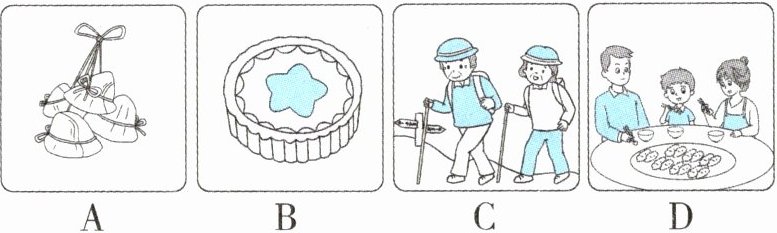
(
C
)1. The Double
Ninth
Festival
is a festival for old people. People often climb mountains
.(
D
)2. In China, people get
together
at the Spring
Festival
. Some people eat jiaozi.(
A
)3. People eat rice dumplings at the Dragon
Boat
Festival
. It's my favourite
festival.(
B
)4. People eat moon cakes and fruit at the Mid-Autumn
Festival
.答案:1. C Double Ninth Festival; mountains
2. D get together; Spring Festival
3. A Dragon Boat Festival; favourite
4. B Mid-Autumn Festival
2. D get together; Spring Festival
3. A Dragon Boat Festival; favourite
4. B Mid-Autumn Festival
解析:
【分析】
我们可以按照两步思路解题:第一步先读懂每个句子的描述,结合中国传统节日的习俗常识,判断对应的节日,同时结合给出的首字母提示补全空缺的单词;第二步将补全后的句子含义和四张图片的内容逐一匹配,选出对应图片。首先回忆常见传统节日的特征:敬老、登高是重阳节的习俗;阖家团聚、吃饺子是春节的习俗;吃粽子是端午节的习俗;吃月饼是中秋节的习俗,再对应图片内容就能顺利完成作答。
【解析】
1. 该句描述的是面向老人、有登高习俗的节日,对应重阳节,英文为Double Ninth Festival,“爬山”的固定表达为climb mountains;图片C呈现两位老年夫妇拄着手杖登山出行的场景,完全符合该句语境,因此选C。
2. 该句提到人们相聚、吃饺子,结合首字母g、t提示,固定搭配get together表示“团聚”,对应节日是春节Spring Festival;图片D呈现一家三口围坐餐桌吃饺子聚餐的场景,符合语境,因此选D。
3. 该句提到人们吃粽子,对应节日是端午节Dragon Boat Festival,结合首字母f提示,favourite表示“最喜欢的”;图片A呈现成串的粽子,符合语境,因此选A。
4. 该句提到人们吃月饼和水果,对应节日是中秋节Mid-Autumn Festival;图片B呈现月饼的图案,符合语境,因此选B。
【答案】
1. C; Double Ninth Festival; mountains
2. D; get together; Spring Festival
3. A; Dragon Boat Festival; favourite
4. B; Mid-Autumn Festival
【知识点】
传统节日英文,习俗匹配,首字母填空
【点评】
本题将英语词汇考察和中国传统文化常识结合,既考查学生对核心节日相关英语表达的掌握,也引导学生了解传统节日的特色习俗,题型生动有趣,符合小学英语文化类题目的考察要求。
【难度系数】
0.7
我们可以按照两步思路解题:第一步先读懂每个句子的描述,结合中国传统节日的习俗常识,判断对应的节日,同时结合给出的首字母提示补全空缺的单词;第二步将补全后的句子含义和四张图片的内容逐一匹配,选出对应图片。首先回忆常见传统节日的特征:敬老、登高是重阳节的习俗;阖家团聚、吃饺子是春节的习俗;吃粽子是端午节的习俗;吃月饼是中秋节的习俗,再对应图片内容就能顺利完成作答。
【解析】
1. 该句描述的是面向老人、有登高习俗的节日,对应重阳节,英文为Double Ninth Festival,“爬山”的固定表达为climb mountains;图片C呈现两位老年夫妇拄着手杖登山出行的场景,完全符合该句语境,因此选C。
2. 该句提到人们相聚、吃饺子,结合首字母g、t提示,固定搭配get together表示“团聚”,对应节日是春节Spring Festival;图片D呈现一家三口围坐餐桌吃饺子聚餐的场景,符合语境,因此选D。
3. 该句提到人们吃粽子,对应节日是端午节Dragon Boat Festival,结合首字母f提示,favourite表示“最喜欢的”;图片A呈现成串的粽子,符合语境,因此选A。
4. 该句提到人们吃月饼和水果,对应节日是中秋节Mid-Autumn Festival;图片B呈现月饼的图案,符合语境,因此选B。
【答案】
1. C; Double Ninth Festival; mountains
2. D; get together; Spring Festival
3. A; Dragon Boat Festival; favourite
4. B; Mid-Autumn Festival
【知识点】
传统节日英文,习俗匹配,首字母填空
【点评】
本题将英语词汇考察和中国传统文化常识结合,既考查学生对核心节日相关英语表达的掌握,也引导学生了解传统节日的特色习俗,题型生动有趣,符合小学英语文化类题目的考察要求。
【难度系数】
0.7
四、传统文化从方框中选择合适的句子补全对话。
Tom:Liu Tao,what are you doing?
Liu Tao:1.
Tom:What's it about?
Liu Tao:It's about a famous Chinese poet,Qu Yuan. 2.
Tom:Tell me more about this festival,please!
Liu Tao:OK. It's more than 2,000 years old. And it's on the 5th day of the fifth month in the Chinese lunar calendar.
Tom:3.
Liu Tao:People usually eat rice dumplings,watch or take part in dragon boat races and put Chinese mugwort on the front door.
Tom:4.
Liu Tao:We'll make rice dumplings at home. 5.
Tom:Of course!
A. That sounds interesting!
B. The Dragon Boat Festival is coming soon.
C. I'm preparing a traditional Chinese play.
D. Would you like to come?
E. What do people usually do on that day?
Tom:Liu Tao,what are you doing?
Liu Tao:1.
C
Tom:What's it about?
Liu Tao:It's about a famous Chinese poet,Qu Yuan. 2.
B
It's an important festival in China.Tom:Tell me more about this festival,please!
Liu Tao:OK. It's more than 2,000 years old. And it's on the 5th day of the fifth month in the Chinese lunar calendar.
Tom:3.
E
Liu Tao:People usually eat rice dumplings,watch or take part in dragon boat races and put Chinese mugwort on the front door.
Tom:4.
A
Liu Tao:We'll make rice dumplings at home. 5.
D
Tom:Of course!
A. That sounds interesting!
B. The Dragon Boat Festival is coming soon.
C. I'm preparing a traditional Chinese play.
D. Would you like to come?
E. What do people usually do on that day?
答案:1. C 2. B 3. E 4. A 5. D
解析:
【分析】
这是一道结合中国传统文化的情景补全对话题,解题时先通读完整对话和所有备选句子,顺着上下文的逻辑关联逐一匹配:首先第一空前面是现在进行时的特殊疑问句,询问正在做什么,直接找对应回答正在进行的动作的选项即可;第二空前后分别提到诗人屈原和中国重要节日,需要找能衔接屈原和对应纪念节日的过渡句;第三空后面的答句全部是节日当天的民俗活动,说明空处是询问节日活动的特殊疑问句;第四空是听完习俗介绍后的评价类回应;第五空后面答句是“当然愿意”,说明空处是发出邀请的问句,顺着这个思路就能快速选出正确答案。
【解析】
1. 第一空:Tom用现在进行时询问Liu Tao正在做什么,C选项“我正在准备一个中国传统戏剧”是对当下正在做的事的直接回应,完全匹配问句,选C。
2. 第二空:前文提到纪念屈原,后文引出中国重要节日,B选项“端午节很快就要到了”,端午节正是纪念屈原的传统节日,完美衔接前后内容,选B。
3. 第三空:后文Liu Tao介绍了吃粽子、赛龙舟、挂艾草的各类节日活动,E选项“人们在那天通常做什么?”正好是对应答句内容的提问,选E。
4. 第四空:Tom听完丰富有趣的端午习俗后,A选项“那听起来很有意思!”是符合语境的夸赞类回应,选A。
5. 第五空:后文Tom回答“当然愿意”,D选项“你想要来吗?”是发出邀请的问句,和答句完全匹配,选D。
【答案】1. C 2. B 3. E 4. A 5. D
【知识点】情景交际,传统节日常识,特殊疑问句问答
【点评】本题把英语对话能力考察和中国传统文化端午节的知识结合起来,既检验了学生日常英语对话的逻辑匹配能力,也渗透了传统文化常识,解题核心是抓住问答呼应的逻辑,结合上下文的内容关联就能快速选出正确选项。
【难度系数】0.8
这是一道结合中国传统文化的情景补全对话题,解题时先通读完整对话和所有备选句子,顺着上下文的逻辑关联逐一匹配:首先第一空前面是现在进行时的特殊疑问句,询问正在做什么,直接找对应回答正在进行的动作的选项即可;第二空前后分别提到诗人屈原和中国重要节日,需要找能衔接屈原和对应纪念节日的过渡句;第三空后面的答句全部是节日当天的民俗活动,说明空处是询问节日活动的特殊疑问句;第四空是听完习俗介绍后的评价类回应;第五空后面答句是“当然愿意”,说明空处是发出邀请的问句,顺着这个思路就能快速选出正确答案。
【解析】
1. 第一空:Tom用现在进行时询问Liu Tao正在做什么,C选项“我正在准备一个中国传统戏剧”是对当下正在做的事的直接回应,完全匹配问句,选C。
2. 第二空:前文提到纪念屈原,后文引出中国重要节日,B选项“端午节很快就要到了”,端午节正是纪念屈原的传统节日,完美衔接前后内容,选B。
3. 第三空:后文Liu Tao介绍了吃粽子、赛龙舟、挂艾草的各类节日活动,E选项“人们在那天通常做什么?”正好是对应答句内容的提问,选E。
4. 第四空:Tom听完丰富有趣的端午习俗后,A选项“那听起来很有意思!”是符合语境的夸赞类回应,选A。
5. 第五空:后文Tom回答“当然愿意”,D选项“你想要来吗?”是发出邀请的问句,和答句完全匹配,选D。
【答案】1. C 2. B 3. E 4. A 5. D
【知识点】情景交际,传统节日常识,特殊疑问句问答
【点评】本题把英语对话能力考察和中国传统文化端午节的知识结合起来,既检验了学生日常英语对话的逻辑匹配能力,也渗透了传统文化常识,解题核心是抓住问答呼应的逻辑,结合上下文的内容关联就能快速选出正确选项。
【难度系数】0.8