听第一段对话,回答第 11~12 小题。
11. What are the speakers talking about?
A. A big hot - air balloon.
B. A colourful kite.
C. A Kongming lantern.
12. What does Peter think of making it?
A. Very easy.
B. Very difficult.
C. Really interesting.
11. What are the speakers talking about?
A. A big hot - air balloon.
B. A colourful kite.
C. A Kongming lantern.
12. What does Peter think of making it?
A. Very easy.
B. Very difficult.
C. Really interesting.
答案:11.C 12.A
听第二段独白,完成信息记录表第 13~15 小题。
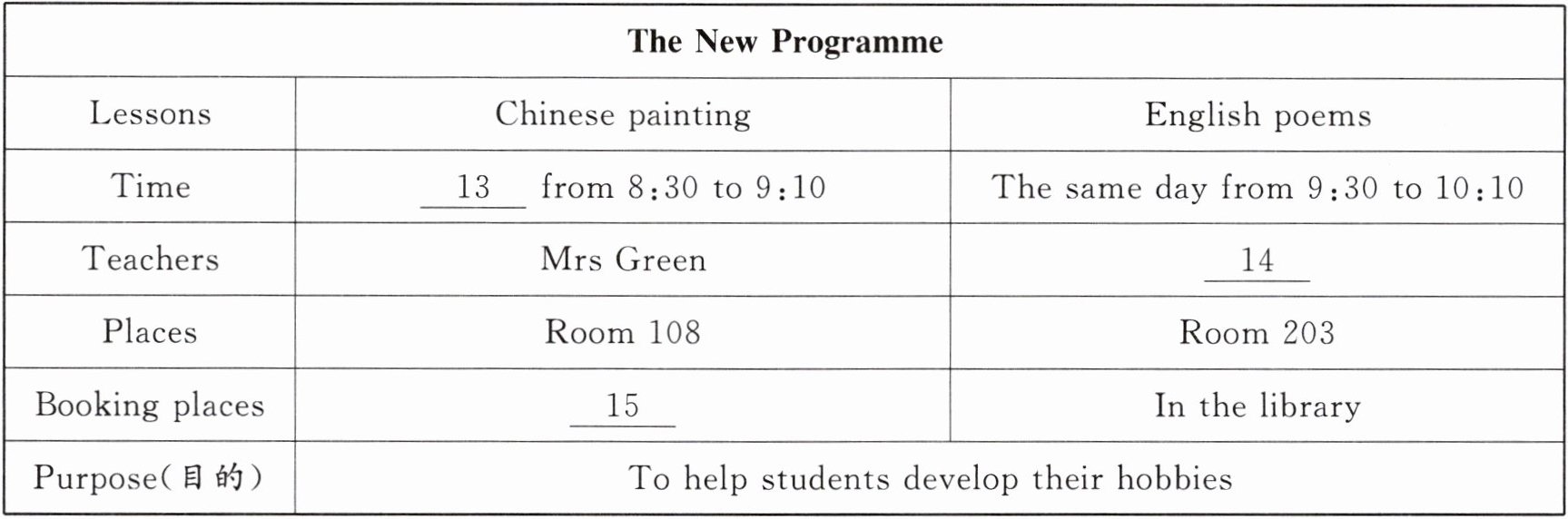
13. A. Every Thursday afternoon
B. Every Sunday evening
C. Every Saturday morning
14. A. Mr Green
B. Mr Black
C. Mrs White
15. A. In the meeting room
B. In the art room
C. In the hall
13. A. Every Thursday afternoon
B. Every Sunday evening
C. Every Saturday morning
14. A. Mr Green
B. Mr Black
C. Mrs White
15. A. In the meeting room
B. In the art room
C. In the hall
答案:13.C 14.B 15.C
听第三段独白,回答第 16~20 小题。
16. Where does Li Baofeng come from?
A. The southeast of China.
B. The northeast of China.
C. The east of China.
17. How does Li tell Chinese story?
A. By paper.
B. By paper - cutting.
C. By drawing.
18. What are Li's works rich in?
A. Shape.
B. Size.
C. Colour.
19. What are most of Li's works about?
A. Chinese traditional culture.
B. Beautiful seas.
C. Tall buildings.
20. Which work tells stories of red lanterns and traditional dresses?
A. Silk Road.
B. Dunhuang.
C. Chinese Red.
16. Where does Li Baofeng come from?
A. The southeast of China.
B. The northeast of China.
C. The east of China.
17. How does Li tell Chinese story?
A. By paper.
B. By paper - cutting.
C. By drawing.
18. What are Li's works rich in?
A. Shape.
B. Size.
C. Colour.
19. What are most of Li's works about?
A. Chinese traditional culture.
B. Beautiful seas.
C. Tall buildings.
20. Which work tells stories of red lanterns and traditional dresses?
A. Silk Road.
B. Dunhuang.
C. Chinese Red.
答案:16.B 17.B 18.C 19.A 20.C