Ⅰ. 单项选择(每小题 1 分,满分 10 分)
1. We should do our
A. everyday; every day
B. every day; every day
C. every day; everyday
D. everyday; everyday
1. We should do our
everyday
homework carefully. That's what my mother tells me every day
.A. everyday; every day
B. every day; every day
C. every day; everyday
D. everyday; everyday
答案:1. A 解析:“everyday”为形容词,修饰“homework”(日常作业);“every day”为副词短语,作时间状语(每天),故选 A。
易错提醒 形容词 everyday(日常的)后接名词,副词短语 every day(每天)作状语,修饰整个句子。
易错提醒 形容词 everyday(日常的)后接名词,副词短语 every day(每天)作状语,修饰整个句子。
2. We should not reach for what is beyond our reach. What we need to do is improving our
A.short
B.basic
C.serious
D.excellent
basic
skills first.A.short
B.basic
C.serious
D.excellent
答案:2. B 解析:A“short”意为“短的”;B“basic”意为“基础的”;C“serious”意为“严肃的”;D“excellent”意为“优秀的”。根据“improving our... skills first”(首先提高……技能),可知选 B。
3. Chinese Women's Volleyball Team won the gold medal. Their
A.sign
B.interest
C.pressure
D.spirit
spirit
of never giving up cheered everyone.A.sign
B.interest
C.pressure
D.spirit
答案:3. D 解析:A“sign”意为“标志”;B“interest”意为“兴趣”;C“pressure”意为“压力”;D“spirit”意为“精神”。根据“never giving up”(永不放弃),可知选 D。
4. —That's all for today. Do you have anything to
A.fill
B.make
C.add
D.mix
add
? —Nothing more. We all agreed with what you said.A.fill
B.make
C.add
D.mix
答案:4. C 解析:A“fill”意为“填满”;B“make”意为“制作”;C“add”意为“补充”;D“mix”意为“混合”。根据“anything to...”(有什么要……的吗),可知选 C。
5. —What are they busy doing over there? They should have a rest now. —They are
A.getting on
B.working on
C.knocking on
D.taking on
working on
a new project. They need to make the final plan as soon as possible.A.getting on
B.working on
C.knocking on
D.taking on
答案:5. B 解析:A“getting on”意为“上车”;B“working on”意为“从事”;C“knocking on”意为“敲门”;D“taking on”意为“承担”。根据“a new project”(新项目),可知选 B。
6. Which word can we put in the vocabulary tree on the right?
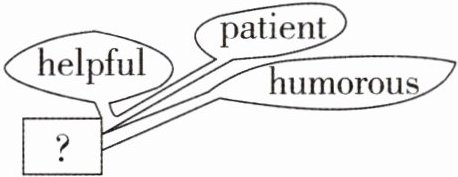
A.jobs
B.qualities
C.looks
D.feelings
A.jobs
B.qualities
C.looks
D.feelings
答案:6. B 解析:“patient”(有耐心的)、“helpful”(有帮助的)、“humorous”(幽默的)均属于人的品质,“qualities”意为“品质”,故选 B。
7. —Let's run to the bus station
A.slowly
B.largely
C.easily
D.quickly
quickly
, or we may miss the early bus. —You're right. We have little time. Let's hurry.A.slowly
B.largely
C.easily
D.quickly
答案:7. D 解析:A“slowly”意为“慢慢地”;B“largely”意为“主要地”;C“easily”意为“容易地”;D“quickly”意为“快速地”。根据“or we may miss the early bus”(否则会错过早班车),可知选 D。
8. The kite is made
A.of; from
B.from; by
C.of; by
D.from; from
of
silk and made by
hand. So it's very expensive.A.of; from
B.from; by
C.of; by
D.from; from
答案:8. C 解析:“be made of”表示“由……制成”,成品能看出原材料(丝绸做的风筝能看出原材料);“be made by hand”意为“手工制作”,固定搭配,故选 C。
9. (2024·淮安)—Oh! I forgot to bring
A.I
B.me
C.my
D.mine
my
ruler. —Don't worry. I can share mine with you.A.I
B.me
C.my
D.mine
答案:9. C 解析:此处用形容词性物主代词“my”修饰“ruler”(我的尺子),故选 C。
10. Please read the sentence: Mr Li owns a three - bedroom flat. If we want to show that Mr Li doesn't rent(租)the flat from others, which part should we stress?
A.Mr Li owns a three - bedroom flat.
B.Mr Li owns a three - bedroom flat.
C.Mr Li owns a three - bedroom flat.
D.Mr Li owns a three - bedroom flat.
A.Mr Li owns a three - bedroom flat.
B.Mr Li owns a three - bedroom flat.
C.Mr Li owns a three - bedroom flat.
D.Mr Li owns a three - bedroom flat.
答案:10. B 解析:要强调“李先生拥有这套公寓,不是租的”,需重读动词“owns”(拥有),故选 B。
Ⅱ. 完形填空(每小题 1 分,满分 15 分)
When I first started learning Chinese, everything seemed new and different. The Chinese words looked like little pictures, and I couldn't 1 any. But my teacher, Mr Li, made it 2 for me. He used colourful flashcards and taught us simple words like “ni hao” and “xie xie”.
We also played 3 in class to remember the words. One of my favourite games was “Simon Says”. Mr Li would say something, and we had to follow his 4. But we needed to move only 5 he started with “Simon says”. It was so much fun!
6, I started recognizing(辨别出)more and more Chinese words. Mr Li taught us how to count 7, from one to ten, and we also learned some animals' names. Saying “mao mao” for “cat” and “gou gou” for “dog” always made me 8. I thought they sounded cute and fun.
One day, Mr Li organized a field trip to Chinatown. It was like stepping into a different world! The streets were 9 colourful signs and delicious smells. We got to try some traditional Chinese food, like noodles. I even practised 10 food in Chinese. It felt amazing to use the words I had learned.
As time went by, my understanding of Chinese improved. I was 11 to have simple conversations with my Chinese friends at school. They were happy about my 12 and we started exchanging words in both English and Chinese. It was like having a secret language 13 us.
Learning Chinese has opened up a whole new world for me. I can now read simple stories and understand Chinese culture 14. It's been a fun journey, and I can't wait to continue 15 and discovering more about this beautiful language. And through the language, I'm able to get a glimpse of Chinese culture.
1. A. buy
B. celebrate
C. see
D. understand
2. A. easy
B. hard
C. exciting
D. useful
3. A. cards
B. games
C. songs
D. sports
4. A. rules
B. ways
C. movements
D. advice
5. A. before
B. since
C. when
D. because
6. A. Slowly
B. Lastly
C. Suddenly
D. Mainly
7. A. numbers
B. money
C. times
D. languages
8. A. dance
B. laugh
C. cry
D. think
9. A. afraid of
B. full of
C. proud of
D. tired of
10. A. growing
B. naming
C. ordering
D. cooking
11. A. creative
B. able
C. unable
D. brave
12. A. teacher
B. story
C. grade
D. improvement
13. A. between
B. with
C. as
D. like
14. A. better
B. louder
C. earlier
D. longer
15. A. travelling
B. learning
C. wondering
D. rushing
When I first started learning Chinese, everything seemed new and different. The Chinese words looked like little pictures, and I couldn't 1 any. But my teacher, Mr Li, made it 2 for me. He used colourful flashcards and taught us simple words like “ni hao” and “xie xie”.
We also played 3 in class to remember the words. One of my favourite games was “Simon Says”. Mr Li would say something, and we had to follow his 4. But we needed to move only 5 he started with “Simon says”. It was so much fun!
6, I started recognizing(辨别出)more and more Chinese words. Mr Li taught us how to count 7, from one to ten, and we also learned some animals' names. Saying “mao mao” for “cat” and “gou gou” for “dog” always made me 8. I thought they sounded cute and fun.
One day, Mr Li organized a field trip to Chinatown. It was like stepping into a different world! The streets were 9 colourful signs and delicious smells. We got to try some traditional Chinese food, like noodles. I even practised 10 food in Chinese. It felt amazing to use the words I had learned.
As time went by, my understanding of Chinese improved. I was 11 to have simple conversations with my Chinese friends at school. They were happy about my 12 and we started exchanging words in both English and Chinese. It was like having a secret language 13 us.
Learning Chinese has opened up a whole new world for me. I can now read simple stories and understand Chinese culture 14. It's been a fun journey, and I can't wait to continue 15 and discovering more about this beautiful language. And through the language, I'm able to get a glimpse of Chinese culture.
1. A. buy
B. celebrate
C. see
D. understand
2. A. easy
B. hard
C. exciting
D. useful
3. A. cards
B. games
C. songs
D. sports
4. A. rules
B. ways
C. movements
D. advice
5. A. before
B. since
C. when
D. because
6. A. Slowly
B. Lastly
C. Suddenly
D. Mainly
7. A. numbers
B. money
C. times
D. languages
8. A. dance
B. laugh
C. cry
D. think
9. A. afraid of
B. full of
C. proud of
D. tired of
10. A. growing
B. naming
C. ordering
D. cooking
11. A. creative
B. able
C. unable
D. brave
12. A. teacher
B. story
C. grade
D. improvement
13. A. between
B. with
C. as
D. like
14. A. better
B. louder
C. earlier
D. longer
15. A. travelling
B. learning
C. wondering
D. rushing
答案:Ⅱ. 1.D 2.A 3.B 4.C 5.C 6.A 7.A 8.B 9.B 10.C 11.B 12.D 13.A 14.A 15.B
【语篇解读】本文是一篇记叙文,主要讲述了作者学习汉语的经历。
1. D 解析:根据“The Chinese words looked like little pictures”可知,应表达“我”不能理解。故选 D。
2. A 解析:根据“He used colourful flashcards and taught us simple words like ‘ni hao’ and ‘xie xie’.”可知,李老师尽可能地让学中文变得很容易。故选 A。
3. B 解析:根据“One of my favourite games”可知,是玩游戏。故选 B。
4. C 解析:根据“But we needed to move”可知,“我们”需要跟着他的动作。故选 C。
5. C 解析:根据“But we needed to move only... he started with ‘Simon says’.”可知,应表达当他说“西蒙说”时“我们”才需要动。故选 C。
6. A 解析:根据“I started recognizing more and more Chinese words”可知,作者从什么都不懂到慢慢地认识越来越多的词。故选 A。
7. A 解析:根据“from one to ten”可知,作者学习数数字。故选 A。
8. B 解析:根据“I thought they sounded cute and fun.”可知,应该是这样说会让“我”笑。故选 B。
9. B 解析:be afraid of 害怕;be full of 充满;be proud of 为……自豪;be tired of 厌烦。根据“colourful signs and delicious smells”可知,应表达街道上充满了五颜六色的标志和香味。故选 B。
10. C 解析:根据“It felt amazing to use the words I had learned.”可知,是用中文点餐。故选 C。
11. B 解析:根据“my understanding of Chinese improved”可知作者中文进步了,故能够进行简单的对话了。故选 B。
12. D 解析:根据“my understanding of Chinese improved”可知,是对“我”的进步感到高兴。故选 D。
13. A 解析:根据“we started exchanging words in both English and Chinese”可知,作者和朋友用英语和中文交流,这好似在他们之间有一种秘密的语言。故选 A。
14. A 解析:根据“I can now read simple stories”可知,阅读故事能帮助作者更好地了解中国文化。故选 A。
15. B 解析:根据“It’s been a fun journey, and I can’t wait to continue... and discovering more about this beautiful language.”可知,作者想要继续学习。故选 B。
【语篇解读】本文是一篇记叙文,主要讲述了作者学习汉语的经历。
1. D 解析:根据“The Chinese words looked like little pictures”可知,应表达“我”不能理解。故选 D。
2. A 解析:根据“He used colourful flashcards and taught us simple words like ‘ni hao’ and ‘xie xie’.”可知,李老师尽可能地让学中文变得很容易。故选 A。
3. B 解析:根据“One of my favourite games”可知,是玩游戏。故选 B。
4. C 解析:根据“But we needed to move”可知,“我们”需要跟着他的动作。故选 C。
5. C 解析:根据“But we needed to move only... he started with ‘Simon says’.”可知,应表达当他说“西蒙说”时“我们”才需要动。故选 C。
6. A 解析:根据“I started recognizing more and more Chinese words”可知,作者从什么都不懂到慢慢地认识越来越多的词。故选 A。
7. A 解析:根据“from one to ten”可知,作者学习数数字。故选 A。
8. B 解析:根据“I thought they sounded cute and fun.”可知,应该是这样说会让“我”笑。故选 B。
9. B 解析:be afraid of 害怕;be full of 充满;be proud of 为……自豪;be tired of 厌烦。根据“colourful signs and delicious smells”可知,应表达街道上充满了五颜六色的标志和香味。故选 B。
10. C 解析:根据“It felt amazing to use the words I had learned.”可知,是用中文点餐。故选 C。
11. B 解析:根据“my understanding of Chinese improved”可知作者中文进步了,故能够进行简单的对话了。故选 B。
12. D 解析:根据“my understanding of Chinese improved”可知,是对“我”的进步感到高兴。故选 D。
13. A 解析:根据“we started exchanging words in both English and Chinese”可知,作者和朋友用英语和中文交流,这好似在他们之间有一种秘密的语言。故选 A。
14. A 解析:根据“I can now read simple stories”可知,阅读故事能帮助作者更好地了解中国文化。故选 A。
15. B 解析:根据“It’s been a fun journey, and I can’t wait to continue... and discovering more about this beautiful language.”可知,作者想要继续学习。故选 B。