Ⅶ. 首字母填空(每小题 1 分,满分 10 分)
根据短文内容及首字母提示,在横线上填入一个适当的词使短文完整。
The art of blowing sugar is an important part of the intangible cultural heritage. It has a long h 1 of more than 600 years. Xiong Chuanfa has been working on blowing sugar figurines(糖人)for more than twenty years. He said it looks easy, b 2 it's very difficult to master the skill. Do you know how to make sugar figurines? Here are three steps.
F 3, the artist heats(加热)the syrup to a certain temperature of 140℃. Next, he pulls off a small piece, m 4 it into a ball with an open centre, then presses(按压)the open area together and stretches(拉伸)it to form a tube(管子). Finally, he blows air into the tube and makes it into different s 5.
Every morning, Xiong gets up early to prepare the molten syrup and drives to start his “m 6 show” around his city. Many people show i 7 in it, especially kids. When he blows a cute dog out of molten maltose(熔化的麦芽糖)in just minutes, kids look carefully at him excitedly, thinking he is a magician.
He hopes this special a 8 can let people feel its beauty. He also hopes to help them learn more about the Chinese c 9. Xiong said, “Sugar paintings and sugar figurines are childhood memories of several generations of Chinese people. We try to make paper - cutting skills and modern elements(元素)together with sugar figurines.” He also said, “I will keep working and s 10 the rest of my life helping pass on this cultural heritage.”
1.
2.
3.
4.
5.
6.
7.
8.
9.
10.
根据短文内容及首字母提示,在横线上填入一个适当的词使短文完整。
The art of blowing sugar is an important part of the intangible cultural heritage. It has a long h 1 of more than 600 years. Xiong Chuanfa has been working on blowing sugar figurines(糖人)for more than twenty years. He said it looks easy, b 2 it's very difficult to master the skill. Do you know how to make sugar figurines? Here are three steps.
F 3, the artist heats(加热)the syrup to a certain temperature of 140℃. Next, he pulls off a small piece, m 4 it into a ball with an open centre, then presses(按压)the open area together and stretches(拉伸)it to form a tube(管子). Finally, he blows air into the tube and makes it into different s 5.
Every morning, Xiong gets up early to prepare the molten syrup and drives to start his “m 6 show” around his city. Many people show i 7 in it, especially kids. When he blows a cute dog out of molten maltose(熔化的麦芽糖)in just minutes, kids look carefully at him excitedly, thinking he is a magician.
He hopes this special a 8 can let people feel its beauty. He also hopes to help them learn more about the Chinese c 9. Xiong said, “Sugar paintings and sugar figurines are childhood memories of several generations of Chinese people. We try to make paper - cutting skills and modern elements(元素)together with sugar figurines.” He also said, “I will keep working and s 10 the rest of my life helping pass on this cultural heritage.”
1.
history
2.
but
3.
First
4.
makes
5.
shapes
6.
magic
7.
interest
8.
art
9.
culture
10.
spend
答案:1. history 解析:根据首字母“h”及“more than 600 years”(600 多年),可知为“history”(历史),“a long history”意为“悠久的历史”。
@@2. but 解析:根据首字母“b”及“looks easy”(看起来容易)和“very difficult”(非常难),表转折,用“but”。
@@3. First 解析:根据首字母“F”及后文“Next”“Finally”,可知为“First”(首先),句首首字母大写。
@@4. makes 解析:根据首字母“m”及“it into a ball”(把它做成球),可知为“makes”(制作),主语为“he”,用第三人称单数形式。
@@5. shapes 解析:根据首字母“s”及“make it into different”(做成不同的),可知为“shapes”(形状),复数形式。易错提醒 误写为 size(尺寸),未结合“吹糖人”的动作逻辑。
@@6. magic 解析:根据首字母“m”及“kids look carefully at him excitedly, thinking he is a magician”,可知为“magic”(魔术的),修饰“show”。
@@7. interest 解析:根据首字母“i”及“show... in it”,可知为“interest”(兴趣),“show interest in”意为“对……感兴趣”。
@@8. art 解析:根据首字母“a”及“The art of blowing sugar”,可知为“art”(艺术),指代吹糖人艺术。
@@9. culture 解析:根据首字母“c”及“learn more about the Chinese”(了解更多中国的),可知为“culture”(文化)。
@@10. spend 解析:根据首字母“s”及“the rest of my life helping pass on”(余生帮助传承),可知为“spend”(花费),“will”后接动词原形。
@@2. but 解析:根据首字母“b”及“looks easy”(看起来容易)和“very difficult”(非常难),表转折,用“but”。
@@3. First 解析:根据首字母“F”及后文“Next”“Finally”,可知为“First”(首先),句首首字母大写。
@@4. makes 解析:根据首字母“m”及“it into a ball”(把它做成球),可知为“makes”(制作),主语为“he”,用第三人称单数形式。
@@5. shapes 解析:根据首字母“s”及“make it into different”(做成不同的),可知为“shapes”(形状),复数形式。易错提醒 误写为 size(尺寸),未结合“吹糖人”的动作逻辑。
@@6. magic 解析:根据首字母“m”及“kids look carefully at him excitedly, thinking he is a magician”,可知为“magic”(魔术的),修饰“show”。
@@7. interest 解析:根据首字母“i”及“show... in it”,可知为“interest”(兴趣),“show interest in”意为“对……感兴趣”。
@@8. art 解析:根据首字母“a”及“The art of blowing sugar”,可知为“art”(艺术),指代吹糖人艺术。
@@9. culture 解析:根据首字母“c”及“learn more about the Chinese”(了解更多中国的),可知为“culture”(文化)。
@@10. spend 解析:根据首字母“s”及“the rest of my life helping pass on”(余生帮助传承),可知为“spend”(花费),“will”后接动词原形。
Ⅷ. 书面表达(满分 15 分)
假设你是李华,即将参加一项交换生活动并住在 John 家里,为表示友好和宣传中国文化,你提前寄送了三份具有中国传统特色的手工艺品作为礼物。请根据提示内容给 John 及其家人写一封电子邮件介绍一下这些礼物及其特色。
风筝 a kite
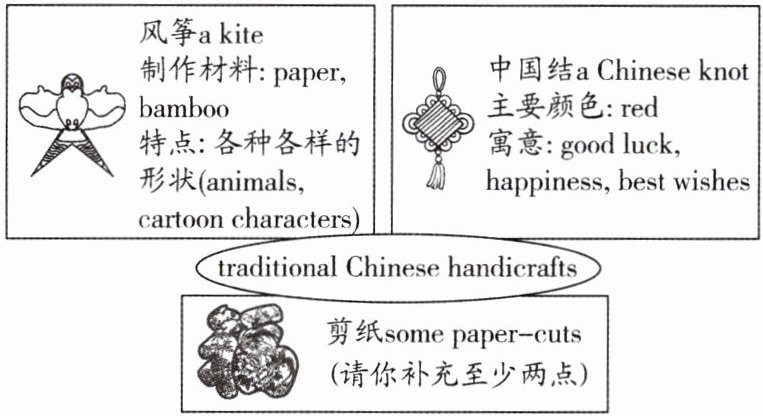
制作材料: paper, bamboo
特点: 各种各样的形状(animals, cartoon characters)
中国结 a Chinese knot
主要颜色: red
寓意: good luck, happiness, best wishes
剪纸 some paper - cuts(请你补充至少两点)
要求:1. 词数 100 左右,短文的开头和结尾已给出,不计入总词数;2. 要对所写内容进行适当的拓展。
Dear John and your family,
As an exchange student, I am very excited about staying with you. To show you my thanks and share Chinese culture with you, I have sent you three traditional Chinese handicrafts as gifts.
Best wishes,
Li Hua
假设你是李华,即将参加一项交换生活动并住在 John 家里,为表示友好和宣传中国文化,你提前寄送了三份具有中国传统特色的手工艺品作为礼物。请根据提示内容给 John 及其家人写一封电子邮件介绍一下这些礼物及其特色。
风筝 a kite
制作材料: paper, bamboo
特点: 各种各样的形状(animals, cartoon characters)
中国结 a Chinese knot
主要颜色: red
寓意: good luck, happiness, best wishes
剪纸 some paper - cuts(请你补充至少两点)
要求:1. 词数 100 左右,短文的开头和结尾已给出,不计入总词数;2. 要对所写内容进行适当的拓展。
Dear John and your family,
As an exchange student, I am very excited about staying with you. To show you my thanks and share Chinese culture with you, I have sent you three traditional Chinese handicrafts as gifts.
The first gift is a kite. It is made of paper and some pieces of bamboo. Kites have different kinds of shapes. Some are animals, and some others are cartoon characters. The second gift is a beautiful Chinese knot which is made of red ropes. It means good luck, happiness and best wishes. There are also some paper - cuts. Chinese paper - cutting has a long history of over 1,500 years. The paper - cuts have different shapes, like animals, flowers and so on. People in China usually put them on doors and windows during the Spring Festival.
Best wishes,
Li Hua
答案:Ⅷ. One possible version:
Dear John and your family,
As an exchange student, I am very excited about staying with you. To show you my thanks and share Chinese culture with you, I have sent you three traditional Chinese handicrafts as gifts.
The first gift is a kite. It is made of paper and some pieces of bamboo. Kites have different kinds of shapes. Some are animals, and some others are cartoon characters. The second gift is a beautiful Chinese knot which is made of red ropes. It means good luck, happiness and best wishes. There are also some paper - cuts. Chinese paper - cutting has a long history of over 1,500 years. The paper - cuts have different shapes, like animals, flowers and so on. People in China usually put them on doors and windows during the Spring Festival.
I hope you will like these beautiful handicrafts. I am looking forward to meeting you soon.
Best wishes,
Li Hua
思路梳理 总体分析:①题材:本文是一封邮件;②时态:时态主要为“一般现在时”;③提示:写作要点围绕三样手工艺品(风筝、中国结、剪纸)展开,需介绍每样工艺品的材料、特点、颜色、寓意等内容,要适当拓展,展现出对中国传统文化的介绍以及对约翰一家的友好之情。
写作步骤:第一步,承接给出的开头,另起一段;第二步,详细介绍送给约翰及其家人的三个手工艺品,包括手工艺品的材料和寓意等;第三步,希望约翰及其家人喜欢这三个手工艺品,并期待相见。
Dear John and your family,
As an exchange student, I am very excited about staying with you. To show you my thanks and share Chinese culture with you, I have sent you three traditional Chinese handicrafts as gifts.
The first gift is a kite. It is made of paper and some pieces of bamboo. Kites have different kinds of shapes. Some are animals, and some others are cartoon characters. The second gift is a beautiful Chinese knot which is made of red ropes. It means good luck, happiness and best wishes. There are also some paper - cuts. Chinese paper - cutting has a long history of over 1,500 years. The paper - cuts have different shapes, like animals, flowers and so on. People in China usually put them on doors and windows during the Spring Festival.
I hope you will like these beautiful handicrafts. I am looking forward to meeting you soon.
Best wishes,
Li Hua
思路梳理 总体分析:①题材:本文是一封邮件;②时态:时态主要为“一般现在时”;③提示:写作要点围绕三样手工艺品(风筝、中国结、剪纸)展开,需介绍每样工艺品的材料、特点、颜色、寓意等内容,要适当拓展,展现出对中国传统文化的介绍以及对约翰一家的友好之情。
写作步骤:第一步,承接给出的开头,另起一段;第二步,详细介绍送给约翰及其家人的三个手工艺品,包括手工艺品的材料和寓意等;第三步,希望约翰及其家人喜欢这三个手工艺品,并期待相见。