Ⅰ. 攀登高峰 首先,Amy 介绍了一座比珠穆朗玛峰更神秘的高峰。是什么呢?我们一起来揭开它神秘的面纱吧。
K2 Mountain is also called Mount Chogori. It sits on the border(边界) between China and Pakistan. It is about 8,611 metres high and is the world's 1. (two) highest mountain after Mount Qomolangma(about 8,848 metres). But it is harder 2. (climb) K2 Mountain than to climb Mount Qomolangma. K2 is the hardest mountain as well as the most dangerous mountain on the earth to climb.
July to September is the best time to climb K2 because the good weather 3. (last) for a longer time. Also,the temperatures during these months are higher 4. those in other months. To climb the mountain,climbers usually reach the base(营地) 5. the river water level is not too high.
In the early 20th century,many teams tried to reach the top of K2,but all of 6. (they) failed. It was not until 1954 that 7. Italian team reached the top successfully. Achille Compagnoni and Lino Lacedelli were the first two team members to make it. The other members included five 8. (science),a doctor,a photographer,and ten other people.
Now the most popular route(路线)on K2 is still the same route that the Italian team 9. ______ (use) in 1954. Over 75% of the climbers take this route. The route 10. ______ (begin) at around 5,394 metres high.
K2 Mountain is also called Mount Chogori. It sits on the border(边界) between China and Pakistan. It is about 8,611 metres high and is the world's 1. (two) highest mountain after Mount Qomolangma(about 8,848 metres). But it is harder 2. (climb) K2 Mountain than to climb Mount Qomolangma. K2 is the hardest mountain as well as the most dangerous mountain on the earth to climb.
July to September is the best time to climb K2 because the good weather 3. (last) for a longer time. Also,the temperatures during these months are higher 4. those in other months. To climb the mountain,climbers usually reach the base(营地) 5. the river water level is not too high.
In the early 20th century,many teams tried to reach the top of K2,but all of 6. (they) failed. It was not until 1954 that 7. Italian team reached the top successfully. Achille Compagnoni and Lino Lacedelli were the first two team members to make it. The other members included five 8. (science),a doctor,a photographer,and ten other people.
Now the most popular route(路线)on K2 is still the same route that the Italian team 9. ______ (use) in 1954. Over 75% of the climbers take this route. The route 10. ______ (begin) at around 5,394 metres high.
答案:Ⅰ.【语篇解读】本文是一篇说明文,主要介绍了乔戈里峰的地理位置、特征及其登山者。
1. second 解析:根据“the world's... highest mountain after Mount Qomolangma”(珠穆朗玛峰之后的第二高峰),用序数词“second”。
2. to climb 解析:“It's+形容词+to do sth”为固定结构,故填“to climb”。
3. lasts 解析:主语“the good weather”不可数,句子描述客观事实,用一般现在时,谓语动词用“lasts”。
4. than 解析:根据“higher”(比较级),用“than”表示比较。
5. when 解析:此处为时间状语从句,“当水位不高时”,用“when”。
6. them 解析:“of”为介词,后接宾格,“they”的宾格为“them”。
7. an 解析:“Italian”的发音以元音音素开头,“一个意大利团队”用“an Italian team”。
8. scientists 解析:“five”后接复数名词,“science”的名词“scientist”的复数为“scientists”。
9. used 解析:根据“in 1954”(1954年),用一般过去时,“use”的过去式为“used”。
10. begins 解析:主语“The route”为单数,句子描述客观事实,用一般现在时,谓语动词用“begins”。
1. second 解析:根据“the world's... highest mountain after Mount Qomolangma”(珠穆朗玛峰之后的第二高峰),用序数词“second”。
2. to climb 解析:“It's+形容词+to do sth”为固定结构,故填“to climb”。
3. lasts 解析:主语“the good weather”不可数,句子描述客观事实,用一般现在时,谓语动词用“lasts”。
4. than 解析:根据“higher”(比较级),用“than”表示比较。
5. when 解析:此处为时间状语从句,“当水位不高时”,用“when”。
6. them 解析:“of”为介词,后接宾格,“they”的宾格为“them”。
7. an 解析:“Italian”的发音以元音音素开头,“一个意大利团队”用“an Italian team”。
8. scientists 解析:“five”后接复数名词,“science”的名词“scientist”的复数为“scientists”。
9. used 解析:根据“in 1954”(1954年),用一般过去时,“use”的过去式为“used”。
10. begins 解析:主语“The route”为单数,句子描述客观事实,用一般现在时,谓语动词用“begins”。
Ⅱ. 沙漠变绿洲 塔克拉玛干沙漠,中国最大的沙漠,在中国人民的不懈努力下,环境越来越好。让我们一起见证沙漠变绿洲的奇迹吧!(每空一词)
The Taklimakan Desert,one of the largest deserts in the world,used to be a huge area full of sand. In the past,it was a vast sea of sand but almost no life lived there. The sand dunes(沙丘) were high,and the weather was extremely hot and dry. It seemed like a place where nothing could grow.
But things have changed greatly. Chinese scientists and workers decided to fight against the desert. They have been working hard to turn this desert green. They came up with many good ideas. First,they planted special plants. These plants have strong roots that can hold the sand and their leaves can stop the sand from moving.
To help the plants grow,people also built a smart water-giving system which is called "drip irrigation". It works like a tiny water drop falling onto the roots of plants slowly. This way,the plants get enough water without wasting it. The water-saving method is very important because water is so precious(宝贵的) in the desert.
Year after year,their hard work paid off. Now,large parts of the Taklimakan Desert are covered with green plants. There are rows of trees and areas of grass and even some small lakes have appeared. The green plants not only make the desert look beautiful but also stop the sandstorms. Some animals that left the desert before are coming back because they can find food and water here again.
The change is not only good for the environment but also for the people living around the desert. Local people can grow some fruits and vegetables in the green areas. Some have even started new businesses. For example,they offer camel rides in the green areas to tourists and show tourists around the "green desert". They also sell local handicrafts to the visitors. These bring more money to their families and make their lives better.
The story of the Taklimakan Desert shows that with hard work and good ideas,we can make a big difference to the environment.
新考法 思维导图
├─ Past
│ ├─ A large area of sand with
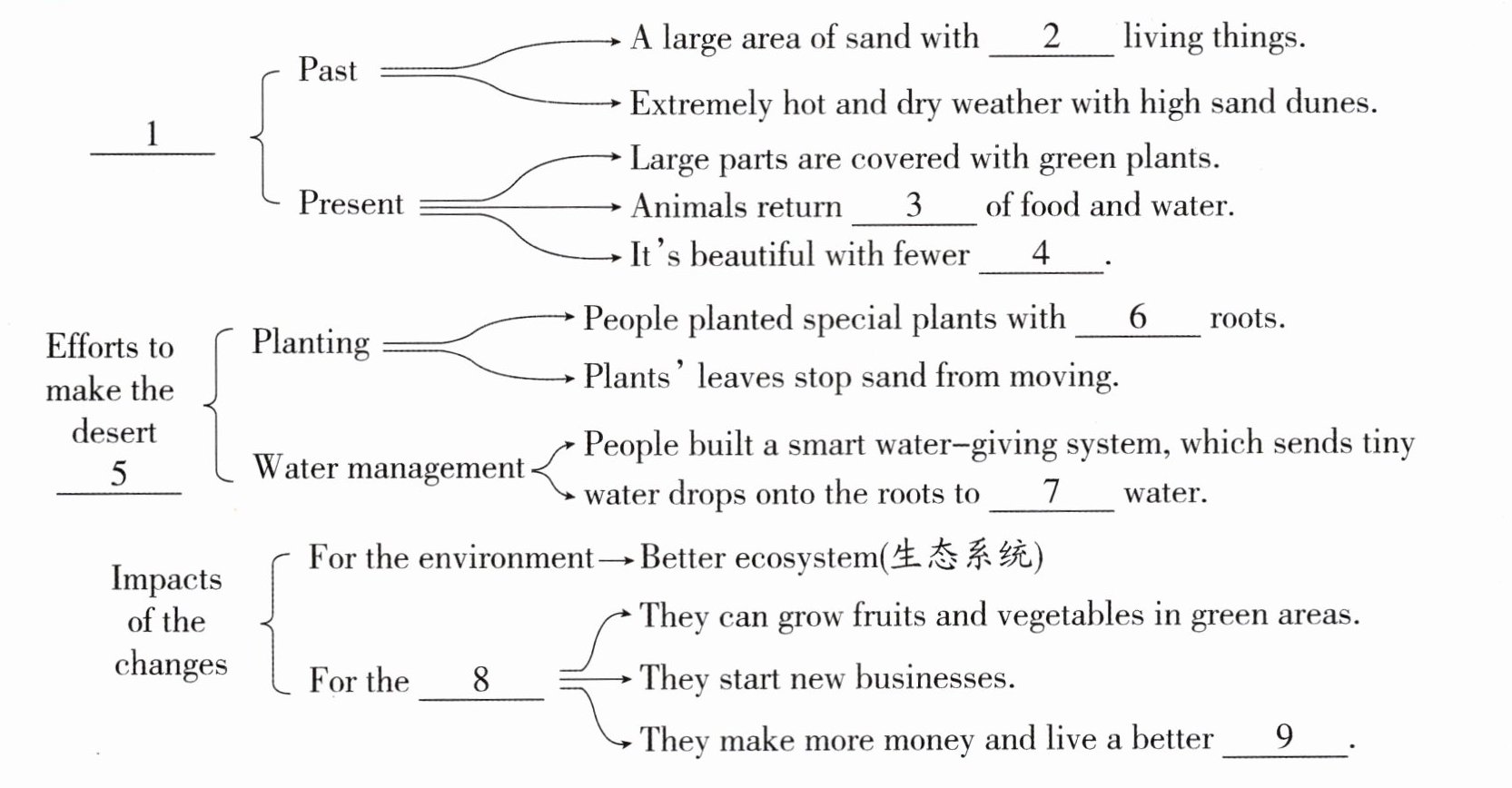
│ └─ Extremely hot and dry weather with high sand dunes.
└─ Present
├─ Large parts are covered with green plants.
├─ Animals return
└─ It's beautiful with fewer
Efforts to make the desert
├─ Planting
│ ├─ People planted special plants with
│ └─ Plants' leaves stop sand from moving.
└─ Water management
└─ People built a smart water-giving system, which sends tiny water drops onto the roots to
Impacts of the changes
├─ For the environment→Better ecosystem(生态系统)
└─ For the
├─ They can grow fruits and vegetables in green areas.
├─ They start new businesses.
└─ They make more money and live a better
Key message Hard work and good ideas can
The Taklimakan Desert,one of the largest deserts in the world,used to be a huge area full of sand. In the past,it was a vast sea of sand but almost no life lived there. The sand dunes(沙丘) were high,and the weather was extremely hot and dry. It seemed like a place where nothing could grow.
But things have changed greatly. Chinese scientists and workers decided to fight against the desert. They have been working hard to turn this desert green. They came up with many good ideas. First,they planted special plants. These plants have strong roots that can hold the sand and their leaves can stop the sand from moving.
To help the plants grow,people also built a smart water-giving system which is called "drip irrigation". It works like a tiny water drop falling onto the roots of plants slowly. This way,the plants get enough water without wasting it. The water-saving method is very important because water is so precious(宝贵的) in the desert.
Year after year,their hard work paid off. Now,large parts of the Taklimakan Desert are covered with green plants. There are rows of trees and areas of grass and even some small lakes have appeared. The green plants not only make the desert look beautiful but also stop the sandstorms. Some animals that left the desert before are coming back because they can find food and water here again.
The change is not only good for the environment but also for the people living around the desert. Local people can grow some fruits and vegetables in the green areas. Some have even started new businesses. For example,they offer camel rides in the green areas to tourists and show tourists around the "green desert". They also sell local handicrafts to the visitors. These bring more money to their families and make their lives better.
The story of the Taklimakan Desert shows that with hard work and good ideas,we can make a big difference to the environment.
新考法 思维导图
Conditions
1├─ Past
│ ├─ A large area of sand with
few
2 living things.│ └─ Extremely hot and dry weather with high sand dunes.
└─ Present
├─ Large parts are covered with green plants.
├─ Animals return
because
3 of food and water.└─ It's beautiful with fewer
sandstorms
4.Efforts to make the desert
green/better
5├─ Planting
│ ├─ People planted special plants with
strong
6 roots.│ └─ Plants' leaves stop sand from moving.
└─ Water management
└─ People built a smart water-giving system, which sends tiny water drops onto the roots to
save
7 water.Impacts of the changes
├─ For the environment→Better ecosystem(生态系统)
└─ For the
locals
8├─ They can grow fruits and vegetables in green areas.
├─ They start new businesses.
└─ They make more money and live a better
life
9.Key message Hard work and good ideas can
change/improve
10 the environment.答案: Ⅱ.【语篇解读】本文是一篇说明文,介绍了中国科学家和工人们如何通过努力和创新技术将塔克拉玛干沙漠从一片荒芜的沙地转变为绿洲,并改善了当地环境和居民生活。 1. Conditions 解析:导图第一部分左侧为“状况”,对应“Conditions”(首字母大写)。 2. few 解析:根据原文“almost no life lived there”(几乎没有生命),“few”表示“几乎没有”。 3. because 解析:根据原文“because they can find food and water here again”(因为能找到食物和水),用“because”。 4. sandstorms 解析:根据原文“stop the sandstorms”(阻止沙尘暴),可知“沙尘暴更少了”,用“sandstorms”。 5. green/better 解析:根据原文“turn this desert green”(使沙漠变绿),故填“green/better”。 6. strong 解析:根据原文“These plants have strong roots”(植物有强壮的根),用“strong”。 7. save 解析:根据原文“without wasting it”(不浪费水),即“节约用水”,用“save”。 8. locals 解析:根据原文“the people living around the desert”(当地居民),“locals”意为“当地人”。 9. life 解析:根据原文“make their lives better”(生活更好),“live a better life”为固定短语。 10. change/improve 解析:根据原文“we can make a big difference to the environment”(改变环境),“change/improve”符合语境。
解析: