()8.(2025·江苏连云港)The mini-programme “Clear Plate” is popular among young people. It
A.will design
B.will be designed
C.designs
D.is designed
D
to help deal with food waste.A.will design
B.will be designed
C.designs
D.is designed
答案:8. D 【点拨】“The mini - programme ‘Clear Plate’”是句子主语,与design之间是被动关系,且句子陈述的是客观事实,用一般现在时的被动语态。故选D。
解析:
翻译:
8.(2025·江苏连云港)“光盘”小程序在年轻人中很受欢迎。它是被设计来帮助处理食物浪费问题的。
A. 将设计
B. 将被设计
C. 设计
D. 被设计
8.(2025·江苏连云港)“光盘”小程序在年轻人中很受欢迎。它是被设计来帮助处理食物浪费问题的。
A. 将设计
B. 将被设计
C. 设计
D. 被设计
()9.What does the picture on the right mean?
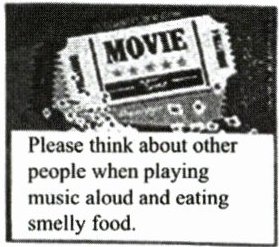
A.Playing music aloud or eating smelly food is not allowed in the cinema.
B.When playing music in a cinema,think about others’ favourite songs.
C.You can listen to music and eat smelly food in a cinema.
D.When you want to listen to music or eat smelly food in a cinema,others will help you.
A.Playing music aloud or eating smelly food is not allowed in the cinema.
B.When playing music in a cinema,think about others’ favourite songs.
C.You can listen to music and eat smelly food in a cinema.
D.When you want to listen to music or eat smelly food in a cinema,others will help you.
答案:9. A 【点拨】根据图片中“Please think about other people when playing music aloud and eating smelly food.”可知,电影院不允许大声播放音乐和吃有臭味的食物。故选A。
解析:
翻译:
9. 右边的图片是什么意思?
A. 电影院内不允许大声播放音乐或食用有异味的食物。
B. 在电影院播放音乐时,要考虑别人最喜欢的歌曲。
C. 你可以在电影院里听音乐和吃有异味的食物。
D. 当你想在电影院里听音乐或吃有异味的食物时,别人会帮助你。
9. 右边的图片是什么意思?
A. 电影院内不允许大声播放音乐或食用有异味的食物。
B. 在电影院播放音乐时,要考虑别人最喜欢的歌曲。
C. 你可以在电影院里听音乐和吃有异味的食物。
D. 当你想在电影院里听音乐或吃有异味的食物时,别人会帮助你。
()10.Amy:It’s nearly the end of the month and I haven’t started my report!
Betty:Better late than never. Hurry up!
What does Betty mean?
A.She will help Amy with the report.
B.Amy should start the report at once.
C.Amy had better give up on the report.
D.It’s too late for Amy to start the report.
Betty:Better late than never. Hurry up!
What does Betty mean?
A.She will help Amy with the report.
B.Amy should start the report at once.
C.Amy had better give up on the report.
D.It’s too late for Amy to start the report.
答案:10. B 【点拨】根据“Better late than never. Hurry up!”可知,是让埃米马上开始写报告。故选B。
解析:
翻译:
10. 埃米:这个月快结束了,我还没开始写我的报告呢!
贝蒂:迟做总比不做好。快点!
贝蒂是什么意思?
A. 她会帮埃米写报告。
B. 埃米应该马上开始写报告。
C. 埃米最好放弃写报告。
D. 埃米现在开始写报告太晚了。
10. 埃米:这个月快结束了,我还没开始写我的报告呢!
贝蒂:迟做总比不做好。快点!
贝蒂是什么意思?
A. 她会帮埃米写报告。
B. 埃米应该马上开始写报告。
C. 埃米最好放弃写报告。
D. 埃米现在开始写报告太晚了。
二、传统文化 完形填空。(共15小题;每小题1分,满分15分)
根据短文内容,从各题所给的A、B、C、D四个选项中选出最佳选项。
When Confucius(孔子) was a young boy,his family was poor. He couldn’t go to a good 1 like rich kids,but he loved learning and got knowledge through self-study. Whenever he had trouble 2 something,he asked people for help,and it didn’t matter if they were young or old. By the age of thirty,Confucius had learned a lot and became famous for his 3 in his town.
Back then,people didn’t have paper like we do now. Instead,they used 4 to make books. They cut the bamboo into thin pieces,dried them with fire,and then 5 on them. These pieces were “bamboo slips”,or zhujian in Chinese. Each slip was long and 6,and people could only write one line on each slip. To 7 a whole book,they needed lots of these bamboo slips. They tied them together with cowhide strings(牛皮绳子) so they could read the book 8. It was a lot of work! Some books,like The Book of Changes,were 9 to read because they had too many bamboo slips.
Confucius didn’t begin studying The Book of Changes until his later years. It was a difficult book, ______ 10 ______ Confucius worked hard to understand it. However,he only ______ 11 ______ what the book was mainly about when he read it for the first time. So,Confucius read it ______ 12 ______ and then understood the important ideas this time. Next,he read it a third time and finally understood the deep meaning. After that,he ______ 13 ______ reading The Book of Changes many more times. Since he read it so many times,the cowhide strings holding the bamboo slips together ______ 14 ______ several times,and Confucius had to use new ones to tie the bamboo slips. Even though he read it many times,Confucius didn’t think he fully understood the ______ 15 ______ . “If I could live a bit longer,” he said,“I would understand everything in The Book of Changes.”
()1. A. hospital B. museum
C. restaurant D. school
()2. A. collecting B. discovering
C. searching D. understanding
()3. A. childhood B. education
C. knowledge D. pressure
()4. A. bamboo B. paper C. leaves D. trees
()5. A. held B. printed C. walked D. wrote
()6. A. big B. small C. wide D. thin
()7. A. make B. open C. buy D. borrow
()8. A. difficultly B. easily
C. quietly D. bravely
()9. A. difficult B. light
C. important D. popular
()10. A. but B. since
C. until D. whenever
()11. A. arrived at B. agreed with
C. improved on D. learned about
()12. A. again B. too
C. together D. anyway
()13. A. enjoyed B. considered C. kept D. got
()14. A. broke B. died
C. happened D. shook
()15. A. book B. story C. reason D. question
根据短文内容,从各题所给的A、B、C、D四个选项中选出最佳选项。
When Confucius(孔子) was a young boy,his family was poor. He couldn’t go to a good 1 like rich kids,but he loved learning and got knowledge through self-study. Whenever he had trouble 2 something,he asked people for help,and it didn’t matter if they were young or old. By the age of thirty,Confucius had learned a lot and became famous for his 3 in his town.
Back then,people didn’t have paper like we do now. Instead,they used 4 to make books. They cut the bamboo into thin pieces,dried them with fire,and then 5 on them. These pieces were “bamboo slips”,or zhujian in Chinese. Each slip was long and 6,and people could only write one line on each slip. To 7 a whole book,they needed lots of these bamboo slips. They tied them together with cowhide strings(牛皮绳子) so they could read the book 8. It was a lot of work! Some books,like The Book of Changes,were 9 to read because they had too many bamboo slips.
Confucius didn’t begin studying The Book of Changes until his later years. It was a difficult book, ______ 10 ______ Confucius worked hard to understand it. However,he only ______ 11 ______ what the book was mainly about when he read it for the first time. So,Confucius read it ______ 12 ______ and then understood the important ideas this time. Next,he read it a third time and finally understood the deep meaning. After that,he ______ 13 ______ reading The Book of Changes many more times. Since he read it so many times,the cowhide strings holding the bamboo slips together ______ 14 ______ several times,and Confucius had to use new ones to tie the bamboo slips. Even though he read it many times,Confucius didn’t think he fully understood the ______ 15 ______ . “If I could live a bit longer,” he said,“I would understand everything in The Book of Changes.”
()1. A. hospital B. museum
C. restaurant D. school
()2. A. collecting B. discovering
C. searching D. understanding
()3. A. childhood B. education
C. knowledge D. pressure
()4. A. bamboo B. paper C. leaves D. trees
()5. A. held B. printed C. walked D. wrote
()6. A. big B. small C. wide D. thin
()7. A. make B. open C. buy D. borrow
()8. A. difficultly B. easily
C. quietly D. bravely
()9. A. difficult B. light
C. important D. popular
()10. A. but B. since
C. until D. whenever
()11. A. arrived at B. agreed with
C. improved on D. learned about
()12. A. again B. too
C. together D. anyway
()13. A. enjoyed B. considered C. kept D. got
()14. A. broke B. died
C. happened D. shook
()15. A. book B. story C. reason D. question
答案:1. D 【点拨】hospital医院;museum博物馆;restaurant餐馆;school学校。根据后文可知,他不能像富家子弟一样去好的学校。故选D。
2. D 【点拨】collect收集;discover发现;search搜索;understand理解。根据语境可知,是理解某事物有困难时,他会请求帮助。故选D。
3. C 【点拨】childhood童年;education教育;knowledge知识;pressure压力。根据语境可知,此处应该是表示“以知识闻名”。故选C。
4. A 【点拨】bamboo竹子;paper纸;leaf叶子;tree树。根据“They cut the bamboo into thin pieces”可知,是使用竹子。故选A。
5. D 【点拨】hold举起;print印刷;walk走路;write写。根据“people could only write one line on each slip”可知,是在上面写字。故选D。
6. D 【点拨】big大的;small小的;wide宽的;thin细的。根据“people could only write one line on each slip”可知,它是很细的。故选D。
7. A 【点拨】make制作;open打开;buy买;borrow借。根据语境可知,这里指要做一本书。故选A。
8. B 【点拨】根据语境可知,应该是容易阅读。故选B。
9. A 【点拨】difficult困难的;light轻的;important重要的;popular流行的。根据“they had too many bamboo slips”可知,这本书用到了很多竹简,所以读起来是很难的。故选A。
10. A 【点拨】but但是;since自……以来;until直到……为止;whenever无论何时。根据“It was a difficult book”和“Confucius worked hard to understand it”可知,前后句是转折关系。故选A。
11. D 【点拨】arrive at到达;agree with同意;improve on改进;learn about了解。根据“what the book was mainly about”可知,是指只了解了这本书是关于什么的。故选D。
12. A 【点拨】again又;too也;together一起;anyway不管怎样。根据语境可知,这里表示又读了一遍。故选A。
13. C 【点拨】enjoy欣赏;consider考虑;keep保持;get得到。根据语境可知,他又继续读了很多遍。故选C。
14. A 【点拨】break断裂;die死亡;happen发生;shake摇动。根据“Confucius had to use new ones to tie the bamboo slips”可知,是绳子断了。故选A。
15. A 【点拨】book书;story故事;reason原因;question问题。根据“Even though he read it many times”可知,这里指读《周易》这本书。故选A。
2. D 【点拨】collect收集;discover发现;search搜索;understand理解。根据语境可知,是理解某事物有困难时,他会请求帮助。故选D。
3. C 【点拨】childhood童年;education教育;knowledge知识;pressure压力。根据语境可知,此处应该是表示“以知识闻名”。故选C。
4. A 【点拨】bamboo竹子;paper纸;leaf叶子;tree树。根据“They cut the bamboo into thin pieces”可知,是使用竹子。故选A。
5. D 【点拨】hold举起;print印刷;walk走路;write写。根据“people could only write one line on each slip”可知,是在上面写字。故选D。
6. D 【点拨】big大的;small小的;wide宽的;thin细的。根据“people could only write one line on each slip”可知,它是很细的。故选D。
7. A 【点拨】make制作;open打开;buy买;borrow借。根据语境可知,这里指要做一本书。故选A。
8. B 【点拨】根据语境可知,应该是容易阅读。故选B。
9. A 【点拨】difficult困难的;light轻的;important重要的;popular流行的。根据“they had too many bamboo slips”可知,这本书用到了很多竹简,所以读起来是很难的。故选A。
10. A 【点拨】but但是;since自……以来;until直到……为止;whenever无论何时。根据“It was a difficult book”和“Confucius worked hard to understand it”可知,前后句是转折关系。故选A。
11. D 【点拨】arrive at到达;agree with同意;improve on改进;learn about了解。根据“what the book was mainly about”可知,是指只了解了这本书是关于什么的。故选D。
12. A 【点拨】again又;too也;together一起;anyway不管怎样。根据语境可知,这里表示又读了一遍。故选A。
13. C 【点拨】enjoy欣赏;consider考虑;keep保持;get得到。根据语境可知,他又继续读了很多遍。故选C。
14. A 【点拨】break断裂;die死亡;happen发生;shake摇动。根据“Confucius had to use new ones to tie the bamboo slips”可知,是绳子断了。故选A。
15. A 【点拨】book书;story故事;reason原因;question问题。根据“Even though he read it many times”可知,这里指读《周易》这本书。故选A。
解析:
翻译:
二、传统文化 完形填空。(共15小题;每小题1分,满分15分)
根据短文内容,从各题所给的A、B、C、D四个选项中选出最佳选项。
当孔子还是个小男孩的时候,他家很穷。他不能像有钱人家的孩子一样去一所好1,但他热爱学习,通过自学获得知识。每当他在2某事上有困难时,他就向别人求助,不管对方是年轻人还是老年人。到三十岁时,孔子已经学到了很多东西,并因他的3在他的城镇里出了名。
在那个时候,人们没有我们现在用的纸。相反,他们用4来制作书籍。他们把竹子切成薄片,用火烘干,然后在上面5。这些薄片就是“竹简”,中文里叫竹简。每根竹简又长又6,人们在每根竹简上只能写一行字。要7一本完整的书,他们需要很多这样的竹简。他们用牛皮绳子把竹简绑在一起,这样他们就可以8读书了。这是一项很费工夫的工作!有些书,比如《易经》,读起来很9,因为它们的竹简太多了。
孔子直到晚年才开始研究《易经》。这是一本很难的书,________10______孔子努力学习去理解它。然而,他第一次读这本书时只________11______了这本书的主要内容。所以,这次孔子又读了一遍,然后理解了其中的重要思想。接下来,他读了第三遍,终于理解了其中的深刻含义。在那之后,他________13______又读了很多遍《易经》。因为他读了很多遍,把竹简绑在一起的牛皮绳子________14______了好几次,孔子不得不换新的绳子来绑竹简。尽管他读了很多遍,孔子还是认为他没有完全理解这本15。“如果我能活得再久一点,”他说,“我就能理解《易经》里的一切了。”
( )1. A. 医院 B. 博物馆
C. 餐馆 D. 学校
( )2. A. 收集 B. 发现
C. 搜索 D. 理解
( )3. A. 童年 B. 教育
C. 知识 D. 压力
( )4. A. 竹子 B. 纸 C. 树叶 D. 树
( )5. A. 握住 B. 印刷 C. 走 D. 写
( )6. A. 大的 B. 小的 C. 宽的 D. 薄的
( )7. A. 制作 B. 打开 C. 买 D. 借
( )8. A. 困难地 B. 容易地
C. 安静地 D. 勇敢地
( )9. A. 困难的 B. 轻的
C. 重要的 D. 受欢迎的
( )10. A. 但是 B. 自从
C. 直到 D. 无论何时
( )11. A. 到达 B. 同意
C. 改进 D. 了解
( )12. A. 再一次 B. 也
C. 一起 D. 无论如何
( )13. A. 喜欢 B. 考虑 C. 保持 D. 得到
( )14. A. 断裂 B. 死亡
C. 发生 D. 摇动
( )15. A. 书 B. 故事 C. 原因 D. 问题
二、传统文化 完形填空。(共15小题;每小题1分,满分15分)
根据短文内容,从各题所给的A、B、C、D四个选项中选出最佳选项。
当孔子还是个小男孩的时候,他家很穷。他不能像有钱人家的孩子一样去一所好1,但他热爱学习,通过自学获得知识。每当他在2某事上有困难时,他就向别人求助,不管对方是年轻人还是老年人。到三十岁时,孔子已经学到了很多东西,并因他的3在他的城镇里出了名。
在那个时候,人们没有我们现在用的纸。相反,他们用4来制作书籍。他们把竹子切成薄片,用火烘干,然后在上面5。这些薄片就是“竹简”,中文里叫竹简。每根竹简又长又6,人们在每根竹简上只能写一行字。要7一本完整的书,他们需要很多这样的竹简。他们用牛皮绳子把竹简绑在一起,这样他们就可以8读书了。这是一项很费工夫的工作!有些书,比如《易经》,读起来很9,因为它们的竹简太多了。
孔子直到晚年才开始研究《易经》。这是一本很难的书,________10______孔子努力学习去理解它。然而,他第一次读这本书时只________11______了这本书的主要内容。所以,这次孔子又读了一遍,然后理解了其中的重要思想。接下来,他读了第三遍,终于理解了其中的深刻含义。在那之后,他________13______又读了很多遍《易经》。因为他读了很多遍,把竹简绑在一起的牛皮绳子________14______了好几次,孔子不得不换新的绳子来绑竹简。尽管他读了很多遍,孔子还是认为他没有完全理解这本15。“如果我能活得再久一点,”他说,“我就能理解《易经》里的一切了。”
( )1. A. 医院 B. 博物馆
C. 餐馆 D. 学校
( )2. A. 收集 B. 发现
C. 搜索 D. 理解
( )3. A. 童年 B. 教育
C. 知识 D. 压力
( )4. A. 竹子 B. 纸 C. 树叶 D. 树
( )5. A. 握住 B. 印刷 C. 走 D. 写
( )6. A. 大的 B. 小的 C. 宽的 D. 薄的
( )7. A. 制作 B. 打开 C. 买 D. 借
( )8. A. 困难地 B. 容易地
C. 安静地 D. 勇敢地
( )9. A. 困难的 B. 轻的
C. 重要的 D. 受欢迎的
( )10. A. 但是 B. 自从
C. 直到 D. 无论何时
( )11. A. 到达 B. 同意
C. 改进 D. 了解
( )12. A. 再一次 B. 也
C. 一起 D. 无论如何
( )13. A. 喜欢 B. 考虑 C. 保持 D. 得到
( )14. A. 断裂 B. 死亡
C. 发生 D. 摇动
( )15. A. 书 B. 故事 C. 原因 D. 问题