Ⅵ. 短文还原
从方框中选出能填入空白处的最佳选项。选项中有一项多余。
Managing stress and anxiety is a worldwide problem. 1.
A “Laylive” themed concert was held in Shanghai on January 6, 2025. The experience allowed people to get together in live houses—places for live music performances to relax or even sleep. 2.
At the same time, the rise of city treasure hunts has caught people’s eye. People hide “treasures” in the city, sharing information through social media to guide others in the search. 3.
4.
5.
A. Stress is a common problem, but it can be solved.
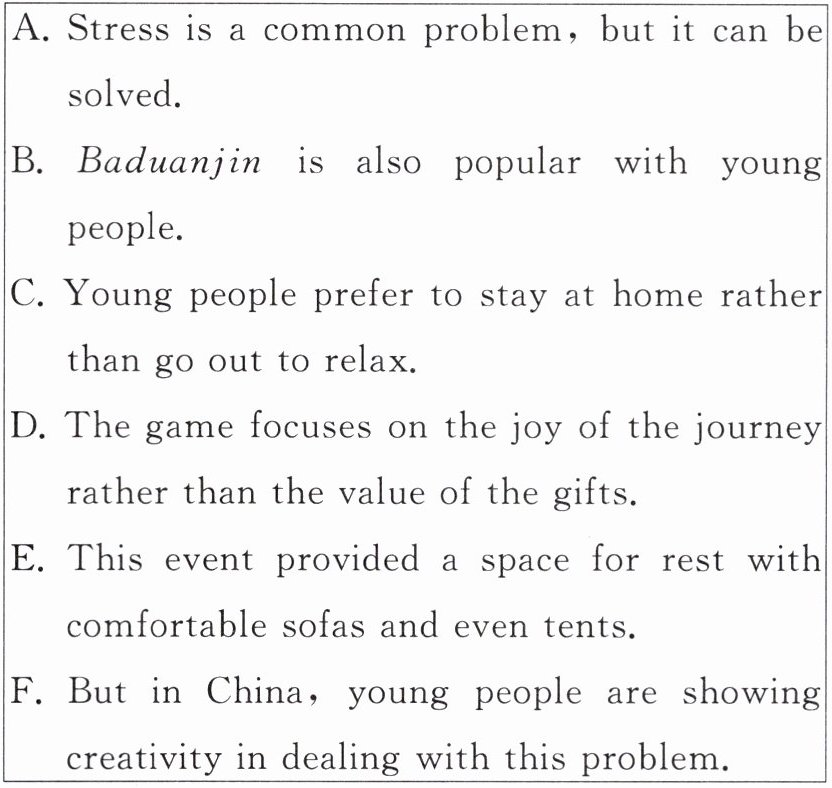
B. Baduanjin is also popular with young people.
C. Young people prefer to stay at home rather than go out to relax.
D. The game focuses on the joy of the journey rather than the value of the gifts.
E. This event provided a space for rest with comfortable sofas and even tents.
F. But in China, young people are showing creativity in dealing with this problem.
从方框中选出能填入空白处的最佳选项。选项中有一项多余。
Managing stress and anxiety is a worldwide problem. 1.
F
By mixing traditional cultural practices with creative activities, they are on their way to mental well-being.A “Laylive” themed concert was held in Shanghai on January 6, 2025. The experience allowed people to get together in live houses—places for live music performances to relax or even sleep. 2.
E
At the same time, the rise of city treasure hunts has caught people’s eye. People hide “treasures” in the city, sharing information through social media to guide others in the search. 3.
D
It creates a connection between players and their city. Through these activities, young people may reduce their sense of loneliness and increase their sense of belonging.4.
B
Baduanjin is a form of traditional Chinese qigong practice. It can actually help people achieve a sense of balance between body and mind. It can improve poor posture (姿势) and help regulate (调节) breathing. Besides, it helps in improving concentration, leading to physical and mental relaxation.5.
A
Whether listening to a “Laylive” themed concert, joining city treasure hunts or practising baduanjin, young people can find healthy ways to relax. These can help you grow happier on your journey!A. Stress is a common problem, but it can be solved.
B. Baduanjin is also popular with young people.
C. Young people prefer to stay at home rather than go out to relax.
D. The game focuses on the joy of the journey rather than the value of the gifts.
E. This event provided a space for rest with comfortable sofas and even tents.
F. But in China, young people are showing creativity in dealing with this problem.
答案:Ⅵ. 1 - 5 FEDBA
【语篇解读】本文是一篇说明文,探讨了中国年轻人如何通过创新方式,如“Laylive”音乐会、城市寻宝和八段锦之类的传统文化实践,应对压力与焦虑。
【语篇解读】本文是一篇说明文,探讨了中国年轻人如何通过创新方式,如“Laylive”音乐会、城市寻宝和八段锦之类的传统文化实践,应对压力与焦虑。
解析:
【分析】
这是一篇短文还原题,解题时需先通读全文,明确文章主旨为介绍中国年轻人应对压力的创意方式,再根据上下文的逻辑关系,如转折、承接、引出话题、总结等,匹配对应选项:
1. 第1空:前文点明压力是全球性问题,后文转向中国年轻人的应对方式,需找转折衔接的句子引出中国的情况。
2. 第2空:前文介绍“Laylive”音乐会可让人放松甚至休息,需找补充该活动休息配套设施的句子。
3. 第3空:前文介绍城市寻宝活动,需找点明该活动核心特点的句子,衔接后文与城市建立联系的内容。
4. 第4空:后文开始介绍八段锦的作用,需找引出八段锦受年轻人欢迎的句子,开启话题。
5. 第5空:文末为总结部分,需找呼应开头压力问题、总结全文的句子。
【解析】
1. 第1空:前文提到“Managing stress and anxiety is a worldwide problem.”,后文讲中国年轻人结合传统文化与创意活动应对压力,F选项“But in China, young people are showing creativity in dealing with this problem.”通过转折衔接,自然引出中国年轻人的应对方式,故选F。
2. 第2空:前文介绍“A ‘Laylive’ themed concert...allowed people to get together in live houses...to relax or even sleep.”,E选项“This event provided a space for rest with comfortable sofas and even tents.”具体说明了该音乐会提供的休息设施,与前文的放松、休息场景呼应,故选E。
3. 第3空:前文介绍城市寻宝活动,D选项“The game focuses on the joy of the journey rather than the value of the gifts.”点明活动核心是旅途乐趣,与后文“It creates a connection between players and their city.”衔接合理,故选D。
4. 第4空:后文开始介绍八段锦的身心调节作用,B选项“Baduanjin is also popular with young people.”引出八段锦受年轻人欢迎这一话题,自然过渡到后文介绍,故选B。
5. 第5空:文末为总结部分,前文列举了多种减压方式,A选项“Stress is a common problem, but it can be solved.”呼应开头的压力问题,总结全文说明压力可通过这些方式解决,故选A。
【答案】
1-5 FEDBA
【知识点】
1. 上下文逻辑衔接
2. 说明文语篇理解
3. 语境词汇匹配
【点评】
本文围绕中国年轻人应对压力的创意方式展开,既考查学生对语篇逻辑的把握能力,也让学生了解了多种健康的减压途径,需学生结合前后文语境精准分析选项与文本的契合度。
【难度系数】
0.6
这是一篇短文还原题,解题时需先通读全文,明确文章主旨为介绍中国年轻人应对压力的创意方式,再根据上下文的逻辑关系,如转折、承接、引出话题、总结等,匹配对应选项:
1. 第1空:前文点明压力是全球性问题,后文转向中国年轻人的应对方式,需找转折衔接的句子引出中国的情况。
2. 第2空:前文介绍“Laylive”音乐会可让人放松甚至休息,需找补充该活动休息配套设施的句子。
3. 第3空:前文介绍城市寻宝活动,需找点明该活动核心特点的句子,衔接后文与城市建立联系的内容。
4. 第4空:后文开始介绍八段锦的作用,需找引出八段锦受年轻人欢迎的句子,开启话题。
5. 第5空:文末为总结部分,需找呼应开头压力问题、总结全文的句子。
【解析】
1. 第1空:前文提到“Managing stress and anxiety is a worldwide problem.”,后文讲中国年轻人结合传统文化与创意活动应对压力,F选项“But in China, young people are showing creativity in dealing with this problem.”通过转折衔接,自然引出中国年轻人的应对方式,故选F。
2. 第2空:前文介绍“A ‘Laylive’ themed concert...allowed people to get together in live houses...to relax or even sleep.”,E选项“This event provided a space for rest with comfortable sofas and even tents.”具体说明了该音乐会提供的休息设施,与前文的放松、休息场景呼应,故选E。
3. 第3空:前文介绍城市寻宝活动,D选项“The game focuses on the joy of the journey rather than the value of the gifts.”点明活动核心是旅途乐趣,与后文“It creates a connection between players and their city.”衔接合理,故选D。
4. 第4空:后文开始介绍八段锦的身心调节作用,B选项“Baduanjin is also popular with young people.”引出八段锦受年轻人欢迎这一话题,自然过渡到后文介绍,故选B。
5. 第5空:文末为总结部分,前文列举了多种减压方式,A选项“Stress is a common problem, but it can be solved.”呼应开头的压力问题,总结全文说明压力可通过这些方式解决,故选A。
【答案】
1-5 FEDBA
【知识点】
1. 上下文逻辑衔接
2. 说明文语篇理解
3. 语境词汇匹配
【点评】
本文围绕中国年轻人应对压力的创意方式展开,既考查学生对语篇逻辑的把握能力,也让学生了解了多种健康的减压途径,需学生结合前后文语境精准分析选项与文本的契合度。
【难度系数】
0.6
Ⅶ. 任务型阅读
阅读并根据下面的短文,在表格中的空格里填入一个最恰当的单词。
In our connected world, cross-cultural communication is becoming very important. When people from different countries meet, understanding cultural differences can help avoid problems and create friendships.
The first lesson is about body language. In Western cultures, a strong handshake shows confidence when greeting. But for Korean people, they usually bow slightly instead. Americans think eye contact (接触) shows they are honest, while in some Asian countries, too much eye contact may seem impolite. Even simple actions like thumbs-up can cause confusion—it means “good” in the USA but is rude in parts of the Middle East.
Good listening is another key. In Finland, people often stay silent for a moment after someone speaks to show respect. However, in Brazil, silence might make people uncomfortable. My Spanish friend once told me, “When I first visited China, I thought silent listeners weren’t interested. Later I learnt it was their way to show careful thinking.”
Speaking with local expressions builds trust. When my classmate Emma visited Paris and said “Bonjour” (hello) and “Merci” (thank you) to French people, they always smiled and were willing to help. But direct translation of idioms sometimes fails. The English saying “break a leg” (meaning good luck) would sound scary if translated into other languages! The Chinese idiom “ma ma hu hu” (horse-horse-tiger-tiger) actually means “just okay”, which often puzzles foreigners. So it’s important to understand the actual meanings behind them.
To improve cross-cultural communication, watch foreign movies, read travel books, or join international school projects. Never be afraid to ask friendly questions like “Could you teach me a local custom?” Remember, mistakes are normal. Last month, our German exchange student accidentally used the informal “du” (you) in a formal meeting. Everyone laughed kindly, and it became a fun culture lesson!
| Bridging Cultures Through Communication |
| --- |
| In the connected world, cross-cultural communication is of great 1.
| Body language | In Western cultures, a strong handshake shows confidence while Koreans 2.
| Listening habits | In Finland, people keep in 6.
| Using local ways to speak | 8.
| How to improve | There are lots of 10.
阅读并根据下面的短文,在表格中的空格里填入一个最恰当的单词。
In our connected world, cross-cultural communication is becoming very important. When people from different countries meet, understanding cultural differences can help avoid problems and create friendships.
The first lesson is about body language. In Western cultures, a strong handshake shows confidence when greeting. But for Korean people, they usually bow slightly instead. Americans think eye contact (接触) shows they are honest, while in some Asian countries, too much eye contact may seem impolite. Even simple actions like thumbs-up can cause confusion—it means “good” in the USA but is rude in parts of the Middle East.
Good listening is another key. In Finland, people often stay silent for a moment after someone speaks to show respect. However, in Brazil, silence might make people uncomfortable. My Spanish friend once told me, “When I first visited China, I thought silent listeners weren’t interested. Later I learnt it was their way to show careful thinking.”
Speaking with local expressions builds trust. When my classmate Emma visited Paris and said “Bonjour” (hello) and “Merci” (thank you) to French people, they always smiled and were willing to help. But direct translation of idioms sometimes fails. The English saying “break a leg” (meaning good luck) would sound scary if translated into other languages! The Chinese idiom “ma ma hu hu” (horse-horse-tiger-tiger) actually means “just okay”, which often puzzles foreigners. So it’s important to understand the actual meanings behind them.
To improve cross-cultural communication, watch foreign movies, read travel books, or join international school projects. Never be afraid to ask friendly questions like “Could you teach me a local custom?” Remember, mistakes are normal. Last month, our German exchange student accidentally used the informal “du” (you) in a formal meeting. Everyone laughed kindly, and it became a fun culture lesson!
| Bridging Cultures Through Communication |
| --- |
| In the connected world, cross-cultural communication is of great 1.
importance
. || Body language | In Western cultures, a strong handshake shows confidence while Koreans 2.
prefer
a slight bow. Americans think eye contact means 3. honesty
, while in some Asian countries, you should 4. avoid
too much eye contact. Thumbs-up means “good” in the USA, but it is not 5. polite
in parts of the Middle East. || Listening habits | In Finland, people keep in 6.
silence
to show respect after someone speaks. But in Brazil, it’s improper to stay silent. In China, silent listening means people are thinking 7. carefully
. || Using local ways to speak | 8.
Saying
“Bonjour” and “Merci” in France can make French happy. Direct translation of idioms may cause 9. confusion/problems
. You should understand their true meanings. || How to improve | There are lots of 10.
ways
to improve. It’s normal to make mistakes when learning. |答案:Ⅶ.【语篇解读】本文是一篇说明文。文章围绕跨文化交流展开,介绍了跨文化交流的重要性,并从肢体语言、良好倾听、使用当地表达这三个交流方式阐述文化差异,还给出了提升跨文化交流能力的建议。
1. importance 解析: 根据原文“In our connected world, cross - cultural communication is becoming very important.”可知,“is becoming very important”可转化为“is of great importance”,故填 importance。
2. prefer 解析: 根据原文“In Western cultures, a strong handshake shows confidence when greeting. But for Korean people, they usually bow slightly instead.”可知,韩国人通常“更喜欢”轻微鞠躬,prefer 符合语境,主语 Koreans 此处指代韩国人,是复数,故填 prefer。
3. honesty 解析: 根据原文“Americans think eye contact shows they are honest”可知,“shows they are honest”可转化为“means honesty”,honest 的名词形式是 honesty,故填 honesty。
4. avoid 解析: 根据原文“while in some Asian countries, too much eye contact may seem impolite”可知,在一些亚洲国家,过多眼神接触是不礼貌的,所以应该“避免”,avoid 符合语境,should 后接动词原形,故填 avoid。
5. polite 解析: 根据原文“Even simple actions like thumbs - up can cause confusion—it means ‘good’ in the USA but is rude in parts of the Middle East.”可知,竖大拇指在中东部分地区是粗鲁的,即“不礼貌的”,not polite 符合语境,故填 polite。
6. silence 解析: 根据原文“In Finland, people often stay silent for a moment after someone speaks to show respect.”可知,“stay silent”可转化为“keep in silence”,silent 的名词形式是 silence,故填 silence。
7. carefully 解析: 根据原文“Later I learnt it was their way to show careful thinking.”可知,中国的沉默倾听是“认真思考”的方式,“careful thinking”可转化为“thinking carefully”,故填 carefully。
8. Saying 解析: 根据原文“When my classmate Emma visited Paris and said ‘Bonjour’(hello) and ‘Merci’(thank you) to French people, they always smiled and were willing to help.”可知,用法语说“你好”和“谢谢”能让法国人开心,此处作主语,需用动词 - ing 形式,句首首字母大写,故填 Saying。
9. confusion/problems 解析: 根据原文“But direct translation of idioms sometimes fails.”及“The Chinese idiom ‘ma ma hu hu’(horse - horse - tiger - tiger) actually means ‘just okay’, which often puzzles foreigners.”可知,习语的直译会“令人困惑”或引起“问题”,confusion 或 problems 符合语境,故填 confusion/problems。
10. ways 解析: 根据原文“To improve cross - cultural communication, watch foreign movies, read travel books, or join international school projects.”可知,有很多“方法”可以提升跨文化交流能力,ways 符合语境,故填 ways。
1. importance 解析: 根据原文“In our connected world, cross - cultural communication is becoming very important.”可知,“is becoming very important”可转化为“is of great importance”,故填 importance。
2. prefer 解析: 根据原文“In Western cultures, a strong handshake shows confidence when greeting. But for Korean people, they usually bow slightly instead.”可知,韩国人通常“更喜欢”轻微鞠躬,prefer 符合语境,主语 Koreans 此处指代韩国人,是复数,故填 prefer。
3. honesty 解析: 根据原文“Americans think eye contact shows they are honest”可知,“shows they are honest”可转化为“means honesty”,honest 的名词形式是 honesty,故填 honesty。
4. avoid 解析: 根据原文“while in some Asian countries, too much eye contact may seem impolite”可知,在一些亚洲国家,过多眼神接触是不礼貌的,所以应该“避免”,avoid 符合语境,should 后接动词原形,故填 avoid。
5. polite 解析: 根据原文“Even simple actions like thumbs - up can cause confusion—it means ‘good’ in the USA but is rude in parts of the Middle East.”可知,竖大拇指在中东部分地区是粗鲁的,即“不礼貌的”,not polite 符合语境,故填 polite。
6. silence 解析: 根据原文“In Finland, people often stay silent for a moment after someone speaks to show respect.”可知,“stay silent”可转化为“keep in silence”,silent 的名词形式是 silence,故填 silence。
7. carefully 解析: 根据原文“Later I learnt it was their way to show careful thinking.”可知,中国的沉默倾听是“认真思考”的方式,“careful thinking”可转化为“thinking carefully”,故填 carefully。
8. Saying 解析: 根据原文“When my classmate Emma visited Paris and said ‘Bonjour’(hello) and ‘Merci’(thank you) to French people, they always smiled and were willing to help.”可知,用法语说“你好”和“谢谢”能让法国人开心,此处作主语,需用动词 - ing 形式,句首首字母大写,故填 Saying。
9. confusion/problems 解析: 根据原文“But direct translation of idioms sometimes fails.”及“The Chinese idiom ‘ma ma hu hu’(horse - horse - tiger - tiger) actually means ‘just okay’, which often puzzles foreigners.”可知,习语的直译会“令人困惑”或引起“问题”,confusion 或 problems 符合语境,故填 confusion/problems。
10. ways 解析: 根据原文“To improve cross - cultural communication, watch foreign movies, read travel books, or join international school projects.”可知,有很多“方法”可以提升跨文化交流能力,ways 符合语境,故填 ways。
解析:
【分析】
这是一篇聚焦跨文化交流的任务型阅读题,解题思路如下:
1. 先通读全文,明确文章主旨:文章介绍了跨文化交流的重要性,从肢体语言、倾听习惯、语言表达三个维度阐述不同文化的差异,还给出了提升跨文化交流能力的具体方法。
2. 逐个分析表格空格,根据空格前后的提示信息,精准定位到原文对应的段落和句子。
3. 结合语法规则进行词性转换或同义替换:比如将原文的形容词important转换为名词importance,把动词短语stay silent转换为名词短语keep in silence;同时注意动词形式,如作主语需用动名词Saying,情态动词should后接动词原形avoid等。
4. 最后核对每个空的单词是否符合语境、语法规范和拼写要求。
【解析】
1. 根据原文“In our connected world, cross - cultural communication is becoming very important.”,“be very important”可转换为固定表达“be of great importance”,此处需要名词形式,故填importance。
2. 根据原文“In Western cultures, a strong handshake shows confidence when greeting. But for Korean people, they usually bow slightly instead.”,可知韩国人相较于握手,更倾向于轻微鞠躬,主语Koreans为复数,故填prefer。
3. 根据原文“Americans think eye contact shows they are honest”,此处需要名词作means的宾语,honest的名词形式是honesty,故填honesty。
4. 根据原文“while in some Asian countries, too much eye contact may seem impolite”,可知过多眼神接触不礼貌,因此要避免,should后接动词原形,故填avoid。
5. 根据原文“Even simple actions like thumbs - up can cause confusion—it means ‘good’ in the USA but is rude in parts of the Middle East.”,rude与not polite表意一致,故填polite。
6. 根据原文“In Finland, people often stay silent for a moment after someone speaks to show respect.”,“stay silent”可转换为固定短语“keep in silence”,此处需要名词形式,故填silence。
7. 根据原文“Later I learnt it was their way to show careful thinking.”,此处需要副词修饰动词thinking,careful的副词形式是carefully,故填carefully。
8. 根据原文“When my classmate Emma visited Paris and said ‘Bonjour’(hello) and ‘Merci’(thank you) to French people, they always smiled and were willing to help.”,此处作主语,需用动名词形式,句首首字母大写,故填Saying。
9. 根据原文“But direct translation of idioms sometimes fails.”及“The Chinese idiom ‘ma ma hu hu’(horse - horse - tiger - tiger) actually means ‘just okay’, which often puzzles foreigners.”,可知习语直译会引起困惑或问题,故填confusion/problems。
10. 根据原文“To improve cross - cultural communication, watch foreign movies, read travel books, or join international school projects.”,这些都是提升跨文化交流能力的方法,way是可数名词,前面有lots of修饰,故填ways。
【答案】
1. importance
2. prefer
3. honesty
4. avoid
5. polite
6. silence
7. carefully
8. Saying
9. confusion/problems
10. ways
【知识点】
1. 任务型阅读信息提取
2. 词汇词性转换
3. 跨文化交际常识
【点评】
本题围绕跨文化交际主题展开,既考查学生对原文信息的定位、提取与转换能力,又渗透了跨文化常识,有助于提升学生的语言综合运用能力和跨文化意识。题目空格涵盖名词、动词、副词、动名词等多种词性,对学生的语法基础和词汇变形能力有一定要求。
【难度系数】
0.6
这是一篇聚焦跨文化交流的任务型阅读题,解题思路如下:
1. 先通读全文,明确文章主旨:文章介绍了跨文化交流的重要性,从肢体语言、倾听习惯、语言表达三个维度阐述不同文化的差异,还给出了提升跨文化交流能力的具体方法。
2. 逐个分析表格空格,根据空格前后的提示信息,精准定位到原文对应的段落和句子。
3. 结合语法规则进行词性转换或同义替换:比如将原文的形容词important转换为名词importance,把动词短语stay silent转换为名词短语keep in silence;同时注意动词形式,如作主语需用动名词Saying,情态动词should后接动词原形avoid等。
4. 最后核对每个空的单词是否符合语境、语法规范和拼写要求。
【解析】
1. 根据原文“In our connected world, cross - cultural communication is becoming very important.”,“be very important”可转换为固定表达“be of great importance”,此处需要名词形式,故填importance。
2. 根据原文“In Western cultures, a strong handshake shows confidence when greeting. But for Korean people, they usually bow slightly instead.”,可知韩国人相较于握手,更倾向于轻微鞠躬,主语Koreans为复数,故填prefer。
3. 根据原文“Americans think eye contact shows they are honest”,此处需要名词作means的宾语,honest的名词形式是honesty,故填honesty。
4. 根据原文“while in some Asian countries, too much eye contact may seem impolite”,可知过多眼神接触不礼貌,因此要避免,should后接动词原形,故填avoid。
5. 根据原文“Even simple actions like thumbs - up can cause confusion—it means ‘good’ in the USA but is rude in parts of the Middle East.”,rude与not polite表意一致,故填polite。
6. 根据原文“In Finland, people often stay silent for a moment after someone speaks to show respect.”,“stay silent”可转换为固定短语“keep in silence”,此处需要名词形式,故填silence。
7. 根据原文“Later I learnt it was their way to show careful thinking.”,此处需要副词修饰动词thinking,careful的副词形式是carefully,故填carefully。
8. 根据原文“When my classmate Emma visited Paris and said ‘Bonjour’(hello) and ‘Merci’(thank you) to French people, they always smiled and were willing to help.”,此处作主语,需用动名词形式,句首首字母大写,故填Saying。
9. 根据原文“But direct translation of idioms sometimes fails.”及“The Chinese idiom ‘ma ma hu hu’(horse - horse - tiger - tiger) actually means ‘just okay’, which often puzzles foreigners.”,可知习语直译会引起困惑或问题,故填confusion/problems。
10. 根据原文“To improve cross - cultural communication, watch foreign movies, read travel books, or join international school projects.”,这些都是提升跨文化交流能力的方法,way是可数名词,前面有lots of修饰,故填ways。
【答案】
1. importance
2. prefer
3. honesty
4. avoid
5. polite
6. silence
7. carefully
8. Saying
9. confusion/problems
10. ways
【知识点】
1. 任务型阅读信息提取
2. 词汇词性转换
3. 跨文化交际常识
【点评】
本题围绕跨文化交际主题展开,既考查学生对原文信息的定位、提取与转换能力,又渗透了跨文化常识,有助于提升学生的语言综合运用能力和跨文化意识。题目空格涵盖名词、动词、副词、动名词等多种词性,对学生的语法基础和词汇变形能力有一定要求。
【难度系数】
0.6