9. —What’s important during my study trip abroad, Mr Wang? —Respect local habits. As the saying goes, “
A.Practice makes perfect
B.Old habits die hard
C.When in Rome, do as the Romans do
D.Don’t burn the candle at both ends
C
.”A.Practice makes perfect
B.Old habits die hard
C.When in Rome, do as the Romans do
D.Don’t burn the candle at both ends
答案:9. C 解析: A 选项 Practice makes perfect 意为“熟能生巧”;B 选项 Old habits die hard 意为“积习难改”;C 选项 When in Rome, do as the Romans do 意为“入乡随俗”;D 选项 Don't burn the candle at both ends 意为“不要过度劳累”。根据前文“Respect local habits.”可知,“入乡随俗”符合语境,故选 C。
解析:
【分析】
首先要理解对话的语境:题目中提到出国学习旅行时要尊重当地习惯,因此需要选择一句与“尊重当地习惯”含义相符的谚语。接下来需要逐一分析每个选项的含义,排除不符合语境的选项,找到匹配的谚语即可。
【解析】
A选项“Practice makes perfect”意为“熟能生巧”;B选项“Old habits die hard”意为“积习难改”;C选项“When in Rome, do as the Romans do”意为“入乡随俗”;D选项“Don’t burn the candle at both ends”意为“不要过度劳累”。根据前文“Respect local habits.”(尊重当地习惯)可知,“入乡随俗”符合语境,故选C。
【答案】
C
【知识点】
英语谚语辨析、情景交际
【点评】
本题考查常见英语谚语的理解与语境运用,要求学生既要掌握谚语的基本含义,又能结合具体情境判断合适的表达,注重对语言运用能力的考查。
【难度系数】
0.7
首先要理解对话的语境:题目中提到出国学习旅行时要尊重当地习惯,因此需要选择一句与“尊重当地习惯”含义相符的谚语。接下来需要逐一分析每个选项的含义,排除不符合语境的选项,找到匹配的谚语即可。
【解析】
A选项“Practice makes perfect”意为“熟能生巧”;B选项“Old habits die hard”意为“积习难改”;C选项“When in Rome, do as the Romans do”意为“入乡随俗”;D选项“Don’t burn the candle at both ends”意为“不要过度劳累”。根据前文“Respect local habits.”(尊重当地习惯)可知,“入乡随俗”符合语境,故选C。
【答案】
C
【知识点】
英语谚语辨析、情景交际
【点评】
本题考查常见英语谚语的理解与语境运用,要求学生既要掌握谚语的基本含义,又能结合具体情境判断合适的表达,注重对语言运用能力的考查。
【难度系数】
0.7
Ⅳ. 句子翻译
1. 我在中国生活时感觉像在自己家一样自在。
2. 一提到玩具,这个男孩就变得兴奋起来。
3. 她没有收下礼物,只是笑了笑就离开了。
4. 中国人习惯等长辈开始用餐后,自己再开始吃饭。
5. 如果对方比你年长很多,直接叫他们的名字是不礼貌的。
6. 中国和英国的礼仪之间存在一些相似之处。
1. 我在中国生活时感觉像在自己家一样自在。
I feel/felt at home while living in China.
2. 一提到玩具,这个男孩就变得兴奋起来。
When it comes to toys, the boy becomes excited.
3. 她没有收下礼物,只是笑了笑就离开了。
Instead of accepting the gift, she just smiled and left.
4. 中国人习惯等长辈开始用餐后,自己再开始吃饭。
Chinese people are used to starting eating after the elderly.
5. 如果对方比你年长很多,直接叫他们的名字是不礼貌的。
It's not polite to call/address people by their names if they're much older than you.
6. 中国和英国的礼仪之间存在一些相似之处。
There is something similar between the manners in China and the UK.
答案:Ⅳ. 1. I feel/felt at home while living in China.
2. When it comes to toys, the boy becomes excited.
3. Instead of accepting the gift, she just smiled and left.
4. Chinese people are used to starting eating after the elderly.
5. It's not polite to call/address people by their names if they're much older than you.
6. There is something similar between the manners in China and the UK.
2. When it comes to toys, the boy becomes excited.
3. Instead of accepting the gift, she just smiled and left.
4. Chinese people are used to starting eating after the elderly.
5. It's not polite to call/address people by their names if they're much older than you.
6. There is something similar between the manners in China and the UK.
解析:
【分析】
1. 第一句:先锁定核心表达“感觉自在”对应的固定短语feel at home,“在中国生活时”用while引导时间状语,因主从句主语一致,可省略从句的主语和be动词,简化为while living in China,时态可根据语境选择一般现在时feel或一般过去时felt。
2. 第二句:“一提到”是固定句式When it comes to,注意to是介词,后接名词toys;主语the boy是第三人称单数,一般现在时中“变得兴奋”用becomes excited。
3. 第三句:“没有收下礼物”用Instead of accepting the gift来体现转折关系,instead of后接动名词形式;“笑了笑就离开”是连贯的过去动作,用smiled and left保持时态一致。
4. 第四句:“习惯做某事”用固定搭配be used to doing sth.,“开始用餐”是start eating,“长辈”用集体名词the elderly指代,主语Chinese people对应的be动词用are。
5. 第五句:采用it作形式主语的常用句式It's not polite to do sth.,避免句子头重脚轻,真正主语是不定式短语;“直接叫他们的名字”译为call/address people by their names,“年长很多”用much older than you强调差距,条件状语从句用if引导。
6. 第六句:用There is something similar between...and...的句式表达“两者之间有相似之处”,明确比较对象为中国和英国的礼仪the manners in China and the UK。
【解析】
1. 运用固定短语feel at home表达“感觉自在”,while引导时间状语从句时,主从句主语一致且从句含be动词,可省略主语和be动词,故写成while living in China,时态可选一般现在时或一般过去时,对应feel/felt。
2. 固定句式“When it comes to...”意为“当提到/谈到...”,to为介词,后接名词;主语the boy是第三人称单数,一般现在时中谓语动词become用第三人称单数形式becomes。
3. “Instead of”表“代替;而不是”,后接动名词accepting;“笑了笑就离开”是连续的过去动作,用smiled and left保证时态统一。
4. “be used to doing sth.”表示“习惯于做某事”,to是介词,后接动名词starting;the elderly作为集体名词,指代“长辈;老年人”。
5. it作形式主语,真正主语是不定式短语“to call/address people by their names”,使句子结构更合理;“much older”突出年龄差,条件状语从句说明行为的前提。
6. “There is something similar between...and...”是表达两者间相似点的常用句式,清晰点明比较对象为中英两国的礼仪。
【答案】
Ⅳ. 1. I feel/felt at home while living in China.
2. When it comes to toys, the boy becomes excited.
3. Instead of accepting the gift, she just smiled and left.
4. Chinese people are used to starting eating after the elderly.
5. It's not polite to call/address people by their names if they're much older than you.
6. There is something similar between the manners in China and the UK.
【知识点】
固定短语搭配、it作形式主语、状语从句省略
【点评】
本题聚焦日常交际场景的中英互译,涵盖多个高频固定短语与经典句式,既考查短语记忆,也考查语法结构的灵活运用,要求学生积累日常表达并熟练掌握相关语法规则,提升翻译能力。
【难度系数】
0.6
1. 第一句:先锁定核心表达“感觉自在”对应的固定短语feel at home,“在中国生活时”用while引导时间状语,因主从句主语一致,可省略从句的主语和be动词,简化为while living in China,时态可根据语境选择一般现在时feel或一般过去时felt。
2. 第二句:“一提到”是固定句式When it comes to,注意to是介词,后接名词toys;主语the boy是第三人称单数,一般现在时中“变得兴奋”用becomes excited。
3. 第三句:“没有收下礼物”用Instead of accepting the gift来体现转折关系,instead of后接动名词形式;“笑了笑就离开”是连贯的过去动作,用smiled and left保持时态一致。
4. 第四句:“习惯做某事”用固定搭配be used to doing sth.,“开始用餐”是start eating,“长辈”用集体名词the elderly指代,主语Chinese people对应的be动词用are。
5. 第五句:采用it作形式主语的常用句式It's not polite to do sth.,避免句子头重脚轻,真正主语是不定式短语;“直接叫他们的名字”译为call/address people by their names,“年长很多”用much older than you强调差距,条件状语从句用if引导。
6. 第六句:用There is something similar between...and...的句式表达“两者之间有相似之处”,明确比较对象为中国和英国的礼仪the manners in China and the UK。
【解析】
1. 运用固定短语feel at home表达“感觉自在”,while引导时间状语从句时,主从句主语一致且从句含be动词,可省略主语和be动词,故写成while living in China,时态可选一般现在时或一般过去时,对应feel/felt。
2. 固定句式“When it comes to...”意为“当提到/谈到...”,to为介词,后接名词;主语the boy是第三人称单数,一般现在时中谓语动词become用第三人称单数形式becomes。
3. “Instead of”表“代替;而不是”,后接动名词accepting;“笑了笑就离开”是连续的过去动作,用smiled and left保证时态统一。
4. “be used to doing sth.”表示“习惯于做某事”,to是介词,后接动名词starting;the elderly作为集体名词,指代“长辈;老年人”。
5. it作形式主语,真正主语是不定式短语“to call/address people by their names”,使句子结构更合理;“much older”突出年龄差,条件状语从句说明行为的前提。
6. “There is something similar between...and...”是表达两者间相似点的常用句式,清晰点明比较对象为中英两国的礼仪。
【答案】
Ⅳ. 1. I feel/felt at home while living in China.
2. When it comes to toys, the boy becomes excited.
3. Instead of accepting the gift, she just smiled and left.
4. Chinese people are used to starting eating after the elderly.
5. It's not polite to call/address people by their names if they're much older than you.
6. There is something similar between the manners in China and the UK.
【知识点】
固定短语搭配、it作形式主语、状语从句省略
【点评】
本题聚焦日常交际场景的中英互译,涵盖多个高频固定短语与经典句式,既考查短语记忆,也考查语法结构的灵活运用,要求学生积累日常表达并熟练掌握相关语法规则,提升翻译能力。
【难度系数】
0.6
Ⅴ. 阅读理解
Whether you are teaching an elementary Spanish class or passing on Spanish to your children, it is important to teach children good manners. And there are culturally proper behaviours that children need to know.
These five behaviours are considered good manners throughout Latin America. Of course, these are good manners in the USA too, but they are not given as much attention because the opposite behaviours are not considered particularly rude in Spanish-speaking countries. However, the opposite behaviours are negative and can change the impression people have of children (and adults)!
All of these good manners can be practised by children with different language levels.
Good manners to teach kids learning Spanish:
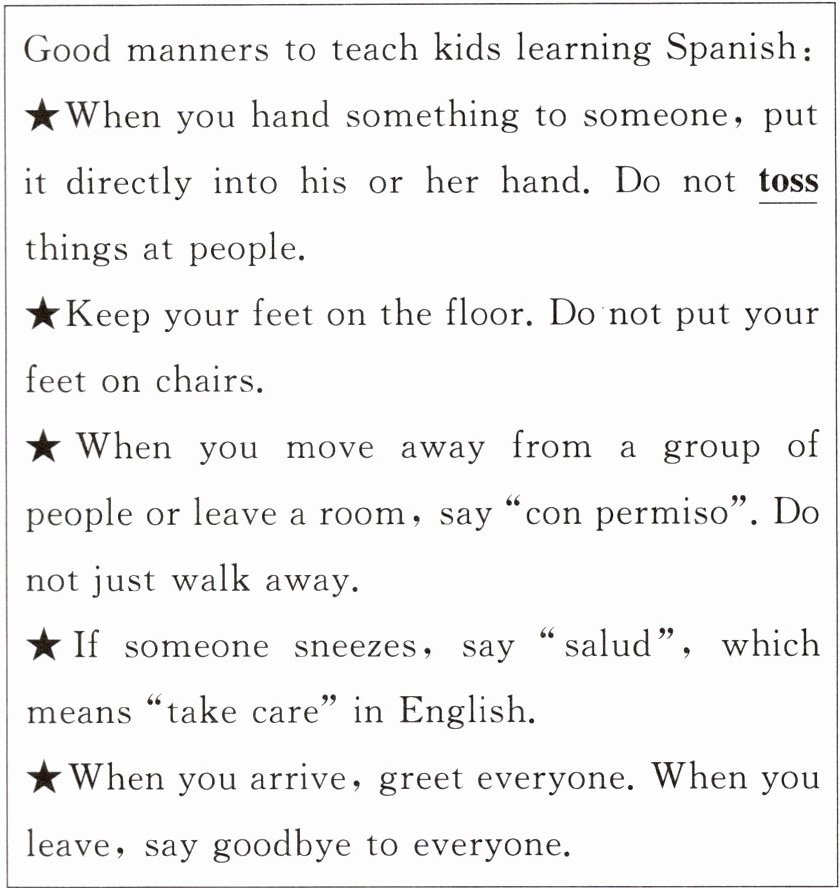
★When you hand something to someone, put it directly into his or her hand. Do not toss things at people.
★Keep your feet on the floor. Do not put your feet on chairs.
★ When you move away from a group of people or leave a room, say “con permiso”. Do not just walk away.
★ If someone sneezes, say “salud”, which means “take care” in English.
★When you arrive, greet everyone. When you leave, say goodbye to everyone.
There are lots of resources for teaching children good manners in Spanish. Many polite behaviours also include language. Here you will find resources for teaching polite expressions, including books and a song. There are also videos that teach polite behaviours.
In my experience, kids are interested in what is considered polite behaviour in different cultures, and they want to learn to act properly. We work hard teaching them to use Spanish. It is important that they also know how to interact so that others are comfortable and they can make the most of the language they have learned.
1. The passage is probably written for .
A. travellers who will go abroad on holiday
B. teachers who are teaching in the Spanish class
C. parents who care about their children’s manners
D. children who want to pass their Spanish tests
2. The underlined word “toss” in the passage can be replaced by “”.
A. send
B. make
C. throw
D. look
3. According to the passage, which is considered a proper behaviour?
A. Jim keeps his feet on his friend’s chair.
B. Jim sneezes, and his friend gets angry with him.
C. Jim comes in and says good morning to his classmates.
D. Jim doesn’t say goodbye to everyone when he leaves a room.
4. The best title for the passage can be “”.
A. Good Manners for Spanish Learners
B. The History of the Spanish Language
C. How to Behave Well in the Spanish Class
D. Some Ways of Teaching Children Spanish
Whether you are teaching an elementary Spanish class or passing on Spanish to your children, it is important to teach children good manners. And there are culturally proper behaviours that children need to know.
These five behaviours are considered good manners throughout Latin America. Of course, these are good manners in the USA too, but they are not given as much attention because the opposite behaviours are not considered particularly rude in Spanish-speaking countries. However, the opposite behaviours are negative and can change the impression people have of children (and adults)!
All of these good manners can be practised by children with different language levels.
Good manners to teach kids learning Spanish:
★When you hand something to someone, put it directly into his or her hand. Do not toss things at people.
★Keep your feet on the floor. Do not put your feet on chairs.
★ When you move away from a group of people or leave a room, say “con permiso”. Do not just walk away.
★ If someone sneezes, say “salud”, which means “take care” in English.
★When you arrive, greet everyone. When you leave, say goodbye to everyone.
There are lots of resources for teaching children good manners in Spanish. Many polite behaviours also include language. Here you will find resources for teaching polite expressions, including books and a song. There are also videos that teach polite behaviours.
In my experience, kids are interested in what is considered polite behaviour in different cultures, and they want to learn to act properly. We work hard teaching them to use Spanish. It is important that they also know how to interact so that others are comfortable and they can make the most of the language they have learned.
1. The passage is probably written for .
A. travellers who will go abroad on holiday
B. teachers who are teaching in the Spanish class
C. parents who care about their children’s manners
D. children who want to pass their Spanish tests
2. The underlined word “toss” in the passage can be replaced by “”.
A. send
B. make
C. throw
D. look
3. According to the passage, which is considered a proper behaviour?
A. Jim keeps his feet on his friend’s chair.
B. Jim sneezes, and his friend gets angry with him.
C. Jim comes in and says good morning to his classmates.
D. Jim doesn’t say goodbye to everyone when he leaves a room.
4. The best title for the passage can be “”.
A. Good Manners for Spanish Learners
B. The History of the Spanish Language
C. How to Behave Well in the Spanish Class
D. Some Ways of Teaching Children Spanish
答案:Ⅴ. 1 - 4 BCCA
【语篇解读】本文是一篇说明文。文章主要介绍了在孩子学习西班牙语时要教给他们的五种被认为有礼貌的行为。
1. B 解析: 推理判断题。根据文章第一句“Whether you are teaching an elementary Spanish class or passing on Spanish to your children, it is important to teach children good manners.”可推断,这篇文章是写给教孩子西班牙语的老师或家长的,结合选项可知 B 项正确。故选 B。
易错点拨 选项 C 仅表述为“关心孩子礼仪的家长”,未限定“西班牙语相关”,范围模糊,普通家长无需了解西班牙语文化中的特定礼仪,C 错误。
2. C 解析: 词义猜测题。根据“toss”所在句的前一句“When you hand something to someone, put it directly into his or her hand.”并结合四个选项可猜测,给别人递东西时应该直接放在他或她的手里,不能“扔”。故选 C。
3. C 解析: 推理判断题。根据最后一个礼貌行为中“When you arrive, greet everyone.”可推断,C 项“Jim comes in and says good morning to his classmates.”是一种恰当的行为。故选 C。
4. A 解析: 标题归纳题。通过阅读全文可知,这篇文章介绍的是学习西班牙语的孩子应该知道的礼貌行为。故选 A。
【语篇解读】本文是一篇说明文。文章主要介绍了在孩子学习西班牙语时要教给他们的五种被认为有礼貌的行为。
1. B 解析: 推理判断题。根据文章第一句“Whether you are teaching an elementary Spanish class or passing on Spanish to your children, it is important to teach children good manners.”可推断,这篇文章是写给教孩子西班牙语的老师或家长的,结合选项可知 B 项正确。故选 B。
易错点拨 选项 C 仅表述为“关心孩子礼仪的家长”,未限定“西班牙语相关”,范围模糊,普通家长无需了解西班牙语文化中的特定礼仪,C 错误。
2. C 解析: 词义猜测题。根据“toss”所在句的前一句“When you hand something to someone, put it directly into his or her hand.”并结合四个选项可猜测,给别人递东西时应该直接放在他或她的手里,不能“扔”。故选 C。
3. C 解析: 推理判断题。根据最后一个礼貌行为中“When you arrive, greet everyone.”可推断,C 项“Jim comes in and says good morning to his classmates.”是一种恰当的行为。故选 C。
4. A 解析: 标题归纳题。通过阅读全文可知,这篇文章介绍的是学习西班牙语的孩子应该知道的礼貌行为。故选 A。
解析:
【分析】
1. 第1题:属于推理判断题,解题时需抓住文章开篇关键句“Whether you are teaching an elementary Spanish class or passing on Spanish to your children, it is important to teach children good manners.”,结合选项分析:A选项旅行者、D选项备考西班牙语的孩子不符合文本受众指向;C选项“关心孩子礼仪的家长”未限定西班牙语相关场景,范围模糊;B选项“西班牙语课的老师”完全契合原文针对的教学群体,因此选B。
2. 第2题:属于词义猜测题,根据前文“put it directly into his or her hand”(直接递到手里)的正确行为,可推断“toss”是与之相反的动作,结合选项含义,“throw(扔)”符合语境,因此选C。
3. 第3题:属于细节推理题,需对照文中给出的礼仪规则逐一判断选项:A选项脚放椅子上、D选项离开不告别是文中明确禁止的行为;B选项别人打喷嚏时生气不符合礼仪要求;C选项进门问候大家符合“When you arrive, greet everyone.”的规则,因此选C。
4. 第4题:属于标题归纳题,需抓住文章核心:全文围绕学习西班牙语的孩子需掌握的礼貌行为展开,B选项西班牙语历史、C选项课堂行为、D选项教学方法均偏离主旨,A选项精准概括核心内容,因此选A。
【解析】
1. 第1题:推理判断题。根据文章第一句“Whether you are teaching an elementary Spanish class or passing on Spanish to your children, it is important to teach children good manners.”可推断,文章受众是教孩子西班牙语的老师或家长,C选项未限定西班牙语相关场景,范围模糊,B选项“西班牙语课的老师”符合要求。故选B。
2. 第2题:词义猜测题。根据“toss”前一句“When you hand something to someone, put it directly into his or her hand.”可知递东西要直接放到对方手里,结合语境可推测“toss”是相反的“扔”的动作,选项中throw符合此意。故选C。
3. 第3题:推理判断题。根据文中最后一条礼仪规则“When you arrive, greet everyone.”,C选项“Jim进来后和同学们说早上好”是符合规则的恰当行为;A、D选项是文中明确禁止的不礼貌行为,B选项不符合礼仪要求。故选C。
4. 第4题:标题归纳题。通读全文可知,文章核心是介绍学习西班牙语的孩子需掌握的礼貌行为,B、C、D选项均偏离主旨,A选项精准概括文章核心。故选A。
【答案】
1-4 BCCA
【知识点】
推理判断、词义猜测、标题归纳
【点评】
本文是一篇说明文,聚焦西班牙语学习者需掌握的礼仪规范,既介绍了具体礼仪内容,也点明了这类礼仪教学的文化意义。题目覆盖阅读理解常见题型,考查学生对文本细节的把握、词义推测及主旨归纳能力,能帮助学生提升阅读理解综合能力,同时了解西班牙语文化中的礼仪知识。
【难度系数】
0.6
1. 第1题:属于推理判断题,解题时需抓住文章开篇关键句“Whether you are teaching an elementary Spanish class or passing on Spanish to your children, it is important to teach children good manners.”,结合选项分析:A选项旅行者、D选项备考西班牙语的孩子不符合文本受众指向;C选项“关心孩子礼仪的家长”未限定西班牙语相关场景,范围模糊;B选项“西班牙语课的老师”完全契合原文针对的教学群体,因此选B。
2. 第2题:属于词义猜测题,根据前文“put it directly into his or her hand”(直接递到手里)的正确行为,可推断“toss”是与之相反的动作,结合选项含义,“throw(扔)”符合语境,因此选C。
3. 第3题:属于细节推理题,需对照文中给出的礼仪规则逐一判断选项:A选项脚放椅子上、D选项离开不告别是文中明确禁止的行为;B选项别人打喷嚏时生气不符合礼仪要求;C选项进门问候大家符合“When you arrive, greet everyone.”的规则,因此选C。
4. 第4题:属于标题归纳题,需抓住文章核心:全文围绕学习西班牙语的孩子需掌握的礼貌行为展开,B选项西班牙语历史、C选项课堂行为、D选项教学方法均偏离主旨,A选项精准概括核心内容,因此选A。
【解析】
1. 第1题:推理判断题。根据文章第一句“Whether you are teaching an elementary Spanish class or passing on Spanish to your children, it is important to teach children good manners.”可推断,文章受众是教孩子西班牙语的老师或家长,C选项未限定西班牙语相关场景,范围模糊,B选项“西班牙语课的老师”符合要求。故选B。
2. 第2题:词义猜测题。根据“toss”前一句“When you hand something to someone, put it directly into his or her hand.”可知递东西要直接放到对方手里,结合语境可推测“toss”是相反的“扔”的动作,选项中throw符合此意。故选C。
3. 第3题:推理判断题。根据文中最后一条礼仪规则“When you arrive, greet everyone.”,C选项“Jim进来后和同学们说早上好”是符合规则的恰当行为;A、D选项是文中明确禁止的不礼貌行为,B选项不符合礼仪要求。故选C。
4. 第4题:标题归纳题。通读全文可知,文章核心是介绍学习西班牙语的孩子需掌握的礼貌行为,B、C、D选项均偏离主旨,A选项精准概括文章核心。故选A。
【答案】
1-4 BCCA
【知识点】
推理判断、词义猜测、标题归纳
【点评】
本文是一篇说明文,聚焦西班牙语学习者需掌握的礼仪规范,既介绍了具体礼仪内容,也点明了这类礼仪教学的文化意义。题目覆盖阅读理解常见题型,考查学生对文本细节的把握、词义推测及主旨归纳能力,能帮助学生提升阅读理解综合能力,同时了解西班牙语文化中的礼仪知识。
【难度系数】
0.6