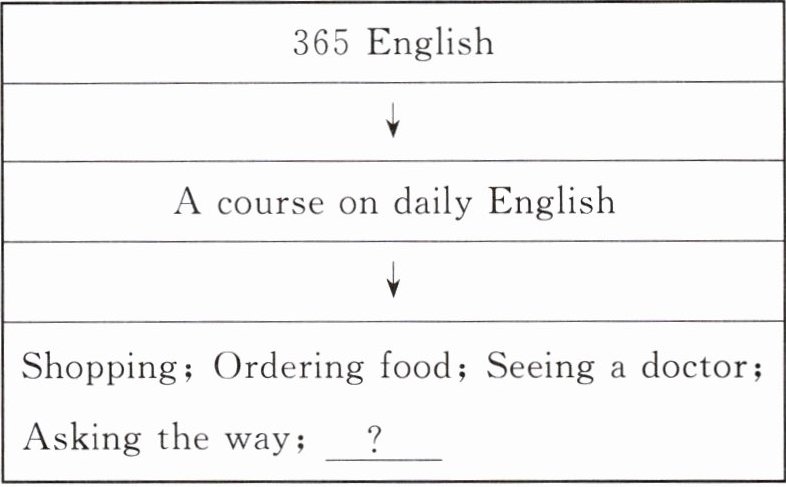
8. 思维品质 逻辑思维 Look at the chart below. Which of the following should be put in the blank?
A.Using English
B.Learning to write
C.Talking about the weather
D.Improving listening skills
A.Using English
B.Learning to write
C.Talking about the weather
D.Improving listening skills
答案:8. C 解析:根据表格内容可知,空格处需填日常英语交流中的具体场景,与购物、点餐、看医生、问路并列。A 选项 Using English 意为使用英语,范围过广;B 选项 Learning to write 意为学习写作,属于学习技能,非日常交流场景;C 选项 Talking about the weather 意为谈论天气,是日常英语交流常见场景;D 选项 Improving listening skills 意为提高听力技能,属于学习技能,非日常交流场景。结合选项,故选 C。
解析:
【分析】
首先梳理表格逻辑:最上层是“365 English”,指向“日常英语课程”,再往下是日常英语里的具体交流场景(购物、点餐、看医生、问路),所以空格需要填入和这些并列的日常英语交流具体场景。接下来逐一分析选项:先排除范围过大的选项,再排除属于英语学习技能而非日常交流场景的选项,最终找到符合要求的选项。
【解析】
根据表格内容的逻辑,空格处需要填写日常英语交流中的具体场景,要和购物、点餐、看医生、问路这类场景并列。
A选项“Using English”意为使用英语,范围过于宽泛,不符合具体场景的要求;
B选项“Learning to write”意为学习写作,属于英语学习技能,并非日常交流场景;
C选项“Talking about the weather”意为谈论天气,是日常英语交流中非常常见的具体场景,符合要求;
D选项“Improving listening skills”意为提高听力技能,属于英语学习技能,不属于日常交流场景。
综上,选C。
【答案】
C
【知识点】
日常英语交际场景
【点评】
本题考查对日常英语交际场景的辨析,需要明确日常交流场景和英语学习技能、宽泛概念的区别,注重对英语实用场景的积累。
【难度系数】
0.8
首先梳理表格逻辑:最上层是“365 English”,指向“日常英语课程”,再往下是日常英语里的具体交流场景(购物、点餐、看医生、问路),所以空格需要填入和这些并列的日常英语交流具体场景。接下来逐一分析选项:先排除范围过大的选项,再排除属于英语学习技能而非日常交流场景的选项,最终找到符合要求的选项。
【解析】
根据表格内容的逻辑,空格处需要填写日常英语交流中的具体场景,要和购物、点餐、看医生、问路这类场景并列。
A选项“Using English”意为使用英语,范围过于宽泛,不符合具体场景的要求;
B选项“Learning to write”意为学习写作,属于英语学习技能,并非日常交流场景;
C选项“Talking about the weather”意为谈论天气,是日常英语交流中非常常见的具体场景,符合要求;
D选项“Improving listening skills”意为提高听力技能,属于英语学习技能,不属于日常交流场景。
综上,选C。
【答案】
C
【知识点】
日常英语交际场景
【点评】
本题考查对日常英语交际场景的辨析,需要明确日常交流场景和英语学习技能、宽泛概念的区别,注重对英语实用场景的积累。
【难度系数】
0.8
Ⅳ. 句子翻译
1. 一场舞蹈比赛即将举办。
2. 我们应当采取行动清除有害污染。
3. 每位学生都积极参与完成了美术作品。
4. 我们将有机会为我们希望开展的活动投票。
5. 每个人都可以就如何保护环境分享想法。
1. 一场舞蹈比赛即将举办。
A dancing competition is going to be held.
2. 我们应当采取行动清除有害污染。
We should take action/act to clean up the harmful pollution.
3. 每位学生都积极参与完成了美术作品。
Every student took an active part in completing the artwork.
4. 我们将有机会为我们希望开展的活动投票。
We will have a chance to vote for activities we want to see/ hold/have/host.
5. 每个人都可以就如何保护环境分享想法。
Everyone can share ideas on how to protect the environment.
答案:Ⅳ. 1. A dancing competition is going to be held.
2. We should take action/act to clean up the harmful pollution.
3. Every student took an active part in completing the artwork.
4. We will have a chance to vote for activities we want to see/ hold/have/host.
5. Everyone can share ideas on how to protect the environment.
2. We should take action/act to clean up the harmful pollution.
3. Every student took an active part in completing the artwork.
4. We will have a chance to vote for activities we want to see/ hold/have/host.
5. Everyone can share ideas on how to protect the environment.
解析:
【分析】
这五道句子翻译题需结合语境确定时态、语态,同时灵活运用固定短语与语法结构:
1. 第1题:“舞蹈比赛”是“举办”这个动作的承受者,要用被动语态;“即将”提示使用一般将来时的被动结构be going to be done,先明确主语和对应词汇,再组织被动句式。
2. 第2题:“应当”对应情态动词should,“采取行动”可译为take action或act,“清除有害污染”是clean up the harmful pollution,直接按照主谓宾的基本结构组织句子即可。
3. 第3题:“完成了”提示句子用一般过去时,“积极参与”是固定短语take an active part in,其后接动名词形式,确定主语和宾语后组合成完整句子。
4. 第4题:“将”提示使用一般将来时,“有机会做某事”是固定搭配have a chance to do sth,“我们希望开展的活动”用省略关系代词that的定语从句修饰activities,最后整合句子。
5. 第5题:“可以”对应情态动词can,“就……分享想法”用share ideas on...结构,“如何保护环境”用疑问词how加不定式的结构作介词宾语,按逻辑组织句子。
【解析】
1. 第1题:
确定主语:一场舞蹈比赛 → A dancing competition
确定时态语态:即将举办,用一般将来时被动语态 → is going to be held
组合成完整句子:A dancing competition is going to be held.
2. 第2题:
确定主语:我们 → We
确定情态动词与核心动作:应当采取行动 → should take action/act
确定目的状语:清除有害污染 → to clean up the harmful pollution
组合成完整句子:We should take action/act to clean up the harmful pollution.
3. 第3题:
确定主语:每位学生 → Every student
确定一般过去时的谓语:积极参与 → took an active part in
确定宾语部分:完成美术作品 → completing the artwork
组合成完整句子:Every student took an active part in completing the artwork.
4. 第4题:
确定主语:我们 → We
确定一般将来时的谓语:将有机会 → will have a chance
确定宾语部分:为活动投票 → to vote for activities
确定定语从句:我们希望开展的 → we want to see/ hold/have/host(省略关系代词that)
组合成完整句子:We will have a chance to vote for activities we want to see/ hold/have/host.
5. 第5题:
确定主语:每个人 → Everyone
确定谓语:可以分享想法 → can share ideas
确定状语:就如何保护环境 → on how to protect the environment
组合成完整句子:Everyone can share ideas on how to protect the environment.
【答案】
Ⅳ. 1. A dancing competition is going to be held.
2. We should take action/act to clean up the harmful pollution.
3. Every student took an active part in completing the artwork.
4. We will have a chance to vote for activities we want to see/ hold/have/host.
5. Everyone can share ideas on how to protect the environment.
【知识点】
1. 一般将来时被动语态
2. 固定动词短语
3. 疑问词+不定式结构
【点评】
这五道翻译题涵盖了初中阶段核心英语语法与常用短语,贴合日常场景,重点考查学生对语境的理解、时态语态的判断及固定搭配的运用能力,需要学生熟练掌握相关语法规则和短语的正确搭配。
【难度系数】
0.6
这五道句子翻译题需结合语境确定时态、语态,同时灵活运用固定短语与语法结构:
1. 第1题:“舞蹈比赛”是“举办”这个动作的承受者,要用被动语态;“即将”提示使用一般将来时的被动结构be going to be done,先明确主语和对应词汇,再组织被动句式。
2. 第2题:“应当”对应情态动词should,“采取行动”可译为take action或act,“清除有害污染”是clean up the harmful pollution,直接按照主谓宾的基本结构组织句子即可。
3. 第3题:“完成了”提示句子用一般过去时,“积极参与”是固定短语take an active part in,其后接动名词形式,确定主语和宾语后组合成完整句子。
4. 第4题:“将”提示使用一般将来时,“有机会做某事”是固定搭配have a chance to do sth,“我们希望开展的活动”用省略关系代词that的定语从句修饰activities,最后整合句子。
5. 第5题:“可以”对应情态动词can,“就……分享想法”用share ideas on...结构,“如何保护环境”用疑问词how加不定式的结构作介词宾语,按逻辑组织句子。
【解析】
1. 第1题:
确定主语:一场舞蹈比赛 → A dancing competition
确定时态语态:即将举办,用一般将来时被动语态 → is going to be held
组合成完整句子:A dancing competition is going to be held.
2. 第2题:
确定主语:我们 → We
确定情态动词与核心动作:应当采取行动 → should take action/act
确定目的状语:清除有害污染 → to clean up the harmful pollution
组合成完整句子:We should take action/act to clean up the harmful pollution.
3. 第3题:
确定主语:每位学生 → Every student
确定一般过去时的谓语:积极参与 → took an active part in
确定宾语部分:完成美术作品 → completing the artwork
组合成完整句子:Every student took an active part in completing the artwork.
4. 第4题:
确定主语:我们 → We
确定一般将来时的谓语:将有机会 → will have a chance
确定宾语部分:为活动投票 → to vote for activities
确定定语从句:我们希望开展的 → we want to see/ hold/have/host(省略关系代词that)
组合成完整句子:We will have a chance to vote for activities we want to see/ hold/have/host.
5. 第5题:
确定主语:每个人 → Everyone
确定谓语:可以分享想法 → can share ideas
确定状语:就如何保护环境 → on how to protect the environment
组合成完整句子:Everyone can share ideas on how to protect the environment.
【答案】
Ⅳ. 1. A dancing competition is going to be held.
2. We should take action/act to clean up the harmful pollution.
3. Every student took an active part in completing the artwork.
4. We will have a chance to vote for activities we want to see/ hold/have/host.
5. Everyone can share ideas on how to protect the environment.
【知识点】
1. 一般将来时被动语态
2. 固定动词短语
3. 疑问词+不定式结构
【点评】
这五道翻译题涵盖了初中阶段核心英语语法与常用短语,贴合日常场景,重点考查学生对语境的理解、时态语态的判断及固定搭配的运用能力,需要学生熟练掌握相关语法规则和短语的正确搭配。
【难度系数】
0.6
Ⅴ. 完形填空
“Hey, Mike! Please don’t throw away the paper!” Tom called, rushing towards his classmate. Mike was 1, “Why not? It has just been used.”
Tom replied, “We should recycle it. If you 2 throw it away, it’ll lead to more rubbish. Waste is a big problem, and 3 it begins with each of us.”
Tom continued, “Many things we usually throw away can be reused. Old 4 can be turned into new notebooks. Plastic bottles can become pencil holders.”
Mike nodded, “You have a point, Tom. 5 our school doesn’t have a recycling programme.”
Tom’s eyes sparkled(闪耀) with excitement. “I’ve been thinking we could 6 a recycling club. We can call on students to recycle everything that can be recycled.”
Mike said, “That’s a(n) 7 idea, Tom! I want to do it with you! But we need to get the 8 of the school.”
Tom quickly 9 his plan. He asked some of his friends who cared about the 10 to join the club. On the weekend, five of his friends came to his house to talk about the idea.
During the meeting, they 11 the tasks clearly. Tom and his friend wrote a letter to the headmaster to 12 why they started this club. Two other friends made eye-catching posters to show why recycling was important. The last two friends told their classmates about the idea. They planned to talk about what could be done next during lunch breaks, and expected more students to 13 them.
A week later, they gave the headmaster their letter, posters and a petition(请愿书) with over 100 students’ names. Soon the school got all excited about their idea and 14 that students set up the recycling club.
No one was more excited than Tom. Not only was the club set up, but also he understood this 15—even a kid can play an important part and more kids can make a difference!
1. A. sad
B. angry
C. surprised
D. afraid
2. A. just
B. slowly
C. quietly
D. even
3. A. reading
B. sharing
C. solving
D. finding
4. A. plastic
B. glass
C. chalk
D. paper
5. A. And
B. But
C. So
D. Or
6. A. visit
B. write
C. start
D. name
7. A. terrible
B. easy
C. common
D. wonderful
8. A. attention
B. condition
C. money
D. support
9. A. carried out
B. put off
C. gave up
D. laughed at
10. A. safety
B. environment
C. health
D. science
11. A. showed
B. refused
C. divided
D. added
12. A. promise
B. know
C. explain
D. guess
13. A. order
B. help
C. allow
D. protect
14. A. agreed
B. enjoyed
C. believed
D. reported
15. A. habit
B. truth
C. news
D. choice
“Hey, Mike! Please don’t throw away the paper!” Tom called, rushing towards his classmate. Mike was 1, “Why not? It has just been used.”
Tom replied, “We should recycle it. If you 2 throw it away, it’ll lead to more rubbish. Waste is a big problem, and 3 it begins with each of us.”
Tom continued, “Many things we usually throw away can be reused. Old 4 can be turned into new notebooks. Plastic bottles can become pencil holders.”
Mike nodded, “You have a point, Tom. 5 our school doesn’t have a recycling programme.”
Tom’s eyes sparkled(闪耀) with excitement. “I’ve been thinking we could 6 a recycling club. We can call on students to recycle everything that can be recycled.”
Mike said, “That’s a(n) 7 idea, Tom! I want to do it with you! But we need to get the 8 of the school.”
Tom quickly 9 his plan. He asked some of his friends who cared about the 10 to join the club. On the weekend, five of his friends came to his house to talk about the idea.
During the meeting, they 11 the tasks clearly. Tom and his friend wrote a letter to the headmaster to 12 why they started this club. Two other friends made eye-catching posters to show why recycling was important. The last two friends told their classmates about the idea. They planned to talk about what could be done next during lunch breaks, and expected more students to 13 them.
A week later, they gave the headmaster their letter, posters and a petition(请愿书) with over 100 students’ names. Soon the school got all excited about their idea and 14 that students set up the recycling club.
No one was more excited than Tom. Not only was the club set up, but also he understood this 15—even a kid can play an important part and more kids can make a difference!
1. A. sad
B. angry
C. surprised
D. afraid
2. A. just
B. slowly
C. quietly
D. even
3. A. reading
B. sharing
C. solving
D. finding
4. A. plastic
B. glass
C. chalk
D. paper
5. A. And
B. But
C. So
D. Or
6. A. visit
B. write
C. start
D. name
7. A. terrible
B. easy
C. common
D. wonderful
8. A. attention
B. condition
C. money
D. support
9. A. carried out
B. put off
C. gave up
D. laughed at
10. A. safety
B. environment
C. health
D. science
11. A. showed
B. refused
C. divided
D. added
12. A. promise
B. know
C. explain
D. guess
13. A. order
B. help
C. allow
D. protect
14. A. agreed
B. enjoyed
C. believed
D. reported
15. A. habit
B. truth
C. news
D. choice
答案:Ⅴ. 1 - 5 CACDB 6 - 10 CDDAB 11 - 15 CCBAB
【语篇解读】本文是一篇记叙文,讲述了 Tom 通过倡导回收废纸发起环保行动,最终成功组建校园回收俱乐部的故事,体现个人行动对环保的重要性。
1. C 解析:根据“Why not? It has just been used.”可知,Mike 对 Tom 要求他不要把用过的纸扔掉这一行为感到惊讶。故选 C。
2. A 解析:根据“it'll lead to more rubbish”可知,如果只是把废纸扔掉,废纸就被当作垃圾处理了,等于产生了更多垃圾。故选 A。
3. C 解析:根据“Waste is a big problem”可知,是指解决这个问题。故选 C。
4. D 解析:根据“be turned into new notebooks”可知,是指旧的、用过的纸能够变成新的笔记本。故选 D。
5. B 解析:根据句意可知,Tom 说的有道理,但是学校没有要求回收,空前后是转折关系,用 But 连接。故选 B。
6. C 解析:根据“our school doesn't have a recycling programme”以及“a recycling club”可知,是指创办一个回收俱乐部。故选 C。
7. D 解析:根据“I want to do it with you!”可知,是觉得 Tom 的主意很好。故选 D。
8. D 解析:根据“get the... of the school”及前文介绍想在学校创办回收俱乐部可知,是指这一想法需要得到学校的支持。故选 D。
9. A 解析:carried out 执行;put off 推迟;gave up 放弃;laughed at 嘲笑。根据“quickly... his plan”可知,是指很快执行计划。故选 A。
10. B 解析:根据前文介绍这个俱乐部是回收俱乐部可知,此处是邀请关心环境的朋友加入该俱乐部。故选 B。
11. C 解析:根据“Tom and his friend wrote a letter to the headmaster... Two other friends made eye - catching posters to show why recycling was important.”可知,他们在分配任务。故选 C。
12. C 解析:根据“why they started this club”可知,是指解释原因。故选 C。
13. B 解析:根据“expected more students to... them”可知,是指期待更多学生来帮助他们。故选 B。
14. A 解析:根据“Soon the school got all excited about their idea”可知,学校最终同意了他们成立回收俱乐部。故选 A。
15. B 解析:根据“even a kid can play an important part and more kids can make a difference”可知,是指明白了这个道理。故选 B。
【语篇解读】本文是一篇记叙文,讲述了 Tom 通过倡导回收废纸发起环保行动,最终成功组建校园回收俱乐部的故事,体现个人行动对环保的重要性。
1. C 解析:根据“Why not? It has just been used.”可知,Mike 对 Tom 要求他不要把用过的纸扔掉这一行为感到惊讶。故选 C。
2. A 解析:根据“it'll lead to more rubbish”可知,如果只是把废纸扔掉,废纸就被当作垃圾处理了,等于产生了更多垃圾。故选 A。
3. C 解析:根据“Waste is a big problem”可知,是指解决这个问题。故选 C。
4. D 解析:根据“be turned into new notebooks”可知,是指旧的、用过的纸能够变成新的笔记本。故选 D。
5. B 解析:根据句意可知,Tom 说的有道理,但是学校没有要求回收,空前后是转折关系,用 But 连接。故选 B。
6. C 解析:根据“our school doesn't have a recycling programme”以及“a recycling club”可知,是指创办一个回收俱乐部。故选 C。
7. D 解析:根据“I want to do it with you!”可知,是觉得 Tom 的主意很好。故选 D。
8. D 解析:根据“get the... of the school”及前文介绍想在学校创办回收俱乐部可知,是指这一想法需要得到学校的支持。故选 D。
9. A 解析:carried out 执行;put off 推迟;gave up 放弃;laughed at 嘲笑。根据“quickly... his plan”可知,是指很快执行计划。故选 A。
10. B 解析:根据前文介绍这个俱乐部是回收俱乐部可知,此处是邀请关心环境的朋友加入该俱乐部。故选 B。
11. C 解析:根据“Tom and his friend wrote a letter to the headmaster... Two other friends made eye - catching posters to show why recycling was important.”可知,他们在分配任务。故选 C。
12. C 解析:根据“why they started this club”可知,是指解释原因。故选 C。
13. B 解析:根据“expected more students to... them”可知,是指期待更多学生来帮助他们。故选 B。
14. A 解析:根据“Soon the school got all excited about their idea”可知,学校最终同意了他们成立回收俱乐部。故选 A。
15. B 解析:根据“even a kid can play an important part and more kids can make a difference”可知,是指明白了这个道理。故选 B。
解析:
【分析】
做这篇完形填空时,首先要通读全文,了解文章讲述Tom倡导回收废纸并组建校园回收俱乐部的环保主题故事,把握整体逻辑。然后逐个分析每个空:
1. 结合Mike的反问“Why not? It has just been used.”,可判断他对Tom阻止扔纸的行为感到惊讶;
2. 根据“it'll lead to more rubbish”的结果,推断出“只是”扔掉废纸就会产生更多垃圾,选择合适副词;
3. 前文提到“Waste is a big problem”,自然对应“解决”这个问题;
4. 依据“turned into new notebooks”的提示,可知是旧纸张能做成新笔记本;
5. 前文Mike认同Tom的观点,后文说学校没有回收项目,前后是转折关系,选转折连词;
6. 结合学校没有回收项目的背景,Tom提出要“创办”回收俱乐部;
7. 从Mike说“I want to do it with you!”能看出他觉得这个主意很好;
8. 在学校创办俱乐部需要得到学校的“支持”,这是常识性逻辑;
9. 后文提到Tom邀请朋友、开会等行动,说明他“执行”了自己的计划;
10. 回收俱乐部和环保相关,所以邀请关心“环境”的朋友;
11. 后文介绍不同朋友做不同任务,说明他们在“分配”任务;
12. 给校长写信是为了“解释”创办俱乐部的原因;
13. 他们期待更多学生来“帮助”他们;
14. 学校对他们的想法很兴奋,所以“同意”成立俱乐部;
15. Tom明白了“即使孩子也能发挥重要作用”这个道理,即这个“真相”。
【解析】
1. C 解析:根据“Why not? It has just been used.”可知,Mike对Tom阻止他扔用过的纸的行为感到惊讶,故选C。
2. A 解析:根据“it'll lead to more rubbish”可知,如果只是把废纸扔掉,就会产生更多垃圾,just符合语境,故选A。
3. C 解析:根据“Waste is a big problem”可知,此处指解决垃圾这个大问题,solving符合语义,故选C。
4. D 解析:根据“be turned into new notebooks”可知,旧纸张可以被做成新笔记本,故选D。
5. B 解析:前文Mike认同Tom的观点,后文提到学校没有回收项目,前后为转折关系,用But连接,故选B。
6. C 解析:根据“our school doesn't have a recycling programme”以及“a recycling club”可知,Tom提议创办一个回收俱乐部,start符合语境,故选C。
7. D 解析:根据“I want to do it with you!”可知,Mike觉得Tom的主意很棒,wonderful符合语义,故选D。
8. D 解析:根据创办校园回收俱乐部的背景,可知需要得到学校的支持,support符合语境,故选D。
9. A 解析:carried out执行;put off推迟;gave up放弃;laughed at嘲笑。根据后文Tom邀请朋友、开会等行动可知,他很快执行了自己的计划,故选A。
10. B 解析:回收俱乐部属于环保项目,所以Tom邀请关心环境的朋友加入,故选B。
11. C 解析:根据后文不同朋友承担不同任务的描述,可知他们在会议上清晰地分配了任务,divided符合语义,故选C。
12. C 解析:根据“why they started this club”可知,给校长写信是为了解释创办俱乐部的原因,explain符合语境,故选C。
13. B 解析:根据“expected more students to... them”可知,他们期待更多学生来帮助他们,help符合语义,故选B。
14. A 解析:根据“Soon the school got all excited about their idea”可知,学校最终同意学生成立回收俱乐部,agreed符合语境,故选A。
15. B 解析:根据“even a kid can play an important part and more kids can make a difference”可知,Tom明白了这个道理,truth表示“真相、道理”,符合语义,故选B。
【答案】
1-5 CACDB 6-10 CDDAB 11-15 CCBAB
【知识点】
1. 语境词义辨析
2. 逻辑连词运用
3. 动词短语辨析
【点评】
本文是一篇环保主题的记叙文,通过Tom发起回收俱乐部的故事,传递了“个人行动也能为环保做贡献”的理念。解题关键在于紧密结合上下文语境,准确辨析词义、逻辑关系与短语含义,同时把握文章主题导向,有助于快速锁定答案。
【难度系数】
0.6
做这篇完形填空时,首先要通读全文,了解文章讲述Tom倡导回收废纸并组建校园回收俱乐部的环保主题故事,把握整体逻辑。然后逐个分析每个空:
1. 结合Mike的反问“Why not? It has just been used.”,可判断他对Tom阻止扔纸的行为感到惊讶;
2. 根据“it'll lead to more rubbish”的结果,推断出“只是”扔掉废纸就会产生更多垃圾,选择合适副词;
3. 前文提到“Waste is a big problem”,自然对应“解决”这个问题;
4. 依据“turned into new notebooks”的提示,可知是旧纸张能做成新笔记本;
5. 前文Mike认同Tom的观点,后文说学校没有回收项目,前后是转折关系,选转折连词;
6. 结合学校没有回收项目的背景,Tom提出要“创办”回收俱乐部;
7. 从Mike说“I want to do it with you!”能看出他觉得这个主意很好;
8. 在学校创办俱乐部需要得到学校的“支持”,这是常识性逻辑;
9. 后文提到Tom邀请朋友、开会等行动,说明他“执行”了自己的计划;
10. 回收俱乐部和环保相关,所以邀请关心“环境”的朋友;
11. 后文介绍不同朋友做不同任务,说明他们在“分配”任务;
12. 给校长写信是为了“解释”创办俱乐部的原因;
13. 他们期待更多学生来“帮助”他们;
14. 学校对他们的想法很兴奋,所以“同意”成立俱乐部;
15. Tom明白了“即使孩子也能发挥重要作用”这个道理,即这个“真相”。
【解析】
1. C 解析:根据“Why not? It has just been used.”可知,Mike对Tom阻止他扔用过的纸的行为感到惊讶,故选C。
2. A 解析:根据“it'll lead to more rubbish”可知,如果只是把废纸扔掉,就会产生更多垃圾,just符合语境,故选A。
3. C 解析:根据“Waste is a big problem”可知,此处指解决垃圾这个大问题,solving符合语义,故选C。
4. D 解析:根据“be turned into new notebooks”可知,旧纸张可以被做成新笔记本,故选D。
5. B 解析:前文Mike认同Tom的观点,后文提到学校没有回收项目,前后为转折关系,用But连接,故选B。
6. C 解析:根据“our school doesn't have a recycling programme”以及“a recycling club”可知,Tom提议创办一个回收俱乐部,start符合语境,故选C。
7. D 解析:根据“I want to do it with you!”可知,Mike觉得Tom的主意很棒,wonderful符合语义,故选D。
8. D 解析:根据创办校园回收俱乐部的背景,可知需要得到学校的支持,support符合语境,故选D。
9. A 解析:carried out执行;put off推迟;gave up放弃;laughed at嘲笑。根据后文Tom邀请朋友、开会等行动可知,他很快执行了自己的计划,故选A。
10. B 解析:回收俱乐部属于环保项目,所以Tom邀请关心环境的朋友加入,故选B。
11. C 解析:根据后文不同朋友承担不同任务的描述,可知他们在会议上清晰地分配了任务,divided符合语义,故选C。
12. C 解析:根据“why they started this club”可知,给校长写信是为了解释创办俱乐部的原因,explain符合语境,故选C。
13. B 解析:根据“expected more students to... them”可知,他们期待更多学生来帮助他们,help符合语义,故选B。
14. A 解析:根据“Soon the school got all excited about their idea”可知,学校最终同意学生成立回收俱乐部,agreed符合语境,故选A。
15. B 解析:根据“even a kid can play an important part and more kids can make a difference”可知,Tom明白了这个道理,truth表示“真相、道理”,符合语义,故选B。
【答案】
1-5 CACDB 6-10 CDDAB 11-15 CCBAB
【知识点】
1. 语境词义辨析
2. 逻辑连词运用
3. 动词短语辨析
【点评】
本文是一篇环保主题的记叙文,通过Tom发起回收俱乐部的故事,传递了“个人行动也能为环保做贡献”的理念。解题关键在于紧密结合上下文语境,准确辨析词义、逻辑关系与短语含义,同时把握文章主题导向,有助于快速锁定答案。
【难度系数】
0.6