B
A home is much more than four walls and a roof. It is the place where our personal stories show. It suggests who we are,what we love and the journey we've taken through life. At the same time,it reminds us of the times we live in. With this in mind,CGTN invites you to step into The Gateway of Time with an immersive visit to homes that shows the changes of Chinese living across the years. Using AI and AR,we invite you to have a time-travel to some homes set in three periods of China:the early years after 1949,the period after reform and opening up,and the modern day. Click here with your finger,and then let's start a historical journey.
As you enter,the first of the three homes you see is a northern Chinese village house from 1955. There is a traditional heated platform called Kang along with a set of farming tools which suggest this home belongs to a farmer. There are also some toys lying around.
The year 1955 in China was a time when most of the people lived in the countryside and the urbanization rate(城镇化率) was really low. Most of the people worked in the primary industry and the GDP per capita(人均 GDP) was 150 yuan that year,but the disposable income(可支配收入)of rural residents(农村居民) was less than half that number.
The second home is an apartment set in a big city in 1999,about 20 years after the introduction of the reform and opening-up policy in the country. The apartment is the home of a young factory worker and his wife,who is a primary school teacher. The man's parents have a background in farming,but they now spend most of their time here with their son and daughter-in-law.
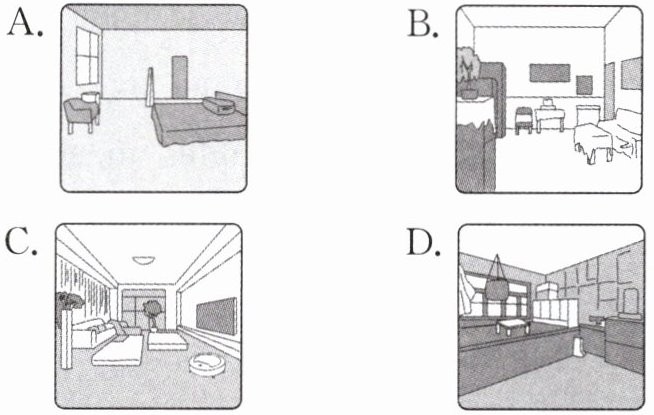
The last of the three homes is a modern Chinese home today. This smart home belongs to a young software engineer who lives here with her parents and grandparents. It is a time of prosperity(繁荣) for this family as the young engineer is progressing rapidly in her career while her father runs his own trading business and her grandparents spend their days feeling proud of their achievements.
This was a time in China when people saw huge improvements in living standards as homes became bigger and equipped with modern things like washing machines and televisions. The cities grew rapidly,with people in the city getting a little over 8,300 yuan a year.
Entering The Gateway of Time,each home you see tells more than just how people lived. It shows how the hopes,dreams and lifestyles of Chinese families have developed. It is not just an exploration of physical spaces,but a close touch of the Chinese society.
5. Which picture may be the home of the software engineer in the passage?
A.
B.
C.
D.
6. Which of the following “saw/see/seen” has the same meaning as the “saw” in Paragraph 6?
A. I think that he saw the main idea.
B. She looked for him but couldn't see him.
C. I saw a TV programme last night.
D. This sports hall has seen many football games.
7. What can we infer from the passage?
A. The travel offers a better understanding of how Chinese society has developed.
B. The technology of AI and AR makes it possible to have time travel.
C. The disposable income of rural residents was 75 yuan or so in the year of 1999.
D. Users can go back to ancient times to experience how people lived and worked.
8. Where can we find this introduction?
A. On a website.
B. On a radio.
C. In a magazine.
D. In a newspaper.
A home is much more than four walls and a roof. It is the place where our personal stories show. It suggests who we are,what we love and the journey we've taken through life. At the same time,it reminds us of the times we live in. With this in mind,CGTN invites you to step into The Gateway of Time with an immersive visit to homes that shows the changes of Chinese living across the years. Using AI and AR,we invite you to have a time-travel to some homes set in three periods of China:the early years after 1949,the period after reform and opening up,and the modern day. Click here with your finger,and then let's start a historical journey.
As you enter,the first of the three homes you see is a northern Chinese village house from 1955. There is a traditional heated platform called Kang along with a set of farming tools which suggest this home belongs to a farmer. There are also some toys lying around.
The year 1955 in China was a time when most of the people lived in the countryside and the urbanization rate(城镇化率) was really low. Most of the people worked in the primary industry and the GDP per capita(人均 GDP) was 150 yuan that year,but the disposable income(可支配收入)of rural residents(农村居民) was less than half that number.
The second home is an apartment set in a big city in 1999,about 20 years after the introduction of the reform and opening-up policy in the country. The apartment is the home of a young factory worker and his wife,who is a primary school teacher. The man's parents have a background in farming,but they now spend most of their time here with their son and daughter-in-law.
The last of the three homes is a modern Chinese home today. This smart home belongs to a young software engineer who lives here with her parents and grandparents. It is a time of prosperity(繁荣) for this family as the young engineer is progressing rapidly in her career while her father runs his own trading business and her grandparents spend their days feeling proud of their achievements.
This was a time in China when people saw huge improvements in living standards as homes became bigger and equipped with modern things like washing machines and televisions. The cities grew rapidly,with people in the city getting a little over 8,300 yuan a year.
Entering The Gateway of Time,each home you see tells more than just how people lived. It shows how the hopes,dreams and lifestyles of Chinese families have developed. It is not just an exploration of physical spaces,but a close touch of the Chinese society.
5. Which picture may be the home of the software engineer in the passage?
A.
B.
C.
D.
6. Which of the following “saw/see/seen” has the same meaning as the “saw” in Paragraph 6?
A. I think that he saw the main idea.
B. She looked for him but couldn't see him.
C. I saw a TV programme last night.
D. This sports hall has seen many football games.
7. What can we infer from the passage?
A. The travel offers a better understanding of how Chinese society has developed.
B. The technology of AI and AR makes it possible to have time travel.
C. The disposable income of rural residents was 75 yuan or so in the year of 1999.
D. Users can go back to ancient times to experience how people lived and worked.
8. Where can we find this introduction?
A. On a website.
B. On a radio.
C. In a magazine.
D. In a newspaper.
答案:5 - 8 CDAA
【语篇解读】本文是一篇说明文,主要讲了 CGTN 推出“时光之门”活动,借助 AI 和 AR 技术带人们沉浸式参观 1949 年后、改革开放后及现代三个时期的中国家庭,展现中国居住变化与社会发展,邀人开启历史之旅。
5. C 解析:图示理解题。根据“This smart home belongs to a young software engineer who lives here with her parents and grandparents.”可知,软件工程师的家是现代中国智能家居,应符合现代、智能的特点。故选 C。
6. D 解析:词义猜测题。根据“This was a time in China when people saw huge improvements in living standards as homes became bigger...”可知,此处“saw”意为“见证,经历”,主语是“time”,表示时间见证了某种变化。选项 C“seen”主语是“sports hall”,意为“体育馆见证了许多激动人心的足球比赛”,与第六段中“saw”“见证,经历”的含义一致。故选 D。
易错提醒 A. 我认为他理解了主旨。“saw”此处表示“理解,领会”。
B. 她找他,但没看见他。“see”表示“用眼睛看到(视觉上的看见)”。
C. 我昨晚看了一个电视节目。“saw”表示“观看(节目、影视等)”。
7. A 解析:推理判断题。根据最后一段“... each home you see tells more than just how people lived... but a close touch of the Chinese society.”可知,这次旅行是对中国社会的亲密接触,因此通过“时光之门”的体验,能更好地理解中国社会的发展。故选 A。
8. A 解析:文章出处题。根据文章第一段“Click here with your finger, and then let's start a historical journey.”可知,文中出现“用手指点击这里”的操作提示,这是网站页面常见的交互引导语,符合网站的呈现形式。故选 A。
【语篇解读】本文是一篇说明文,主要讲了 CGTN 推出“时光之门”活动,借助 AI 和 AR 技术带人们沉浸式参观 1949 年后、改革开放后及现代三个时期的中国家庭,展现中国居住变化与社会发展,邀人开启历史之旅。
5. C 解析:图示理解题。根据“This smart home belongs to a young software engineer who lives here with her parents and grandparents.”可知,软件工程师的家是现代中国智能家居,应符合现代、智能的特点。故选 C。
6. D 解析:词义猜测题。根据“This was a time in China when people saw huge improvements in living standards as homes became bigger...”可知,此处“saw”意为“见证,经历”,主语是“time”,表示时间见证了某种变化。选项 C“seen”主语是“sports hall”,意为“体育馆见证了许多激动人心的足球比赛”,与第六段中“saw”“见证,经历”的含义一致。故选 D。
易错提醒 A. 我认为他理解了主旨。“saw”此处表示“理解,领会”。
B. 她找他,但没看见他。“see”表示“用眼睛看到(视觉上的看见)”。
C. 我昨晚看了一个电视节目。“saw”表示“观看(节目、影视等)”。
7. A 解析:推理判断题。根据最后一段“... each home you see tells more than just how people lived... but a close touch of the Chinese society.”可知,这次旅行是对中国社会的亲密接触,因此通过“时光之门”的体验,能更好地理解中国社会的发展。故选 A。
8. A 解析:文章出处题。根据文章第一段“Click here with your finger, and then let's start a historical journey.”可知,文中出现“用手指点击这里”的操作提示,这是网站页面常见的交互引导语,符合网站的呈现形式。故选 A。
解析:
【分析】
本次阅读理解围绕CGTN推出的“时光之门”沉浸式家居体验活动展开,包含4道不同类型的题目,解题思路如下:
1. 第5题:先定位原文中软件工程师家的描述,提取“现代智能家居”“多代同居住宅”的关键信息,再对比四张图片的风格特征,匹配符合现代家居特点的选项。
2. 第6题:先明确原文中“saw”的语境含义(事物见证变化),再逐一分析各选项中“saw/see/seen”的语义,筛选出语义一致的选项。
3. 第7题:结合文章最后一段的总结内容,分析各选项的合理性,排除与原文信息不符的选项,推断出正确结论。
4. 第8题:寻找文中的关键交互线索(如“Click here”),结合不同媒介的特征,判断文章的出处。
【解析】
5. 图示理解题:根据原文“This smart home belongs to a young software engineer who lives here with her parents and grandparents.”可知,软件工程师的家是适合多代人居住的现代智能家居。对比选项,A为早期农村房屋,B为90年代城市公寓,D为功能性空间,仅C符合现代智能家居的特征,故选C。
6. 词义猜测题:原文第六段中“saw”的主语是“time”,意为“见证、经历”,表示时代见证了生活水平的提升。选项D中“seen”的主语是“sports hall”,意为“体育馆见证了诸多足球赛事”,与原文中“saw”的语义一致。A选项“saw”表“理解”,B选项“see”表“视觉上看见”,C选项“saw”表“观看节目”,均不符合,故选D。
7. 推理判断题:根据最后一段“each home you see tells more than just how people lived... but a close touch of the Chinese society.”可知,该体验能让人们近距离接触中国社会,由此可推断出它能帮助人们更好地理解中国社会的发展。B选项中AI和AR是提供沉浸式体验,并非真正的时间旅行;C选项的收入数据属于1955年,并非1999年;D选项文中未涉及古代场景,均排除,故选A。
8. 文章出处题:根据第一段“Click here with your finger,and then let's start a historical journey.”可知,“点击这里”是网站特有的交互引导语,符合网页的呈现形式,而收音机、杂志、报纸无此类交互提示,故选A。
【答案】
5-8 CDAA
【知识点】
词义猜测、推理判断、文章出处
【点评】
本文以“时光之门”活动为载体,展现了中国不同时期的家居变迁与社会发展,题目涵盖多种阅读理解题型,既考查细节捕捉能力,也考查语义理解、逻辑推理及媒介常识,能有效提升学生的综合阅读素养。
【难度系数】
0.6
本次阅读理解围绕CGTN推出的“时光之门”沉浸式家居体验活动展开,包含4道不同类型的题目,解题思路如下:
1. 第5题:先定位原文中软件工程师家的描述,提取“现代智能家居”“多代同居住宅”的关键信息,再对比四张图片的风格特征,匹配符合现代家居特点的选项。
2. 第6题:先明确原文中“saw”的语境含义(事物见证变化),再逐一分析各选项中“saw/see/seen”的语义,筛选出语义一致的选项。
3. 第7题:结合文章最后一段的总结内容,分析各选项的合理性,排除与原文信息不符的选项,推断出正确结论。
4. 第8题:寻找文中的关键交互线索(如“Click here”),结合不同媒介的特征,判断文章的出处。
【解析】
5. 图示理解题:根据原文“This smart home belongs to a young software engineer who lives here with her parents and grandparents.”可知,软件工程师的家是适合多代人居住的现代智能家居。对比选项,A为早期农村房屋,B为90年代城市公寓,D为功能性空间,仅C符合现代智能家居的特征,故选C。
6. 词义猜测题:原文第六段中“saw”的主语是“time”,意为“见证、经历”,表示时代见证了生活水平的提升。选项D中“seen”的主语是“sports hall”,意为“体育馆见证了诸多足球赛事”,与原文中“saw”的语义一致。A选项“saw”表“理解”,B选项“see”表“视觉上看见”,C选项“saw”表“观看节目”,均不符合,故选D。
7. 推理判断题:根据最后一段“each home you see tells more than just how people lived... but a close touch of the Chinese society.”可知,该体验能让人们近距离接触中国社会,由此可推断出它能帮助人们更好地理解中国社会的发展。B选项中AI和AR是提供沉浸式体验,并非真正的时间旅行;C选项的收入数据属于1955年,并非1999年;D选项文中未涉及古代场景,均排除,故选A。
8. 文章出处题:根据第一段“Click here with your finger,and then let's start a historical journey.”可知,“点击这里”是网站特有的交互引导语,符合网页的呈现形式,而收音机、杂志、报纸无此类交互提示,故选A。
【答案】
5-8 CDAA
【知识点】
词义猜测、推理判断、文章出处
【点评】
本文以“时光之门”活动为载体,展现了中国不同时期的家居变迁与社会发展,题目涵盖多种阅读理解题型,既考查细节捕捉能力,也考查语义理解、逻辑推理及媒介常识,能有效提升学生的综合阅读素养。
【难度系数】
0.6