五、按要求完成句子。
1. I'll come with my uncle this afternoon. (改为否定句)
2. My mother and father will visit Uncle Li the day after tomorrow. (对画线部分提问)
3. Helen will play the violin in the music room. (对画线部分提问)
4. My sister will have a party this Friday. (改为一般疑问句,并作肯定回答)
—
—Yes,
1. I'll come with my uncle this afternoon. (改为否定句)
I
won’t
come
with my uncle this afternoon.2. My mother and father will visit Uncle Li the day after tomorrow. (对画线部分提问)
Who
will
visit Uncle Li the day after tomorrow?3. Helen will play the violin in the music room. (对画线部分提问)
What
will
Helen play
in the music room?4. My sister will have a party this Friday. (改为一般疑问句,并作肯定回答)
—
Will
your sister have
a
party
this Friday?—Yes,
she
will
.答案:五、1. I won’t come 2. Who will 3. What will,play 4. Will,have a party,she will
1. 含有will的句子变成否定句,在will后面加not,故填I won’t come。
2. 对“人”提问用who,故填Who will。
3. 对“物品”提问用what,故填What will,play。
4. 含有will的句子改成一般疑问句,把will提前,故填Will,have a party,she will。
1. 含有will的句子变成否定句,在will后面加not,故填I won’t come。
2. 对“人”提问用who,故填Who will。
3. 对“物品”提问用what,故填What will,play。
4. 含有will的句子改成一般疑问句,把will提前,故填Will,have a party,she will。
解析:
【分析】
这几道题都是考查will引导的一般将来时的句式变换,我们可以分题梳理思路:
1. 第1题:原句是含will的一般将来时肯定句,改否定句时,只需在will后加not(可缩写为won’t),主语和动词原形保持不变即可。
2. 第2题:画线部分“My mother and father”指人,对人提问要用疑问词Who,再将原句中的will提到主语位置,构成特殊疑问句。
3. 第3题:画线部分“the violin”是谓语动词play的宾语,询问做什么要用疑问词What,特殊疑问句结构为“疑问词+will+主语+动词原形”,所以要填对应的内容。
4. 第4题:含will的一般将来时肯定句改一般疑问句,需把will提前,第一人称my改为第二人称your,动词短语保持不变;肯定回答时,用人称代词she指代my sister,再加上will即可。
【解析】
1. 原句是will引导的一般将来时肯定句,变否定句时在will后加not,缩写为won’t,主语I和动词come不变,故填I won’t come。
2. 画线部分表示人,用疑问词Who提问,将原句中的will提到主语位置,构成特殊疑问句,故填Who will。
3. 画线部分是play的宾语,询问具体做什么用疑问词What,按照特殊疑问句“疑问词+will+主语+动词原形”的结构,故填What will,play。
4. 变一般疑问句时将will提前,第一人称my改为第二人称your,动词短语have a party保持不变;肯定回答用人称代词she指代my sister,后接will,故填Will,have a party,she will。
【答案】
1. I won’t come
2. Who will
3. What will;play
4. Will;have a party;she will
【知识点】
1. 一般将来时否定句变换
2. 一般将来时特殊疑问句
3. 一般将来时一般疑问句及回答
【点评】
本题聚焦will引导的一般将来时的基础句式变换,涵盖否定句、特殊疑问句、一般疑问句及回答三类核心考点,是英语入门阶段的基础语法题型。解题核心是牢记一般将来时不同句式的结构规则,注意人称转换和疑问词的精准选择,通过反复练习可熟练掌握这类题型。
【难度系数】
0.8
这几道题都是考查will引导的一般将来时的句式变换,我们可以分题梳理思路:
1. 第1题:原句是含will的一般将来时肯定句,改否定句时,只需在will后加not(可缩写为won’t),主语和动词原形保持不变即可。
2. 第2题:画线部分“My mother and father”指人,对人提问要用疑问词Who,再将原句中的will提到主语位置,构成特殊疑问句。
3. 第3题:画线部分“the violin”是谓语动词play的宾语,询问做什么要用疑问词What,特殊疑问句结构为“疑问词+will+主语+动词原形”,所以要填对应的内容。
4. 第4题:含will的一般将来时肯定句改一般疑问句,需把will提前,第一人称my改为第二人称your,动词短语保持不变;肯定回答时,用人称代词she指代my sister,再加上will即可。
【解析】
1. 原句是will引导的一般将来时肯定句,变否定句时在will后加not,缩写为won’t,主语I和动词come不变,故填I won’t come。
2. 画线部分表示人,用疑问词Who提问,将原句中的will提到主语位置,构成特殊疑问句,故填Who will。
3. 画线部分是play的宾语,询问具体做什么用疑问词What,按照特殊疑问句“疑问词+will+主语+动词原形”的结构,故填What will,play。
4. 变一般疑问句时将will提前,第一人称my改为第二人称your,动词短语have a party保持不变;肯定回答用人称代词she指代my sister,后接will,故填Will,have a party,she will。
【答案】
1. I won’t come
2. Who will
3. What will;play
4. Will;have a party;she will
【知识点】
1. 一般将来时否定句变换
2. 一般将来时特殊疑问句
3. 一般将来时一般疑问句及回答
【点评】
本题聚焦will引导的一般将来时的基础句式变换,涵盖否定句、特殊疑问句、一般疑问句及回答三类核心考点,是英语入门阶段的基础语法题型。解题核心是牢记一般将来时不同句式的结构规则,注意人称转换和疑问词的精准选择,通过反复练习可熟练掌握这类题型。
【难度系数】
0.8
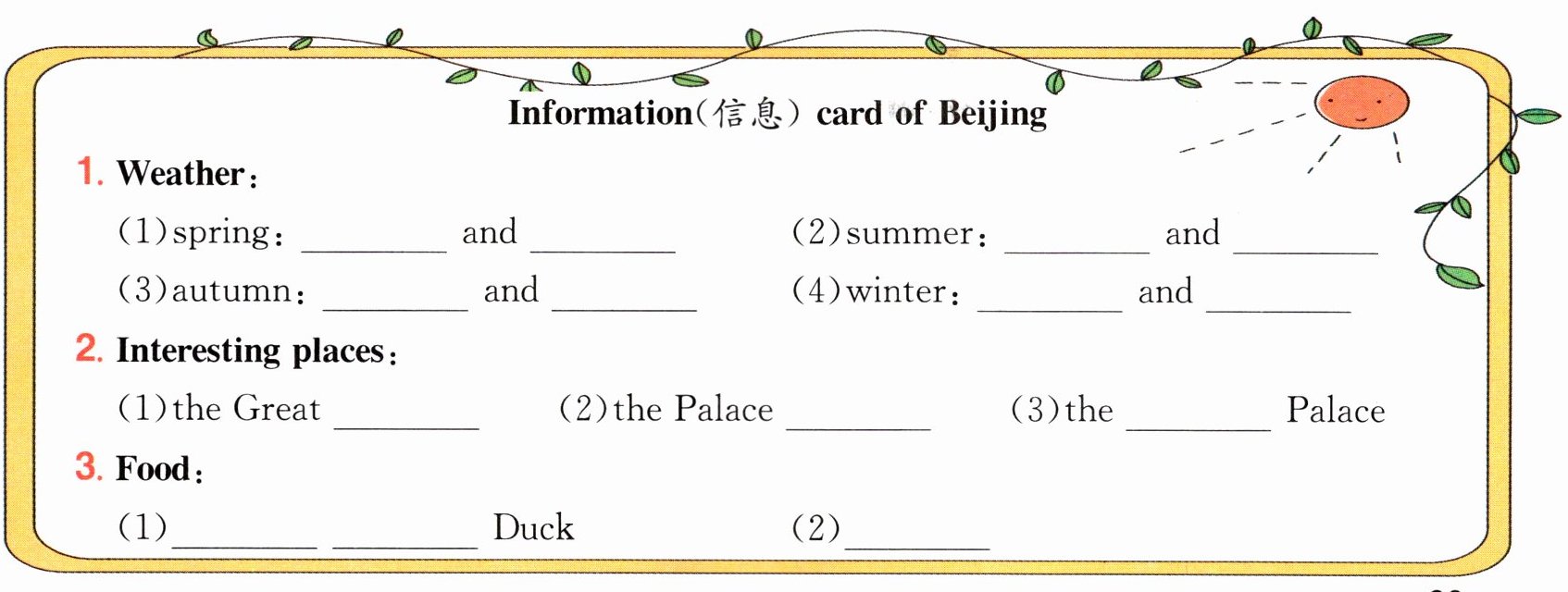
六、新考法 补全信息卡片 Bill 想去北京旅游, Wang Ning 给他写了一封邮件介绍北京。请你阅读邮件,完成信息表。
Dear Bill,
I'm very happy to get your email. I grow up in Beijing, so I can tell you a lot about this wonderful city.
In Beijing, spring is short and windy. In summer, it is usually very hot and rainy. Autumn is a very nice season here. It is usually sunny and cool. Winter is cold and dry. When you come in September, you will find the weather is very pleasant(宜人的).
There are many interesting places in Beijing. A lot of visitors come to see the Great Wall, the Palace Museum and the Summer Palace. You will learn about the history(历史) of China in these places. You will also find many modern(现代的) buildings in Beijing. Some of them are very nice.
You will find a lot of yummy and interesting food in Beijing too. Beijing Roast Duck is very famous and delicious. Many snacks here are also very nice. I can't wait to see you in Beijing. I believe you will have a great time here.
Dear Bill,
I'm very happy to get your email. I grow up in Beijing, so I can tell you a lot about this wonderful city.
In Beijing, spring is short and windy. In summer, it is usually very hot and rainy. Autumn is a very nice season here. It is usually sunny and cool. Winter is cold and dry. When you come in September, you will find the weather is very pleasant(宜人的).
There are many interesting places in Beijing. A lot of visitors come to see the Great Wall, the Palace Museum and the Summer Palace. You will learn about the history(历史) of China in these places. You will also find many modern(现代的) buildings in Beijing. Some of them are very nice.
You will find a lot of yummy and interesting food in Beijing too. Beijing Roast Duck is very famous and delicious. Many snacks here are also very nice. I can't wait to see you in Beijing. I believe you will have a great time here.
答案:六、1.(1)short,windy (2)hot,rainy (3)sunny,cool (4)cold,dry
2.(1)Wall (2)Museum (3)Summer
3.(1)Beijing Roast (2)snacks
2.(1)Wall (2)Museum (3)Summer
3.(1)Beijing Roast (2)snacks
解析:
【分析】
这道题需要我们根据邮件内容补全北京信息卡片,解题思路是:先明确信息卡的三个板块(天气、景点、食物),然后逐一回到邮件中找到对应板块的描述内容,提取关键信息进行填空。具体来说,先看天气部分的春夏秋冬,在邮件的第二段找对应季节的形容词;景点部分看邮件第三段提到的北京知名景点;食物部分看邮件第四段介绍的特色美食,把找到的关键词填入对应空格即可。
【解析】
1. Weather(天气):
邮件第二段提到“In Beijing, spring is short and windy.”,所以春天对应的是short和windy;
接着“it is usually very hot and rainy.”描述夏天,所以夏天是hot和rainy;
然后“It is usually sunny and cool.”是秋天的天气,所以秋天填sunny和cool;
最后“Winter is cold and dry.”,冬天对应cold和dry。
2. Interesting places(景点):
邮件第三段指出“A lot of visitors come to see the Great Wall, the Palace Museum and the Summer Palace.”,所以三个景点分别填Wall、Museum、Summer。
3. Food(食物):
邮件第四段提到“Beijing Roast Duck is very famous and delicious. Many snacks here are also very nice.”,所以食物部分填Beijing Roast和snacks。
【答案】
1.(1)short,windy (2)hot,rainy (3)sunny,cool (4)cold,dry
2.(1)Wall (2)Museum (3)Summer
3.(1)Beijing Roast (2)snacks
【知识点】
信息提取能力、英语专有名词、日常词汇运用
【点评】
本题通过邮件介绍北京的形式,考查学生从英语文本中提取关键信息的能力,同时涉及北京的特色天气、知名景点和传统美食,在练习英语的同时也能了解地域文化,题目难度较低,只要仔细阅读文本就能准确找到答案。
【难度系数】
0.9
这道题需要我们根据邮件内容补全北京信息卡片,解题思路是:先明确信息卡的三个板块(天气、景点、食物),然后逐一回到邮件中找到对应板块的描述内容,提取关键信息进行填空。具体来说,先看天气部分的春夏秋冬,在邮件的第二段找对应季节的形容词;景点部分看邮件第三段提到的北京知名景点;食物部分看邮件第四段介绍的特色美食,把找到的关键词填入对应空格即可。
【解析】
1. Weather(天气):
邮件第二段提到“In Beijing, spring is short and windy.”,所以春天对应的是short和windy;
接着“it is usually very hot and rainy.”描述夏天,所以夏天是hot和rainy;
然后“It is usually sunny and cool.”是秋天的天气,所以秋天填sunny和cool;
最后“Winter is cold and dry.”,冬天对应cold和dry。
2. Interesting places(景点):
邮件第三段指出“A lot of visitors come to see the Great Wall, the Palace Museum and the Summer Palace.”,所以三个景点分别填Wall、Museum、Summer。
3. Food(食物):
邮件第四段提到“Beijing Roast Duck is very famous and delicious. Many snacks here are also very nice.”,所以食物部分填Beijing Roast和snacks。
【答案】
1.(1)short,windy (2)hot,rainy (3)sunny,cool (4)cold,dry
2.(1)Wall (2)Museum (3)Summer
3.(1)Beijing Roast (2)snacks
【知识点】
信息提取能力、英语专有名词、日常词汇运用
【点评】
本题通过邮件介绍北京的形式,考查学生从英语文本中提取关键信息的能力,同时涉及北京的特色天气、知名景点和传统美食,在练习英语的同时也能了解地域文化,题目难度较低,只要仔细阅读文本就能准确找到答案。
【难度系数】
0.9