三、阅读理解(共15小题;每小题2分,满分30分)
A)阅读下面三篇短文,从短文后各题所给的A、B、C、D四个选项中,选择最佳选项。
A
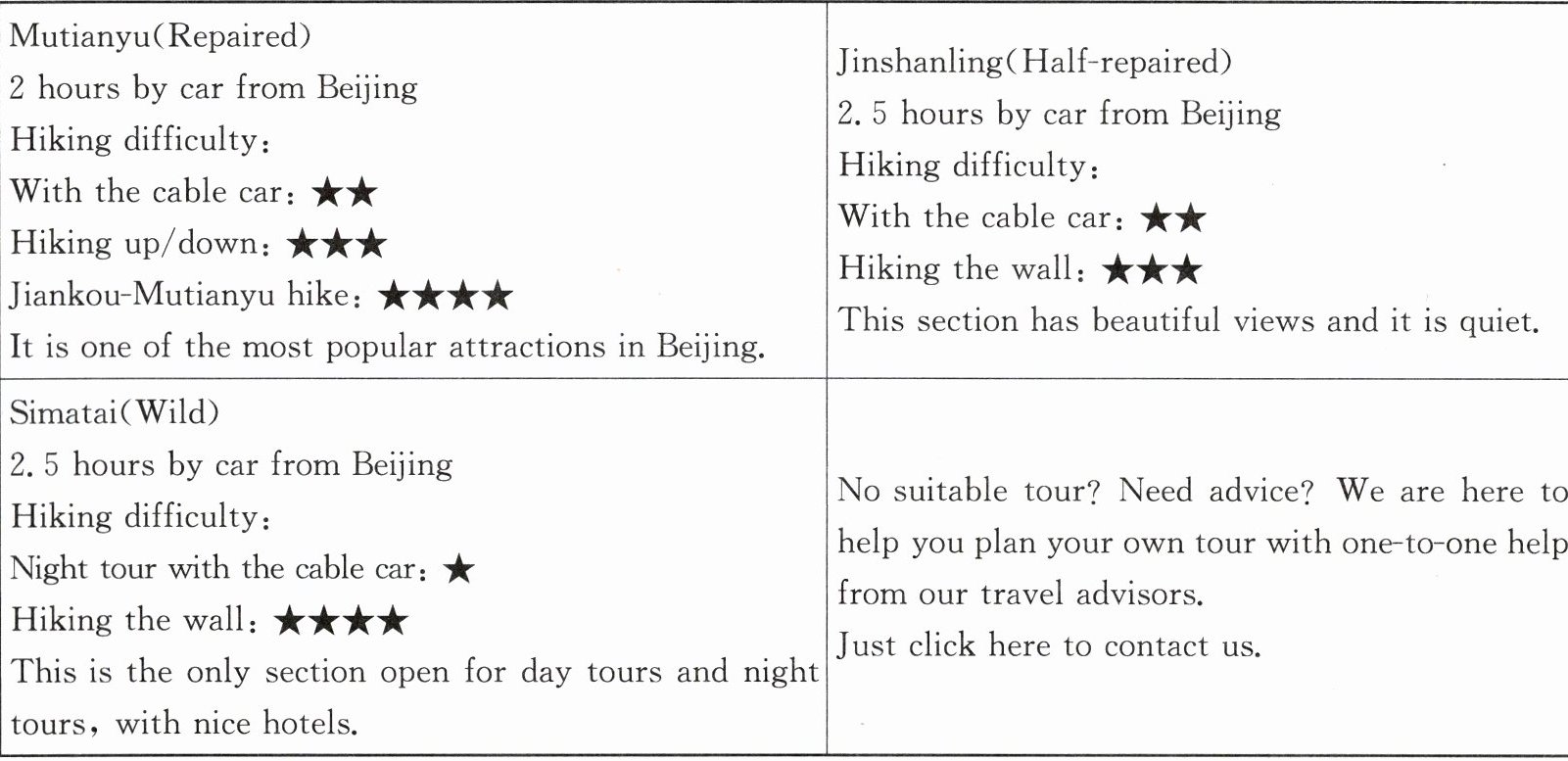
There are about nine sections(段) of the Great Wall around Beijing. Here are three sections for you to consider.
(
A. Three.
B. Five.
C. Nine.
D. Seven.
(
A. Visiting Mutianyu with the cable car.
B. Hiking from Jiankou to Mutianyu.
C. Hiking the wall in Jinshanling section.
D. Hiking up in Mutianyu section.
(
A. In a magazine.
B. In a storybook.
C. On a website.
D. In a newspaper.
A)阅读下面三篇短文,从短文后各题所给的A、B、C、D四个选项中,选择最佳选项。
A
There are about nine sections(段) of the Great Wall around Beijing. Here are three sections for you to consider.
(
A
)1. How many sections of the Great Wall are introduced in detail(详细) in the text?A. Three.
B. Five.
C. Nine.
D. Seven.
(
B
)2. Which of the following is the most difficult journey according to the text?A. Visiting Mutianyu with the cable car.
B. Hiking from Jiankou to Mutianyu.
C. Hiking the wall in Jinshanling section.
D. Hiking up in Mutianyu section.
(
C
)3. Where can we most probably read the text?A. In a magazine.
B. In a storybook.
C. On a website.
D. In a newspaper.
答案:A)1. A 【点拨】根据“Here are three sections for you to consider.”和表格内容可知,文中详细介绍了长城的三个开放区域。故选A。
2. B 【点拨】根据“Jiankou-Mutianyu hike: ★★★★”可知选B。
3. C 【点拨】根据“Just click here to contact us.”可知,是在网站上。故选C。
2. B 【点拨】根据“Jiankou-Mutianyu hike: ★★★★”可知选B。
3. C 【点拨】根据“Just click here to contact us.”可知,是在网站上。故选C。
解析:
【分析】
这是一篇信息类应用文阅读理解,解题思路非常清晰:首先带着每道题的题干关键词,回到原文和表格的对应位置定位信息,直接比对匹配就能选出答案。第一题找文中明确说明的介绍的长城段落数量,直接看开篇提示和表格里的板块数量就能得到结果;第二题把四个选项对应的徒步难度星级全部找出来对比,星数越多难度越高,就能选出最难的路线;第三题找文本末尾的标志性提示词,判断文本的出处即可。
【解析】
1. 定位原文第一段末尾句"Here are three sections for you to consider.",同时表格内分别详细介绍了慕田峪、金山岭、司马台共3段长城的位置、徒步难度、特色等信息,因此详细介绍的长城段落数量为3,选A。
2. 逐一比对各选项对应的难度星级:A选项坐缆车游览慕田峪难度为2星;B选项箭扣到慕田峪徒步难度为4星;C选项金山岭段长城徒步难度为3星;D选项慕田峪上下山徒步难度为3星,星级越高代表徒步难度越大,因此难度最高的是箭扣到慕田峪的徒步路线,选B。
3. 定位表格右下角的提示语"Just click here to contact us.","点击此处联系我们"是网页的典型交互特征,说明这篇文本最有可能出现在网站上,选C。
【答案】
1. A 2. B 3. C
【知识点】
应用文信息定位,旅游类文本阅读,网页文体特征
【点评】
本题属于低难度的广告类应用文阅读,核心考察学生快速抓取图文关键信息的能力,不需要逐句通读全文,只需要带着题干关键词定向查找对应内容就可以顺利解题,第三题的"click here"是非常明显的网页标识,很容易判断出文本出处。
【难度系数】
0.8
这是一篇信息类应用文阅读理解,解题思路非常清晰:首先带着每道题的题干关键词,回到原文和表格的对应位置定位信息,直接比对匹配就能选出答案。第一题找文中明确说明的介绍的长城段落数量,直接看开篇提示和表格里的板块数量就能得到结果;第二题把四个选项对应的徒步难度星级全部找出来对比,星数越多难度越高,就能选出最难的路线;第三题找文本末尾的标志性提示词,判断文本的出处即可。
【解析】
1. 定位原文第一段末尾句"Here are three sections for you to consider.",同时表格内分别详细介绍了慕田峪、金山岭、司马台共3段长城的位置、徒步难度、特色等信息,因此详细介绍的长城段落数量为3,选A。
2. 逐一比对各选项对应的难度星级:A选项坐缆车游览慕田峪难度为2星;B选项箭扣到慕田峪徒步难度为4星;C选项金山岭段长城徒步难度为3星;D选项慕田峪上下山徒步难度为3星,星级越高代表徒步难度越大,因此难度最高的是箭扣到慕田峪的徒步路线,选B。
3. 定位表格右下角的提示语"Just click here to contact us.","点击此处联系我们"是网页的典型交互特征,说明这篇文本最有可能出现在网站上,选C。
【答案】
1. A 2. B 3. C
【知识点】
应用文信息定位,旅游类文本阅读,网页文体特征
【点评】
本题属于低难度的广告类应用文阅读,核心考察学生快速抓取图文关键信息的能力,不需要逐句通读全文,只需要带着题干关键词定向查找对应内容就可以顺利解题,第三题的"click here"是非常明显的网页标识,很容易判断出文本出处。
【难度系数】
0.8
B(2025·江苏盐城盐都区月考改编)
Last summer I went to one of the world's most famous historical places, the Forbidden City in Beijing, China. It was the home of the emperors(皇帝) of the last two dynasties in China, the Ming and Qing Dynasties.
The Forbidden City was built in 1420. The palace has over 10,000 rooms. It was where the emperors dealt with the official business with their ministers.
In Mandarin(普通话), the Forbidden City is called the Purple Forbidden City. However, the colour of the palace itself is not purple. The colour purple means the great emperors of China have powerful right. It was so sacred(神圣的) that the commoners could not even dream of ever going in.
The emperor also had some of the largest festival celebrations at the Forbidden City. During Chinese New Year, the emperor would invite all the members of his family and his officials to a banquet. The banquet had a hundred and eight Chinese dishes. It was such an expensive banquet that it could feed a commoner's family for three generations(代).
Right now the Forbidden City is known as a historical site for tourists from all over the world. Everyone can go in there. It is a museum with priceless Chinese antiques(古董) and treasures in it. I really learned a lot about the Chinese culture and its history from this trip to the Forbidden City. It was like a dream come true to go on the trip and see the things that I had always wanted to see.
(
A. About 500 years.
B. More than 600 years.
C. 1,420 years.
D. Over 10,000 years.
(
A. power
B. honesty
C. wealth
D. health
(
A. performance
B. competition
C. exhibition
D. feast
(
A. The emperor lived there.
B. The wall of the City was purple.
C. It is a historical place for visiting.
D. The emperor had festival celebrations there.
Last summer I went to one of the world's most famous historical places, the Forbidden City in Beijing, China. It was the home of the emperors(皇帝) of the last two dynasties in China, the Ming and Qing Dynasties.
The Forbidden City was built in 1420. The palace has over 10,000 rooms. It was where the emperors dealt with the official business with their ministers.
In Mandarin(普通话), the Forbidden City is called the Purple Forbidden City. However, the colour of the palace itself is not purple. The colour purple means the great emperors of China have powerful right. It was so sacred(神圣的) that the commoners could not even dream of ever going in.
The emperor also had some of the largest festival celebrations at the Forbidden City. During Chinese New Year, the emperor would invite all the members of his family and his officials to a banquet. The banquet had a hundred and eight Chinese dishes. It was such an expensive banquet that it could feed a commoner's family for three generations(代).
Right now the Forbidden City is known as a historical site for tourists from all over the world. Everyone can go in there. It is a museum with priceless Chinese antiques(古董) and treasures in it. I really learned a lot about the Chinese culture and its history from this trip to the Forbidden City. It was like a dream come true to go on the trip and see the things that I had always wanted to see.
(
B
)4. How long is the history of the Forbidden City?A. About 500 years.
B. More than 600 years.
C. 1,420 years.
D. Over 10,000 years.
(
A
)5. We call the palace the Purple Forbidden City because colour purple stood for A
of the emperor.A. power
B. honesty
C. wealth
D. health
(
D
)6. What's the meaning of the underlined word "banquet" in Paragraph 4?A. performance
B. competition
C. exhibition
D. feast
(
B
)7. Which of the following is NOT true about the Forbidden City in the passage?A. The emperor lived there.
B. The wall of the City was purple.
C. It is a historical place for visiting.
D. The emperor had festival celebrations there.
答案:4. B 【点拨】原文提到故宫建于1420年,至今(以2026年计算)已有600多年,“more than 600 years”符合时间推算。故选B。
5. A 【点拨】根据“The colour purple means the great emperors of China have powerful right”可知,“powerful right”对应选项A“power”(权力)。故选A。
6. D 【点拨】根据“The banquet had a hundred and eight Chinese dishes.”可知,banquet是有大量菜肴的聚餐场景。故选D。
7. B 【点拨】根据“However, the colour of the palace itself is not purple.”可知,故宫本身的颜色并非紫色,B选项“城墙是紫色的”与原文矛盾。A、C、D均能在原文中找到对应表述。故选B。
5. A 【点拨】根据“The colour purple means the great emperors of China have powerful right”可知,“powerful right”对应选项A“power”(权力)。故选A。
6. D 【点拨】根据“The banquet had a hundred and eight Chinese dishes.”可知,banquet是有大量菜肴的聚餐场景。故选D。
7. B 【点拨】根据“However, the colour of the palace itself is not purple.”可知,故宫本身的颜色并非紫色,B选项“城墙是紫色的”与原文矛盾。A、C、D均能在原文中找到对应表述。故选B。
解析:
【分析】
这是一篇介绍故宫文化常识的说明文阅读,所有题目都属于细节理解类题型,解题的核心思路是先提取每道题干的关键词,回到原文对应段落定位相关内容,再将选项和原文信息逐一比对,排除干扰项即可得出正确答案:第4题提取关键词"history of the Forbidden City"找建造时间推算时长;第5题提取关键词"purple stood for"回原文找紫色的象征含义;第6题结合划线词的后文内容猜测词义;第7题逐一核对每个选项和原文内容是否匹配,选出描述错误的选项。
【解析】
4. 细节推算题:根据原文第二段"The Forbidden City was built in 1420",以当前参考年份2026计算,2026-1420=606年,可知故宫历史超过600年,对应B选项。A选项约500年不符合推算结果,C选项1420是故宫建造年份并非历史时长,D选项超10000年是和故宫房间数相关的干扰信息,均排除。
5. 细节理解题:根据原文第三段"The colour purple means the great emperors of China have powerful right",可知紫色代表皇帝的强权,对应A选项power(权力),B诚实、C财富、D健康的含义均未在原文提及,排除。
6. 词义猜测题:根据划线词后文"The banquet had a hundred and eight Chinese dishes",可知这个场合有108道菜品,属于大型聚餐宴会,D选项feast意为盛宴,符合词义。A表演、B比赛、C展览均不符合语境,排除。
7. 细节判断题:逐一核对选项:A选项皇帝住在故宫,对应原文第一段"It was the home of the emperors of the last two dynasties",描述正确;B选项故宫的墙是紫色的,和原文第三段"the colour of the palace itself is not purple"表述矛盾,描述错误;C选项故宫是可供参观的历史景点,对应原文最后一段"Right now the Forbidden City is known as a historical site for tourists from all over the world",描述正确;D选项皇帝在故宫举办节日庆典,对应原文第四段"The emperor also had some of the largest festival celebrations at the Forbidden City",描述正确。本题要求选不正确的选项,故选B。
【答案】
4. B 5. A 6. D 7. B
【知识点】
阅读理解细节定位,词义猜测,信息正误判断
【点评】
本题属于传统文化主题的基础阅读题,所有考点都可以通过回原文定位直接得出答案,没有复杂的推理要求,学生解题时只要耐心将选项和原文内容逐一比对,就能避免出错,同时还能积累和故宫相关的文化常识,提升用英语介绍中国传统文化的相关表达储备。
【难度系数】
0.85
这是一篇介绍故宫文化常识的说明文阅读,所有题目都属于细节理解类题型,解题的核心思路是先提取每道题干的关键词,回到原文对应段落定位相关内容,再将选项和原文信息逐一比对,排除干扰项即可得出正确答案:第4题提取关键词"history of the Forbidden City"找建造时间推算时长;第5题提取关键词"purple stood for"回原文找紫色的象征含义;第6题结合划线词的后文内容猜测词义;第7题逐一核对每个选项和原文内容是否匹配,选出描述错误的选项。
【解析】
4. 细节推算题:根据原文第二段"The Forbidden City was built in 1420",以当前参考年份2026计算,2026-1420=606年,可知故宫历史超过600年,对应B选项。A选项约500年不符合推算结果,C选项1420是故宫建造年份并非历史时长,D选项超10000年是和故宫房间数相关的干扰信息,均排除。
5. 细节理解题:根据原文第三段"The colour purple means the great emperors of China have powerful right",可知紫色代表皇帝的强权,对应A选项power(权力),B诚实、C财富、D健康的含义均未在原文提及,排除。
6. 词义猜测题:根据划线词后文"The banquet had a hundred and eight Chinese dishes",可知这个场合有108道菜品,属于大型聚餐宴会,D选项feast意为盛宴,符合词义。A表演、B比赛、C展览均不符合语境,排除。
7. 细节判断题:逐一核对选项:A选项皇帝住在故宫,对应原文第一段"It was the home of the emperors of the last two dynasties",描述正确;B选项故宫的墙是紫色的,和原文第三段"the colour of the palace itself is not purple"表述矛盾,描述错误;C选项故宫是可供参观的历史景点,对应原文最后一段"Right now the Forbidden City is known as a historical site for tourists from all over the world",描述正确;D选项皇帝在故宫举办节日庆典,对应原文第四段"The emperor also had some of the largest festival celebrations at the Forbidden City",描述正确。本题要求选不正确的选项,故选B。
【答案】
4. B 5. A 6. D 7. B
【知识点】
阅读理解细节定位,词义猜测,信息正误判断
【点评】
本题属于传统文化主题的基础阅读题,所有考点都可以通过回原文定位直接得出答案,没有复杂的推理要求,学生解题时只要耐心将选项和原文内容逐一比对,就能避免出错,同时还能积累和故宫相关的文化常识,提升用英语介绍中国传统文化的相关表达储备。
【难度系数】
0.85