B
①Nowadays, DeepSeek is a famous name. It's a great AI assistant that surprises everyone.
②DeepSeek is really clever. It can answer all kinds of difficult questions. You can ask about Geography, like "What is a supermoon?" It will tell you many interesting facts. It's also great for helping with schoolwork. If you have trouble(问题) with a Maths problem, don't worry! DeepSeek can show you how to work it out.
③What's more, making great AI assistants doesn't need a lot of capital or a long time. The team(团队) spent only 5.58 million for about two months. It uses a special way to work well on not-so-strong chips(芯片) and still works very well. How smart the people behind it are!
④However, DeepSeek isn't perfect. Sometimes the answers it gives may not be totally right. Because it gets information from the Internet, and there's some wrong information there. We can't always trust its answers. We should use it carefully.
⑤Another problem is about us. If we always depend on DeepSeek to answer questions, we will become lazy and stop thinking hard on our own. Our brains(头脑) need to work too!
⑥In the end, DeepSeek is a magic tool. It can help us a lot, but we need to use it wisely. We should enjoy the help it gives, but also keep our own thinking active.
(
A. Time.
B. Information.
C. Computers.
D. Money.
(
A. Because it depends on the Internet.
B. Because its answers may be wrong.
C. Because it can't answer difficult questions.
D. Because it can keep our brains active.
(
(
A. Early to bed, early to rise.
B. A friend in need is a friend indeed.
C. Love me, love my dog.
D. Every coin has two sides.
①Nowadays, DeepSeek is a famous name. It's a great AI assistant that surprises everyone.
②DeepSeek is really clever. It can answer all kinds of difficult questions. You can ask about Geography, like "What is a supermoon?" It will tell you many interesting facts. It's also great for helping with schoolwork. If you have trouble(问题) with a Maths problem, don't worry! DeepSeek can show you how to work it out.
③What's more, making great AI assistants doesn't need a lot of capital or a long time. The team(团队) spent only 5.58 million for about two months. It uses a special way to work well on not-so-strong chips(芯片) and still works very well. How smart the people behind it are!
④However, DeepSeek isn't perfect. Sometimes the answers it gives may not be totally right. Because it gets information from the Internet, and there's some wrong information there. We can't always trust its answers. We should use it carefully.
⑤Another problem is about us. If we always depend on DeepSeek to answer questions, we will become lazy and stop thinking hard on our own. Our brains(头脑) need to work too!
⑥In the end, DeepSeek is a magic tool. It can help us a lot, but we need to use it wisely. We should enjoy the help it gives, but also keep our own thinking active.
(
D
)4. What does the underlined word "capital" in Paragraph 3 mean?A. Time.
B. Information.
C. Computers.
D. Money.
(
B
)5. Why should we use DeepSeek wisely?A. Because it depends on the Internet.
B. Because its answers may be wrong.
C. Because it can't answer difficult questions.
D. Because it can keep our brains active.
(
A
)6. Which of the following shows the structure of the passage?(
D
)7. What can we learn from the passage?A. Early to bed, early to rise.
B. A friend in need is a friend indeed.
C. Love me, love my dog.
D. Every coin has two sides.
答案:4. D 【点拨】根据第三段中“The team(团队) spent only 5.58 million for about two months.”可知,此处提到了具体的花费金额,由此可推断“capital”指的是“金钱”。故选 D。
5. B 【点拨】根据第四段中“Sometimes the answers it gives may not be totally right ... We can't always trust its answers. We should use it carefully.”可知,DeepSeek 的答案可能不准确,这是需要谨慎使用的原因。故选 B。
6. A 【点拨】第一段总起介绍 DeepSeek 是著名的 AI 助手;第二、三段阐述其优点(聪明、辅助学业、研发成本低等);第四、五段指出其缺点(答案可能错误、让人懒惰);第六段总结。其为“总—分—总”结构。故选 A。
7. D 【点拨】文章既介绍了 DeepSeek 的优点,也指出了其缺点,体现了“事物都有两面性”的道理。故选 D。
5. B 【点拨】根据第四段中“Sometimes the answers it gives may not be totally right ... We can't always trust its answers. We should use it carefully.”可知,DeepSeek 的答案可能不准确,这是需要谨慎使用的原因。故选 B。
6. A 【点拨】第一段总起介绍 DeepSeek 是著名的 AI 助手;第二、三段阐述其优点(聪明、辅助学业、研发成本低等);第四、五段指出其缺点(答案可能错误、让人懒惰);第六段总结。其为“总—分—总”结构。故选 A。
7. D 【点拨】文章既介绍了 DeepSeek 的优点,也指出了其缺点,体现了“事物都有两面性”的道理。故选 D。
解析:
【分析】
这是一篇介绍AI工具DeepSeek的阅读理解题,共设置4类典型阅读题型,解题时可按题型逐个突破:1. 词义猜测题先定位划线词所在段落,结合后文出现的花费金额的描述推断词义;2. 细节理解题根据题干关键词回原文定位,找到对应原因匹配选项;3. 篇章结构题逐段梳理段落核心内容,划分段落的功能模块,匹配对应的结构图示;4. 主旨道理题结合全文既讲优点又讲缺点的内容,匹配对应的谚语道理。
【解析】
4. 词义猜测:定位到第3段划线单词capital,后文明确提到该团队仅花费558万、耗时约两个月就完成了DeepSeek的研发,花费的558万属于资金,因此capital的含义是金钱,对应选项D。
5. 细节理解:题干询问为什么要明智使用DeepSeek,回文定位到第4段,文中说明DeepSeek给出的答案有时并不完全正确,我们不能完全信任它的答案,需要谨慎使用,对应选项B。
6. 篇章结构梳理:第①段总起,引出DeepSeek是知名AI助手的核心话题;第②、③段共同介绍DeepSeek的各类优点;第④、⑤段共同指出DeepSeek存在的两类不足;第⑥段总结全文,点明要明智使用DeepSeek的观点,整体为总-分-总结构,对应选项A的图示。
7. 主旨推断:文章既介绍了DeepSeek能为我们提供诸多帮助的优势,也点明了它存在答案不准确、容易让人产生依赖的缺点,体现了事物都有两面性的核心道理,对应谚语Every coin has two sides,选D。
【答案】
4. D 5. B 6. A 7. D
【知识点】
细节理解,篇章结构,主旨推断
【点评】
本题属于初中英语常规阅读题型,话题贴近当下热点,既考查学生定位原文信息的基础阅读能力,也考查学生梳理篇章逻辑、推断生词含义和理解文章主旨的综合能力,解题时要注意所有判断都要依托原文内容,不要脱离文本主观选择。
【难度系数】
0.7
这是一篇介绍AI工具DeepSeek的阅读理解题,共设置4类典型阅读题型,解题时可按题型逐个突破:1. 词义猜测题先定位划线词所在段落,结合后文出现的花费金额的描述推断词义;2. 细节理解题根据题干关键词回原文定位,找到对应原因匹配选项;3. 篇章结构题逐段梳理段落核心内容,划分段落的功能模块,匹配对应的结构图示;4. 主旨道理题结合全文既讲优点又讲缺点的内容,匹配对应的谚语道理。
【解析】
4. 词义猜测:定位到第3段划线单词capital,后文明确提到该团队仅花费558万、耗时约两个月就完成了DeepSeek的研发,花费的558万属于资金,因此capital的含义是金钱,对应选项D。
5. 细节理解:题干询问为什么要明智使用DeepSeek,回文定位到第4段,文中说明DeepSeek给出的答案有时并不完全正确,我们不能完全信任它的答案,需要谨慎使用,对应选项B。
6. 篇章结构梳理:第①段总起,引出DeepSeek是知名AI助手的核心话题;第②、③段共同介绍DeepSeek的各类优点;第④、⑤段共同指出DeepSeek存在的两类不足;第⑥段总结全文,点明要明智使用DeepSeek的观点,整体为总-分-总结构,对应选项A的图示。
7. 主旨推断:文章既介绍了DeepSeek能为我们提供诸多帮助的优势,也点明了它存在答案不准确、容易让人产生依赖的缺点,体现了事物都有两面性的核心道理,对应谚语Every coin has two sides,选D。
【答案】
4. D 5. B 6. A 7. D
【知识点】
细节理解,篇章结构,主旨推断
【点评】
本题属于初中英语常规阅读题型,话题贴近当下热点,既考查学生定位原文信息的基础阅读能力,也考查学生梳理篇章逻辑、推断生词含义和理解文章主旨的综合能力,解题时要注意所有判断都要依托原文内容,不要脱离文本主观选择。
【难度系数】
0.7
C
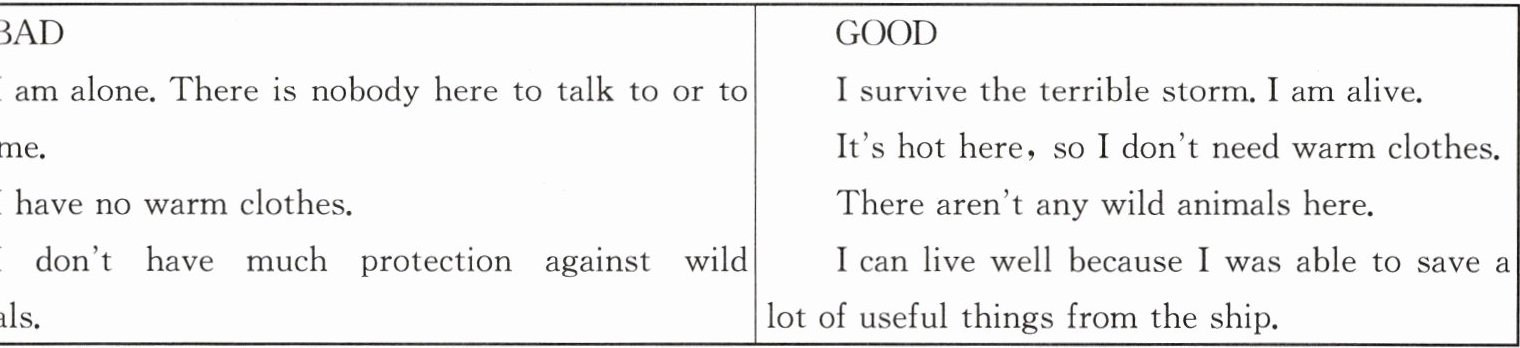
The next day I looked for a pen and some paper among my things. I made two lists: one of all the bad things about my situation, and the other of all the good things.
Sometimes it rained all day, so I had to stay inside. It was hard to read or write because the house was dark and I didn't have candles. Then I remembered in Africa people made lamps using the fat of animals. I did the same. They didn't give much light, but they were better than nothing.
I looked at my lists and thought, "These lists show something important. We can always find something good in a bad situation if we look for it. I must stop feeling sad and sorry for myself. My new life is here, on this island. I must make it as comfortable as I can."
I started by making my house stronger. I built thick walls and put branches on the roof to keep out the rain. I put up some shelves and put my things on them. I made some furniture—two tables and a chair. They weren't very beautiful but they were very useful. I made a small cave at the back of my house. It was cool and a good place to keep food. I called it my "kitchen".
Time passed quickly because I was always busy. In the mornings I went for a walk in the woods and hills with my dog. I caught birds and small animals for food. When I came back, I worked until about 11 o'clock. Then I prepared something to eat. I rested between midday and 2 o'clock because it was very hot. In the evenings I did some more work or I took out my pen and wrote about my life on the island. At 7 o'clock, I went to bed as it got dark early on the island.
(
A. On an island.
B. In a small cave.
C. At the back of a house.
D. On the shelves.
(
A. I survive the terrible storm.
B. I don't need any warm clothes.
C. There aren't wild animals here.
D. No one comes and helps me.
(
A. The top of a house.
B. A piece of furniture.
C. A shelf to put things on.
D. The place to keep food.
(
A. We can start a new life in a new place.
B. Life is hopeless when we are left alone.
C. Nobody can survive without others' help.
D. One can try to find something good in a bad situation.
The next day I looked for a pen and some paper among my things. I made two lists: one of all the bad things about my situation, and the other of all the good things.
Sometimes it rained all day, so I had to stay inside. It was hard to read or write because the house was dark and I didn't have candles. Then I remembered in Africa people made lamps using the fat of animals. I did the same. They didn't give much light, but they were better than nothing.
I looked at my lists and thought, "These lists show something important. We can always find something good in a bad situation if we look for it. I must stop feeling sad and sorry for myself. My new life is here, on this island. I must make it as comfortable as I can."
I started by making my house stronger. I built thick walls and put branches on the roof to keep out the rain. I put up some shelves and put my things on them. I made some furniture—two tables and a chair. They weren't very beautiful but they were very useful. I made a small cave at the back of my house. It was cool and a good place to keep food. I called it my "kitchen".
Time passed quickly because I was always busy. In the mornings I went for a walk in the woods and hills with my dog. I caught birds and small animals for food. When I came back, I worked until about 11 o'clock. Then I prepared something to eat. I rested between midday and 2 o'clock because it was very hot. In the evenings I did some more work or I took out my pen and wrote about my life on the island. At 7 o'clock, I went to bed as it got dark early on the island.
(
A
)8. Where did the story take place?A. On an island.
B. In a small cave.
C. At the back of a house.
D. On the shelves.
(
D
)9. Which of the following is a bad thing to "me"?A. I survive the terrible storm.
B. I don't need any warm clothes.
C. There aren't wild animals here.
D. No one comes and helps me.
(
A
)10. What does the underlined word "roof" mean?A. The top of a house.
B. A piece of furniture.
C. A shelf to put things on.
D. The place to keep food.
(
D
)11. What can we learn from the text?A. We can start a new life in a new place.
B. Life is hopeless when we are left alone.
C. Nobody can survive without others' help.
D. One can try to find something good in a bad situation.
答案:8. A 【点拨】根据最后一段中“In the evenings I did some more work or I took out my pen and wrote about my life on the island. At 7 o'clock, I went to bed as it got dark early on the island.”可知,故事发生在岛上。故选 A。
9. D 【点拨】根据表格中“I am alone. There is nobody here to talk to or to help me.”可知,没有人来帮助“我”,对“我”来说是坏事。故选 D。
10. A 【点拨】根据第四段中“I started by making my house stronger. I built thick walls and put branches on the roof to keep out the rain.”可知,“roof”是屋顶的意思。故选 A。
11. D 【点拨】根据第三段中“We can always find something good in a bad situation if we look for it.”并结合全文内容可知,一个人可以尝试在糟糕的情况下找到好的东西。故选 D。
9. D 【点拨】根据表格中“I am alone. There is nobody here to talk to or to help me.”可知,没有人来帮助“我”,对“我”来说是坏事。故选 D。
10. A 【点拨】根据第四段中“I started by making my house stronger. I built thick walls and put branches on the roof to keep out the rain.”可知,“roof”是屋顶的意思。故选 A。
11. D 【点拨】根据第三段中“We can always find something good in a bad situation if we look for it.”并结合全文内容可知,一个人可以尝试在糟糕的情况下找到好的东西。故选 D。
解析:
【分析】
这是一篇记叙文阅读理解,解题时可以先明确每道题的考点,带着题干关键词回到原文定位对应内容即可快速得出答案:第8题询问故事发生的地点,直接查找文中出现地点描述的语句就能锁定答案;第9题需要区分文中列出的“坏事”和“好事”,对照给出的两个列表排除属于好事的选项即可;第10题是词义猜测题,结合上下文动作“铺树枝挡雨”和房屋建造的常识就能推断词义;第11题是主旨理解题,找到作者直接点明感悟的语句就能匹配正确选项。
【解析】
8. 细节查找题:定位原文最后一段的语句“I wrote about my life on the island. At 7 o'clock, I went to bed as it got dark early on the island”,可以直接确认故事发生在岛上,因此选A。
9. 细节查找题:对照文中的BAD列表,内容包含“我孤身一人,没有可以交谈、求助的人”,而A、B、C三个选项都属于右侧GOOD列表里的好事,只有D选项“没有人来帮助我”属于对“我”而言的坏事,因此选D。
10. 词义猜测题:划线词所在句的上下文提到“我加固房屋,砌了厚墙,把树枝铺在______上来阻挡雨水”,结合生活常识,房屋用来挡雨的顶部就是roof,对应A选项“房屋的顶部”,因此选A。
11. 主旨理解题:定位原文第三段作者的感悟“We can always find something good in a bad situation if we look for it”,这是全文传递的核心道理,其余选项A偏离文章核心,B、C的表述和原文积极面对困境的内容相悖,因此选D。
【答案】
8.A 9.D 10.A 11.D
【知识点】
阅读理解细节定位,词义猜测,主旨理解
【点评】
本题选取荒岛求生主题的经典文本节选,题目设置以细节查找为主,难度梯度平缓,既锻炼学生快速从文本中提取关键信息的能力,也引导学生理解面对困境时保持积极心态的重要性,易错点是第11题容易误选偏离主旨的干扰项,需要学生准确抓住作者的核心观点。
【难度系数】
0.8
这是一篇记叙文阅读理解,解题时可以先明确每道题的考点,带着题干关键词回到原文定位对应内容即可快速得出答案:第8题询问故事发生的地点,直接查找文中出现地点描述的语句就能锁定答案;第9题需要区分文中列出的“坏事”和“好事”,对照给出的两个列表排除属于好事的选项即可;第10题是词义猜测题,结合上下文动作“铺树枝挡雨”和房屋建造的常识就能推断词义;第11题是主旨理解题,找到作者直接点明感悟的语句就能匹配正确选项。
【解析】
8. 细节查找题:定位原文最后一段的语句“I wrote about my life on the island. At 7 o'clock, I went to bed as it got dark early on the island”,可以直接确认故事发生在岛上,因此选A。
9. 细节查找题:对照文中的BAD列表,内容包含“我孤身一人,没有可以交谈、求助的人”,而A、B、C三个选项都属于右侧GOOD列表里的好事,只有D选项“没有人来帮助我”属于对“我”而言的坏事,因此选D。
10. 词义猜测题:划线词所在句的上下文提到“我加固房屋,砌了厚墙,把树枝铺在______上来阻挡雨水”,结合生活常识,房屋用来挡雨的顶部就是roof,对应A选项“房屋的顶部”,因此选A。
11. 主旨理解题:定位原文第三段作者的感悟“We can always find something good in a bad situation if we look for it”,这是全文传递的核心道理,其余选项A偏离文章核心,B、C的表述和原文积极面对困境的内容相悖,因此选D。
【答案】
8.A 9.D 10.A 11.D
【知识点】
阅读理解细节定位,词义猜测,主旨理解
【点评】
本题选取荒岛求生主题的经典文本节选,题目设置以细节查找为主,难度梯度平缓,既锻炼学生快速从文本中提取关键信息的能力,也引导学生理解面对困境时保持积极心态的重要性,易错点是第11题容易误选偏离主旨的干扰项,需要学生准确抓住作者的核心观点。
【难度系数】
0.8