A)阅读下面三篇短文,从短文后各题所给的 A、B、C、D 四个选项中,选择最佳选项。
A
(
A. Fixing broken windows.
B. Leaving a TV on while sleeping.
C. Using LED bulbs in the kitchen.
D. Choosing electronic devices with energy-saving labels.
(
A. It costs less to build.
B. It needs less cleaning.
C. It looks more modern.
D. It keeps the air inside.
(
A. sell energy-saving bulbs
B. introduce how computers work
C. explain how electricity is made
D. teach ways to reduce home energy consumption(消耗)
A
(
B
)1. Which action would the writer most likely(可能地) disagree with?A. Fixing broken windows.
B. Leaving a TV on while sleeping.
C. Using LED bulbs in the kitchen.
D. Choosing electronic devices with energy-saving labels.
(
D
)2. What can we learn about a well-sealed house?A. It costs less to build.
B. It needs less cleaning.
C. It looks more modern.
D. It keeps the air inside.
(
D
)3. The writer wrote the passage to .A. sell energy-saving bulbs
B. introduce how computers work
C. explain how electricity is made
D. teach ways to reduce home energy consumption(消耗)
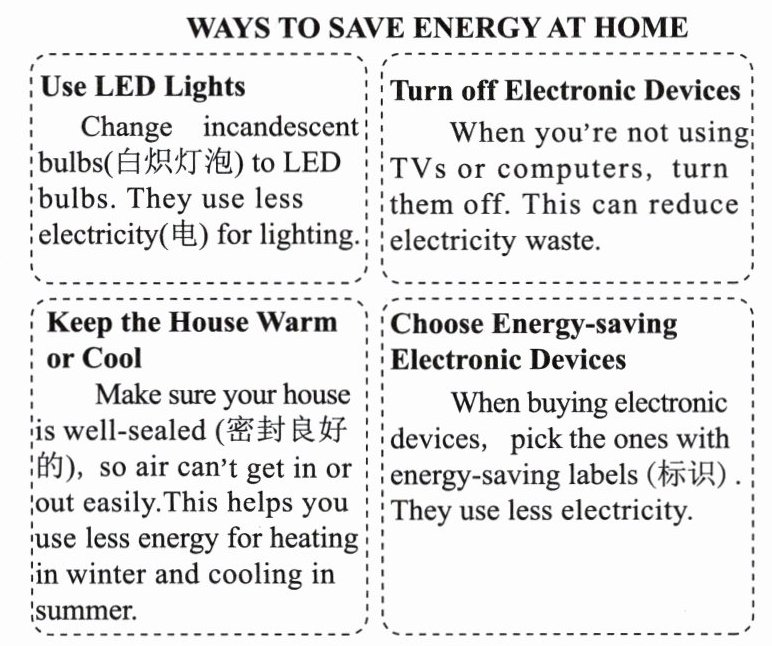
答案:A)1.B 【点拨】根据“When you're not using TVs or computers, turn them off.”可知,作者建议不用电视时要关掉,而“睡觉时让电视开着”与作者的观点相悖,所以作者最可能不同意这个行为。故选B。
2.D 【点拨】根据“Keep the House Warm or Cool”部分的“Make sure your house is well-sealed(密封良好的), so air can't get in or out easily.”可知,密封良好的房屋能让空气不容易进出。故选D。
3.D 【点拨】文章标题是“WAYS TO SAVE ENERGY AT HOME”,作者写这篇材料是为了教大家减少家庭能源消耗的方法。故选D。
2.D 【点拨】根据“Keep the House Warm or Cool”部分的“Make sure your house is well-sealed(密封良好的), so air can't get in or out easily.”可知,密封良好的房屋能让空气不容易进出。故选D。
3.D 【点拨】文章标题是“WAYS TO SAVE ENERGY AT HOME”,作者写这篇材料是为了教大家减少家庭能源消耗的方法。故选D。
解析:
【分析】
这是一篇家庭节能主题的应用文阅读,解题时可以带着题干关键词回到原文对应板块定位信息,不需要复杂推理就能选出答案:第1题要找出作者反对的行为,逐个把四个选项和文中四条节能建议比对,排除符合原文倡导的行为,剩下的就是作者不认同的;第2题直接定位到“Keep the House Warm or Cool”板块里关于密封良好的房屋的描述,匹配对应选项即可;第3题是主旨题,直接结合文章标题和全文内容就能判断写作目的。
【解析】
1. 逐一核对选项:
选项A:修理破损窗户,符合房屋要密封良好的节能要求,是作者支持的行为;
选项B:睡觉时让电视一直开着,和“Turn off Electronic Devices”板块提到的“不用电视、电脑时要关掉,减少电力浪费”的建议完全相悖,是作者最可能不同意的行为;
选项C:厨房使用LED灯泡,符合“Use LED Lights”板块的节能建议,是作者支持的行为;
选项D:选择带有节能标识的电器,符合“Choose Energy-saving Electronic Devices”板块的建议,是作者支持的行为。
因此本题选B。
2. 定位到“Keep the House Warm or Cool”板块的原文描述“Make sure your house is well-sealed(密封良好的), so air can't get in or out easily”,可知密封良好的房屋空气很难随意进出,对应“它留住内部的空气”的描述,选项A建造价格更低、选项B需要更少清洁、选项C外观更现代在原文中均无提及,因此本题选D。
3. 文章标题为“WAYS TO SAVE ENERGY AT HOME”,全文四个板块都在介绍家庭场景下的具体节能方法,因此作者的写作目的是教大家减少家庭能源消耗的方法,选项A售卖节能灯泡、选项B介绍电脑工作原理、选项C解释电力的生成方式均不符合原文内容,因此本题选D。
【答案】
1.B 2.D 3.D
【知识点】
应用文细节查找,主旨大意判断
【点评】
本题属于非常基础的信息类阅读,所有题目的正确答案都能直接在原文中找到对应内容,几乎不需要额外推理,适合刚接触英语应用文阅读的学生练习,只要掌握题干关键词定位的技巧就能快速选出正确答案,整体得分率很高。
【难度系数】
0.9
这是一篇家庭节能主题的应用文阅读,解题时可以带着题干关键词回到原文对应板块定位信息,不需要复杂推理就能选出答案:第1题要找出作者反对的行为,逐个把四个选项和文中四条节能建议比对,排除符合原文倡导的行为,剩下的就是作者不认同的;第2题直接定位到“Keep the House Warm or Cool”板块里关于密封良好的房屋的描述,匹配对应选项即可;第3题是主旨题,直接结合文章标题和全文内容就能判断写作目的。
【解析】
1. 逐一核对选项:
选项A:修理破损窗户,符合房屋要密封良好的节能要求,是作者支持的行为;
选项B:睡觉时让电视一直开着,和“Turn off Electronic Devices”板块提到的“不用电视、电脑时要关掉,减少电力浪费”的建议完全相悖,是作者最可能不同意的行为;
选项C:厨房使用LED灯泡,符合“Use LED Lights”板块的节能建议,是作者支持的行为;
选项D:选择带有节能标识的电器,符合“Choose Energy-saving Electronic Devices”板块的建议,是作者支持的行为。
因此本题选B。
2. 定位到“Keep the House Warm or Cool”板块的原文描述“Make sure your house is well-sealed(密封良好的), so air can't get in or out easily”,可知密封良好的房屋空气很难随意进出,对应“它留住内部的空气”的描述,选项A建造价格更低、选项B需要更少清洁、选项C外观更现代在原文中均无提及,因此本题选D。
3. 文章标题为“WAYS TO SAVE ENERGY AT HOME”,全文四个板块都在介绍家庭场景下的具体节能方法,因此作者的写作目的是教大家减少家庭能源消耗的方法,选项A售卖节能灯泡、选项B介绍电脑工作原理、选项C解释电力的生成方式均不符合原文内容,因此本题选D。
【答案】
1.B 2.D 3.D
【知识点】
应用文细节查找,主旨大意判断
【点评】
本题属于非常基础的信息类阅读,所有题目的正确答案都能直接在原文中找到对应内容,几乎不需要额外推理,适合刚接触英语应用文阅读的学生练习,只要掌握题干关键词定位的技巧就能快速选出正确答案,整体得分率很高。
【难度系数】
0.9
B
The materials of a product are usually our first focus. What is it made of? Are there any harmful chemicals in it? Green products are made of more natural materials which are free from harmful chemicals, so they can be good for our physical health.
Packaging(包装) is important. How is a product packaged? Is it over-packaged? We'd bette choose glass, metal and paper packaging, as these can be reused or more easily recycled. We can also look for less packaging or even choose unpackaged products whenever possible.
The location(地点) matters. Where is a product made? Where do we buy it? Think about the energy used to transport it. So try to choose local products. When it comes to food, it is a good idea to order directly from local farmers, shop at markets and buy fruit in season. Buying from stores near our houses is also a good choice because we can go there without driving a car.
Look into what the company tells us about their products. It's easy to say that a product is "green" or "all natural", but the words may be too good to be true. So, much of the information about a product should be taken with a grain of salt. After all, companies try to make us believe that their products are environmentally friendly.
▲ Things like food and clothing are necessary for life. But many others are not. It's better to leave an unnecessary product on the shelf than to buy it. It sends a message to the producer, keeps money in our pockets, reduces waste and keeps the planet green.
(
①a glass of honey
②a plastic bag of chips
③an over-packaged gift
④a box of chocolate with paper packaging
⑤fruit without packaging
A. ①②③
B. ①④⑤
C. ③④⑤
D. ①②⑤
(
A. We should only buy products near our houses.
B. We should know all the information about a product.
C. We should buy fewer unnecessary products in our life.
D. We should pay little attention to the materials of a product.
(
A. The greenest product is the one you never buy.
B. Try your best to live a green and healthy life.
C. Let the producer know you are a smart buyer.
D. Save money, reduce waste and keep green.
(
A. To teach us how to tell different materials.
B. To tell us how to save money for ourselves.
C. To tell us all the companies should be green.
D. To give advice on how to be a green customer.
The materials of a product are usually our first focus. What is it made of? Are there any harmful chemicals in it? Green products are made of more natural materials which are free from harmful chemicals, so they can be good for our physical health.
Packaging(包装) is important. How is a product packaged? Is it over-packaged? We'd bette choose glass, metal and paper packaging, as these can be reused or more easily recycled. We can also look for less packaging or even choose unpackaged products whenever possible.
The location(地点) matters. Where is a product made? Where do we buy it? Think about the energy used to transport it. So try to choose local products. When it comes to food, it is a good idea to order directly from local farmers, shop at markets and buy fruit in season. Buying from stores near our houses is also a good choice because we can go there without driving a car.
Look into what the company tells us about their products. It's easy to say that a product is "green" or "all natural", but the words may be too good to be true. So, much of the information about a product should be taken with a grain of salt. After all, companies try to make us believe that their products are environmentally friendly.
▲ Things like food and clothing are necessary for life. But many others are not. It's better to leave an unnecessary product on the shelf than to buy it. It sends a message to the producer, keeps money in our pockets, reduces waste and keeps the planet green.
(
B
)4. When we go shopping in the supermarket, we should buy products with green packaging, such as .①a glass of honey
②a plastic bag of chips
③an over-packaged gift
④a box of chocolate with paper packaging
⑤fruit without packaging
A. ①②③
B. ①④⑤
C. ③④⑤
D. ①②⑤
(
C
)5. What can we learn from the passage?A. We should only buy products near our houses.
B. We should know all the information about a product.
C. We should buy fewer unnecessary products in our life.
D. We should pay little attention to the materials of a product.
(
A
)6. Which of the following is the best to fill in "▲"?A. The greenest product is the one you never buy.
B. Try your best to live a green and healthy life.
C. Let the producer know you are a smart buyer.
D. Save money, reduce waste and keep green.
(
D
)7. Why does the author write the passage?A. To teach us how to tell different materials.
B. To tell us how to save money for ourselves.
C. To tell us all the companies should be green.
D. To give advice on how to be a green customer.
答案:4.B 【点拨】根据第二段内容可知,我们应选择环保包装,如玻璃、金属和纸包装,尽量选择无包装或包装少的产品。故选B。
5.C 【点拨】根据“It's better to leave an unnecessary product on the shelf than to buy it.”可知,我们应该在生活中少买不必要的产品。故选C。
6.A 【点拨】根据后文可知,最环保的产品就是你永远不买的产品。故选A。
7.D 【点拨】通读全文可知,本文从产品材料、包装、购买地点、对产品信息的判断以及减少不必要产品的购买等方面,给出了如何成为环保消费者的建议。故选D。
5.C 【点拨】根据“It's better to leave an unnecessary product on the shelf than to buy it.”可知,我们应该在生活中少买不必要的产品。故选C。
6.A 【点拨】根据后文可知,最环保的产品就是你永远不买的产品。故选A。
7.D 【点拨】通读全文可知,本文从产品材料、包装、购买地点、对产品信息的判断以及减少不必要产品的购买等方面,给出了如何成为环保消费者的建议。故选D。
解析:
【分析】
这是一篇介绍绿色消费相关知识的说明文阅读理解,解题时首先要通读全文,梳理出文章从产品材料、包装、选购产地、甄别商家宣传、减少非必要购买五个维度给出绿色消费建议的核心脉络。之后逐题对应原文定位信息:细节题直接找到对应段落核对选项正误,主旨类、句段补全类题目结合对应段落的核心内容匹配最贴合的选项,排除表述片面、和原文矛盾的干扰项即可得出正确答案。
【解析】
1. 第4题:定位文章第二段关于包装的描述,原文明确说明要选择玻璃、金属、这类可重复利用、易回收的包装,优先选少包装甚至无包装的产品,反对过度包装。逐一核对选项内容:①玻璃装蜂蜜符合玻璃包装的环保要求;②塑料袋装薯片属于塑料包装,不符合环保要求;③过度包装的礼物是原文明确反对的;④纸包装的巧克力符合环保要求;⑤无包装的水果符合优先选无包装产品的要求。符合要求的是①④⑤,对应选项B。
2. 第5题:逐一核对选项和原文内容:A选项“我们只能买家附近的产品”和原文“尽量选本地产品、家附近门店是好选择”的表述不符,属于过度绝对;B选项“我们要了解产品的全部信息”和原文“很多产品宣传信息要持保留怀疑态度”的表述不符;C选项“生活中我们应该少买不必要的产品”完全匹配原文“没必要的产品最好留在货架上不要购买”的内容;D选项“我们几乎不用关注产品的材料”和原文第一段“产品材料是我们首要关注的内容”表述矛盾。因此正确选项为C。
3. 第6题:空缺处是最后一段的段首主题句,后文核心内容是除了衣食这类生活必需品,很多商品都没有购买必要,不买非必要产品既省钱减浪费还环保。A选项“最环保的产品是你从来不会买的那一个”完全契合段落核心;B选项表述过于宽泛,没有贴合本段“不买非必要产品”的核心;C选项只提及让生产商知道你是聪明买家,无法总领全段;D选项是不买非必要产品的好处,不能作为段首总起句。因此选A。
4. 第7题:通读全文可知,文章所有内容都是围绕如何践行绿色消费、成为环保消费者给出相关建议。A选项“教大家分辨不同材料”只是文章的部分内容,过于片面;B选项“教大家省钱”不是文章核心目的;C选项“要求所有公司都要做到环保”原文完全没有提及;只有D选项“给出如何成为绿色消费者的相关建议”完全匹配全文的写作目的。因此选D。
【答案】
4.B 5.C 6.A 7.D
【知识点】
细节信息查找,主旨大意判断,阅读逻辑推理
【点评】
本题属于环保主题的常规初中英语阅读题,考点覆盖了细节理解、段首句补全、主旨判断、写作目的四类高频阅读题型,解题的核心技巧是精准定位原文对应区间,注意排除表述绝对化、以偏概全的干扰项,整体难度不高,适合锻炼学生说明文阅读的信息提取能力。
【难度系数】
0.7
这是一篇介绍绿色消费相关知识的说明文阅读理解,解题时首先要通读全文,梳理出文章从产品材料、包装、选购产地、甄别商家宣传、减少非必要购买五个维度给出绿色消费建议的核心脉络。之后逐题对应原文定位信息:细节题直接找到对应段落核对选项正误,主旨类、句段补全类题目结合对应段落的核心内容匹配最贴合的选项,排除表述片面、和原文矛盾的干扰项即可得出正确答案。
【解析】
1. 第4题:定位文章第二段关于包装的描述,原文明确说明要选择玻璃、金属、这类可重复利用、易回收的包装,优先选少包装甚至无包装的产品,反对过度包装。逐一核对选项内容:①玻璃装蜂蜜符合玻璃包装的环保要求;②塑料袋装薯片属于塑料包装,不符合环保要求;③过度包装的礼物是原文明确反对的;④纸包装的巧克力符合环保要求;⑤无包装的水果符合优先选无包装产品的要求。符合要求的是①④⑤,对应选项B。
2. 第5题:逐一核对选项和原文内容:A选项“我们只能买家附近的产品”和原文“尽量选本地产品、家附近门店是好选择”的表述不符,属于过度绝对;B选项“我们要了解产品的全部信息”和原文“很多产品宣传信息要持保留怀疑态度”的表述不符;C选项“生活中我们应该少买不必要的产品”完全匹配原文“没必要的产品最好留在货架上不要购买”的内容;D选项“我们几乎不用关注产品的材料”和原文第一段“产品材料是我们首要关注的内容”表述矛盾。因此正确选项为C。
3. 第6题:空缺处是最后一段的段首主题句,后文核心内容是除了衣食这类生活必需品,很多商品都没有购买必要,不买非必要产品既省钱减浪费还环保。A选项“最环保的产品是你从来不会买的那一个”完全契合段落核心;B选项表述过于宽泛,没有贴合本段“不买非必要产品”的核心;C选项只提及让生产商知道你是聪明买家,无法总领全段;D选项是不买非必要产品的好处,不能作为段首总起句。因此选A。
4. 第7题:通读全文可知,文章所有内容都是围绕如何践行绿色消费、成为环保消费者给出相关建议。A选项“教大家分辨不同材料”只是文章的部分内容,过于片面;B选项“教大家省钱”不是文章核心目的;C选项“要求所有公司都要做到环保”原文完全没有提及;只有D选项“给出如何成为绿色消费者的相关建议”完全匹配全文的写作目的。因此选D。
【答案】
4.B 5.C 6.A 7.D
【知识点】
细节信息查找,主旨大意判断,阅读逻辑推理
【点评】
本题属于环保主题的常规初中英语阅读题,考点覆盖了细节理解、段首句补全、主旨判断、写作目的四类高频阅读题型,解题的核心技巧是精准定位原文对应区间,注意排除表述绝对化、以偏概全的干扰项,整体难度不高,适合锻炼学生说明文阅读的信息提取能力。
【难度系数】
0.7