八、警察叔叔正在进行"文明出行"主题的宣讲。请根据中文提示,完成警察叔叔的发言稿。(每小题2分,共10分)
There is something we must know: There are 1.
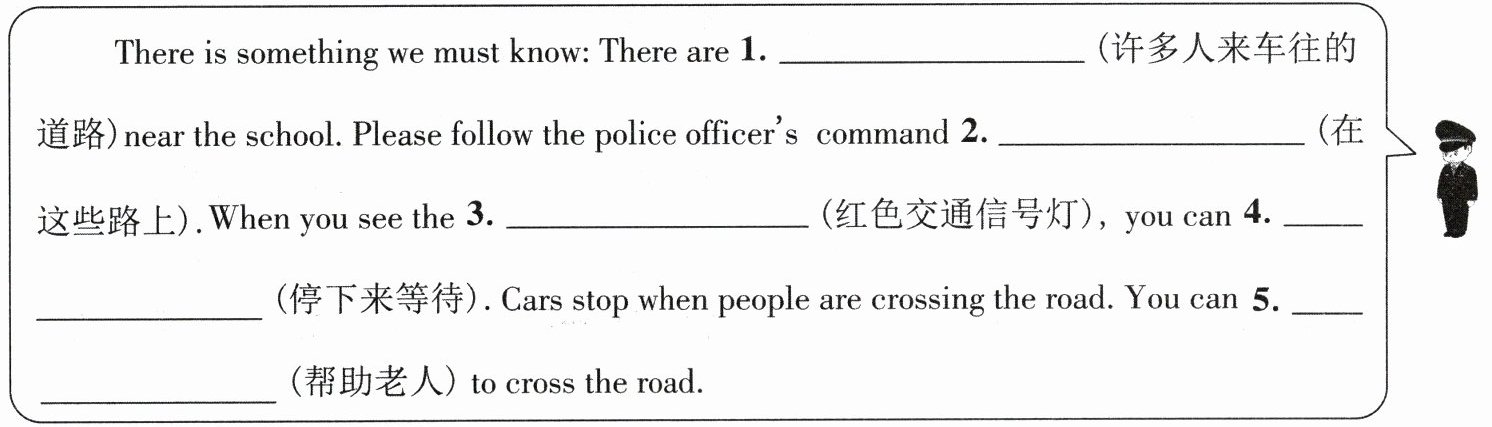
There is something we must know: There are 1.
many busy roads
(许多人来车往的道路) near the school. Please follow the police officer's command 2. on these roads
(在这些路上). When you see the 3. red traffic light
(红色交通信号灯), you can 4. stop and wait
(停下来等待). Cars stop when people are crossing the road. You can 5. help old people
(帮助老人) to cross the road.答案:1. many busy roads 2. on these roads 3. red traffic light 4. stop and wait 5. help old people
解析:
【分析】
这是一道根据中文提示完成英文发言稿的题目,解题时需先结合语境理解每个中文提示的含义,再将其转化为符合英文表达习惯的短语:
1. 第一空“许多人来车往的道路”,“人来车往”指道路繁忙,对应英文“busy”,“许多道路”用“many roads”,组合起来就是符合语境的表达;
2. 第二空“在这些路上”,英文中表示“在道路上”常用介词“on”,“这些路”是“these roads”,直接搭配即可;
3. 第三空“红色交通信号灯”,对应常见的交通用语“red traffic light”;
4. 第四空“停下来等待”,是两个连续的动作,用“and”连接“stop”和“wait”即可;
5. 第五空“帮助老人”,“帮助”是“help”,“老人”常用“old people”,直接组成短语。
【解析】
1. “许多人来车往的道路”:“人来车往的”译为“busy”,“许多道路”译为“many roads”,所以填many busy roads;
2. “在这些路上”:在道路上用介词“on”,“这些路”是“these roads”,所以填on these roads;
3. “红色交通信号灯”:固定交通用语,译为red traffic light;
4. “停下来等待”:两个并列动作,用“and”连接“stop”和“wait”,译为stop and wait;
5. “帮助老人”:“帮助”是“help”,“老人”是“old people”,译为help old people。
【答案】
1. many busy roads
2. on these roads
3. red traffic light
4. stop and wait
5. help old people
【知识点】
短语汉译英,介词固定搭配,日常交通用语
【点评】
本题围绕“文明出行”主题,考查与日常交通相关的英语短语,内容贴近生活实际,既考查学生的英汉互译能力,也引导学生了解交通出行的相关常识,需注意英文表达习惯,避免生硬直译。
【难度系数】
0.9
这是一道根据中文提示完成英文发言稿的题目,解题时需先结合语境理解每个中文提示的含义,再将其转化为符合英文表达习惯的短语:
1. 第一空“许多人来车往的道路”,“人来车往”指道路繁忙,对应英文“busy”,“许多道路”用“many roads”,组合起来就是符合语境的表达;
2. 第二空“在这些路上”,英文中表示“在道路上”常用介词“on”,“这些路”是“these roads”,直接搭配即可;
3. 第三空“红色交通信号灯”,对应常见的交通用语“red traffic light”;
4. 第四空“停下来等待”,是两个连续的动作,用“and”连接“stop”和“wait”即可;
5. 第五空“帮助老人”,“帮助”是“help”,“老人”常用“old people”,直接组成短语。
【解析】
1. “许多人来车往的道路”:“人来车往的”译为“busy”,“许多道路”译为“many roads”,所以填many busy roads;
2. “在这些路上”:在道路上用介词“on”,“这些路”是“these roads”,所以填on these roads;
3. “红色交通信号灯”:固定交通用语,译为red traffic light;
4. “停下来等待”:两个并列动作,用“and”连接“stop”和“wait”,译为stop and wait;
5. “帮助老人”:“帮助”是“help”,“老人”是“old people”,译为help old people。
【答案】
1. many busy roads
2. on these roads
3. red traffic light
4. stop and wait
5. help old people
【知识点】
短语汉译英,介词固定搭配,日常交通用语
【点评】
本题围绕“文明出行”主题,考查与日常交通相关的英语短语,内容贴近生活实际,既考查学生的英汉互译能力,也引导学生了解交通出行的相关常识,需注意英文表达习惯,避免生硬直译。
【难度系数】
0.9
九、班主任正在为"道路安全"主题班会讲话。请选择正确的选项,将老师的发言稿补充完整。(每小题2分,共10分)
There are many buses and cars on the road. It's not safe. To 1

(
B. cross
C. keep
(
B. left
C. right
(
B. run
C. stop
(
B. can't
C. isn't
(
B. or
C. and
There are many buses and cars on the road. It's not safe. To 1
cross
the road, look left and 2right
first. If you see the red traffic light, you must 3stop
. When the traffic light is green, we 4can
go. Don't play 5or
run on the road. Don't listen to music.(
B
) 1. A. beB. cross
C. keep
(
C
) 2. A. aroundB. left
C. right
(
C
) 3. A. jumpB. run
C. stop
(
A
) 4. A. canB. can't
C. isn't
(
B
) 5. A. butB. or
C. and
答案:1. B 2. C 3. C 4. A 5. B
解析:
【分析】
这是一道结合道路安全常识的英语完形填空题,解题时需结合生活常识与英语词汇、语法知识逐一分析:
1. 第1空:要结合“过马路”的固定表达,从选项里选符合“穿过道路”含义的词汇;
2. 第2空:依据交通规则,过马路需先左看再右看,据此选择对应方向词汇;
3. 第3空:根据红灯的交通规则,判断此时应做出的动作;
4. 第4空:结合绿灯的通行规则,选择表示“可以、能够”的情态动词;
5. 第5空:注意否定句中并列成分的连词使用规则,区分and、or在肯定/否定句中的用法。
【解析】
1. 第1题:选项A.be(是)、C.keep(保持)不符合“过马路”的语境,B.cross(穿过)可构成固定短语cross the road(过马路),符合题意,故选B。
2. 第2题:根据交通安全常识,过马路时要先看左边再看右边(look left and right),故选C.right。
3. 第3题:红灯时需停下等待,A.jump(跳)、B.run(跑)均违反交通规则,C.stop(停下)符合要求,故选C。
4. 第4题:绿灯时允许通行,can表示“可以、能够”,B.can't(不能)、C.isn't(不是)不符合语境,故选A。
5. 第5题:在否定句中,连接并列的动作需用or,and用于肯定句,but表转折,故选B。
【答案】
1. B 2. C 3. C 4. A 5. B
【知识点】
1. 交通主题词汇
2. 否定句连词用法
3. 情态动词用法
【点评】
本题结合生活中的道路安全场景,既考查学生对英语基础词汇、短语的掌握,也考查否定句连词、情态动词的语法运用,贴近日常,实用性强,能帮助学生在真实语境中巩固英语知识。
【难度系数】
0.8
这是一道结合道路安全常识的英语完形填空题,解题时需结合生活常识与英语词汇、语法知识逐一分析:
1. 第1空:要结合“过马路”的固定表达,从选项里选符合“穿过道路”含义的词汇;
2. 第2空:依据交通规则,过马路需先左看再右看,据此选择对应方向词汇;
3. 第3空:根据红灯的交通规则,判断此时应做出的动作;
4. 第4空:结合绿灯的通行规则,选择表示“可以、能够”的情态动词;
5. 第5空:注意否定句中并列成分的连词使用规则,区分and、or在肯定/否定句中的用法。
【解析】
1. 第1题:选项A.be(是)、C.keep(保持)不符合“过马路”的语境,B.cross(穿过)可构成固定短语cross the road(过马路),符合题意,故选B。
2. 第2题:根据交通安全常识,过马路时要先看左边再看右边(look left and right),故选C.right。
3. 第3题:红灯时需停下等待,A.jump(跳)、B.run(跑)均违反交通规则,C.stop(停下)符合要求,故选C。
4. 第4题:绿灯时允许通行,can表示“可以、能够”,B.can't(不能)、C.isn't(不是)不符合语境,故选A。
5. 第5题:在否定句中,连接并列的动作需用or,and用于肯定句,but表转折,故选B。
【答案】
1. B 2. C 3. C 4. A 5. B
【知识点】
1. 交通主题词汇
2. 否定句连词用法
3. 情态动词用法
【点评】
本题结合生活中的道路安全场景,既考查学生对英语基础词汇、短语的掌握,也考查否定句连词、情态动词的语法运用,贴近日常,实用性强,能帮助学生在真实语境中巩固英语知识。
【难度系数】
0.8
十、[文化知识]阅读短文,判断正(T)误(F)。(每小题2分,共10分)
Traffic lights in many cities now show a red man and a green man. They are bigger and brighter than red and green dots(点). People who can't see the red or the green can know the meaning of the two men easily. They are great! Do you know who designed(设计) them?
A scientist named Karl Peglau designed them in 1961. And people started to see them in the streets of Berlin(柏林), Germany(德国) in 1969. They look a little different from those in China. They both wear a hat.
Today, the two men have become a part of German culture. You can see them on T-shirts, bags, flags(旗帜) and so on. They also become toys and statues(雕像). You can see them almost everywhere in Berlin.
(
(
(
(
(
Traffic lights in many cities now show a red man and a green man. They are bigger and brighter than red and green dots(点). People who can't see the red or the green can know the meaning of the two men easily. They are great! Do you know who designed(设计) them?
A scientist named Karl Peglau designed them in 1961. And people started to see them in the streets of Berlin(柏林), Germany(德国) in 1969. They look a little different from those in China. They both wear a hat.
Today, the two men have become a part of German culture. You can see them on T-shirts, bags, flags(旗帜) and so on. They also become toys and statues(雕像). You can see them almost everywhere in Berlin.
(
T
) 1. Karl Peglau designed the green man and the red man.(
F
) 2. The red man and the green man both wear a hat in China.(
F
) 3. We can't see the two men on T-shirts in Germany.(
F
) 4. The two men were designed as toys at first.(
F
) 5. Karl Peglau is a doctor.答案:1. T 2. F 解析:由“They look a little different from those in China. They both wear a hat.”可知,中国的红绿灯上,小红人和小绿人是不戴帽子的。3. F 4. F 5. F
解析:
【分析】
这是一道阅读理解判断正误题,解题思路如下:首先通读短文,整体了解文章内容——介绍红绿灯上红、绿小人的设计者、起源及在德国的文化影响力;接着针对每一道小题,回到原文中定位对应的关键语句,将题目表述与原文内容逐一对比,若表述与原文一致则判断为正(T),不一致则判断为误(F)。
【解析】
1. 定位短文第二段第一句“A scientist named Karl Peglau designed them in 1961.”,句中的“them”指代前文提到的red man和green man,与题目表述一致,故判断为T。
2. 根据短文第二段“They look a little different from those in China. They both wear a hat.”可知,这里的“They”指德国的红、绿小人,说明中国的红、绿小人与德国的不同,并不戴帽子,题目表述与原文不符,故判断为F。
3. 从短文第三段“You can see them on T-shirts, bags, flags(旗帜) and so on.”可知,在德国的T恤上能看到这两个小人,题目中“can't see”的表述错误,故判断为F。
4. 短文第一段和第二段表明红、绿小人最初是作为红绿灯标识设计的,并非作为玩具,后来才衍生出玩具等形式,题目表述错误,故判断为F。
5. 由第二段第一句“A scientist named Karl Peglau designed them in 1961.”可知,Karl Peglau是科学家,不是医生,题目表述错误,故判断为F。
【答案】
1. T;2. F;3. F;4. F;5. F
【知识点】
细节定位判断,阅读理解正误判断,国外交通文化常识
【点评】
本题重点考查学生对短文细节信息的捕捉与比对能力,需要学生具备细致阅读、精准定位原文内容的能力,同时涉及德国交通标识相关文化常识,能帮助学生拓展国际文化视野。
【难度系数】
0.7
这是一道阅读理解判断正误题,解题思路如下:首先通读短文,整体了解文章内容——介绍红绿灯上红、绿小人的设计者、起源及在德国的文化影响力;接着针对每一道小题,回到原文中定位对应的关键语句,将题目表述与原文内容逐一对比,若表述与原文一致则判断为正(T),不一致则判断为误(F)。
【解析】
1. 定位短文第二段第一句“A scientist named Karl Peglau designed them in 1961.”,句中的“them”指代前文提到的red man和green man,与题目表述一致,故判断为T。
2. 根据短文第二段“They look a little different from those in China. They both wear a hat.”可知,这里的“They”指德国的红、绿小人,说明中国的红、绿小人与德国的不同,并不戴帽子,题目表述与原文不符,故判断为F。
3. 从短文第三段“You can see them on T-shirts, bags, flags(旗帜) and so on.”可知,在德国的T恤上能看到这两个小人,题目中“can't see”的表述错误,故判断为F。
4. 短文第一段和第二段表明红、绿小人最初是作为红绿灯标识设计的,并非作为玩具,后来才衍生出玩具等形式,题目表述错误,故判断为F。
5. 由第二段第一句“A scientist named Karl Peglau designed them in 1961.”可知,Karl Peglau是科学家,不是医生,题目表述错误,故判断为F。
【答案】
1. T;2. F;3. F;4. F;5. F
【知识点】
细节定位判断,阅读理解正误判断,国外交通文化常识
【点评】
本题重点考查学生对短文细节信息的捕捉与比对能力,需要学生具备细致阅读、精准定位原文内容的能力,同时涉及德国交通标识相关文化常识,能帮助学生拓展国际文化视野。
【难度系数】
0.7