八、[新考法]Lily 周五放学回家后,她和妈妈聊了些什么呢?请你根据图片提示,连词成句,并给下列句子排序。(排序共 6 分,连词成句每句 2 分,共 16 分)

(Today is Friday. Lily comes back home. )
(
(
(
(
(
I can wait.
(
(Today is Friday. Lily comes back home. )
(
2
)Hi,Mum. I'm hot and thirsty/I'm thirsty and hot
(hot,I'm,thirsty,and).(
1
)Oh,dear. What's the matter with you
(the,matter,you,with,what's)?(
4
)Thank you,Mum. Is dinner ready? I'm hungry too.(
3
)Here is some water for you
(some,water,here,is,you,for).(
6
)No,thanks. Let me set the table first
(set,let,me,the,table,first).I can wait.
(
5
)Wait a moment(等一会儿). Would you like some bread
(would,like,you,some,bread)?答案:2 1 4 3 6 5 I'm hot and thirsty/I'm thirsty and hot; What's the matter with you; Here is some water for you; Let me set the table first; Would you like some bread
解析:
【分析】
首先我们需要结合图片提示(Lily放学回家→喝水→摆桌子)理清对话的逻辑顺序:
1. 妈妈先看到Lily的状态,关切询问她怎么了,这是对话的起始。
2. 接着Lily回应妈妈,打招呼并说明自己又热又渴。
3. 妈妈听到后给Lily递水。
4. Lily感谢妈妈,同时询问晚饭是否准备好,还补充说自己也饿了。
5. 妈妈让Lily等一会儿,并询问她要不要吃面包。
6. 最后Lily拒绝面包,提出先帮忙摆桌子。
之后再根据单词的词性和句式规则完成连词成句,注意句子的正确语序。
【解析】
排序步骤:
根据日常交际的逻辑顺序,对话流程为:妈妈关切询问→Lily说明状态→妈妈递水→Lily感谢并问晚饭→妈妈提议吃面包→Lily拒绝并摆桌子,因此括号内的序号依次为2、1、4、3、6、5。
连词成句:
1. 给定单词`hot,I'm,thirsty,and`,组成陈述句:`I'm hot and thirsty/I'm thirsty and hot`
2. 给定单词`the,matter,you,with,what's`,组成特殊疑问句:`What's the matter with you`
3. 给定单词`some,water,here,is,you,for`,组成倒装句:`Here is some water for you`
4. 给定单词`set,let,me,the,table,first`,组成祈使句:`Let me set the table first`
5. 给定单词`would,like,you,some,bread`,组成一般疑问句:`Would you like some bread`
【答案】
2 1 4 3 6 5
I'm hot and thirsty/I'm thirsty and hot; What's the matter with you; Here is some water for you; Let me set the table first; Would you like some bread
【知识点】
1. 情景对话排序
2. 连词成句(多句式)
3. 日常交际用语
【点评】
本题结合图片情景考查日常交际对话的逻辑排序和连词成句,需要学生理解对话语境逻辑,掌握不同句式的语序规则,同时熟悉日常交际常用表达,能有效锻炼学生的语言运用和逻辑推理能力。
【难度系数】
0.6
首先我们需要结合图片提示(Lily放学回家→喝水→摆桌子)理清对话的逻辑顺序:
1. 妈妈先看到Lily的状态,关切询问她怎么了,这是对话的起始。
2. 接着Lily回应妈妈,打招呼并说明自己又热又渴。
3. 妈妈听到后给Lily递水。
4. Lily感谢妈妈,同时询问晚饭是否准备好,还补充说自己也饿了。
5. 妈妈让Lily等一会儿,并询问她要不要吃面包。
6. 最后Lily拒绝面包,提出先帮忙摆桌子。
之后再根据单词的词性和句式规则完成连词成句,注意句子的正确语序。
【解析】
排序步骤:
根据日常交际的逻辑顺序,对话流程为:妈妈关切询问→Lily说明状态→妈妈递水→Lily感谢并问晚饭→妈妈提议吃面包→Lily拒绝并摆桌子,因此括号内的序号依次为2、1、4、3、6、5。
连词成句:
1. 给定单词`hot,I'm,thirsty,and`,组成陈述句:`I'm hot and thirsty/I'm thirsty and hot`
2. 给定单词`the,matter,you,with,what's`,组成特殊疑问句:`What's the matter with you`
3. 给定单词`some,water,here,is,you,for`,组成倒装句:`Here is some water for you`
4. 给定单词`set,let,me,the,table,first`,组成祈使句:`Let me set the table first`
5. 给定单词`would,like,you,some,bread`,组成一般疑问句:`Would you like some bread`
【答案】
2 1 4 3 6 5
I'm hot and thirsty/I'm thirsty and hot; What's the matter with you; Here is some water for you; Let me set the table first; Would you like some bread
【知识点】
1. 情景对话排序
2. 连词成句(多句式)
3. 日常交际用语
【点评】
本题结合图片情景考查日常交际对话的逻辑排序和连词成句,需要学生理解对话语境逻辑,掌握不同句式的语序规则,同时熟悉日常交际常用表达,能有效锻炼学生的语言运用和逻辑推理能力。
【难度系数】
0.6
九、阅读短文,完成表格。(每小题 2 分,共 14 分)
I'm Susie. It's Monday today. It's busy. In the morning,I have an Art lesson. I'm happy. I can draw pictures well. At noon,I'm hungry. I want to have some fish for lunch. In the afternoon,I have a PE lesson. I run in the playground. I'm thirsty. I want to have some water. In the evening,I am sad because I can't find my Maths book. It's nine thirty. I want to go to bed. This is my day.
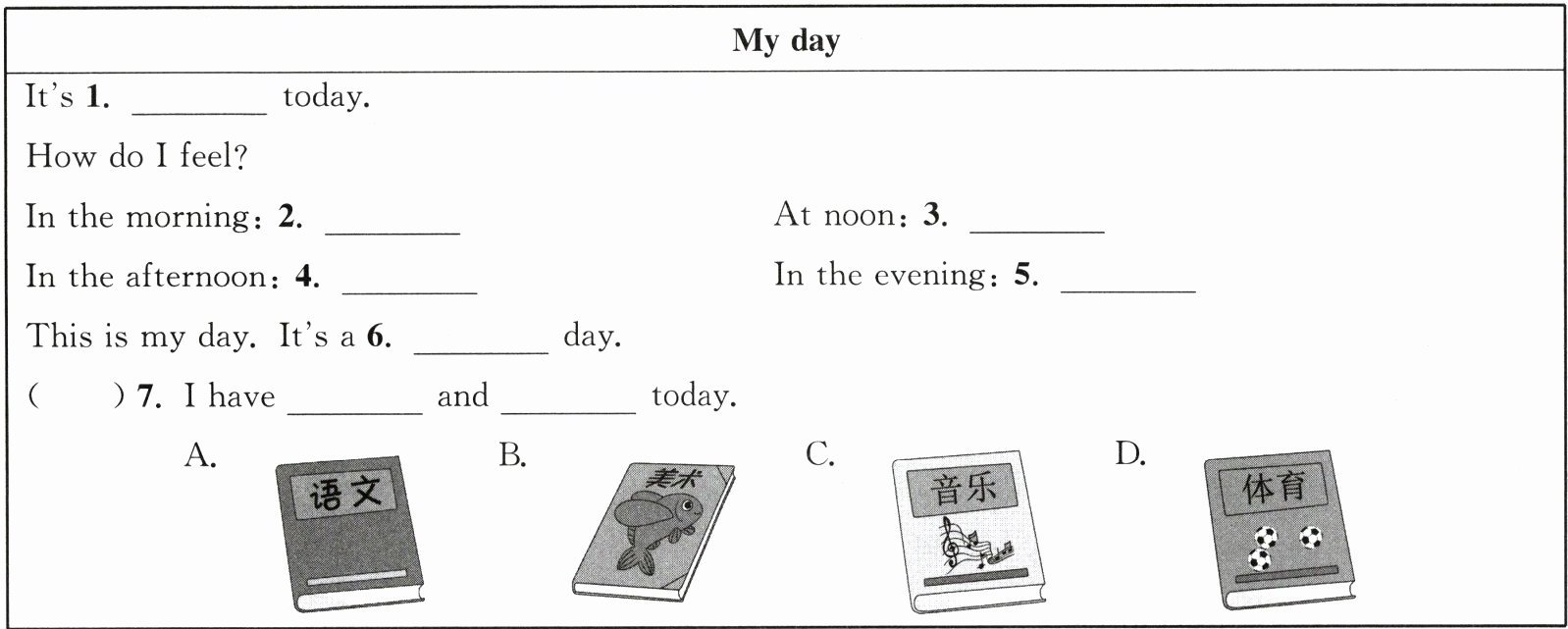
B.
C.
D.|
I'm Susie. It's Monday today. It's busy. In the morning,I have an Art lesson. I'm happy. I can draw pictures well. At noon,I'm hungry. I want to have some fish for lunch. In the afternoon,I have a PE lesson. I run in the playground. I'm thirsty. I want to have some water. In the evening,I am sad because I can't find my Maths book. It's nine thirty. I want to go to bed. This is my day.
B.
C.
D.|
答案:1. Monday 2. happy 3. hungry 4. thirsty 5. sad 6. busy/tired 7. BD
解析:
【分析】
这是一道阅读理解信息提取题,解题思路如下:
1. 首先通读短文,明确短文围绕Susie的一天展开,包含日期、不同时段的感受以及当天的课程信息。
2. 针对表格中的每一个空,回到短文中寻找对应的关键语句:
第1空询问日期,定位短文开头的“It's Monday today”;
第2-5空分别对应早、中、下午、晚上的感受,依次找到各时段描述感受的句子;
第6空是对这一天的总结,结合短文开头“It's busy”和结尾的疲惫状态确定答案;
第7空需要匹配当天的课程,根据短文中的Art(美术)和PE(体育),对应选项中的书籍图片。
3. 逐一核对信息,确保答案与短文内容一致。
【解析】
1. 根据短文第一句“I'm Susie. It's Monday today.”,可知今天是Monday。
2. 由“In the morning,I have an Art lesson. I'm happy.”可知早上的感受是happy。
3. 根据“At noon,I'm hungry.”,可知中午的感受是hungry。
4. 从“In the afternoon,I have a PE lesson. I run in the playground. I'm thirsty.”可知下午的感受是thirsty。
5. 由“In the evening,I am sad because I can't find my Maths book.”可知晚上的感受是sad。
6. 短文开头提到“It's busy”,且一天的活动后Susie想睡觉,所以这一天可以描述为busy或tired。
7. 短文提到上午有Art(美术,对应选项B的美术书),下午有PE(体育,对应选项D的体育书),所以选BD。
【答案】
1. Monday
2. happy
3. hungry
4. thirsty
5. sad
6. busy/tired
7. BD
【知识点】
细节信息提取、学科词汇匹配
【点评】
本题考查学生从英语短文中提取关键信息的能力,题目设置贴合短文内容,需要学生仔细阅读、精准定位语句,同时考查对基础学科词汇的识别,整体侧重基础阅读能力的检测。
【难度系数】
0.8
这是一道阅读理解信息提取题,解题思路如下:
1. 首先通读短文,明确短文围绕Susie的一天展开,包含日期、不同时段的感受以及当天的课程信息。
2. 针对表格中的每一个空,回到短文中寻找对应的关键语句:
第1空询问日期,定位短文开头的“It's Monday today”;
第2-5空分别对应早、中、下午、晚上的感受,依次找到各时段描述感受的句子;
第6空是对这一天的总结,结合短文开头“It's busy”和结尾的疲惫状态确定答案;
第7空需要匹配当天的课程,根据短文中的Art(美术)和PE(体育),对应选项中的书籍图片。
3. 逐一核对信息,确保答案与短文内容一致。
【解析】
1. 根据短文第一句“I'm Susie. It's Monday today.”,可知今天是Monday。
2. 由“In the morning,I have an Art lesson. I'm happy.”可知早上的感受是happy。
3. 根据“At noon,I'm hungry.”,可知中午的感受是hungry。
4. 从“In the afternoon,I have a PE lesson. I run in the playground. I'm thirsty.”可知下午的感受是thirsty。
5. 由“In the evening,I am sad because I can't find my Maths book.”可知晚上的感受是sad。
6. 短文开头提到“It's busy”,且一天的活动后Susie想睡觉,所以这一天可以描述为busy或tired。
7. 短文提到上午有Art(美术,对应选项B的美术书),下午有PE(体育,对应选项D的体育书),所以选BD。
【答案】
1. Monday
2. happy
3. hungry
4. thirsty
5. sad
6. busy/tired
7. BD
【知识点】
细节信息提取、学科词汇匹配
【点评】
本题考查学生从英语短文中提取关键信息的能力,题目设置贴合短文内容,需要学生仔细阅读、精准定位语句,同时考查对基础学科词汇的识别,整体侧重基础阅读能力的检测。
【难度系数】
0.8
十、猫女士今天钓鱼时发生了一件有趣的事。请你根据她的钓鱼故事,完成任务。(共 10 分)
Miss Cat likes fishing(钓鱼). One day,she fishes by the river. Suddenly,the fishing rod moves. Miss Cat is very happy. “Oh,a big fish! What a big fish!” she shouts. But she looks at the fish again and again. She puts the fish into the river and goes on fishing.
Mr Monkey goes by and sees it. “Why don't you eat it?” he asks.
“My pot(锅)is too small. I can't cook that fish,” Miss Cat says. She is sad.
Miss Cat goes on fishing again. But after a long time,there is no fish. Miss Cat is very hungry and tired.
任务一:[新考法]根据故事内容,给下列图片排序。(共 5 分)

(
(
(
(
(
任务二:根据故事内容,选择正确的答案。(每小题 1 分,共 4 分)
(
A. her pot
B. the river
C. the lake
(
A. big;small
B. small;big
C. big;big
(
A. by the river
B. by the pool(水池)
C. by the lake
(
A. happy and hungry
B. sad and tired
C. tired and hungry
任务三:画线短语的中文意思是“
Miss Cat likes fishing(钓鱼). One day,she fishes by the river. Suddenly,the fishing rod moves. Miss Cat is very happy. “Oh,a big fish! What a big fish!” she shouts. But she looks at the fish again and again. She puts the fish into the river and goes on fishing.
Mr Monkey goes by and sees it. “Why don't you eat it?” he asks.
“My pot(锅)is too small. I can't cook that fish,” Miss Cat says. She is sad.
Miss Cat goes on fishing again. But after a long time,there is no fish. Miss Cat is very hungry and tired.
任务一:[新考法]根据故事内容,给下列图片排序。(共 5 分)
(
1
)(
4
)(
5
)(
2
)(
3
)任务二:根据故事内容,选择正确的答案。(每小题 1 分,共 4 分)
(
B
)1. Miss Cat puts the big fish into B
.A. her pot
B. the river
C. the lake
(
A
)2. Miss Cat's fish is A
and her pot is A
.A. big;small
B. small;big
C. big;big
(
A
)3. Miss Cat fishes A
.A. by the river
B. by the pool(水池)
C. by the lake
(
C
)4. At last(最后),Miss Cat is C
.A. happy and hungry
B. sad and tired
C. tired and hungry
任务三:画线短语的中文意思是“
鱼竿
”。(共 1 分)答案:任务一:1 4 5 2 3
任务二:1. B 2. A 3. A 4. C
任务三:鱼竿
任务二:1. B 2. A 3. A 4. C
任务三:鱼竿
解析:
【分析】
任务一:要完成图片排序,需先梳理故事的发展脉络:首先猫女士在河边钓鱼,接着她钓到了鱼,然后她得到大鱼,之后猴子路过询问她不吃鱼的原因,最后猫女士没再钓到鱼,又饿又累还想着鱼。按照这个情节顺序对应图片即可完成排序。
任务二:属于细节考查题,需要从原文中找到对应的句子,匹配选项即可得出答案。比如第1题找“put the fish into...”的对应内容,第2题找描述鱼和锅大小的句子,第3题找钓鱼地点,第4题找最后猫女士的状态。
任务三:需要结合语境猜测短语意思,“fishing rod”是钓鱼时用的工具,结合故事中钓鱼的场景,可得出其意思。
【解析】
任务一:
1. 故事开篇提到“Miss Cat likes fishing. One day,she fishes by the river.”,对应第一张图(猫女士在河边持竿钓鱼),所以第一张图排1;
2. 接着“Suddenly,the fishing rod moves... she shouts.”,对应第四张图(猫女士钓到鱼,很惊讶),排4;
3. 故事中提到“Oh,a big fish!”,对应第五张图(猫女士抱着大鱼),排5;
4. 之后“Mr Monkey goes by and sees it. ‘Why don't you eat it?’ he asks.”,对应第二张图(猴子指着鱼询问猫女士,旁边有鱼和锅),排2;
5. 最后“Miss Cat goes on fishing again. But after a long time,there is no fish. Miss Cat is very hungry and tired.”,对应第三张图(猫女士想着鱼,状态疲惫饥饿),排3。
最终排序为1 4 5 2 3。
任务二:
1. 根据原文“She puts the fish into the river”,可知猫女士把鱼放回河里,选B;
2. 根据“Oh,a big fish!”和“My pot(锅)is too small”,可知鱼是大的,锅是小的,选A;
3. 根据“she fishes by the river”,可知猫女士在河边钓鱼,选A;
4. 根据“Miss Cat is very hungry and tired”,可知最后猫女士又累又饿,选C。
任务三:
结合故事中钓鱼的场景,“fishing rod”是钓鱼时使用的工具,中文意思是“鱼竿”。
【答案】
任务一:1 4 5 2 3
任务二:1. B 2. A 3. A 4. C
任务三:鱼竿
【知识点】
图片排序技巧、细节阅读理解、短语翻译
【点评】
本题以猫女士钓鱼的故事为载体,结合图片、选择题和短语翻译多种题型,全面考查学生的英语阅读理解能力、逻辑梳理能力和词汇理解能力。题型贴近生活,能激发学生的解题兴趣,同时引导学生养成从原文提取信息、梳理故事逻辑的解题习惯。
【难度系数】
0.7
任务一:要完成图片排序,需先梳理故事的发展脉络:首先猫女士在河边钓鱼,接着她钓到了鱼,然后她得到大鱼,之后猴子路过询问她不吃鱼的原因,最后猫女士没再钓到鱼,又饿又累还想着鱼。按照这个情节顺序对应图片即可完成排序。
任务二:属于细节考查题,需要从原文中找到对应的句子,匹配选项即可得出答案。比如第1题找“put the fish into...”的对应内容,第2题找描述鱼和锅大小的句子,第3题找钓鱼地点,第4题找最后猫女士的状态。
任务三:需要结合语境猜测短语意思,“fishing rod”是钓鱼时用的工具,结合故事中钓鱼的场景,可得出其意思。
【解析】
任务一:
1. 故事开篇提到“Miss Cat likes fishing. One day,she fishes by the river.”,对应第一张图(猫女士在河边持竿钓鱼),所以第一张图排1;
2. 接着“Suddenly,the fishing rod moves... she shouts.”,对应第四张图(猫女士钓到鱼,很惊讶),排4;
3. 故事中提到“Oh,a big fish!”,对应第五张图(猫女士抱着大鱼),排5;
4. 之后“Mr Monkey goes by and sees it. ‘Why don't you eat it?’ he asks.”,对应第二张图(猴子指着鱼询问猫女士,旁边有鱼和锅),排2;
5. 最后“Miss Cat goes on fishing again. But after a long time,there is no fish. Miss Cat is very hungry and tired.”,对应第三张图(猫女士想着鱼,状态疲惫饥饿),排3。
最终排序为1 4 5 2 3。
任务二:
1. 根据原文“She puts the fish into the river”,可知猫女士把鱼放回河里,选B;
2. 根据“Oh,a big fish!”和“My pot(锅)is too small”,可知鱼是大的,锅是小的,选A;
3. 根据“she fishes by the river”,可知猫女士在河边钓鱼,选A;
4. 根据“Miss Cat is very hungry and tired”,可知最后猫女士又累又饿,选C。
任务三:
结合故事中钓鱼的场景,“fishing rod”是钓鱼时使用的工具,中文意思是“鱼竿”。
【答案】
任务一:1 4 5 2 3
任务二:1. B 2. A 3. A 4. C
任务三:鱼竿
【知识点】
图片排序技巧、细节阅读理解、短语翻译
【点评】
本题以猫女士钓鱼的故事为载体,结合图片、选择题和短语翻译多种题型,全面考查学生的英语阅读理解能力、逻辑梳理能力和词汇理解能力。题型贴近生活,能激发学生的解题兴趣,同时引导学生养成从原文提取信息、梳理故事逻辑的解题习惯。
【难度系数】
0.7