() 1.In the picture on the right, the students are .
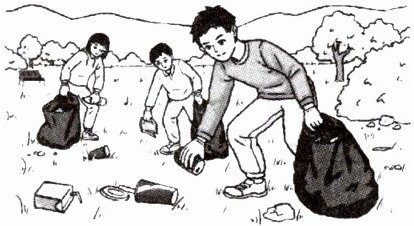
A.cleaning up the park
B.doing housework
C.repairing things
D.doing some washing
A.cleaning up the park
B.doing housework
C.repairing things
D.doing some washing
答案:A
解析:
观察插图可知,学生们正在户外的公园里捡拾垃圾,逐一比对选项:A清理公园,B做家务,C修理物品,D洗衣服,只有A符合画面描述的场景。
() 2.—It's cold here.
—OK. I and close the window.
A.go
B.am going
C.goes
D.will go
—OK. I and close the window.
A.go
B.am going
C.goes
D.will go
答案:D
解析:
首先分析对话语境:一方指出这里很冷,答话人是当下临时做出将要执行动作的决定。第一步排除C:主语是I,goes是动词第三人称单数形式,不符合语法规则;第二步排除A:go是一般现在时形式,用来表示经常性、习惯性的动作,不符合当下要做即将发生的事的语境;第三步排除B:am going是现在进行时结构,多表示预先计划好的安排,不符合临时做决定的场景;will+动词原形可以表示当下临时决定将要做的事,完全符合对话语境。
() 3.— is it from your school to the Science Museum?
—About three kilometres.
A.How often
B.How far
C.How much
D.How tall
—About three kilometres.
A.How often
B.How far
C.How much
D.How tall
答案:B
解析:
先明确各选项疑问词组的用法:A. How often用于询问动作发生的频率;B. How far用于询问距离;C. How much用于询问价格或不可数名词的数量;D. How tall用于询问人或事物的高度。本题答句“大约三千米”是对两地之间的距离作出回答,因此要用询问距离的How far提问。
() 4.—Are you clear about to meet tomorrow? —Sure. At 9:00 a.m.
A.when
B.where
C.who
D.how
A.when
B.where
C.who
D.how
答案:A
解析:
首先观察答语,答句"At 9:00 a.m."是具体的时间点。再辨析四个选项的含义:A.when意为“什么时候”,用于询问时间;B.where意为“哪里”,用于询问地点;C.who意为“谁”,用于询问人物;D.how意为“怎样”,用于询问方式或状态。此处询问见面的时间,符合语境的是when,因此选A。
() 5.—Shall we be volunteers in the local museum during the summer holiday?
— I'm looking forward to it.
A.Not at all.
B.I don't agree.
C.Why not?
D.Anything else?
— I'm looking forward to it.
A.Not at all.
B.I don't agree.
C.Why not?
D.Anything else?
答案:C
解析:
题干第一句是用Shall we...提出活动建议,由答句后半句“我很期待”可知,答话人赞同该提议。A项用于回应感谢,B项表达反对,都不符合语境;C项“Why not?”用于赞同对方提出的建议,符合情景;D项意为“还有别的吗”,不符合对话逻辑,因此选C。
二、完形填空
Last year, I got my dream job in this city. There was only one 1—it was far away from my hometown and I 2 visited here before. When I first came here, I had to find somewhere to 3. I did not know anyone in this city, so I stayed in a hotel when I 4 a new home. I finally found the perfect flat. It is small 5 very nice. The flat is 6 my office, so I can walk to work. There 7 a supermarket at the end of the road. There are also some restaurants. I can go and eat there when I do not want to 8. My new neighbours are really 9. We are now friends. I'm really 10 to live in a neighbourhood like that.
() 1. A. problem
B. way
C. job
D. thing
() 2. A. always
B. often
C. usually
D. never
() 3. A. work
B. sing
C. live
D. stand
() 4. A. looked after
B. looked at
C. looked out
D. looked for
() 5. A. and
B. but
C. so
D. or
() 6. A. far away from
B. near
C. between
D. at the foot of
() 7. A. is
B. are
C. was
D. were
() 8. A. sleep
B. run
C. cook
D. shop
() 9. A. smart
B. friendly
C. hard - working
D. shy
() 10. A. happy
B. sad
C. careful
D. afraid
Last year, I got my dream job in this city. There was only one 1—it was far away from my hometown and I 2 visited here before. When I first came here, I had to find somewhere to 3. I did not know anyone in this city, so I stayed in a hotel when I 4 a new home. I finally found the perfect flat. It is small 5 very nice. The flat is 6 my office, so I can walk to work. There 7 a supermarket at the end of the road. There are also some restaurants. I can go and eat there when I do not want to 8. My new neighbours are really 9. We are now friends. I'm really 10 to live in a neighbourhood like that.
() 1. A. problem
B. way
C. job
D. thing
() 2. A. always
B. often
C. usually
D. never
() 3. A. work
B. sing
C. live
D. stand
() 4. A. looked after
B. looked at
C. looked out
D. looked for
() 5. A. and
B. but
C. so
D. or
() 6. A. far away from
B. near
C. between
D. at the foot of
() 7. A. is
B. are
C. was
D. were
() 8. A. sleep
B. run
C. cook
D. shop
() 9. A. smart
B. friendly
C. hard - working
D. shy
() 10. A. happy
B. sad
C. careful
D. afraid
答案:1-5 ADCDB 6-10 BACBA
解析:
这是一篇记叙文,讲述了作者在新城市获得心仪工作后安家生活的经历,逐题解析如下:
1. 根据前文作者得到了梦寐以求的工作,后文提到这份工作的地点离家乡很远,可判断这是唯一的问题,problem符合语境。
2. 结合后文“我在这座城市一个人都不认识”,能推出作者之前从未来过这座城市,never(从未)符合语境。
3. 刚来到陌生的新城市,作者首先需要找可以居住的地方,live(居住)符合语境。
4. 作者在找到合适的公寓之前在酒店暂住,这段时间是在寻找新家,look for意为“寻找”,符合语境。
5. 前半句说公寓很小,后半句说公寓很不错,前后是转折关系,用转折连词but连接。
6. 根据后文“我可以步行去上班”,可知公寓离办公室很近,near意为“在……附近”,符合语境。
7. 本句是there be句型,后面的主语a supermarket是单数,句子描述当下的客观情况用一般现在时,所以be动词用is。
8. 前文提到周边有很多餐馆,可判断作者不想自己做饭的时候就可以去餐馆就餐,cook意为“做饭”,符合语境。
9. 根据后文“我们现在成了朋友”,可知作者的新邻居十分友好,friendly意为“友好的”,符合语境。
10. 周边生活便利、邻居友善,作者住在这样的社区里自然十分开心,happy意为“开心的”,符合语境。
1. 根据前文作者得到了梦寐以求的工作,后文提到这份工作的地点离家乡很远,可判断这是唯一的问题,problem符合语境。
2. 结合后文“我在这座城市一个人都不认识”,能推出作者之前从未来过这座城市,never(从未)符合语境。
3. 刚来到陌生的新城市,作者首先需要找可以居住的地方,live(居住)符合语境。
4. 作者在找到合适的公寓之前在酒店暂住,这段时间是在寻找新家,look for意为“寻找”,符合语境。
5. 前半句说公寓很小,后半句说公寓很不错,前后是转折关系,用转折连词but连接。
6. 根据后文“我可以步行去上班”,可知公寓离办公室很近,near意为“在……附近”,符合语境。
7. 本句是there be句型,后面的主语a supermarket是单数,句子描述当下的客观情况用一般现在时,所以be动词用is。
8. 前文提到周边有很多餐馆,可判断作者不想自己做饭的时候就可以去餐馆就餐,cook意为“做饭”,符合语境。
9. 根据后文“我们现在成了朋友”,可知作者的新邻居十分友好,friendly意为“友好的”,符合语境。
10. 周边生活便利、邻居友善,作者住在这样的社区里自然十分开心,happy意为“开心的”,符合语境。