十三、连词成句。
1. Christmas, they, buy, tree, a, also, Christmas, at(.)
2. weekends, Helen, watches, sometimes, at, films(.)
3. Sundays, we, have, often, dinner, our, with, grandparents, on(.)
4. like, you, drawing, him, park, the, with, do, in(?)
5. show, you, me, can, around, school, your(?)
1. Christmas, they, buy, tree, a, also, Christmas, at(.)
They also buy a Christmas tree at Christmas.
2. weekends, Helen, watches, sometimes, at, films(.)
Helen sometimes watches films at weekends.
3. Sundays, we, have, often, dinner, our, with, grandparents, on(.)
We often have dinner with our grandparents on Sundays.
4. like, you, drawing, him, park, the, with, do, in(?)
Do you like drawing with him in the park?
5. show, you, me, can, around, school, your(?)
Can you show me around your school?
答案:1. They also buy a Christmas tree at Christmas. 2. Helen sometimes watches films at weekends. 3. We often have dinner with our grandparents on Sundays. 4. Do you like drawing with him in the park? 5. Can you show me around your school?
解析:
【解析】
1. 确定主语They,频度副词also置于实义动词buy之前,宾语为a Christmas tree,时间状语at Christmas放句末,组成陈述句:They also buy a Christmas tree at Christmas.
2. 主语Helen,频度副词sometimes置于实义动词watches之前,宾语films,时间状语at weekends放句末,组成陈述句:Helen sometimes watches films at weekends.
3. 主语We,频度副词often置于实义动词have之前,have dinner with our grandparents是固定搭配,时间状语on Sundays放句末,组成陈述句:We often have dinner with our grandparents on Sundays.
4. 这是一般疑问句,助动词Do开头,主语you,like drawing with him是固定表达,地点状语in the park放句末,组成疑问句:Do you like drawing with him in the park?
5. 这是情态动词引导的一般疑问句,Can开头,主语you,show sb. around sp.是固定搭配,组成疑问句:Can you show me around your school?
【答案】
1. They also buy a Christmas tree at Christmas.
2. Helen sometimes watches films at weekends.
3. We often have dinner with our grandparents on Sundays.
4. Do you like drawing with him in the park?
5. Can you show me around your school?
【知识点】
陈述句语序、一般疑问句结构、频度副词位置
【点评】
本题考查英语句子的语序规则,涵盖陈述句和一般疑问句的结构,以及频度副词在句中的正确位置,同时涉及固定搭配的运用,能有效检验学生对基本句子结构的掌握和语言组织能力。
【难度系数】
0.7
1. 确定主语They,频度副词also置于实义动词buy之前,宾语为a Christmas tree,时间状语at Christmas放句末,组成陈述句:They also buy a Christmas tree at Christmas.
2. 主语Helen,频度副词sometimes置于实义动词watches之前,宾语films,时间状语at weekends放句末,组成陈述句:Helen sometimes watches films at weekends.
3. 主语We,频度副词often置于实义动词have之前,have dinner with our grandparents是固定搭配,时间状语on Sundays放句末,组成陈述句:We often have dinner with our grandparents on Sundays.
4. 这是一般疑问句,助动词Do开头,主语you,like drawing with him是固定表达,地点状语in the park放句末,组成疑问句:Do you like drawing with him in the park?
5. 这是情态动词引导的一般疑问句,Can开头,主语you,show sb. around sp.是固定搭配,组成疑问句:Can you show me around your school?
【答案】
1. They also buy a Christmas tree at Christmas.
2. Helen sometimes watches films at weekends.
3. We often have dinner with our grandparents on Sundays.
4. Do you like drawing with him in the park?
5. Can you show me around your school?
【知识点】
陈述句语序、一般疑问句结构、频度副词位置
【点评】
本题考查英语句子的语序规则,涵盖陈述句和一般疑问句的结构,以及频度副词在句中的正确位置,同时涉及固定搭配的运用,能有效检验学生对基本句子结构的掌握和语言组织能力。
【难度系数】
0.7
十四、找出每句中有误的一项,并在横线上订正。
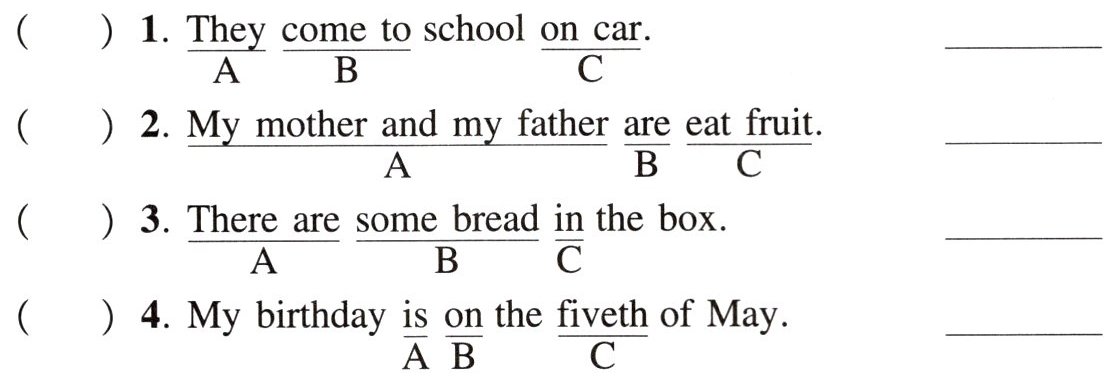
答案:1. C by car/on foot 2. C eating fruit 3. A There is 4. C fifth
解析:
【解析】
1. 第1题:表示乘坐交通工具的正确固定搭配为“by+交通工具”,“on car”表述错误,应改为by car。
2. 第2题:句子为现在进行时,其结构为“be动词+动词现在分词”,“are eat”不符合该结构,应将C处改为eating fruit。
3. 第3题:bread是不可数名词,there be句型中be动词需与名词的数保持一致,故A处应改为There is。
4. 第4题:“第五”的正确序数词形式是fifth,fiveth拼写错误,C处应改为fifth。
【答案】
1. C by car
2. C eating fruit
3. A There is
4. C fifth
【知识点】
介词固定搭配、现在进行时结构、序数词正确写法
【点评】
本题考查英语基础语法与固定搭配,涵盖介词搭配、时态结构、不可数名词与be动词的搭配及序数词拼写,需学生注重日常基础知识点的积累与运用。
【难度系数】
0.8
1. 第1题:表示乘坐交通工具的正确固定搭配为“by+交通工具”,“on car”表述错误,应改为by car。
2. 第2题:句子为现在进行时,其结构为“be动词+动词现在分词”,“are eat”不符合该结构,应将C处改为eating fruit。
3. 第3题:bread是不可数名词,there be句型中be动词需与名词的数保持一致,故A处应改为There is。
4. 第4题:“第五”的正确序数词形式是fifth,fiveth拼写错误,C处应改为fifth。
【答案】
1. C by car
2. C eating fruit
3. A There is
4. C fifth
【知识点】
介词固定搭配、现在进行时结构、序数词正确写法
【点评】
本题考查英语基础语法与固定搭配,涵盖介词搭配、时态结构、不可数名词与be动词的搭配及序数词拼写,需学生注重日常基础知识点的积累与运用。
【难度系数】
0.8
十五、阅读对话或短文,判断正(T)误(F)。
(A)
Helen: What date is it today?
Nancy: It’s the 6th of November.
Helen: Oh, my father’s birthday is coming.
Nancy: Really? When’s your father’s birthday?
Helen: It’s on the 10th of November.
Nancy: What would he like as a birthday present?
Helen: He would like some books.
Nancy: Does he often have a birthday party?
Helen: No, he doesn’t. Let’s go and buy some books.
Nancy: OK.
(
(
(
(
(
(B)
In China, there are many different kinds of food. Some of them are very popular. The most well-known Chinese food is jiaozi. Now let’s talk about them. Everyone in China likes jiaozi very much. And there are many different kinds of jiaozi. Some have meat and vegetables;others have sugar, eggs and so on. I like jiaozi with vegetables and pork(猪肉)better than any other kinds.
Usually people make jiaozi at home. If you have no time to make them, you can buy them from a supermarket. Then you take them home and eat them with vinegar(醋).
Today is Sunday. My parents are making jiaozi at home. I will help them.
“Please make a jiaozi like this.” My mother teaches me. After a short time, I can make a good jiaozi.
(
(
(
(
(
(A)
Helen: What date is it today?
Nancy: It’s the 6th of November.
Helen: Oh, my father’s birthday is coming.
Nancy: Really? When’s your father’s birthday?
Helen: It’s on the 10th of November.
Nancy: What would he like as a birthday present?
Helen: He would like some books.
Nancy: Does he often have a birthday party?
Helen: No, he doesn’t. Let’s go and buy some books.
Nancy: OK.
(
F
) 1. It’s the 10th of November.(
T
) 2. Helen’s father’s birthday is coming.(
F
) 3. Helen’s father would like some flowers.(
F
) 4. Helen’s father often has a birthday party.(
T
) 5. They go and buy some books.(B)
In China, there are many different kinds of food. Some of them are very popular. The most well-known Chinese food is jiaozi. Now let’s talk about them. Everyone in China likes jiaozi very much. And there are many different kinds of jiaozi. Some have meat and vegetables;others have sugar, eggs and so on. I like jiaozi with vegetables and pork(猪肉)better than any other kinds.
Usually people make jiaozi at home. If you have no time to make them, you can buy them from a supermarket. Then you take them home and eat them with vinegar(醋).
Today is Sunday. My parents are making jiaozi at home. I will help them.
“Please make a jiaozi like this.” My mother teaches me. After a short time, I can make a good jiaozi.
(
F
) 1. Everyone in China doesn’t like jiaozi very much.(
T
) 2. Usually people make jiaozi at home.(
T
) 3. People eat jiaozi with vinegar.(
F
) 4. My parents teach me to make jiaozi.(
F
) 5. I can’t make a good jiaozi.答案:(A) 1. F 2. T 3. F 4. F 5. T (B) 1. F 2. T 3. T 4. F 5. F
解析:
【解析】
(A)
1. 根据对话中Nancy的回答“It’s the 6th of November.”,可知今天是11月6日,不是11月10日,故判断为F。
2. 根据Helen的话“Oh, my father’s birthday is coming.”,可知海伦爸爸的生日即将到来,故判断为T。
3. 根据Helen的回答“He would like some books.”,可知海伦爸爸想要书,不是花,故判断为F。
4. 根据Helen对“Does he often have a birthday party?”的回答“No, he doesn’t.”,可知海伦爸爸不经常举办生日派对,故判断为F。
5. 根据对话最后Helen说“Let’s go and buy some books.”以及Nancy的回应“OK.”,可知他们要去买书,故判断为T。
(B)
1. 根据文中“Everyone in China likes jiaozi very much.”,可知中国人都很喜欢饺子,题目表述与之相反,故判断为F。
2. 根据文中“Usually people make jiaozi at home.”,可知人们通常在家包饺子,故判断为T。
3. 根据文中“Then you take them home and eat them with vinegar(醋).”,可知人们就着醋吃饺子,故判断为T。
4. 根据文中“My mother teaches me.”,是妈妈教“我”包饺子,不是父母,故判断为F。
5. 根据文中“After a short time, I can make a good jiaozi.”,可知“我”能包出好的饺子,题目表述与之相反,故判断为F。
【答案】
(A) 1. F 2. T 3. F 4. F 5. T
(B) 1. F 2. T 3. T 4. F 5. F
【知识点】
细节理解判断;对话短文阅读
【点评】
本题通过对话和短文的形式,考查学生对文本细节信息的捕捉与比对能力,需要学生仔细阅读原文,逐一核对题目表述与原文内容是否一致。
【难度系数】
0.8
(A)
1. 根据对话中Nancy的回答“It’s the 6th of November.”,可知今天是11月6日,不是11月10日,故判断为F。
2. 根据Helen的话“Oh, my father’s birthday is coming.”,可知海伦爸爸的生日即将到来,故判断为T。
3. 根据Helen的回答“He would like some books.”,可知海伦爸爸想要书,不是花,故判断为F。
4. 根据Helen对“Does he often have a birthday party?”的回答“No, he doesn’t.”,可知海伦爸爸不经常举办生日派对,故判断为F。
5. 根据对话最后Helen说“Let’s go and buy some books.”以及Nancy的回应“OK.”,可知他们要去买书,故判断为T。
(B)
1. 根据文中“Everyone in China likes jiaozi very much.”,可知中国人都很喜欢饺子,题目表述与之相反,故判断为F。
2. 根据文中“Usually people make jiaozi at home.”,可知人们通常在家包饺子,故判断为T。
3. 根据文中“Then you take them home and eat them with vinegar(醋).”,可知人们就着醋吃饺子,故判断为T。
4. 根据文中“My mother teaches me.”,是妈妈教“我”包饺子,不是父母,故判断为F。
5. 根据文中“After a short time, I can make a good jiaozi.”,可知“我”能包出好的饺子,题目表述与之相反,故判断为F。
【答案】
(A) 1. F 2. T 3. F 4. F 5. T
(B) 1. F 2. T 3. T 4. F 5. F
【知识点】
细节理解判断;对话短文阅读
【点评】
本题通过对话和短文的形式,考查学生对文本细节信息的捕捉与比对能力,需要学生仔细阅读原文,逐一核对题目表述与原文内容是否一致。
【难度系数】
0.8