−、完形填空(10分)
For anyone who enjoys reading, it's $\boldsymbol{\underline{1}}$ not to have heard of *The Adventures of Tom Sawyer* by Mark Twain. This book is really loved by kids everywhere. As an adult now, it $\boldsymbol{\underline{2}}$ holds a special place in my heart. During my recent re-read of it, I drew a lesson from Tom's adventures.
In our daily life, we often have to do some $\boldsymbol{\underline{3}}$ that are boring or tiring. When your mum asks you to help with housework, what comes to your mind? Haven't you ever wanted to complain(抱怨)$\boldsymbol{\underline{4}}$ in your heart? I think most of us have had this feeling.
Tom Sawyer, $\boldsymbol{\underline{5}}$, had a clever twist in his mind when stuck with such a boring task. One day, Aunt Polly told Tom he had to paint the fence. Tom was busy with the job when his friend Ben Rogers happened to come along. Rather than complaining about it, Tom told Ben that he was really $\boldsymbol{\underline{6}}$ about the task. "Only one boy in a thousand—maybe even two thousand—gets to take on a job like this!" Tom said.
Tom's words really caught Ben's interest in this piece of work. He even handed over his apple to Tom just to have a(n) $\boldsymbol{\underline{7}}$ at painting the fence. If Tom had thought about $\boldsymbol{\underline{8}}$ but complaining, he would have ended up having a terrible time painting the fence.
This story has taught me a useful lesson: complaining never $\boldsymbol{\underline{9}}$ anything. Unlike Tom's situation in the story, no one is going to step in and take over your tasks for you. So, stop complaining, $\boldsymbol{\underline{10}}$ you'll feel better and maybe even do a better job!
( ) 1. A. simple B. common C. difficult D. fantastic
( ) 2. A. just B. still C. even D. only
( ) 3. A. stories B. programmes C. chores D. lessons
( ) 4. A. closely B. especially C. fully D. silently
( ) 5. A. moreover B. however C. already D. therefore
( ) 6. A. bored B. excited C. afraid D. tired
( ) 7. A. go B. choice C. advice D. training
( ) 8. A. everything B. anything C. nothing D. something
( ) 9. A. solves B. repairs C. checks D. creates
( )10. A. if B. or C. but D. and
For anyone who enjoys reading, it's $\boldsymbol{\underline{1}}$ not to have heard of *The Adventures of Tom Sawyer* by Mark Twain. This book is really loved by kids everywhere. As an adult now, it $\boldsymbol{\underline{2}}$ holds a special place in my heart. During my recent re-read of it, I drew a lesson from Tom's adventures.
In our daily life, we often have to do some $\boldsymbol{\underline{3}}$ that are boring or tiring. When your mum asks you to help with housework, what comes to your mind? Haven't you ever wanted to complain(抱怨)$\boldsymbol{\underline{4}}$ in your heart? I think most of us have had this feeling.
Tom Sawyer, $\boldsymbol{\underline{5}}$, had a clever twist in his mind when stuck with such a boring task. One day, Aunt Polly told Tom he had to paint the fence. Tom was busy with the job when his friend Ben Rogers happened to come along. Rather than complaining about it, Tom told Ben that he was really $\boldsymbol{\underline{6}}$ about the task. "Only one boy in a thousand—maybe even two thousand—gets to take on a job like this!" Tom said.
Tom's words really caught Ben's interest in this piece of work. He even handed over his apple to Tom just to have a(n) $\boldsymbol{\underline{7}}$ at painting the fence. If Tom had thought about $\boldsymbol{\underline{8}}$ but complaining, he would have ended up having a terrible time painting the fence.
This story has taught me a useful lesson: complaining never $\boldsymbol{\underline{9}}$ anything. Unlike Tom's situation in the story, no one is going to step in and take over your tasks for you. So, stop complaining, $\boldsymbol{\underline{10}}$ you'll feel better and maybe even do a better job!
( ) 1. A. simple B. common C. difficult D. fantastic
( ) 2. A. just B. still C. even D. only
( ) 3. A. stories B. programmes C. chores D. lessons
( ) 4. A. closely B. especially C. fully D. silently
( ) 5. A. moreover B. however C. already D. therefore
( ) 6. A. bored B. excited C. afraid D. tired
( ) 7. A. go B. choice C. advice D. training
( ) 8. A. everything B. anything C. nothing D. something
( ) 9. A. solves B. repairs C. checks D. creates
( )10. A. if B. or C. but D. and
答案:一、1.C 2.B 3.C 4.D 5.B 6.B 7.A 8.C 9.A 10.D
解析:
【分析】
这是一篇夹叙夹议的完形填空,围绕《汤姆·索亚历险记》中汤姆刷栅栏的故事展开,核心传达“抱怨无用,换角度看待任务能收获不同结果”的生活哲理。解题需遵循以下思路:
1. 先通读全文,把握整体主旨和情感倾向;
2. 针对每个空,结合上下文语境、词义差异、固定搭配来逐一判断:
第1空:结合“喜欢阅读的人”与“没听过《汤姆·索亚历险记》”的逻辑,判断应选表“不可能”的选项;
第2空:前文提及孩子喜爱这本书,后文说成年后它仍在作者心中有特殊位置,需选表“仍然”的副词;
第3空:后文提到“无聊、累人”的事(如做家务),需选表“任务”的名词;
第4空:“在心里抱怨”对应“默默地”这一状态,选符合的副词;
第5空:前文说普通人遇无聊任务会抱怨,后文说汤姆有聪明办法,是转折关系,选表转折的词;
第6空:汤姆为吸引本,故意表现出对刷栅栏的热衷,结合他说的“千分之一的男孩能做这份工作”,选表“兴奋、热衷”的形容词;
第7空:固定短语“have a go at sth.”表示“尝试做某事”,本用苹果换刷栅栏的机会,对应此搭配;
第8空:“nothing but”是固定搭配,表“仅仅、只有”,符合“汤姆只想着抱怨”的语义;
第9空:主旨是抱怨无法解决问题,选表“解决”的动词;
第10空:停止抱怨后要保持积极态度,才能更开心、做得更好,选表“积极的”形容词。
【解析】
1. 第1题:选C(impossible)。语境为“喜欢阅读的人不可能没听过这本书”,符合逻辑;
2. 第2题:选B(still)。前文提到孩子喜爱这本书,此处强调作为成年人,它“仍然”在作者心中有特殊位置,契合语境;
3. 第3题:选C(tasks)。后文举例的做家务属于“无聊累人的任务”,tasks符合语义;
4. 第4题:选D(silently)。“在心里默默地抱怨”,silently表示“默默地”,与“in your heart”的语境匹配;
5. 第5题:选B(however)。前文说普通人遇无聊任务会抱怨,后文说汤姆有聪明应对办法,是转折关系,however表转折;
6. 第6题:选B(excited)。汤姆为吸引本,故意表现出对刷栅栏很兴奋,结合他说的“千分之一的男孩能做这份工作”,excited符合语境;
7. 第7题:选A(go)。固定短语“have a go at”意为“尝试”,本用苹果换尝试刷栅栏的机会,符合搭配;
8. 第8题:选C(nothing)。固定搭配“nothing but”意为“仅仅、只有”,句意为“如果汤姆只想着抱怨”,符合语义;
9. 第9题:选A(solves)。文章主旨是抱怨不能解决任何问题,solves表示“解决”,契合文意;
10. 第10题:选D(positive)。停止抱怨,保持积极态度,会更开心甚至做得更好,positive表示“积极的”,符合语境。
【答案】
一、1.C 2.B 3.C 4.D 5.B 6.B 7.A 8.C 9.A 10.D
【知识点】
1. 词义辨析
2. 固定短语搭配
3. 语境逻辑推理
【点评】
本文以经典文学故事为载体,结合学生日常经历传递积极哲理,既考查了词汇、短语的基础运用,又引导学生树立“换角度看问题、拒绝抱怨”的生活态度。题目设置紧密结合上下文逻辑,需要学生兼顾基础知识与语境理解能力。
【难度系数】
0.6
这是一篇夹叙夹议的完形填空,围绕《汤姆·索亚历险记》中汤姆刷栅栏的故事展开,核心传达“抱怨无用,换角度看待任务能收获不同结果”的生活哲理。解题需遵循以下思路:
1. 先通读全文,把握整体主旨和情感倾向;
2. 针对每个空,结合上下文语境、词义差异、固定搭配来逐一判断:
第1空:结合“喜欢阅读的人”与“没听过《汤姆·索亚历险记》”的逻辑,判断应选表“不可能”的选项;
第2空:前文提及孩子喜爱这本书,后文说成年后它仍在作者心中有特殊位置,需选表“仍然”的副词;
第3空:后文提到“无聊、累人”的事(如做家务),需选表“任务”的名词;
第4空:“在心里抱怨”对应“默默地”这一状态,选符合的副词;
第5空:前文说普通人遇无聊任务会抱怨,后文说汤姆有聪明办法,是转折关系,选表转折的词;
第6空:汤姆为吸引本,故意表现出对刷栅栏的热衷,结合他说的“千分之一的男孩能做这份工作”,选表“兴奋、热衷”的形容词;
第7空:固定短语“have a go at sth.”表示“尝试做某事”,本用苹果换刷栅栏的机会,对应此搭配;
第8空:“nothing but”是固定搭配,表“仅仅、只有”,符合“汤姆只想着抱怨”的语义;
第9空:主旨是抱怨无法解决问题,选表“解决”的动词;
第10空:停止抱怨后要保持积极态度,才能更开心、做得更好,选表“积极的”形容词。
【解析】
1. 第1题:选C(impossible)。语境为“喜欢阅读的人不可能没听过这本书”,符合逻辑;
2. 第2题:选B(still)。前文提到孩子喜爱这本书,此处强调作为成年人,它“仍然”在作者心中有特殊位置,契合语境;
3. 第3题:选C(tasks)。后文举例的做家务属于“无聊累人的任务”,tasks符合语义;
4. 第4题:选D(silently)。“在心里默默地抱怨”,silently表示“默默地”,与“in your heart”的语境匹配;
5. 第5题:选B(however)。前文说普通人遇无聊任务会抱怨,后文说汤姆有聪明应对办法,是转折关系,however表转折;
6. 第6题:选B(excited)。汤姆为吸引本,故意表现出对刷栅栏很兴奋,结合他说的“千分之一的男孩能做这份工作”,excited符合语境;
7. 第7题:选A(go)。固定短语“have a go at”意为“尝试”,本用苹果换尝试刷栅栏的机会,符合搭配;
8. 第8题:选C(nothing)。固定搭配“nothing but”意为“仅仅、只有”,句意为“如果汤姆只想着抱怨”,符合语义;
9. 第9题:选A(solves)。文章主旨是抱怨不能解决任何问题,solves表示“解决”,契合文意;
10. 第10题:选D(positive)。停止抱怨,保持积极态度,会更开心甚至做得更好,positive表示“积极的”,符合语境。
【答案】
一、1.C 2.B 3.C 4.D 5.B 6.B 7.A 8.C 9.A 10.D
【知识点】
1. 词义辨析
2. 固定短语搭配
3. 语境逻辑推理
【点评】
本文以经典文学故事为载体,结合学生日常经历传递积极哲理,既考查了词汇、短语的基础运用,又引导学生树立“换角度看问题、拒绝抱怨”的生活态度。题目设置紧密结合上下文逻辑,需要学生兼顾基础知识与语境理解能力。
【难度系数】
0.6
二、阅读理解(16分)
(A)
A reading passage can have several parts.Looking through every part is very useful for you
to get a complete understanding.
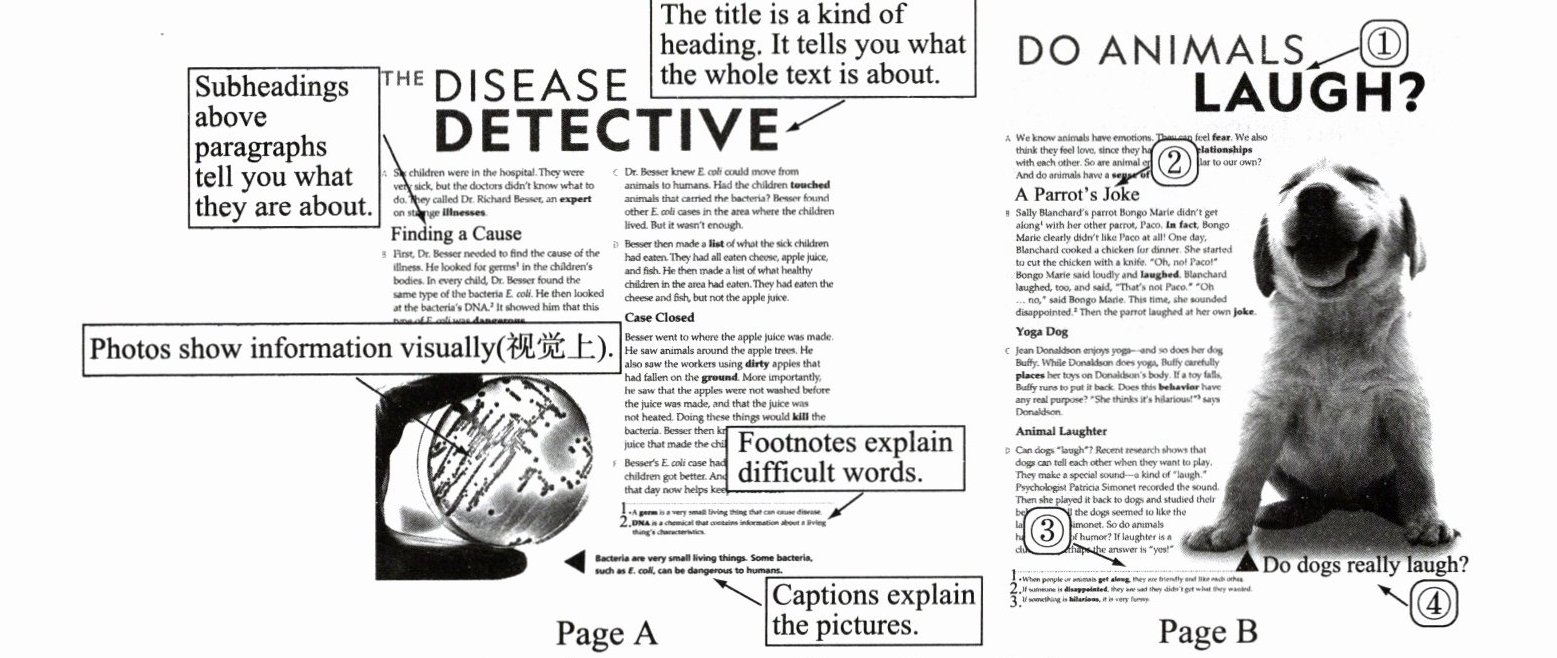
(
A.It can explain the pictures. B.It can explain difficult words.
C.It can tell you what a paragraph is about.
D.It can tell you what the whole text is about.
(
A.Photos. B.Footnotes. C.Passages. D.Headings.
(
A.① B.② C.③ D.④
(
A.One. B.Two. C.Three. D.Four.
(A)
A reading passage can have several parts.Looking through every part is very useful for you
to get a complete understanding.
(
D
)1.According to Page A,what can Part ① on Page B do?A.It can explain the pictures. B.It can explain difficult words.
C.It can tell you what a paragraph is about.
D.It can tell you what the whole text is about.
(
A
)2.According to Page A,what can show information visually?A.Photos. B.Footnotes. C.Passages. D.Headings.
(
B
)3.Which part is the subheading on Page B?A.① B.② C.③ D.④
(
C
)4.How many footnotes are there on Page B?A.One. B.Two. C.Three. D.Four.
答案:1.D 2.A 3.B 4.C
解析:
【分析】
这是一道考查文本各组成部分功能的阅读理解题,解题思路如下:
1. 第1题:先查看Page A中对标题(Title)的定义和作用描述,再对应Page B的①是文章标题,匹配对应选项。
2. 第2题:直接在Page A中寻找“show information visually”对应的文本元素,定位相关描述即可得出答案。
3. 第3题:先明确Page A中小标题(Subheadings)的特征,再在Page B中找到符合该特征的部分。
4. 第4题:直接数Page B中的脚注(Footnotes)数量,得出答案。
【解析】
1. 第1题:根据Page A的说明,标题(Title)是一种标题(heading),作用是“tells you what the whole text is about”,Page B的①是文章标题“DO ANIMALS LAUGH?”,所以对应选项D。
2. 第2题:Page A明确标注“Photos show information visually(视觉上).”,所以能视觉化展示信息的是Photos,选A。
3. 第3题:Page A说明“Subheadings above paragraphs tell you what they are about”,Page B的②“Relationships”是段落上方的小标题,符合该特征,选B。
4. 第4题:查看Page B的脚注,标注有1、2、3,共三个,所以选C。
【答案】
1.D 2.A 3.B 4.C
【知识点】
文本元素功能,细节信息查找
【点评】
本题主要考查学生对文本不同组成部分(标题、小标题、图片、脚注等)功能的理解,需要学生仔细对照Page A的说明和Page B的内容,精准定位信息,侧重细节理解能力的考查。
【难度系数】
0.8
这是一道考查文本各组成部分功能的阅读理解题,解题思路如下:
1. 第1题:先查看Page A中对标题(Title)的定义和作用描述,再对应Page B的①是文章标题,匹配对应选项。
2. 第2题:直接在Page A中寻找“show information visually”对应的文本元素,定位相关描述即可得出答案。
3. 第3题:先明确Page A中小标题(Subheadings)的特征,再在Page B中找到符合该特征的部分。
4. 第4题:直接数Page B中的脚注(Footnotes)数量,得出答案。
【解析】
1. 第1题:根据Page A的说明,标题(Title)是一种标题(heading),作用是“tells you what the whole text is about”,Page B的①是文章标题“DO ANIMALS LAUGH?”,所以对应选项D。
2. 第2题:Page A明确标注“Photos show information visually(视觉上).”,所以能视觉化展示信息的是Photos,选A。
3. 第3题:Page A说明“Subheadings above paragraphs tell you what they are about”,Page B的②“Relationships”是段落上方的小标题,符合该特征,选B。
4. 第4题:查看Page B的脚注,标注有1、2、3,共三个,所以选C。
【答案】
1.D 2.A 3.B 4.C
【知识点】
文本元素功能,细节信息查找
【点评】
本题主要考查学生对文本不同组成部分(标题、小标题、图片、脚注等)功能的理解,需要学生仔细对照Page A的说明和Page B的内容,精准定位信息,侧重细节理解能力的考查。
【难度系数】
0.8