一、侗族大歌国家级传承人胡官美携众弟子登台,用纯粹嗓音唤醒心灵共鸣,让古老旋律在当代舞台绽放新生。阅读下面短文,在空白处填入一个适当的单词或括号内单词的适当形式。
The Grand Song of the Dong ethnic group(侗族大歌$) is the folk song of the Dong people in China. It is performed \underline{1} (wide) in Guizhou and Guangxi now. Hu Guanmei is one of the masters of the Grand Song. Her parents encouraged her \underline{2} (learn) it when she was three years old. At that time, she would rather \underline{3} (stay) at home and practise the Grand Song than go out to play. In her \underline{4} (twenty), Hu became famous in her village because she could sing the Grand Song well. Then she began helping spread the Grand Song. Every night, the kids who lived nearby met at Hu's home to sing together. Later, Hu \underline{5} (invite) to teach students at school. Up to now, she has trained over 1,000 students of all \underline{6} (age). Her students all speak \underline{7} (high) of her. "She is a totally committed ($尽心尽力的$) teacher. She has not only passed on the singing skills to us, \underline{8} succeeded in helping us have a much deeper understanding of Dong culture," one of her students said. Many of her students \underline{9} (win) music competitions and given \underline{10} (perform) at home and abroad during the past few years. Hu hopes they can continue to pass on the traditional culture and bring joy to more people.$
1.
2.
3.
4.
5.
6.
7.
8.
9.
10.
The Grand Song of the Dong ethnic group(侗族大歌$) is the folk song of the Dong people in China. It is performed \underline{1} (wide) in Guizhou and Guangxi now. Hu Guanmei is one of the masters of the Grand Song. Her parents encouraged her \underline{2} (learn) it when she was three years old. At that time, she would rather \underline{3} (stay) at home and practise the Grand Song than go out to play. In her \underline{4} (twenty), Hu became famous in her village because she could sing the Grand Song well. Then she began helping spread the Grand Song. Every night, the kids who lived nearby met at Hu's home to sing together. Later, Hu \underline{5} (invite) to teach students at school. Up to now, she has trained over 1,000 students of all \underline{6} (age). Her students all speak \underline{7} (high) of her. "She is a totally committed ($尽心尽力的$) teacher. She has not only passed on the singing skills to us, \underline{8} succeeded in helping us have a much deeper understanding of Dong culture," one of her students said. Many of her students \underline{9} (win) music competitions and given \underline{10} (perform) at home and abroad during the past few years. Hu hopes they can continue to pass on the traditional culture and bring joy to more people.$
1.
widely
2.
to learn
3.
stay
4.
twenties
5.
was invited
6.
ages
7.
highly
8.
but
9.
have won
10.
performances
答案:1. widely 2. to learn 3. stay 4. twenties
5. was invited 6. ages 7. highly 8. but
9. have won 10. performances
5. was invited 6. ages 7. highly 8. but
9. have won 10. performances
解析:
【分析】
拿到这道短文语法填空题,首先先通读全文,了解文章核心是介绍侗族大歌国家级传承人胡官美传承推广侗族大歌的事迹,整体时态以一般过去时、现在完成时为主。接下来逐空推导答案:
1. 先观察空格位置,修饰动词performed,括号给出的是形容词wide,副词才能修饰动词,因此要将wide变为副词形式;
2. 看到前面的动词encourage,回忆固定搭配encourage sb to do sth,后面要接不定式结构;
3. 识别出would rather...than...的特殊句式,该结构中would rather后必须接动词原形;
4. 看到结构in her加基数词twenty,对应固定表达“在某人几十多岁时”,需要用整十基数词的复数形式;
5. 判断主语Hu和动作invite的逻辑关系,胡官美是“被邀请”去学校授课,动作发生在过去,要用一般过去时的被动语态;
6. 空格前有all修饰,可数名词age要变为复数形式,表达“各个年龄段”;
7. 此处是固定搭配speak highly of sb,表达“高度评价某人”,需要用副词highly修饰动词speak;
8. 前面出现了not only,对应固定并列结构not only...but (also)...,表达“不但…而且…”;
9. 后面的时间状语during the past few years是现在完成时的标志,主语是复数,因此用现在完成时结构;
10. 空格在动词give后面作宾语,要把动词perform变为名词,指代多场演出用复数形式。
最后把所有答案代入通读全文,确认语义和语法都通顺即可。
【解析】
1. 此处修饰动词performed,需将形容词wide变为副词widely,意为“广泛地”,句意为“如今侗族大歌在贵州和广西被广泛传唱”。
2. 固定搭配encourage sb. to do sth. 意为“鼓励某人做某事”,因此填不定式to learn。
3. 固定结构would rather do sth. than do sth. 意为“宁愿做某事也不愿做某事”,would rather后接动词原形,因此填stay。
4. 固定表达in one's + 整十基数词的复数,表示“在某人几十多岁时”,twenty变为twenties,in her twenties意为“在她二十多岁时”。
5. 主语Hu和动词invite是逻辑被动关系,即胡官美是被邀请去学校授课,且动作发生在过去,因此用一般过去时的被动语态was invited。
6. all修饰可数名词时需接复数形式,all ages表示“各个年龄段”,因此age变为ages。
7. 固定搭配speak highly of sb. 意为“高度评价某人”,用副词highly修饰动词speak,因此填highly。
8. 固定并列结构not only...but also...意为“不但…而且…”,此处also可省略,因此填but。
9. 时间状语during the past few years是现在完成时的标志性时间状语,主语Many of her students是复数,因此填have won。
10. 此处作动词give的宾语,将动词perform变为名词复数performances,give performances意为“举办演出”。
【答案】
1. widely 2. to learn 3. stay 4. twenties
5. was invited 6. ages 7. highly 8. but
9. have won 10. performances
【知识点】
词性转换,固定搭配,时态语态
【点评】
本题以非遗侗族大歌的传承为命题语境,既渗透了中国传统文化相关的素养考察,又覆盖了中学阶段核心的基础语法考点,绝大多数考点都是日常学习中反复强调的固定搭配和基础变形,仅少数被动语态、现在完成时的考点需要学生结合主被动关系、时间状语推导,整体侧重考察学生的语法基础掌握程度。
【难度系数】
0.7
拿到这道短文语法填空题,首先先通读全文,了解文章核心是介绍侗族大歌国家级传承人胡官美传承推广侗族大歌的事迹,整体时态以一般过去时、现在完成时为主。接下来逐空推导答案:
1. 先观察空格位置,修饰动词performed,括号给出的是形容词wide,副词才能修饰动词,因此要将wide变为副词形式;
2. 看到前面的动词encourage,回忆固定搭配encourage sb to do sth,后面要接不定式结构;
3. 识别出would rather...than...的特殊句式,该结构中would rather后必须接动词原形;
4. 看到结构in her加基数词twenty,对应固定表达“在某人几十多岁时”,需要用整十基数词的复数形式;
5. 判断主语Hu和动作invite的逻辑关系,胡官美是“被邀请”去学校授课,动作发生在过去,要用一般过去时的被动语态;
6. 空格前有all修饰,可数名词age要变为复数形式,表达“各个年龄段”;
7. 此处是固定搭配speak highly of sb,表达“高度评价某人”,需要用副词highly修饰动词speak;
8. 前面出现了not only,对应固定并列结构not only...but (also)...,表达“不但…而且…”;
9. 后面的时间状语during the past few years是现在完成时的标志,主语是复数,因此用现在完成时结构;
10. 空格在动词give后面作宾语,要把动词perform变为名词,指代多场演出用复数形式。
最后把所有答案代入通读全文,确认语义和语法都通顺即可。
【解析】
1. 此处修饰动词performed,需将形容词wide变为副词widely,意为“广泛地”,句意为“如今侗族大歌在贵州和广西被广泛传唱”。
2. 固定搭配encourage sb. to do sth. 意为“鼓励某人做某事”,因此填不定式to learn。
3. 固定结构would rather do sth. than do sth. 意为“宁愿做某事也不愿做某事”,would rather后接动词原形,因此填stay。
4. 固定表达in one's + 整十基数词的复数,表示“在某人几十多岁时”,twenty变为twenties,in her twenties意为“在她二十多岁时”。
5. 主语Hu和动词invite是逻辑被动关系,即胡官美是被邀请去学校授课,且动作发生在过去,因此用一般过去时的被动语态was invited。
6. all修饰可数名词时需接复数形式,all ages表示“各个年龄段”,因此age变为ages。
7. 固定搭配speak highly of sb. 意为“高度评价某人”,用副词highly修饰动词speak,因此填highly。
8. 固定并列结构not only...but also...意为“不但…而且…”,此处also可省略,因此填but。
9. 时间状语during the past few years是现在完成时的标志性时间状语,主语Many of her students是复数,因此填have won。
10. 此处作动词give的宾语,将动词perform变为名词复数performances,give performances意为“举办演出”。
【答案】
1. widely 2. to learn 3. stay 4. twenties
5. was invited 6. ages 7. highly 8. but
9. have won 10. performances
【知识点】
词性转换,固定搭配,时态语态
【点评】
本题以非遗侗族大歌的传承为命题语境,既渗透了中国传统文化相关的素养考察,又覆盖了中学阶段核心的基础语法考点,绝大多数考点都是日常学习中反复强调的固定搭配和基础变形,仅少数被动语态、现在完成时的考点需要学生结合主被动关系、时间状语推导,整体侧重考察学生的语法基础掌握程度。
【难度系数】
0.7
二、一曲流行音乐与京剧戏腔碰撞的佳作在音乐节上点燃全场,将氛围推向最高潮。京剧是我国传统文化的瑰宝,下面让我们一起来了解它的起源、艺术特点等。根据短文内容,补全表格信息。
Chinese operas are traditional dramas including literature, music, dance, martial arts(武术), and acrobatics(杂技). There are many local Chinese operas and some enjoy great popularity. Among them, Beijing opera is the most famous type of opera in China.
In the beginning, Beijing did not have its own style of opera. According to the legend, Emperor Qianlong(1711—1799) had seen and enjoyed some Huiban performances when he toured Yangzhou, Jiangsu Province. The word "ban" means an opera company, while the word "hui" probably refers to Anhui Province. There were many famous Huiban groups performing in Yangzhou, and they performed various opera styles, including erhuang and kunqu. Since Qianlong had enjoyed Huiban performances so much, four Huiban groups were invited to perform in Beijing for Qianlong's 80th birthday celebration in 1790, which proved successful. From then on, they lived in the capital, mostly performing for the palace, and then later also performing for the public. Over the years, Beijing opera developed and changed, borrowing parts of other opera styles, particularly Kunqu opera, which had been popular in the palace before 1790. Over time, it developed its own artistic style and a complete performing system(表演体系). It is now considered as the crown of Chinese opera.
Singing, recitation, acting, and acrobatic fighting(唱、念、做、打) are the four artistic means and the four basic skills of Beijing opera. Footwork(脚步动作) and other movements express the actions such as riding a horse, rowing a boat, opening a door, going upstairs, climbing a hill, or travelling. Beijing opera is a number of stylized(非写实的) actions to tell a story or present different characters and their feelings of happiness, anger, sorrow, surprise, fear and sadness.
There are many famous masters who are good at performing Beijing opera. Among them, the four famous Dans—Mei Lanfang, Cheng Yanqiu, Shang Xiaoyun and Xun Huisheng are the most well-known. They are experts in performing the role of Dan and each has its own artistic feature. Their wonderful performances are still praised by many people.
Beijing opera is a prized form of theatre in China. It continues to bring to life many ancient stories and heroes, which enchants(使陶醉) many Chinese people and foreigners with its artistic charm. As the most influential type of opera in China, Beijing opera is an important form of expression of the traditional culture of the Chinese nation. It is sure that it is really the treasure of Chinese culture.
| Beijing opera | |
| --- | --- |
| Introduction | As the most famous national opera, Beijing opera is famous across the country and becomes popular among people. |
|$ The \underline{ 1 } of Beijing opera $|$ • Huiban performances caught Emperor Qianlong's great \underline{ 2 } when he toured Yangzhou.$
$• In 1790, Huiban groups were invited to Beijing in order to celebrate Qianlong's 80th birthday, which turned out a \underline{ 3 }.$
• Later, Huiban groups made their homes in Beijing and gave performances to more people.
• Other opera styles were also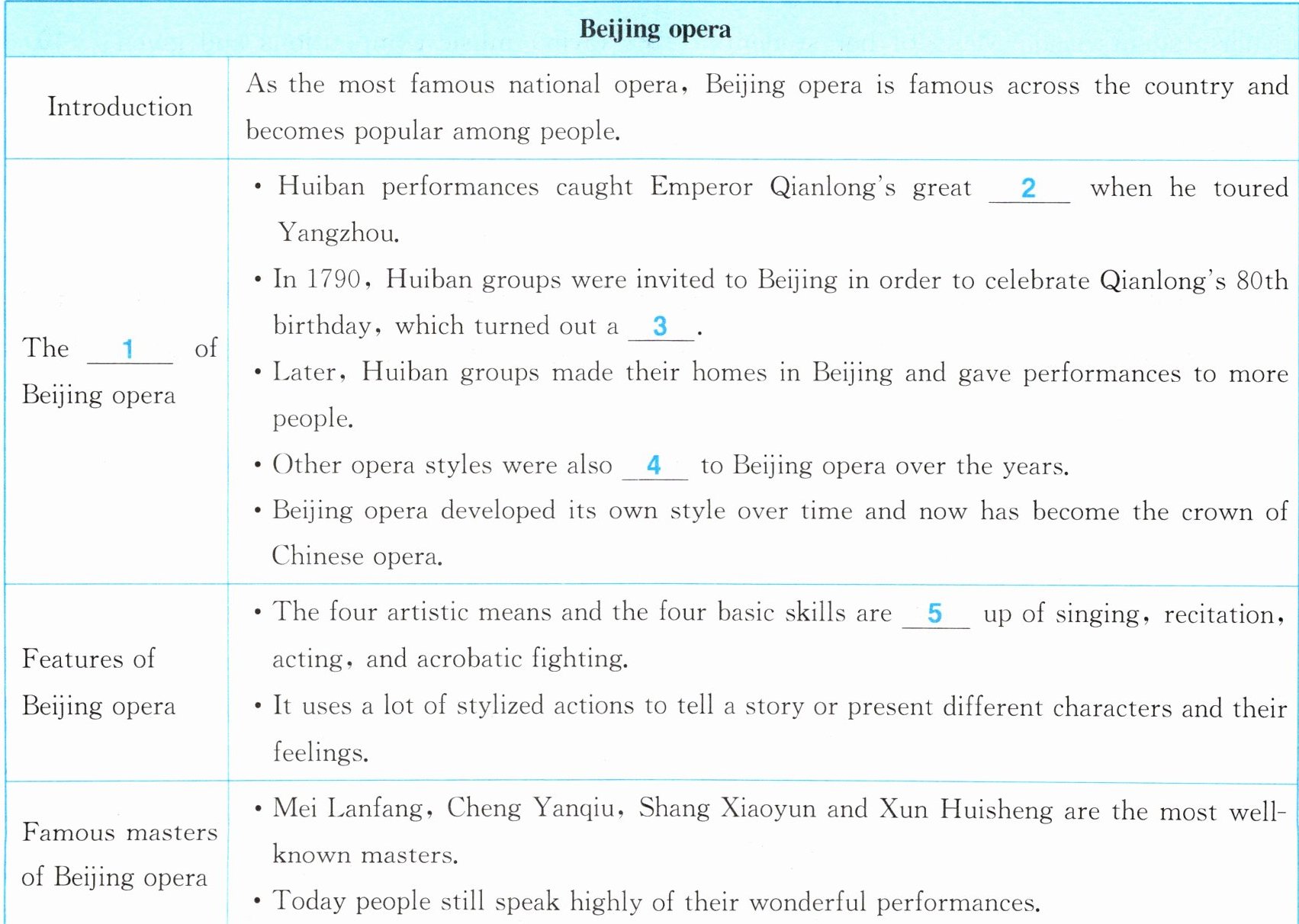 to Beijing opera over the years.
• Beijing opera developed its own style over time and now has become the crown of Chinese opera. |
| Features of Beijing opera |$ • The four artistic means and the four basic skills are \underline{ 5 } up of singing, recitation, acting, and acrobatic fighting.$
• It uses a lot of stylized actions to tell a story or present different characters and their feelings. |
| Famous masters of Beijing opera | • Mei Lanfang, Cheng Yanqiu, Shang Xiaoyun and Xun Huisheng are the most well-known masters.
• Today people still speak highly of their wonderful performances. |
续表

1.
2.
3.
4.
5.
6.
7.
8.
Chinese operas are traditional dramas including literature, music, dance, martial arts(武术), and acrobatics(杂技). There are many local Chinese operas and some enjoy great popularity. Among them, Beijing opera is the most famous type of opera in China.
In the beginning, Beijing did not have its own style of opera. According to the legend, Emperor Qianlong(1711—1799) had seen and enjoyed some Huiban performances when he toured Yangzhou, Jiangsu Province. The word "ban" means an opera company, while the word "hui" probably refers to Anhui Province. There were many famous Huiban groups performing in Yangzhou, and they performed various opera styles, including erhuang and kunqu. Since Qianlong had enjoyed Huiban performances so much, four Huiban groups were invited to perform in Beijing for Qianlong's 80th birthday celebration in 1790, which proved successful. From then on, they lived in the capital, mostly performing for the palace, and then later also performing for the public. Over the years, Beijing opera developed and changed, borrowing parts of other opera styles, particularly Kunqu opera, which had been popular in the palace before 1790. Over time, it developed its own artistic style and a complete performing system(表演体系). It is now considered as the crown of Chinese opera.
Singing, recitation, acting, and acrobatic fighting(唱、念、做、打) are the four artistic means and the four basic skills of Beijing opera. Footwork(脚步动作) and other movements express the actions such as riding a horse, rowing a boat, opening a door, going upstairs, climbing a hill, or travelling. Beijing opera is a number of stylized(非写实的) actions to tell a story or present different characters and their feelings of happiness, anger, sorrow, surprise, fear and sadness.
There are many famous masters who are good at performing Beijing opera. Among them, the four famous Dans—Mei Lanfang, Cheng Yanqiu, Shang Xiaoyun and Xun Huisheng are the most well-known. They are experts in performing the role of Dan and each has its own artistic feature. Their wonderful performances are still praised by many people.
Beijing opera is a prized form of theatre in China. It continues to bring to life many ancient stories and heroes, which enchants(使陶醉) many Chinese people and foreigners with its artistic charm. As the most influential type of opera in China, Beijing opera is an important form of expression of the traditional culture of the Chinese nation. It is sure that it is really the treasure of Chinese culture.
| Beijing opera | |
| --- | --- |
| Introduction | As the most famous national opera, Beijing opera is famous across the country and becomes popular among people. |
|$ The \underline{ 1 } of Beijing opera $|$ • Huiban performances caught Emperor Qianlong's great \underline{ 2 } when he toured Yangzhou.$
$• In 1790, Huiban groups were invited to Beijing in order to celebrate Qianlong's 80th birthday, which turned out a \underline{ 3 }.$
• Later, Huiban groups made their homes in Beijing and gave performances to more people.
• Other opera styles were also
to Beijing opera over the years.• Beijing opera developed its own style over time and now has become the crown of Chinese opera. |
| Features of Beijing opera |$ • The four artistic means and the four basic skills are \underline{ 5 } up of singing, recitation, acting, and acrobatic fighting.$
• It uses a lot of stylized actions to tell a story or present different characters and their feelings. |
| Famous masters of Beijing opera | • Mei Lanfang, Cheng Yanqiu, Shang Xiaoyun and Xun Huisheng are the most well-known masters.
• Today people still speak highly of their wonderful performances. |
续表
1.
history/origin/development
2.
attention/interest
3.
success
4.
added/introduced
5.
made
6.
alive
7.
doubt
8.
I will watch Beijing opera performances and introduce them to my foreign friends.(答案不唯一,言之有理即可)
答案:1. history/origin/development 2. attention/interest 3. success 4. added/introduced
5. made 6. alive 7. doubt 8. I will watch Beijing opera performances and introduce them to my foreign friends.(答案不唯一,言之有理即可)
5. made 6. alive 7. doubt 8. I will watch Beijing opera performances and introduce them to my foreign friends.(答案不唯一,言之有理即可)
解析:
【分析】
这是一篇信息提取型的阅读填空题,解题时首先要梳理表格的板块划分,明确每个板块对应的原文段落范围,再逐空定位到原文的对应语句,结合语义、词性要求和固定搭配推导答案:
1. 先看第1空所在板块的所有内容,全部围绕京剧从徽班进京到逐步形成独有风格的全过程展开,对应主题就是京剧的起源/发展/历史;
2. 第2空定位到乾隆在扬州观赏徽班演出的相关描述,原文提到乾隆十分喜爱徽班表演,说明徽班演出吸引了他的注意力/兴趣;
3. 第3空对应1790年徽班进京祝寿的结果,原文明确提到这次活动十分成功,转换为名词形式即可;
4. 第4空对应京剧发展过程中吸纳其他戏曲风格的描述,结合被动语态的语法要求推导合适的动词;
5. 剩余空结合固定短语搭配和原文同义转换即可得出,最后开放题围绕推广传承京剧文化的合理行为作答即可。
【解析】
1. 该板块完整介绍了京剧从无到有逐步成型的全过程,主题为京剧的历史/起源/发展,故填history/origin/development;
2. 原文第二段提到乾隆观赏徽班演出后十分喜爱,说明徽班演出获得了乾隆的关注/兴趣,故填attention/interest;
3. 原文第二段明确说明1790年徽班进京祝寿的活动取得了成功,冠词a后接名词,故填success;
4. 原文第二段提到京剧发展过程中借鉴了其他戏曲风格的内容,即其他戏曲元素被融入京剧,被动语态下可填added/introduced;
5. 固定搭配be made up of意为“由……组成”,对应原文“唱念做打是京剧的四大艺术手段和基本功”的语义,故填made;
6. 对应原文最后一段“它不断让很多古代故事和英雄鲜活起来”,固定搭配bring sth to life,故填alive;
7. 对应原文最后一段“毫无疑问京剧是中国文化的瑰宝”,固定句型There is no doubt that...,故填doubt;
8. 开放题围绕传承、推广京剧文化的合理行为作答即可,示例:I will watch Beijing opera performances and introduce them to my foreign friends.
【答案】
1. history/origin/development
2. attention/interest
3. success
4. added/introduced
5. made
6. alive
7. doubt
8. I will watch Beijing opera performances and introduce them to my foreign friends.(答案不唯一,言之有理即可)
【知识点】
阅读信息提取;固定短语搭配;京剧文化常识
【点评】
本题属于阅读类信息还原题型,既考查学生快速定位原文关键信息、进行语义转换的能力,也考查常用固定搭配的积累,同时融入中华传统文化京剧的相关内容,引导学生了解本土非遗文化,最后设置的开放性问题也引导学生思考文化传承的实际做法,难度适中。
【难度系数】
0.6
这是一篇信息提取型的阅读填空题,解题时首先要梳理表格的板块划分,明确每个板块对应的原文段落范围,再逐空定位到原文的对应语句,结合语义、词性要求和固定搭配推导答案:
1. 先看第1空所在板块的所有内容,全部围绕京剧从徽班进京到逐步形成独有风格的全过程展开,对应主题就是京剧的起源/发展/历史;
2. 第2空定位到乾隆在扬州观赏徽班演出的相关描述,原文提到乾隆十分喜爱徽班表演,说明徽班演出吸引了他的注意力/兴趣;
3. 第3空对应1790年徽班进京祝寿的结果,原文明确提到这次活动十分成功,转换为名词形式即可;
4. 第4空对应京剧发展过程中吸纳其他戏曲风格的描述,结合被动语态的语法要求推导合适的动词;
5. 剩余空结合固定短语搭配和原文同义转换即可得出,最后开放题围绕推广传承京剧文化的合理行为作答即可。
【解析】
1. 该板块完整介绍了京剧从无到有逐步成型的全过程,主题为京剧的历史/起源/发展,故填history/origin/development;
2. 原文第二段提到乾隆观赏徽班演出后十分喜爱,说明徽班演出获得了乾隆的关注/兴趣,故填attention/interest;
3. 原文第二段明确说明1790年徽班进京祝寿的活动取得了成功,冠词a后接名词,故填success;
4. 原文第二段提到京剧发展过程中借鉴了其他戏曲风格的内容,即其他戏曲元素被融入京剧,被动语态下可填added/introduced;
5. 固定搭配be made up of意为“由……组成”,对应原文“唱念做打是京剧的四大艺术手段和基本功”的语义,故填made;
6. 对应原文最后一段“它不断让很多古代故事和英雄鲜活起来”,固定搭配bring sth to life,故填alive;
7. 对应原文最后一段“毫无疑问京剧是中国文化的瑰宝”,固定句型There is no doubt that...,故填doubt;
8. 开放题围绕传承、推广京剧文化的合理行为作答即可,示例:I will watch Beijing opera performances and introduce them to my foreign friends.
【答案】
1. history/origin/development
2. attention/interest
3. success
4. added/introduced
5. made
6. alive
7. doubt
8. I will watch Beijing opera performances and introduce them to my foreign friends.(答案不唯一,言之有理即可)
【知识点】
阅读信息提取;固定短语搭配;京剧文化常识
【点评】
本题属于阅读类信息还原题型,既考查学生快速定位原文关键信息、进行语义转换的能力,也考查常用固定搭配的积累,同时融入中华传统文化京剧的相关内容,引导学生了解本土非遗文化,最后设置的开放性问题也引导学生思考文化传承的实际做法,难度适中。
【难度系数】
0.6