一、听录音,选出你所听到的句子。
(
C. Who was Cai Lun?
(
C. He liked making things.
(
C. How did he do it?
(
(
B
)1. A. Who is Yuan Longping? B. Who was Yuan Longping?C. Who was Cai Lun?
(
A
)2. A. He lived in the Han Dynasty. B. He lives in Nanjing.C. He liked making things.
(
C
)3. A. How can we help? B. How was school today?C. How did he do it?
(
A
)4. A. It was useful. B. It is useful. C. It was expensive.答案:1~4 B A C A
二、用所给单词的适当形式填空。
1. Cai Lun
2. At that time, people often
3. Silk
4. He
5. His paper
1. Cai Lun
lived
(live) in the Han Dynasty.2. At that time, people often
wrote
(write) on bamboo or silk.3. Silk
was
(be) dear in the past.4. He
made
(make) cheap but good paper at last.5. His paper
helped
(help) more people read and write.答案:1. lived 2. wrote 3. was 4. made 5. helped
1. 本句描述的是过去发生的历史事实,应使用一般过去时。live 的过去式为 lived。
2. at that time 表明是过去的时间,用一般过去时。write 的过去式为 wrote。
3. in the past 表明是过去的时间,silk 是不可数名词,be 动词应用过去式 was。
4. 句子描述的是过去的动作,应用一般过去时。make 的过去式为 made。
5. 主语 His paper 为第三人称单数,且句子描述的是历史贡献(过去事实),动词应用过去式。help 的过去式为 helped。
1. 本句描述的是过去发生的历史事实,应使用一般过去时。live 的过去式为 lived。
2. at that time 表明是过去的时间,用一般过去时。write 的过去式为 wrote。
3. in the past 表明是过去的时间,silk 是不可数名词,be 动词应用过去式 was。
4. 句子描述的是过去的动作,应用一般过去时。make 的过去式为 made。
5. 主语 His paper 为第三人称单数,且句子描述的是历史贡献(过去事实),动词应用过去式。help 的过去式为 helped。
解析:
【分析】首先判断所有句子均描述过去的历史事实或过去的情况,需使用一般过去时。接着根据每个句子的语境和所给单词,将动词转换为对应的过去式;be动词需结合主语的单复数及时态变化过去式。
【解析】1. 句子描述蔡伦生活在汉代这一过去的历史事实,使用一般过去时,live的过去式为lived;2. 句中“at that time”是过去时间标志,需用一般过去时,write的过去式为wrote;3. “in the past”表明是过去时间,主语silk为不可数名词,be动词的过去式用was;4. 句子描述过去的动作,使用一般过去时,make的过去式为made;5. 句子描述过去的贡献,使用一般过去时,help的过去式为helped。
【答案】lived;wrote;was;made;helped
【知识点】一般过去时、动词过去式、be动词过去式
【点评】本题考查一般过去时的基本运用,需准确识别句子的过去语境,掌握规则与不规则动词的过去式变化,属于基础题型,难度较低。
【难度系数】0.8
【解析】1. 句子描述蔡伦生活在汉代这一过去的历史事实,使用一般过去时,live的过去式为lived;2. 句中“at that time”是过去时间标志,需用一般过去时,write的过去式为wrote;3. “in the past”表明是过去时间,主语silk为不可数名词,be动词的过去式用was;4. 句子描述过去的动作,使用一般过去时,make的过去式为made;5. 句子描述过去的贡献,使用一般过去时,help的过去式为helped。
【答案】lived;wrote;was;made;helped
【知识点】一般过去时、动词过去式、be动词过去式
【点评】本题考查一般过去时的基本运用,需准确识别句子的过去语境,掌握规则与不规则动词的过去式变化,属于基础题型,难度较低。
【难度系数】0.8
三、实验班原创 文化意识 中国历史悠久,各个朝代都有名人。根据答语完成相应的问句。
1. —Who
—Zhang Heng was a great Chinese inventor.
2. —When
—Huo Qubing lived in the Han Dynasty.
3. —Why did Cai Lun
—Because paper was useful.
4. —Who
—Confucius was a great teacher.
5. —Where was
—Emperor Wu was born in Shaanxi Province(省).
1. —Who
was Zhang Heng
?—Zhang Heng was a great Chinese inventor.
2. —When
did Huo Qubing live
?—Huo Qubing lived in the Han Dynasty.
3. —Why did Cai Lun
invent/make paper
?—Because paper was useful.
4. —Who
was Confucius
?—Confucius was a great teacher.
5. —Where was
Emperor Wu born
?—Emperor Wu was born in Shaanxi Province(省).
答案:1. was Zhang Heng 2. did Huo Qubing live
3. invent/make paper 4. was Confucius
5. Emperor Wu born
3. invent/make paper 4. was Confucius
5. Emperor Wu born
解析:
【分析】
本题为根据答语补全特殊疑问句的题目,解题思路是先明确每个答语的核心信息,再结合疑问词(who/when/why/where)、时态及句子结构补全问句。需注意特殊疑问句的语序、一般过去时中助动词的使用,以及结合语境匹配答语的关键内容。
【解析】
1. 答语核心为“Zhang Heng was...”,询问“张衡是谁”,故补全为was Zhang Heng。
2. 答语核心为“Huo Qubing lived...”,询问“霍去病生活在什么时候”,答语为一般过去时,live是实义动词,需借助助动词did,故补全为did Huo Qubing live。
3. 答语核心为“Because paper was useful”,询问“蔡伦为什么发明/造纸”,前面有助动词did,后接动词原形,结合答语的paper,故补全为invent/make paper。
4. 答语核心为“Confucius was...”,询问“孔子是谁”,故补全为was Confucius。
5. 答语核心为“Emperor Wu was born...”,询问“汉武帝出生在哪里”,故补全为Emperor Wu born。
【答案】
1. was Zhang Heng 2. did Huo Qubing live 3. invent/make paper 4. was Confucius 5. Emperor Wu born
【知识点】
特殊疑问句、一般过去时
【点评】
本题结合中国历史名人的文化语境,考察特殊疑问句的结构及一般过去时的运用,将语言知识与文化常识结合,注重基础语言能力的考查。
【难度系数】
0.6
本题为根据答语补全特殊疑问句的题目,解题思路是先明确每个答语的核心信息,再结合疑问词(who/when/why/where)、时态及句子结构补全问句。需注意特殊疑问句的语序、一般过去时中助动词的使用,以及结合语境匹配答语的关键内容。
【解析】
1. 答语核心为“Zhang Heng was...”,询问“张衡是谁”,故补全为was Zhang Heng。
2. 答语核心为“Huo Qubing lived...”,询问“霍去病生活在什么时候”,答语为一般过去时,live是实义动词,需借助助动词did,故补全为did Huo Qubing live。
3. 答语核心为“Because paper was useful”,询问“蔡伦为什么发明/造纸”,前面有助动词did,后接动词原形,结合答语的paper,故补全为invent/make paper。
4. 答语核心为“Confucius was...”,询问“孔子是谁”,故补全为was Confucius。
5. 答语核心为“Emperor Wu was born...”,询问“汉武帝出生在哪里”,故补全为Emperor Wu born。
【答案】
1. was Zhang Heng 2. did Huo Qubing live 3. invent/make paper 4. was Confucius 5. Emperor Wu born
【知识点】
特殊疑问句、一般过去时
【点评】
本题结合中国历史名人的文化语境,考察特殊疑问句的结构及一般过去时的运用,将语言知识与文化常识结合,注重基础语言能力的考查。
【难度系数】
0.6
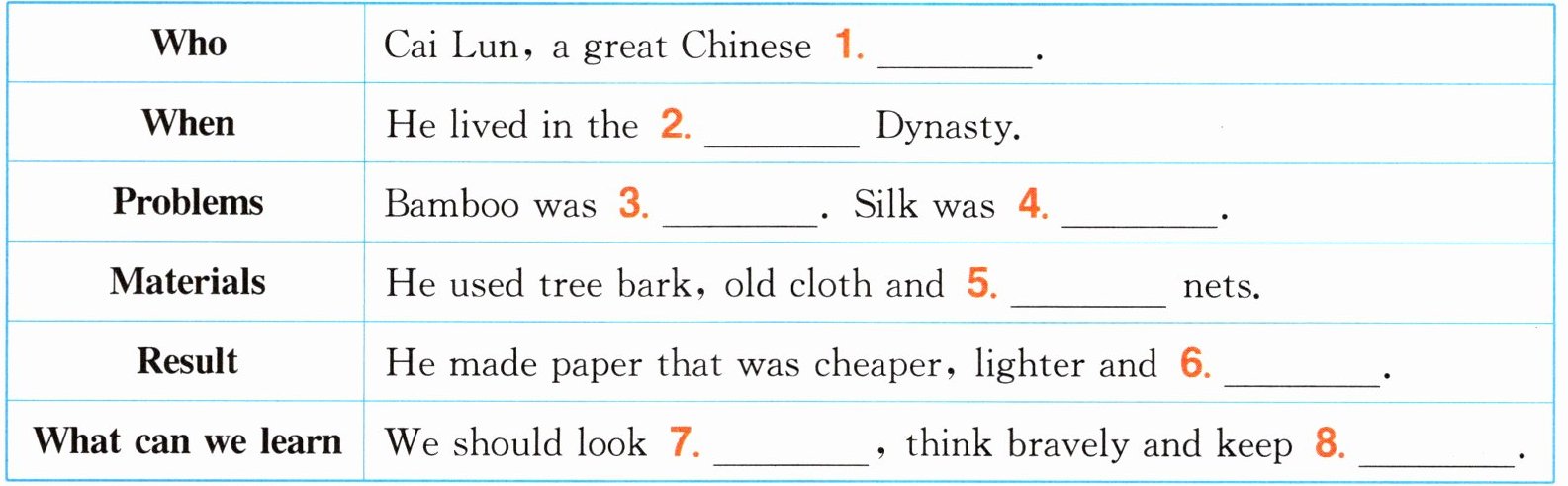
四、新语篇 蔡伦与造纸术 阅读短文,完成蔡伦的人物信息卡。(每空一词)
Cai Lun lived in the Han Dynasty. He worked in the palace and liked watching how people made things. At that time, many people wrote on bamboo or silk. Bamboo was heavy, so a long book was hard to carry. Silk was light but expensive, so poor students could not use it often. Cai Lun wanted to find a cheaper and better way. He collected tree bark(树皮), old cloth and fishing nets(渔网). He washed them, cut them into small pieces and cooked them in water. Then he beat the pieces into pulp(纸浆) and spread it on a screen. After it dried, it became paper. The work was not easy. He tried many times and changed his way again and again.
Finally, he made paper that was cheaper, lighter and useful. His paper helped more people read, write and keep records. From Cai Lun, we learn that a good inventor looks carefully, thinks bravely and never stops trying.
Cai Lun lived in the Han Dynasty. He worked in the palace and liked watching how people made things. At that time, many people wrote on bamboo or silk. Bamboo was heavy, so a long book was hard to carry. Silk was light but expensive, so poor students could not use it often. Cai Lun wanted to find a cheaper and better way. He collected tree bark(树皮), old cloth and fishing nets(渔网). He washed them, cut them into small pieces and cooked them in water. Then he beat the pieces into pulp(纸浆) and spread it on a screen. After it dried, it became paper. The work was not easy. He tried many times and changed his way again and again.
Finally, he made paper that was cheaper, lighter and useful. His paper helped more people read, write and keep records. From Cai Lun, we learn that a good inventor looks carefully, thinks bravely and never stops trying.
答案:1. inventor 2. Han 3. heavy 4. expensive
5. fishing 6. useful 7. carefully 8. trying
5. fishing 6. useful 7. carefully 8. trying
解析:
【分析】本题要求根据短文内容填写蔡伦的人物信息卡,解题时需先通读短文,明确每个空格对应的问题,再在短文中定位相关信息,提取符合要求的单词填空,注意每空一词的要求。
【解析】1. 短文提到蔡伦是伟大的中国发明家,故填inventor;2. 短文明确说明蔡伦生活在汉代,即Han Dynasty,故填Han;3. 短文指出竹子很重,故填heavy;4. 短文提到丝绸很昂贵,故填expensive;5. 短文说明蔡伦收集的材料包括树皮、旧布和渔网,即fishing nets,故填fishing;6. 短文提到他造出的纸更便宜、更轻且有用,故填useful;7. 短文指出好的发明家会仔细观察,故填carefully;8. 短文提到要坚持尝试,keep后接动名词trying,故填trying。
【答案】1. inventor 2. Han 3. heavy 4. expensive 5. fishing 6. useful 7. carefully 8. trying
【知识点】英语阅读理解、词汇运用、历史文化常识
【点评】本题结合中国古代科技人物蔡伦的事迹,考查学生对短文细节的理解和词汇的实际运用能力,兼具语言学习与文化渗透的作用,题目难度适中。
【难度系数】0.5
【解析】1. 短文提到蔡伦是伟大的中国发明家,故填inventor;2. 短文明确说明蔡伦生活在汉代,即Han Dynasty,故填Han;3. 短文指出竹子很重,故填heavy;4. 短文提到丝绸很昂贵,故填expensive;5. 短文说明蔡伦收集的材料包括树皮、旧布和渔网,即fishing nets,故填fishing;6. 短文提到他造出的纸更便宜、更轻且有用,故填useful;7. 短文指出好的发明家会仔细观察,故填carefully;8. 短文提到要坚持尝试,keep后接动名词trying,故填trying。
【答案】1. inventor 2. Han 3. heavy 4. expensive 5. fishing 6. useful 7. carefully 8. trying
【知识点】英语阅读理解、词汇运用、历史文化常识
【点评】本题结合中国古代科技人物蔡伦的事迹,考查学生对短文细节的理解和词汇的实际运用能力,兼具语言学习与文化渗透的作用,题目难度适中。
【难度系数】0.5