D 核心素养 中华优秀传统文化
The Spring Festival couplets are an important part of the Chinese New Year culture.
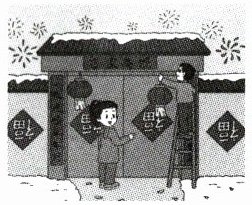
People write the Spring Festival couplets with black or golden words on red paper. They put up a pair of lines on each side of the front door. Putting up couplets shows people's happiness during the festival and wishes for a better life in the coming year.
In a pair of the Spring Festival couplets, the first line and the second line have the same number of words, and their meanings match each other well. The horizontal scroll(横批) is a four-word phrase. It has the two lines' meanings.
Reading the Spring Festival couplets is interesting. Here is the way: First, look at the horizontal scroll. If the four words are from left to right, the first line is on the left and the second line is on the right. If opposite, we read them from right to left.
The Spring Festival couplets started from taofu, some words on peach boards, in the Zhou dynasty. At that time, people thought that peach trees could stop bad things, so they put peach boards with words on the doors. This tradition lasted till the Tang dynasty. During the Song dynasty, people began to write the Spring Festival couplets on paper. It became popular in the Ming dynasty. Zhu Yuanzhang found those pairs of lines interesting, so he asked all families to put up the lines during the Chinese New Year.
(
A. It carries people's wishes for a good new year.
B. It helps people remember Zhu Yuanzhang forever.
C. It makes houses beautiful with no special meaning.
D. It helps people sell more red paper and peach boards.
(
A. 类似的
B. 可能的
C. 相反的
D. 必要的
(
A. The words are black or red.
B. Each line of them has four words.
C. The meanings of the two lines match.
D. People put them up on their windows.
(
A. The peach boards in the Tang dynasty had no words.
B. People in the Zhou dynasty put paper couplets on their doors.
C. People in the Song dynasty used peach boards with words.
D. All families began to put up paper couplets in the Ming dynasty.
The Spring Festival couplets are an important part of the Chinese New Year culture.
People write the Spring Festival couplets with black or golden words on red paper. They put up a pair of lines on each side of the front door. Putting up couplets shows people's happiness during the festival and wishes for a better life in the coming year.
In a pair of the Spring Festival couplets, the first line and the second line have the same number of words, and their meanings match each other well. The horizontal scroll(横批) is a four-word phrase. It has the two lines' meanings.
Reading the Spring Festival couplets is interesting. Here is the way: First, look at the horizontal scroll. If the four words are from left to right, the first line is on the left and the second line is on the right. If opposite, we read them from right to left.
The Spring Festival couplets started from taofu, some words on peach boards, in the Zhou dynasty. At that time, people thought that peach trees could stop bad things, so they put peach boards with words on the doors. This tradition lasted till the Tang dynasty. During the Song dynasty, people began to write the Spring Festival couplets on paper. It became popular in the Ming dynasty. Zhu Yuanzhang found those pairs of lines interesting, so he asked all families to put up the lines during the Chinese New Year.
(
A
)37. What is the special meaning of putting up Spring Festival couplets?A. It carries people's wishes for a good new year.
B. It helps people remember Zhu Yuanzhang forever.
C. It makes houses beautiful with no special meaning.
D. It helps people sell more red paper and peach boards.
(
C
)38. What does the underlined word "opposite" mean in Paragraph 4?A. 类似的
B. 可能的
C. 相反的
D. 必要的
(
C
)39. Which of the following is true about the Spring Festival couplets?A. The words are black or red.
B. Each line of them has four words.
C. The meanings of the two lines match.
D. People put them up on their windows.
(
D
)40. What can we learn about the Spring Festival couplets in different dynasties?A. The peach boards in the Tang dynasty had no words.
B. People in the Zhou dynasty put paper couplets on their doors.
C. People in the Song dynasty used peach boards with words.
D. All families began to put up paper couplets in the Ming dynasty.
答案:D[语篇解读]本文主要介绍了中国的春联,内容包括其寓意、结构特征、阅读规则以及演变的过程。
37. A
38. C 词义猜测题。根据“If the four words are from left to right, the first line is on the left and the second line is on the right. If opposite, we read them from right to left.”可知,文中对比了横批文字“从左往右”与“从右往左”两种相反的阅读顺序,说明opposite表达的是与前文“相反”的情况。opposite意为“相反的”。
39. C 细节理解题。根据“In a pair of the Spring Festival couplets ... their meanings match each other well.”可知,春联要求上下联的字数相等且含义相互匹配。
40. D
37. A
38. C 词义猜测题。根据“If the four words are from left to right, the first line is on the left and the second line is on the right. If opposite, we read them from right to left.”可知,文中对比了横批文字“从左往右”与“从右往左”两种相反的阅读顺序,说明opposite表达的是与前文“相反”的情况。opposite意为“相反的”。
39. C 细节理解题。根据“In a pair of the Spring Festival couplets ... their meanings match each other well.”可知,春联要求上下联的字数相等且含义相互匹配。
40. D
解析:
【分析】
这是一篇介绍中国春联的阅读理解题,包含4道小题,分别考查细节理解、词义猜测和文化常识相关的细节判断。解题思路为:1. 针对每道题的题干关键词,定位原文对应段落;2. 对比选项与原文信息,排除错误选项,选出正确答案;3. 词义猜测题需结合上下文逻辑关系推断词义。
【解析】
37. 细节理解题。根据原文第一段最后一句“Putting up couplets shows people's happiness during the festival and wishes for a better life in the coming year.”可知,贴春联的特殊意义是承载人们对新年的美好祝愿,对应选项A。B选项“纪念朱元璋”、C选项“使房子美观无特殊意义”、D选项“帮助卖红纸和桃板”均与原文不符,故选A。
38. 词义猜测题。根据原文第四段“If the four words are from left to right, the first line is on the left and the second line is on the right. If opposite, we read them from right to left.”可知,前文提到横批从左到右的情况,后文说opposite时从右到左,说明opposite意为“相反的”,故选C。
39. 细节理解题。根据原文第二段“In a pair of the Spring Festival couplets, the first line and the second line have the same number of words, and their meanings match each other well.”可知,春联上下联含义相互匹配,对应选项C。A选项“文字是黑或红色”(原文是黑或金色)、B选项“每联四个字”(原文是横批四个字)、D选项“贴在窗户上”(原文是贴在大门两侧)均错误,故选C。
40. 细节理解题。根据原文最后一段“It became popular in the Ming dynasty. Zhu Yuanzhang found those pairs of lines interesting, so he asked all families to put up the lines during the Chinese New Year.”可知,明朝时所有家庭开始贴春联,对应选项D。A选项“唐朝桃板无文字”、B选项“周朝贴纸春联”、C选项“宋朝用带文字的桃板”均与原文不符,故选D。
【答案】
37. A
38. C
39. C
40. D
【知识点】
阅读理解(细节理解)、词义猜测、中华传统文化
【点评】
本题结合中国传统春联文化命题,既考查学生的英语阅读理解能力,又渗透了文化常识的考查,题型常规,难度适中,适合学生巩固细节查找和词义猜测的解题方法。
【难度系数】
0.6
这是一篇介绍中国春联的阅读理解题,包含4道小题,分别考查细节理解、词义猜测和文化常识相关的细节判断。解题思路为:1. 针对每道题的题干关键词,定位原文对应段落;2. 对比选项与原文信息,排除错误选项,选出正确答案;3. 词义猜测题需结合上下文逻辑关系推断词义。
【解析】
37. 细节理解题。根据原文第一段最后一句“Putting up couplets shows people's happiness during the festival and wishes for a better life in the coming year.”可知,贴春联的特殊意义是承载人们对新年的美好祝愿,对应选项A。B选项“纪念朱元璋”、C选项“使房子美观无特殊意义”、D选项“帮助卖红纸和桃板”均与原文不符,故选A。
38. 词义猜测题。根据原文第四段“If the four words are from left to right, the first line is on the left and the second line is on the right. If opposite, we read them from right to left.”可知,前文提到横批从左到右的情况,后文说opposite时从右到左,说明opposite意为“相反的”,故选C。
39. 细节理解题。根据原文第二段“In a pair of the Spring Festival couplets, the first line and the second line have the same number of words, and their meanings match each other well.”可知,春联上下联含义相互匹配,对应选项C。A选项“文字是黑或红色”(原文是黑或金色)、B选项“每联四个字”(原文是横批四个字)、D选项“贴在窗户上”(原文是贴在大门两侧)均错误,故选C。
40. 细节理解题。根据原文最后一段“It became popular in the Ming dynasty. Zhu Yuanzhang found those pairs of lines interesting, so he asked all families to put up the lines during the Chinese New Year.”可知,明朝时所有家庭开始贴春联,对应选项D。A选项“唐朝桃板无文字”、B选项“周朝贴纸春联”、C选项“宋朝用带文字的桃板”均与原文不符,故选D。
【答案】
37. A
38. C
39. C
40. D
【知识点】
阅读理解(细节理解)、词义猜测、中华传统文化
【点评】
本题结合中国传统春联文化命题,既考查学生的英语阅读理解能力,又渗透了文化常识的考查,题型常规,难度适中,适合学生巩固细节查找和词义猜测的解题方法。
【难度系数】
0.6