一、完形填空(10分)
This is a story about a storm in Moscow. It happened several years ago. It was my first time that I had seen such a terrible storm.
It was a sunny day in July, and I was at home watching TV. The window was open
Then I looked outside. I found that the big tree in front of my house was going to fall to the ground and some parts of it had broken off. The thunder and lightning lasted for a while. I started to
After a while, the wind stopped, but it began to hail(下冰雹). After about ten minutes, everything stopped, and the sun came out again. How
In the streets, many trees were lying here and there. For a few days, people helped clean parks and gardens. Some people's cars were broken by trees' falling parts on them. The
(
(
(
(
(
(
(
(
(
(
This is a story about a storm in Moscow. It happened several years ago. It was my first time that I had seen such a terrible storm.
It was a sunny day in July, and I was at home watching TV. The window was open
because
1 the weather was so hot. Suddenly, I felt a strong
2 wind from outside. I looked out of the window and saw a black sky and trees blowing over because of it. I tried to close
3 the window, but the wind made me fall
4 down. I was afraid that the glass might break(破裂). I stood up and tried to close the window again. Luckily
5, I made it.Then I looked outside. I found that the big tree in front of my house was going to fall to the ground and some parts of it had broken off. The thunder and lightning lasted for a while. I started to
turn off
6 all the appliances(电器)as quickly as possible.After a while, the wind stopped, but it began to hail(下冰雹). After about ten minutes, everything stopped, and the sun came out again. How
strange
7 the weather was! A few minutes later, the phone began to ring. It was my friend. We asked each other what it was like and how
8 we felt after the storm.In the streets, many trees were lying here and there. For a few days, people helped clean parks and gardens. Some people's cars were broken by trees' falling parts on them. The
experience
9 tells me that in the face of natural disasters, human beings are insignificant(微不足道的). We can't stop them, but we must protect
10 ourselves from them.(
B
) 1. A. so B. because C. but D. if(
A
) 2. A. strong B. little C. gentle D. deep(
D
) 3. A. hold B. clean C. change D. close(
C
) 4. A. come B. jump C. fall D. lie(
A
) 5. A. Luckily B. Easily C. Loudly D. Clearly(
A
) 6. A. turn off B. turn on C. turn down D. turn up(
D
) 7. A. hard B. similar C. usual D. strange(
C
) 8. A. what B. who C. how D. when(
B
) 9. A. trip B. experience C. action D. exchange(
A
)10. A. protect B. return C. manage D. raise答案:1.B 2.A 3.D 4.C 5.A 6.A 7.D 8.C 9.B 10.A
解析:
【分析】
做完形填空需先通读全文把握主旨(本文讲述作者在莫斯科经历的一场暴风雨的过程与感悟),再结合上下文语境、词义辨析、逻辑关系及固定搭配逐一分析:1. 依据因果逻辑选连词;2. 描述暴风雨的风选形容词;3. 结合后文动作选动词;4. 对应风的作用选动词短语;5. 结合成功结果选副词;6. 对应暴风雨时的操作选动词短语;7. 描述特殊天气选形容词;8. 询问感受选疑问词;9. 对应感悟载体选名词;10. 依据固定搭配选动词。
【解析】
1. 第1空:前句“窗户开着”与后句“天气很热”是因果关系,表原因用because,故选B。
2. 第2空:暴风雨的风是强劲的,strong符合语境,故选A。
3. 第3空:后文提到“尝试关窗”,此处对应close(关闭),故选D。
4. 第4空:风太大导致人摔倒,fall down是固定短语“摔倒”,故选C。
5. 第5空:前文尝试关窗未成功,后文成功,用Luckily(幸运地)表庆幸,故选A。
6. 第6空:暴风雨时需关闭电器,turn off意为“关闭”,故选A。
7. 第7空:暴风雨刚过太阳又出来,天气很奇怪,strange符合语境,故选D。
8. 第8空:询问“感受如何”,用how引导宾语从句,故选C。
9. 第9空:这次暴风雨的经历让作者有感悟,experience意为“经历”,故选B。
10. 第10空:固定搭配protect...from意为“保护……免受……”,符合句意,故选A。
【答案】
1.B 2.A 3.D 4.C 5.A 6.A 7.D 8.C 9.B 10.A
【知识点】
英语完形填空、词义辨析、固定搭配
【点评】
本文为记叙文,围绕个人经历展开,考查语境理解、词汇辨析及常用固定搭配,难度适中,学生需结合上下文逻辑和生活常识分析,属于基础型完形练习。
【难度系数】
0.6
做完形填空需先通读全文把握主旨(本文讲述作者在莫斯科经历的一场暴风雨的过程与感悟),再结合上下文语境、词义辨析、逻辑关系及固定搭配逐一分析:1. 依据因果逻辑选连词;2. 描述暴风雨的风选形容词;3. 结合后文动作选动词;4. 对应风的作用选动词短语;5. 结合成功结果选副词;6. 对应暴风雨时的操作选动词短语;7. 描述特殊天气选形容词;8. 询问感受选疑问词;9. 对应感悟载体选名词;10. 依据固定搭配选动词。
【解析】
1. 第1空:前句“窗户开着”与后句“天气很热”是因果关系,表原因用because,故选B。
2. 第2空:暴风雨的风是强劲的,strong符合语境,故选A。
3. 第3空:后文提到“尝试关窗”,此处对应close(关闭),故选D。
4. 第4空:风太大导致人摔倒,fall down是固定短语“摔倒”,故选C。
5. 第5空:前文尝试关窗未成功,后文成功,用Luckily(幸运地)表庆幸,故选A。
6. 第6空:暴风雨时需关闭电器,turn off意为“关闭”,故选A。
7. 第7空:暴风雨刚过太阳又出来,天气很奇怪,strange符合语境,故选D。
8. 第8空:询问“感受如何”,用how引导宾语从句,故选C。
9. 第9空:这次暴风雨的经历让作者有感悟,experience意为“经历”,故选B。
10. 第10空:固定搭配protect...from意为“保护……免受……”,符合句意,故选A。
【答案】
1.B 2.A 3.D 4.C 5.A 6.A 7.D 8.C 9.B 10.A
【知识点】
英语完形填空、词义辨析、固定搭配
【点评】
本文为记叙文,围绕个人经历展开,考查语境理解、词汇辨析及常用固定搭配,难度适中,学生需结合上下文逻辑和生活常识分析,属于基础型完形练习。
【难度系数】
0.6
二、阅读理解(16分)
A
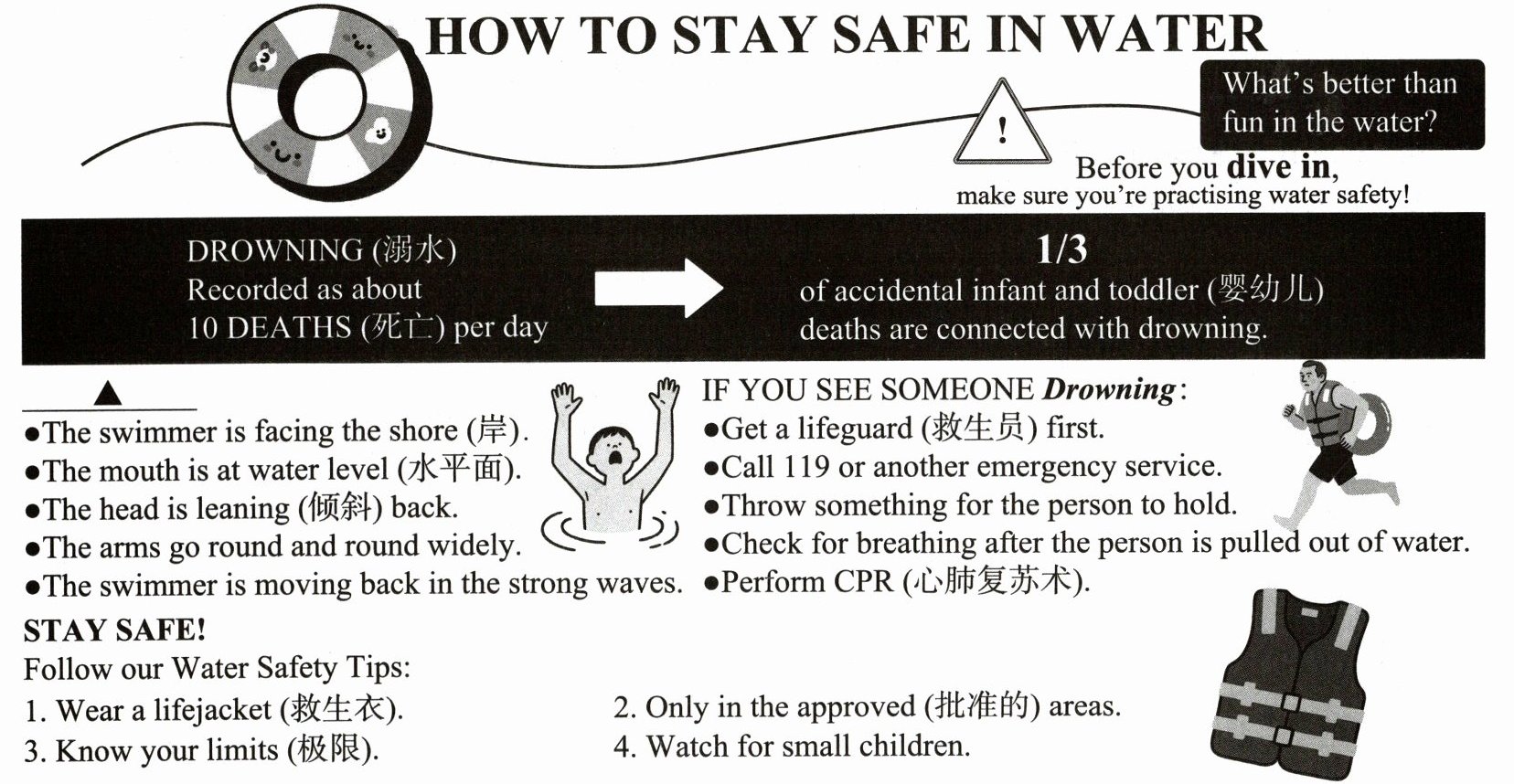
HOW TO STAY SAFE IN WATER
What’s better than fun in the water?
Before you dive in, make sure you’re practising water safety!
DROWNING (溺水)
Recorded as about 10 DEATHS (死亡) per day
$\frac{1}{3}$ of accidental infant and toddler (婴幼儿) deaths are connected with drowning.
●The swimmer is facing the shore (岸).
●The mouth is at water level (水平面).
●The head is leaning (倾斜) back.
●The arms go round and round widely.
●The swimmer is moving back in the strong waves.
IF YOU SEE SOMEONE Drowning:
●Get a lifeguard (救生员) first.
●Call 119 or another emergency service.
●Throw something for the person to hold.
●Check for breathing after the person is pulled out of water.
●Perform CPR (心肺复苏术).
STAY SAFE!
Follow our Water Safety Tips:
1. Wear a lifejacket (救生衣).
2. Only in the approved (批准的) areas.
3. Know your limits (极限).
4. Watch for small children.
(
A. Signs of Drowning.
B. Dos and Don'ts in the Water.
C. Danger of the Water.
D. Ways to Call for Help.
(
A. To teach safety tips.
B. To show teenagers' death.
C. To show the great danger.
D. To show how the tips help.
(
A. Jump into the sea to save him at once.
B. Swim as far as possible to safe areas.
C. Call his parents for help.
D. Give him something to hold.
(
A. A swimming guide.
B. An advertisement of lifejackets.
C. Swimming pool instructions.
D. A poster about water safety.
A
HOW TO STAY SAFE IN WATER
What’s better than fun in the water?
Before you dive in, make sure you’re practising water safety!
DROWNING (溺水)
Recorded as about 10 DEATHS (死亡) per day
$\frac{1}{3}$ of accidental infant and toddler (婴幼儿) deaths are connected with drowning.
Signs of Drowning.
▲●The swimmer is facing the shore (岸).
●The mouth is at water level (水平面).
●The head is leaning (倾斜) back.
●The arms go round and round widely.
●The swimmer is moving back in the strong waves.
IF YOU SEE SOMEONE Drowning:
●Get a lifeguard (救生员) first.
●Call 119 or another emergency service.
●Throw something for the person to hold.
●Check for breathing after the person is pulled out of water.
●Perform CPR (心肺复苏术).
STAY SAFE!
Follow our Water Safety Tips:
1. Wear a lifejacket (救生衣).
2. Only in the approved (批准的) areas.
3. Know your limits (极限).
4. Watch for small children.
(
A
) 1. Which of the following might be the heading(小标题) for “ ▲ ”?A. Signs of Drowning.
B. Dos and Don'ts in the Water.
C. Danger of the Water.
D. Ways to Call for Help.
(
C
) 2. Why does the writer mention (提及) “$\frac{1}{3}$”?A. To teach safety tips.
B. To show teenagers' death.
C. To show the great danger.
D. To show how the tips help.
(
D
) 3. What should Jack do if he sees a drowning boy in the sea according to the text?A. Jump into the sea to save him at once.
B. Swim as far as possible to safe areas.
C. Call his parents for help.
D. Give him something to hold.
(
D
) 4. What type of text is this?A. A swimming guide.
B. An advertisement of lifejackets.
C. Swimming pool instructions.
D. A poster about water safety.
答案:1.A 2.C 3.D 4.D
解析:
【分析】
首先梳理每道题的解题思路:
1. 第1题:需确定▲处的小标题,观察▲下方内容,均为溺水者的外在表现(如脸朝岸、嘴在水面等),属于溺水的迹象,对应选项A。
2. 第2题:定位“1/3”所在句子,其表述为“1/3的婴幼儿意外死亡与溺水有关”,目的是体现溺水的危险性,故选C。
3. 第3题:根据题干“看到溺水男孩该做什么”,定位原文“IF YOU SEE SOMEONE Drowning”部分,其中提到“Throw something for the person to hold”,对应选项D,其他选项不符合原文要求。
4. 第4题:分析文本整体内容,围绕水上安全展开,是宣传水上安全的海报,对应选项D。
【解析】
1. 第1题:▲下方列举的都是溺水者的特征,即溺水的迹象,A选项“Signs of Drowning”匹配;B选项“水中注意事项”、C选项“水的危险”、D选项“求助方式”均不相关,故选A。
2. 第2题:原文用“1/3的婴幼儿意外死亡与溺水有关”的比例,体现溺水对婴幼儿的危害大,突出其危险性,C选项正确;A、B、D均不符合表述目的,故选C。
3. 第3题:原文提到看到溺水者可做“Throw something for the person to hold”,D选项符合;A选项未提及立刻跳海,B选项无依据,C选项应先找救生员或打119而非找父母,故选D。
4. 第4题:文本围绕水上安全展开,是关于水上安全的海报,D选项正确;A选项“游泳指南”、B选项“救生衣广告”、C选项“泳池说明”均不符合文本类型,故选D。
【答案】
1.A 2.C 3.D 4.D
【知识点】
英语阅读理解,细节理解,主旨大意
【点评】
本题为英语阅读理解题,文本是关于水上安全的实用海报,题型涵盖细节理解和主旨大意,要求学生从原文定位关键信息、理解文本主旨,整体难度适中,能有效考查学生的信息提取与文本理解能力。
【难度系数】
0.6
首先梳理每道题的解题思路:
1. 第1题:需确定▲处的小标题,观察▲下方内容,均为溺水者的外在表现(如脸朝岸、嘴在水面等),属于溺水的迹象,对应选项A。
2. 第2题:定位“1/3”所在句子,其表述为“1/3的婴幼儿意外死亡与溺水有关”,目的是体现溺水的危险性,故选C。
3. 第3题:根据题干“看到溺水男孩该做什么”,定位原文“IF YOU SEE SOMEONE Drowning”部分,其中提到“Throw something for the person to hold”,对应选项D,其他选项不符合原文要求。
4. 第4题:分析文本整体内容,围绕水上安全展开,是宣传水上安全的海报,对应选项D。
【解析】
1. 第1题:▲下方列举的都是溺水者的特征,即溺水的迹象,A选项“Signs of Drowning”匹配;B选项“水中注意事项”、C选项“水的危险”、D选项“求助方式”均不相关,故选A。
2. 第2题:原文用“1/3的婴幼儿意外死亡与溺水有关”的比例,体现溺水对婴幼儿的危害大,突出其危险性,C选项正确;A、B、D均不符合表述目的,故选C。
3. 第3题:原文提到看到溺水者可做“Throw something for the person to hold”,D选项符合;A选项未提及立刻跳海,B选项无依据,C选项应先找救生员或打119而非找父母,故选D。
4. 第4题:文本围绕水上安全展开,是关于水上安全的海报,D选项正确;A选项“游泳指南”、B选项“救生衣广告”、C选项“泳池说明”均不符合文本类型,故选D。
【答案】
1.A 2.C 3.D 4.D
【知识点】
英语阅读理解,细节理解,主旨大意
【点评】
本题为英语阅读理解题,文本是关于水上安全的实用海报,题型涵盖细节理解和主旨大意,要求学生从原文定位关键信息、理解文本主旨,整体难度适中,能有效考查学生的信息提取与文本理解能力。
【难度系数】
0.6