B
Big snowstorms and cold air swept across Northern China in the first week of November. At the same time, a global(全球的) meeting on climate change was held in Glasgow, Scotland. There, leaders from around the world tried to deal with global warming.
Why are we having such a cold winter on a warming planet? In fact, the cold winter and global warming are not contradictory. Global warming does not happen evenly(均衡地) on earth, and it leads to more extreme(极端的) heat and cold.
Because of the warming climate, China has seen a growing temperature in winter. It has risen by $0.41°\mathrm{C}$ every 10 years since 1961. But in some cases, the country has also seen extreme cold—for example, the icy weather in early 2008.
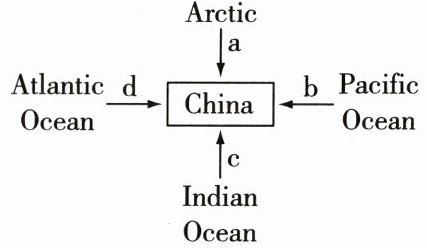
Global warming has changed the earth's air circulation(循环), affecting the local weather through sea-air or land-air interaction(相互作用). For example, in October, La Nina affected China. It was caused by strong winds above the Pacific Ocean. It brought more cold air to China. Another reason for the cold weather is the warming Arctic, according to BBC. It is warming almost three times as fast as any other place on earth. The polar vortex(极地涡旋)—a rotating(旋转的) pool of cold air—becomes active as the temperature rises there. So lots of cold Arctic air then goes southward.
Will this winter be much colder? The official forecast(预报) said a cold winter is possible. Northern China may see more snow than usual, and Southern China, less rainfall than usual.
(
A. We may have cold winter under global warming.
B. Global warming doesn't happen in cold winter.
C. The cold winter leads to global warming.
D. The cold winter has nothing to do with global warming.
(
A. doesn't happen everywhere
B. is not as serious as we thought
C. can cause more heat and rain
D. can also lead to more cold
(
A. had a rise in temperature
B. went through extreme floods
C. was much colder than usual
D. had a hotter summer than usual
(
A. ab
B. ac
C. bc
D. bd
Big snowstorms and cold air swept across Northern China in the first week of November. At the same time, a global(全球的) meeting on climate change was held in Glasgow, Scotland. There, leaders from around the world tried to deal with global warming.
Why are we having such a cold winter on a warming planet? In fact, the cold winter and global warming are not contradictory. Global warming does not happen evenly(均衡地) on earth, and it leads to more extreme(极端的) heat and cold.
Because of the warming climate, China has seen a growing temperature in winter. It has risen by $0.41°\mathrm{C}$ every 10 years since 1961. But in some cases, the country has also seen extreme cold—for example, the icy weather in early 2008.
Global warming has changed the earth's air circulation(循环), affecting the local weather through sea-air or land-air interaction(相互作用). For example, in October, La Nina affected China. It was caused by strong winds above the Pacific Ocean. It brought more cold air to China. Another reason for the cold weather is the warming Arctic, according to BBC. It is warming almost three times as fast as any other place on earth. The polar vortex(极地涡旋)—a rotating(旋转的) pool of cold air—becomes active as the temperature rises there. So lots of cold Arctic air then goes southward.
Will this winter be much colder? The official forecast(预报) said a cold winter is possible. Northern China may see more snow than usual, and Southern China, less rainfall than usual.
(
A
)5. What does the underlined sentence mean?A. We may have cold winter under global warming.
B. Global warming doesn't happen in cold winter.
C. The cold winter leads to global warming.
D. The cold winter has nothing to do with global warming.
(
D
)6. The icy weather in early 2008 may show that global warming .A. doesn't happen everywhere
B. is not as serious as we thought
C. can cause more heat and rain
D. can also lead to more cold
(
C
)7. When La Nina happened, China .A. had a rise in temperature
B. went through extreme floods
C. was much colder than usual
D. had a hotter summer than usual
(
A
)8. The cold weather in October in China was affected by cold air from .A. ab
B. ac
C. bc
D. bd
答案:5.A 6.D 7.C 8.A
解析:
【分析】
本题为英语阅读理解的句意理解与细节推理题,需结合原文内容及插图信息逐一分析各小题。第5题需理解划线句的含义;第6题需结合2008年冰灾的例子对应全球变暖与极端天气的关系;第7题需定位拉尼娜对中国的影响;第8题需结合插图和原文找出影响中国冷天气的冷空气来源。
【解析】
5. 划线句意为“冷冬和全球变暖并不矛盾”,即全球变暖背景下仍可能出现冷冬,对应选项A。B选项与文意相悖,C、D选项逻辑错误,故选A。
6. 原文第三段提到中国出现过2008年初的极端冰灾,结合第二段“全球变暖会导致更多极端冷热天气”,可知该例子说明全球变暖也会引发极端寒冷,对应选项D。A、B、C均不符合文意,故选D。
7. 原文第四段指出拉尼娜由太平洋强风导致,会给中国带来更多冷空气,因此中国会比平常更冷,对应选项C。A选项与文意相反,B、D选项未提及,故选C。
8. 结合原文第四段及插图,影响中国冷天气的冷空气来自北极(a)和太平洋(b),对应选项A。故选A。
【答案】
5.A 6.D 7.C 8.A
【知识点】
英语阅读理解、句意理解、细节推理
【点评】
本题围绕全球变暖与极端天气的关系展开,考查学生对原文信息的定位、理解与推理能力,需结合文本和插图解答,难度适中。
【难度系数】
0.6
本题为英语阅读理解的句意理解与细节推理题,需结合原文内容及插图信息逐一分析各小题。第5题需理解划线句的含义;第6题需结合2008年冰灾的例子对应全球变暖与极端天气的关系;第7题需定位拉尼娜对中国的影响;第8题需结合插图和原文找出影响中国冷天气的冷空气来源。
【解析】
5. 划线句意为“冷冬和全球变暖并不矛盾”,即全球变暖背景下仍可能出现冷冬,对应选项A。B选项与文意相悖,C、D选项逻辑错误,故选A。
6. 原文第三段提到中国出现过2008年初的极端冰灾,结合第二段“全球变暖会导致更多极端冷热天气”,可知该例子说明全球变暖也会引发极端寒冷,对应选项D。A、B、C均不符合文意,故选D。
7. 原文第四段指出拉尼娜由太平洋强风导致,会给中国带来更多冷空气,因此中国会比平常更冷,对应选项C。A选项与文意相反,B、D选项未提及,故选C。
8. 结合原文第四段及插图,影响中国冷天气的冷空气来自北极(a)和太平洋(b),对应选项A。故选A。
【答案】
5.A 6.D 7.C 8.A
【知识点】
英语阅读理解、句意理解、细节推理
【点评】
本题围绕全球变暖与极端天气的关系展开,考查学生对原文信息的定位、理解与推理能力,需结合文本和插图解答,难度适中。
【难度系数】
0.6
三、信息还原(10分)
Safety education is important, especially for us students. It helps us with knowledge to avoid dangers. 1.
First, it can develop our safety sense. Follow rules in different places. At school, don't run.
2.
Second, it helps reduce the risk. In daily internet use, don't share personal information online. Be serious about making friends online. Reports show that students who have studied safety have a nearly 40% decrease(减少) in danger. 3.
Third, it helps us develop survival skills. We can quickly know what to do when we're in danger. 4.
5.
A. In a word, safety education is the key to protecting life.
B. At home, check appliances (电器) like TVs to stop fires from happening.
C. So learning safety knowledge can reduce the happening of bad things.
D. Only when we learn this knowledge can we survive in such natural disasters.
E. It also helps us develop quick thinking during dangerous situations.
F. Always check our phones to find out if there's a fire on the way.
G. For example, knowledge like covering mouths and noses with hands in a fire is useful.
Safety education is important, especially for us students. It helps us with knowledge to avoid dangers. 1.
E
Here are three main reasons why every student should study it.First, it can develop our safety sense. Follow rules in different places. At school, don't run.
2.
B
Outside, always watch before crossing the street, and don't use phones while walking.Second, it helps reduce the risk. In daily internet use, don't share personal information online. Be serious about making friends online. Reports show that students who have studied safety have a nearly 40% decrease(减少) in danger. 3.
C
Third, it helps us develop survival skills. We can quickly know what to do when we're in danger. 4.
G
With this knowledge, we have a higher chance of surviving in a fire.5.
A
Teenagers should actively learn, practise, and spread safety knowledge. Only in this way can we make safety education all around our lives.A. In a word, safety education is the key to protecting life.
B. At home, check appliances (电器) like TVs to stop fires from happening.
C. So learning safety knowledge can reduce the happening of bad things.
D. Only when we learn this knowledge can we survive in such natural disasters.
E. It also helps us develop quick thinking during dangerous situations.
F. Always check our phones to find out if there's a fire on the way.
G. For example, knowledge like covering mouths and noses with hands in a fire is useful.
答案:1.E 2.B 3.C 4.G 5.A
解析:
【分析】本题为信息还原题,需结合上下文语境、逻辑关系(如承接、举例、总结、场所对应等)匹配选项。首先通读全文,明确文章围绕“安全教育的重要性”展开,分三个原因阐述,最后总结。第1空需承接前文安全教育的作用,引出下文三个原因;第2空对应前文“学校”、后文“外面”,应填“家里”的安全事项;第3空承接前文“危险减少40%”的数据,说明减少坏事发生;第4空需举例说明生存技能,对应后文“火灾”;第5空为总结句,需用总结性语句。
【解析】1. 第1空:前文提到安全教育帮助避免危险,E选项用“also”承接前文的帮助作用,引出下文三个原因,故选E。
2. 第2空:前文讲学校的安全规则,后文讲外面的安全注意事项,B选项对应不同场所(学校、家、外面)的安全要求,故选B。
3. 第3空:前文提到“学过安全的学生危险减少近40%”,C选项承接前文数据,说明安全知识可减少坏事发生,故选C。
4. 第4空:后文提到“在火灾中生存的机会”,G选项举火灾自救的例子,对应后文的“fire”,故选G。
5. 第5空:后文是对全文的总结,A选项是总结性语句,故选A。
【答案】1.E 2.B 3.C 4.G 5.A
【知识点】信息还原题、上下文逻辑衔接
【点评】本题考查学生对语篇逻辑和语境的理解能力,需结合上下文的场所、举例、总结等逻辑线索匹配选项,难度适中。
【难度系数】0.6
【解析】1. 第1空:前文提到安全教育帮助避免危险,E选项用“also”承接前文的帮助作用,引出下文三个原因,故选E。
2. 第2空:前文讲学校的安全规则,后文讲外面的安全注意事项,B选项对应不同场所(学校、家、外面)的安全要求,故选B。
3. 第3空:前文提到“学过安全的学生危险减少近40%”,C选项承接前文数据,说明安全知识可减少坏事发生,故选C。
4. 第4空:后文提到“在火灾中生存的机会”,G选项举火灾自救的例子,对应后文的“fire”,故选G。
5. 第5空:后文是对全文的总结,A选项是总结性语句,故选A。
【答案】1.E 2.B 3.C 4.G 5.A
【知识点】信息还原题、上下文逻辑衔接
【点评】本题考查学生对语篇逻辑和语境的理解能力,需结合上下文的场所、举例、总结等逻辑线索匹配选项,难度适中。
【难度系数】0.6