英语八年级
1.—How amazing AI is!
—Yes. The invention makes it quite
A.late
B.simple
C.natural
D.difficult
1.—How amazing AI is!
—Yes. The invention makes it quite
B
for people to write papers and stories.A.late
B.simple
C.natural
D.difficult
答案:1.B 句意:——AI真是太神奇了!——是的。这项发明使人们写论文和故事变得很简单。simple意为“简单的”,符合题意。故选B。
解析:
【分析】
先通读对话理解语境:第一句感叹AI很神奇,第二句回应称这项发明让人们写论文和故事变得怎样,需结合选项词义和固定搭配选出符合语境的形容词。
【解析】
本题考查固定搭配“make it + 形容词 + for sb to do sth”(使某人做某事变得……)。逐一分析选项:
A. late(晚的),不符合AI辅助后写内容的状态;
B. simple(简单的),符合AI让写论文、故事变得容易的语境;
C. natural(自然的),与语境不符;
D. difficult(困难的),和AI的神奇作用相悖,排除。
因此选B。
【答案】B
【知识点】形容词词义辨析;固定搭配make it + adj + to do sth
【点评】本题为基础词义辨析题,结合语境和固定搭配即可快速选出答案,难度较低。
【难度系数】0.8
先通读对话理解语境:第一句感叹AI很神奇,第二句回应称这项发明让人们写论文和故事变得怎样,需结合选项词义和固定搭配选出符合语境的形容词。
【解析】
本题考查固定搭配“make it + 形容词 + for sb to do sth”(使某人做某事变得……)。逐一分析选项:
A. late(晚的),不符合AI辅助后写内容的状态;
B. simple(简单的),符合AI让写论文、故事变得容易的语境;
C. natural(自然的),与语境不符;
D. difficult(困难的),和AI的神奇作用相悖,排除。
因此选B。
【答案】B
【知识点】形容词词义辨析;固定搭配make it + adj + to do sth
【点评】本题为基础词义辨析题,结合语境和固定搭配即可快速选出答案,难度较低。
【难度系数】0.8
上册
人教版
2. The writer
A.forgets
B.catches
C.mixes
D.chooses
人教版
2. The writer
C
real things with his imagination(想象力)in this book and offers readers a special reading experience.A.forgets
B.catches
C.mixes
D.chooses
答案:2.C 此处指将真实的事情与想象力结合。故选C。
解析:
【分析】首先理解句子含义:作者在这本书里将真实事物与想象力结合,给读者提供特别的阅读体验。接着辨析四个选项的词义,结合语境判断符合句意的动词,同时注意固定搭配的用法。
【解析】先翻译句子:作者在这本书中把真实的事物与他的想象力结合,给读者提供了一种特别的阅读体验。再分析选项:A.forgets(忘记)不符合语境;B.catches(抓住)语义不通;C.mixes(混合),mix...with...是固定短语,意为“把……与……混合”,符合句意;D.chooses(选择)不符合语境。因此选C。
【答案】C
【知识点】动词词义辨析;固定搭配
【点评】本题考查动词词义及固定搭配的运用,需结合句子语境辨析各选项含义,难度适中,属于基础题型。
【难度系数】0.5
【解析】先翻译句子:作者在这本书中把真实的事物与他的想象力结合,给读者提供了一种特别的阅读体验。再分析选项:A.forgets(忘记)不符合语境;B.catches(抓住)语义不通;C.mixes(混合),mix...with...是固定短语,意为“把……与……混合”,符合句意;D.chooses(选择)不符合语境。因此选C。
【答案】C
【知识点】动词词义辨析;固定搭配
【点评】本题考查动词词义及固定搭配的运用,需结合句子语境辨析各选项含义,难度适中,属于基础题型。
【难度系数】0.5
3.「2025江苏扬州中考」—
—None, I'm afraid.
A.How many
B.How much
C.How soon
D.How long
B
do you remember about this week's news?—None, I'm afraid.
A.How many
B.How much
C.How soon
D.How long
答案:3.B 根据“None”可知,此处询问记得多少(新闻),应用how much来提问不可数名词。故选B。
解析:
【分析】
本题考查疑问词组的辨析,需结合名词的可数性和答语语境判断合适的疑问词。首先明确各选项疑问词组的用法,再根据问句中核心名词的属性及答语含义筛选答案。
【解析】
1. 分析选项:A.How many修饰可数名词复数,用于提问可数事物的数量;B.How much可修饰不可数名词,用于提问不可数事物的数量或程度;C.How soon用于提问“多久以后”,答语常为“in+时间段”;D.How long用于提问时长,答语常为“for+时间段”或“since+时间点”。
2. 结合题干:问句核心名词news(新闻)是不可数名词,答语None表示“一点都没有”,是对不可数事物数量的提问,因此需用How much。
【答案】
B
【知识点】
疑问词辨析;不可数名词用法
【点评】
本题为中考英语基础题型,聚焦疑问词组的核心用法,需学生掌握不同疑问词的适用场景,结合名词属性和答语语境即可快速解题,注重基础知识点的应用。
【难度系数】
0.6
本题考查疑问词组的辨析,需结合名词的可数性和答语语境判断合适的疑问词。首先明确各选项疑问词组的用法,再根据问句中核心名词的属性及答语含义筛选答案。
【解析】
1. 分析选项:A.How many修饰可数名词复数,用于提问可数事物的数量;B.How much可修饰不可数名词,用于提问不可数事物的数量或程度;C.How soon用于提问“多久以后”,答语常为“in+时间段”;D.How long用于提问时长,答语常为“for+时间段”或“since+时间点”。
2. 结合题干:问句核心名词news(新闻)是不可数名词,答语None表示“一点都没有”,是对不可数事物数量的提问,因此需用How much。
【答案】
B
【知识点】
疑问词辨析;不可数名词用法
【点评】
本题为中考英语基础题型,聚焦疑问词组的核心用法,需学生掌握不同疑问词的适用场景,结合名词属性和答语语境即可快速解题,注重基础知识点的应用。
【难度系数】
0.6
Ⅱ.根据句意和首字母或音标提示写出所缺单词
4.—How did you fix up the broken bicycle?
—I just followed the i
5.「2025 甘肃武威中考改编」Turn the h
6.「2025 甘肃兰州中考改编」Today is my brother's birthday. I want to make a b
7. Spring rain is as valuable (宝贵的) as
4.—How did you fix up the broken bicycle?
—I just followed the i
nstructions
.5.「2025 甘肃武威中考改编」Turn the h
eat
down or it'll burn.6.「2025 甘肃兰州中考改编」Today is my brother's birthday. I want to make a b
owl
of long noodles for him.7. Spring rain is as valuable (宝贵的) as
oil
/ɔɪl/ because it's especially helpful for farming.答案:4.instructions 5.heat 6.bowl 7.oil
解析:
【分析】
本题为根据句意和首字母或音标写单词的基础题,解题思路是先理解每句的语境,再结合给出的首字母或音标,确定符合语义的名词。第4题需结合“修自行车”的语境,确定“遵循说明书”;第5题结合“调小否则会烧”的语境,确定对应名词;第6题结合“做长寿面”的固定搭配确定单词;第7题直接根据音标匹配单词。
【解析】
4. 问句询问修理坏自行车的方式,答句表示“我只是遵循……”,结合首字母i,此处应填名词instructions(说明书);
5. 句意是“把……调小否则会烧”,结合首字母h,应填名词heat(热度);
6. 固定搭配a bowl of表示“一碗……”,结合首字母b,此处应填名词bowl(碗);
7. 根据音标/ɔɪl/,对应单词oil。
【答案】
4.instructions 5.heat 6.bowl 7.oil
【知识点】
名词的用法、音标与单词对应、固定搭配
【点评】
本题考查基础词汇的运用,结合语境、首字母或音标即可完成,属于简单题。
【难度系数】
0.8
本题为根据句意和首字母或音标写单词的基础题,解题思路是先理解每句的语境,再结合给出的首字母或音标,确定符合语义的名词。第4题需结合“修自行车”的语境,确定“遵循说明书”;第5题结合“调小否则会烧”的语境,确定对应名词;第6题结合“做长寿面”的固定搭配确定单词;第7题直接根据音标匹配单词。
【解析】
4. 问句询问修理坏自行车的方式,答句表示“我只是遵循……”,结合首字母i,此处应填名词instructions(说明书);
5. 句意是“把……调小否则会烧”,结合首字母h,应填名词heat(热度);
6. 固定搭配a bowl of表示“一碗……”,结合首字母b,此处应填名词bowl(碗);
7. 根据音标/ɔɪl/,对应单词oil。
【答案】
4.instructions 5.heat 6.bowl 7.oil
【知识点】
名词的用法、音标与单词对应、固定搭配
【点评】
本题考查基础词汇的运用,结合语境、首字母或音标即可完成,属于简单题。
【难度系数】
0.8
Ⅲ.根据汉语意思完成句子,每空一词
8.我不知道如何处理这些旧书籍。
I don't know what to
9.他小心地把那个玻璃杯放回原处,然后离开了房间。
He carefully
10.你能告诉我如何到达邮局吗?
Could you tell me
8.我不知道如何处理这些旧书籍。
I don't know what to
do
with
the old books.9.他小心地把那个玻璃杯放回原处,然后离开了房间。
He carefully
put
the glass back
and then left the room.10.你能告诉我如何到达邮局吗?
Could you tell me
how
to
get to the post office?答案:8.do with 9.put;back 10.how to
解析:
【分析】
这三道题考查英语常用固定搭配与结构的运用,解题时需结合汉语意思,回忆对应的英语固定表达:第8题“处理”对应固定搭配do with,常与what连用;第9题“放回原处”对应动词短语put back,需注意时态;第10题“如何到达”对应“疑问词+不定式”结构。
【解析】
8题:根据汉语“处理”,固定搭配为do with,构成“what to do with sth”结构,符合句意,故填do with;
9题:“放回原处”的固定短语是put back,由后面的left(过去式)可知此处用一般过去时,put的过去式仍为put,故填put; back;
10题:“如何做某事”用“疑问词+不定式”结构,“如何”对应how,故填how to。
【答案】
8.do with 9.put;back 10.how to
【知识点】
固定搭配、动词短语、疑问词+不定式
【点评】
本题为基础英语填空题,考查常用固定表达的掌握,难度较低,熟记相关短语和结构即可轻松作答。
【难度系数】
0.7
这三道题考查英语常用固定搭配与结构的运用,解题时需结合汉语意思,回忆对应的英语固定表达:第8题“处理”对应固定搭配do with,常与what连用;第9题“放回原处”对应动词短语put back,需注意时态;第10题“如何到达”对应“疑问词+不定式”结构。
【解析】
8题:根据汉语“处理”,固定搭配为do with,构成“what to do with sth”结构,符合句意,故填do with;
9题:“放回原处”的固定短语是put back,由后面的left(过去式)可知此处用一般过去时,put的过去式仍为put,故填put; back;
10题:“如何做某事”用“疑问词+不定式”结构,“如何”对应how,故填how to。
【答案】
8.do with 9.put;back 10.how to
【知识点】
固定搭配、动词短语、疑问词+不定式
【点评】
本题为基础英语填空题,考查常用固定表达的掌握,难度较低,熟记相关短语和结构即可轻松作答。
【难度系数】
0.7
Ⅳ.补全对话
「2026陕西西安交大附中期中」
根据下面对话中的情境,在每个空白处填入
一个适当的语句,使对话恢复完整。
[Amy (A) is curious(好奇的) about Chinese food and wants to learn a simple Chinese dish. She is asking Zhang Peng (B) for help at school.]
A: Hi, Zhang Peng, can you teach me to make a Chinese dish?
B: Sure. 11.
A: Sounds great! How do we make dumplings?
B: First, we need flour, meat, and vegetables. We can use them to make dumplings.
A: 12.
B: Next, mix the meat and vegetables together. That’s the filling (馅) for dumplings.
A: OK. How do we make the dumpling wrappers (饺子皮)?
B: Use the flour to make thin circles. Those are dumpling wrappers.
A: Like this?
B: Perfect. Now, put the filling in the center of a wrapper. That’s how to fill a dumpling.
A: I see. What then?
B: Fold the wrapper. That’s how to shape a dumpling.
A: 13.
B: No, the final step is to cook the dumplings in boiling water.
A: That sounds easy. I’ll try to 14.
B: I’m sure your family will fall in love with them.
A: You are right. Thanks so much!
B: 15.
「2026陕西西安交大附中期中」
根据下面对话中的情境,在每个空白处填入
一个适当的语句,使对话恢复完整。
[Amy (A) is curious(好奇的) about Chinese food and wants to learn a simple Chinese dish. She is asking Zhang Peng (B) for help at school.]
A: Hi, Zhang Peng, can you teach me to make a Chinese dish?
B: Sure. 11.
How about learning to make dumplings/Would you like to learn to make dumplings
?A: Sounds great! How do we make dumplings?
B: First, we need flour, meat, and vegetables. We can use them to make dumplings.
A: 12.
What should we do next/What's next
?B: Next, mix the meat and vegetables together. That’s the filling (馅) for dumplings.
A: OK. How do we make the dumpling wrappers (饺子皮)?
B: Use the flour to make thin circles. Those are dumpling wrappers.
A: Like this?
B: Perfect. Now, put the filling in the center of a wrapper. That’s how to fill a dumpling.
A: I see. What then?
B: Fold the wrapper. That’s how to shape a dumpling.
A: 13.
Is that all/Are we done now
?B: No, the final step is to cook the dumplings in boiling water.
A: That sounds easy. I’ll try to 14.
make some for my family/make them at home
.B: I’m sure your family will fall in love with them.
A: You are right. Thanks so much!
B: 15.
You're welcome/My pleasure
.答案:11.How about learning to make dumplings/Would you like to learn to make dumplings
12.What should we do next/What's next
13.Is that all/Are we done now
14.make some for my family/make them at home
15.You're welcome/My pleasure
12.What should we do next/What's next
13.Is that all/Are we done now
14.make some for my family/make them at home
15.You're welcome/My pleasure
解析:
【分析】
本题为补全对话题型,解题思路是先通读对话,把握整体情境(Amy想学习制作中国菜,向张鹏求助),再结合上下句的问答逻辑、语境衔接来补全空白:11空需承接Amy想学中国菜的请求,结合下文Amy问做饺子的内容,应是提议学做饺子;12空需对应下文张鹏说的下一步操作,是询问接下来要做什么;13空需对应下文张鹏说的最后一步煮饺子,是询问是否完成步骤;14空需对应下文张鹏提到家人的内容,是表达要做给家人;15空需回应Amy的感谢,用日常交际用语。
【解析】
11. 根据下文Amy问“How do we make dumplings?”,可知张鹏提议学做饺子,故填How about learning to make dumplings/Would you like to learn to make dumplings;
12. 根据下文张鹏说“Next, mix the meat and vegetables together.”,可知Amy询问接下来的步骤,故填What should we do next/What's next;
13. 根据下文张鹏回答“No, the final step is to cook the dumplings in boiling water.”,可知Amy询问是否完成所有步骤,故填Is that all/Are we done now;
14. 根据下文张鹏说“I’m sure your family will fall in love with them.”,可知Amy表示要做给家人,故填make some for my family/make them at home;
15. 根据上文Amy说“Thanks so much!”,可知张鹏回应感谢,故填You're welcome/My pleasure。
【答案】
11.How about learning to make dumplings/Would you like to learn to make dumplings
12.What should we do next/What's next
13.Is that all/Are we done now
14.make some for my family/make them at home
15.You're welcome/My pleasure
【知识点】
补全对话、日常交际用语
【点评】
本题为日常交际类补全对话,贴近生活场景,考查学生的语境理解与日常用语运用能力,难度适中。
【难度系数】
0.6
本题为补全对话题型,解题思路是先通读对话,把握整体情境(Amy想学习制作中国菜,向张鹏求助),再结合上下句的问答逻辑、语境衔接来补全空白:11空需承接Amy想学中国菜的请求,结合下文Amy问做饺子的内容,应是提议学做饺子;12空需对应下文张鹏说的下一步操作,是询问接下来要做什么;13空需对应下文张鹏说的最后一步煮饺子,是询问是否完成步骤;14空需对应下文张鹏提到家人的内容,是表达要做给家人;15空需回应Amy的感谢,用日常交际用语。
【解析】
11. 根据下文Amy问“How do we make dumplings?”,可知张鹏提议学做饺子,故填How about learning to make dumplings/Would you like to learn to make dumplings;
12. 根据下文张鹏说“Next, mix the meat and vegetables together.”,可知Amy询问接下来的步骤,故填What should we do next/What's next;
13. 根据下文张鹏回答“No, the final step is to cook the dumplings in boiling water.”,可知Amy询问是否完成所有步骤,故填Is that all/Are we done now;
14. 根据下文张鹏说“I’m sure your family will fall in love with them.”,可知Amy表示要做给家人,故填make some for my family/make them at home;
15. 根据上文Amy说“Thanks so much!”,可知张鹏回应感谢,故填You're welcome/My pleasure。
【答案】
11.How about learning to make dumplings/Would you like to learn to make dumplings
12.What should we do next/What's next
13.Is that all/Are we done now
14.make some for my family/make them at home
15.You're welcome/My pleasure
【知识点】
补全对话、日常交际用语
【点评】
本题为日常交际类补全对话,贴近生活场景,考查学生的语境理解与日常用语运用能力,难度适中。
【难度系数】
0.6
Ⅴ.阅读理解
语篇类型「2026广东河源期末」
Fish and apple soup? Yes.
And you won't believe how delicious it is. This first came out of a restaurant in Singapore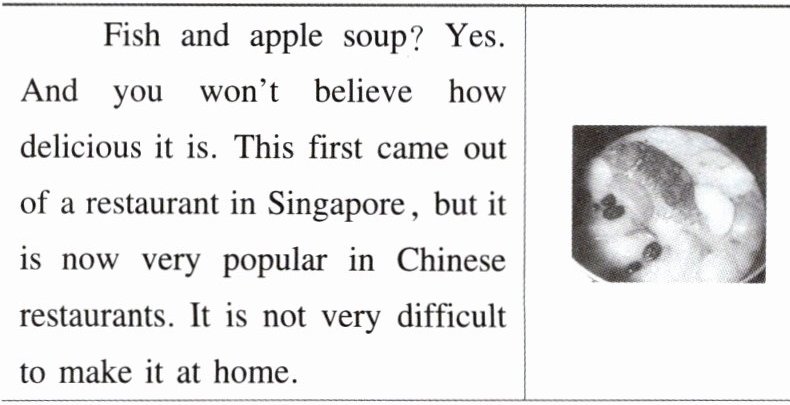 but it is now very popular in Chinese restaurants. It is not very difficult to make it at home.
续表
Ingredients(serve four people):
♥1 whole fish
♥2 apples, cut into 4 pieces
♥4-6 ginger slices (姜片)
♥oil, salt and pepper
♥1 bunch of spring onions, cut into pieces
♥1 red tomato, cut into 8 pieces
Methods:
♥Remove (除去) the bones from the fish.
♥Pour oil into a pan. Fry the ginger slices and the spring onions. Add the fish bones and fry.
♥Add enough water and boil it for about 15 to 20 minutes.
♥Add the apple pieces, the fish and the tomato pieces. When the apple pieces go soft, add salt and pepper.
16. Fish and apple soup first appeared in
A. China B. Malaysia
C. Singapore D. Japan
17. If you want to cook the soup for 8 people, you will need
A. one B. two C. three D. four
18. Which ingredient is NOT needed to cook fish and apple soup?
A. Oil. B. The tomato.
C. Pepper. D. Sugar.
19. 特色考法信息排序题 In what order should you add the ingredients while cooking the soup?
①oil ②fish bones ③apples, the fish and the tomato ④ginger slices and spring onions
A.③④①② B.①②④③
C.①④②③ D.④②③①
20. This passage is
A. a report B. a recipe
C. a story D. a poem
语篇类型「2026广东河源期末」
Fish and apple soup? Yes.
And you won't believe how delicious it is. This first came out of a restaurant in Singapore
but it is now very popular in Chinese restaurants. It is not very difficult to make it at home.续表
Ingredients(serve four people):
♥1 whole fish
♥2 apples, cut into 4 pieces
♥4-6 ginger slices (姜片)
♥oil, salt and pepper
♥1 bunch of spring onions, cut into pieces
♥1 red tomato, cut into 8 pieces
Methods:
♥Remove (除去) the bones from the fish.
♥Pour oil into a pan. Fry the ginger slices and the spring onions. Add the fish bones and fry.
♥Add enough water and boil it for about 15 to 20 minutes.
♥Add the apple pieces, the fish and the tomato pieces. When the apple pieces go soft, add salt and pepper.
16. Fish and apple soup first appeared in
C
.A. China B. Malaysia
C. Singapore D. Japan
17. If you want to cook the soup for 8 people, you will need
B
red tomato(es).A. one B. two C. three D. four
18. Which ingredient is NOT needed to cook fish and apple soup?
A. Oil. B. The tomato.
C. Pepper. D. Sugar.
19. 特色考法信息排序题 In what order should you add the ingredients while cooking the soup?
①oil ②fish bones ③apples, the fish and the tomato ④ginger slices and spring onions
A.③④①② B.①②④③
C.①④②③ D.④②③①
20. This passage is
B
.A. a report B. a recipe
C. a story D. a poem
答案:[语篇解读] 本文是一篇食谱,介绍了“苹果鱼汤”的起源、所需食材及制作步骤。
16.C 细节理解题。根据“This first came out of a restaurant in Singapore”可知,这道汤起源于新加坡。故选C。
17.B 数字计算题。文中的食材(1个红番茄)是为4个人准备的,如果要做8个人的量,则需要2个红番茄。故选B。
18.D 细节理解题。根据“Ingredients”中的内容可知,制作这道汤需要油、番茄、胡椒粉,没有提到糖。故选D。
19.C 信息排序题。根据“Methods”中的内容可知,先倒入油,炒姜片和香葱,加入鱼骨,最后加入苹果、鱼和番茄。故选C。
20.B 推理判断题。文章包含食材(Ingredients)和制作步骤(Methods),属于食谱。故选B。
16.C 细节理解题。根据“This first came out of a restaurant in Singapore”可知,这道汤起源于新加坡。故选C。
17.B 数字计算题。文中的食材(1个红番茄)是为4个人准备的,如果要做8个人的量,则需要2个红番茄。故选B。
18.D 细节理解题。根据“Ingredients”中的内容可知,制作这道汤需要油、番茄、胡椒粉,没有提到糖。故选D。
19.C 信息排序题。根据“Methods”中的内容可知,先倒入油,炒姜片和香葱,加入鱼骨,最后加入苹果、鱼和番茄。故选C。
20.B 推理判断题。文章包含食材(Ingredients)和制作步骤(Methods),属于食谱。故选B。
解析:
【分析】
本题为英语阅读理解题,围绕“苹果鱼汤”的起源、食材及制作步骤设置5道小题。解题思路:16题是细节理解题,需定位原文关于汤起源地点的信息;17题是数字计算题,根据食材对应的服务人数计算所需番茄数量;18题是细节理解题,查找食材列表中未提及的物品;19题是信息排序题,按制作步骤的先后顺序梳理添加食材的顺序;20题是文体判断题,根据文章包含的食材、制作步骤等内容判断文体。
【解析】
16. 细节理解题:根据原文“This first came out of a restaurant in Singapore”可知,苹果鱼汤最初出现在新加坡,故选C。
17. 数字计算题:食材中1个红番茄供4人食用,若要做8人的量,需1×(8÷4)=2个红番茄,故选B。
18. 细节理解题:查看食材列表,制作苹果鱼汤需要油、番茄、胡椒粉,未提到糖,故选D。
19. 信息排序题:根据制作步骤,先倒油(①),再炒姜片和香葱(④),接着加鱼骨(②),最后加入苹果、鱼和番茄(③),顺序为①④②③,故选C。
20. 文体判断题:文章包含食材(Ingredients)和制作步骤(Methods),属于食谱,故选B。
【答案】
16.C 17.B 18.D 19.C 20.B
【知识点】
细节理解题、数字计算、文体判断
【点评】
本题为基础英语阅读理解题,考查学生从原文提取信息、简单计算及判断文体的能力,题型常规,难度较低,适合巩固阅读理解基础。
【难度系数】
0.8
本题为英语阅读理解题,围绕“苹果鱼汤”的起源、食材及制作步骤设置5道小题。解题思路:16题是细节理解题,需定位原文关于汤起源地点的信息;17题是数字计算题,根据食材对应的服务人数计算所需番茄数量;18题是细节理解题,查找食材列表中未提及的物品;19题是信息排序题,按制作步骤的先后顺序梳理添加食材的顺序;20题是文体判断题,根据文章包含的食材、制作步骤等内容判断文体。
【解析】
16. 细节理解题:根据原文“This first came out of a restaurant in Singapore”可知,苹果鱼汤最初出现在新加坡,故选C。
17. 数字计算题:食材中1个红番茄供4人食用,若要做8人的量,需1×(8÷4)=2个红番茄,故选B。
18. 细节理解题:查看食材列表,制作苹果鱼汤需要油、番茄、胡椒粉,未提到糖,故选D。
19. 信息排序题:根据制作步骤,先倒油(①),再炒姜片和香葱(④),接着加鱼骨(②),最后加入苹果、鱼和番茄(③),顺序为①④②③,故选C。
20. 文体判断题:文章包含食材(Ingredients)和制作步骤(Methods),属于食谱,故选B。
【答案】
16.C 17.B 18.D 19.C 20.B
【知识点】
细节理解题、数字计算、文体判断
【点评】
本题为基础英语阅读理解题,考查学生从原文提取信息、简单计算及判断文体的能力,题型常规,难度较低,适合巩固阅读理解基础。
【难度系数】
0.8