三、阅读理解
A
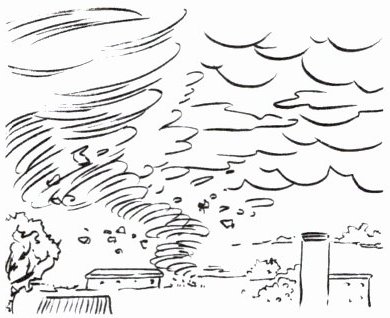
Typhoons are among the worst storms, usually occurring around the Pacific Ocean. Most typhoons happen in July, August and September.
How does a typhoon happen? When lots of seawater gets hot in summer, it evaporates (蒸发) into the air. This makes the air hotter. When the air gets warm enough, it starts to move higher up into the sky. Then cooler air around it rushes in. It fills the space that is left. After the air gets warmer, it starts to move quickly, making wind. The wind goes in circles and keeps moving higher in the sky. The warmer the air gets, the more quickly the wind moves. And when the wind moves faster than 33 metres a second, a typhoon starts.
A typhoon has two parts, and one is called the “eye”. In the eye, the winds do not move so fast. The other part is the wall of clouds around the eye. Here are the strongest winds and hardest rain.
Typhoons are very dangerous. What should you do when a typhoon hits?
• Stay in buildings. Close all the windows and stay away from them.
• Try to bring all of your things inside. Strong wind could even blow away bikes!
• Listen to the radio or watch TV for the important and latest information.
• If you’re told to go to a safer place by your community, do it right now.
(
A. an advertisement B. a travel journal
C. a weather report D. a science magazine
(
A. in the hot season B. in the cold season
C. only in China D. under the sea
(
a. The wind moves faster than 33 metres a second.
b. The air moves quickly, making wind.
c. The sun makes seawater hot.
d. The air gets warmer and moves higher.
A. dcba B. cdba C. cdab D. dbac
(
A. The warmer the air gets, the more slowly the wind moves.
B. A few people died because of typhoons all around the world.
C. The strongest winds and hardest rain are in the wall of clouds.
D. A typhoon starts when the wind goes faster than 33 km a second.
(
A. close all the windows B. listen to typhoon news
C. stay in strong houses D. go outside to check
A
Typhoons are among the worst storms, usually occurring around the Pacific Ocean. Most typhoons happen in July, August and September.
How does a typhoon happen? When lots of seawater gets hot in summer, it evaporates (蒸发) into the air. This makes the air hotter. When the air gets warm enough, it starts to move higher up into the sky. Then cooler air around it rushes in. It fills the space that is left. After the air gets warmer, it starts to move quickly, making wind. The wind goes in circles and keeps moving higher in the sky. The warmer the air gets, the more quickly the wind moves. And when the wind moves faster than 33 metres a second, a typhoon starts.
A typhoon has two parts, and one is called the “eye”. In the eye, the winds do not move so fast. The other part is the wall of clouds around the eye. Here are the strongest winds and hardest rain.
Typhoons are very dangerous. What should you do when a typhoon hits?
• Stay in buildings. Close all the windows and stay away from them.
• Try to bring all of your things inside. Strong wind could even blow away bikes!
• Listen to the radio or watch TV for the important and latest information.
• If you’re told to go to a safer place by your community, do it right now.
(
D
) 26. This passage is most probably from .A. an advertisement B. a travel journal
C. a weather report D. a science magazine
(
A
) 27. Typhoons often happen .A. in the hot season B. in the cold season
C. only in China D. under the sea
(
B
) 28. In which order does a typhoon happen?a. The wind moves faster than 33 metres a second.
b. The air moves quickly, making wind.
c. The sun makes seawater hot.
d. The air gets warmer and moves higher.
A. dcba B. cdba C. cdab D. dbac
(
C
) 29. Which of the following is true according to the passage?A. The warmer the air gets, the more slowly the wind moves.
B. A few people died because of typhoons all around the world.
C. The strongest winds and hardest rain are in the wall of clouds.
D. A typhoon starts when the wind goes faster than 33 km a second.
(
D
) 30. When a typhoon comes, we’d better NOT .A. close all the windows B. listen to typhoon news
C. stay in strong houses D. go outside to check
答案:26.D 27.A 28.B 29.C 30.D
解析:
【分析】
本题为科普类英语阅读理解,需结合文章内容逐一分析各题:1. 第26题判断文章来源,需根据文本的科普属性筛选选项;2. 第27题找台风发生的时间,定位原文对应月份判断季节;3. 第28题梳理台风形成的先后顺序,按原文描述的步骤排序;4. 第29题判断选项正误,需定位原文对应内容逐一核对;5. 第30题明确台风来临时的禁止行为,结合原文建议分析。
【解析】
26题:文章介绍台风的形成、结构及应对措施,属于科普内容,最可能来自科学杂志,故选D;A广告、B旅行日志、C天气预报均不符合文本属性,排除。
27题:原文提到“Most typhoons happen in July, August and September”,这三个月为热季,故选A;B冷季、C仅中国、D海底均与原文不符,排除。
28题:台风形成顺序为:c.海水被太阳晒热→d.空气变暖并上升→b.空气快速移动形成风→a.风速超33米/秒形成台风,顺序为cdba,故选B。
29题:A选项与原文“The warmer the air gets, the more quickly the wind moves”相悖,错误;B选项原文未提及台风导致的死亡人数,错误;C选项对应原文“The other part is the wall of clouds around the eye. Here are the strongest winds and hardest rain”,正确;D选项风速单位应为米/秒而非公里/秒,错误,故选C。
30题:台风来临时的建议包括待在建筑内、关窗、听新闻等,禁止外出检查,故选D;A、B、C均为正确做法,排除。
【答案】
26.D 27.A 28.B 29.C 30.D
【知识点】
英语阅读理解、科普类文本阅读、细节理解
【点评】
本题围绕台风的科普知识设题,侧重考查学生对文章细节信息的定位与理解能力,题型常规,难度适中。
【难度系数】
0.6
本题为科普类英语阅读理解,需结合文章内容逐一分析各题:1. 第26题判断文章来源,需根据文本的科普属性筛选选项;2. 第27题找台风发生的时间,定位原文对应月份判断季节;3. 第28题梳理台风形成的先后顺序,按原文描述的步骤排序;4. 第29题判断选项正误,需定位原文对应内容逐一核对;5. 第30题明确台风来临时的禁止行为,结合原文建议分析。
【解析】
26题:文章介绍台风的形成、结构及应对措施,属于科普内容,最可能来自科学杂志,故选D;A广告、B旅行日志、C天气预报均不符合文本属性,排除。
27题:原文提到“Most typhoons happen in July, August and September”,这三个月为热季,故选A;B冷季、C仅中国、D海底均与原文不符,排除。
28题:台风形成顺序为:c.海水被太阳晒热→d.空气变暖并上升→b.空气快速移动形成风→a.风速超33米/秒形成台风,顺序为cdba,故选B。
29题:A选项与原文“The warmer the air gets, the more quickly the wind moves”相悖,错误;B选项原文未提及台风导致的死亡人数,错误;C选项对应原文“The other part is the wall of clouds around the eye. Here are the strongest winds and hardest rain”,正确;D选项风速单位应为米/秒而非公里/秒,错误,故选C。
30题:台风来临时的建议包括待在建筑内、关窗、听新闻等,禁止外出检查,故选D;A、B、C均为正确做法,排除。
【答案】
26.D 27.A 28.B 29.C 30.D
【知识点】
英语阅读理解、科普类文本阅读、细节理解
【点评】
本题围绕台风的科普知识设题,侧重考查学生对文章细节信息的定位与理解能力,题型常规,难度适中。
【难度系数】
0.6