一、单项选择
(
—Because the lotus the special culture and land features of this place.
A.stands for
B.builds up
C.shows off
D.points out
(
A
) 1. —Miss Li, why do people use the lotus to represent Macau?—Because the lotus the special culture and land features of this place.
A.stands for
B.builds up
C.shows off
D.points out
答案:1.A
解析:
【分析】本题为英语单项选择题,考查动词短语的词义辨析。解题时,先明确各选项短语的含义,再结合题干语境(问句提及“用莲花代表澳门”,答句需对应莲花与澳门文化地貌的关系),选出符合语境的短语。
【解析】逐一分析选项:A. stands for意为“代表”;B. builds up意为“增进、加强”;C. shows off意为“炫耀”;D. points out意为“指出”。题干语境为“莲花代表澳门的特殊文化和地貌”,与问句中的“represent(代表)”呼应,A选项符合语境,其余选项均不符合,故答案为A。
【答案】A
【知识点】动词短语辨析;词义辨析
【点评】本题考查常用动词短语的含义,属于基础词义辨析题,学生掌握常见短语意思并结合语境即可作答,难度较低。
【难度系数】0.7
【解析】逐一分析选项:A. stands for意为“代表”;B. builds up意为“增进、加强”;C. shows off意为“炫耀”;D. points out意为“指出”。题干语境为“莲花代表澳门的特殊文化和地貌”,与问句中的“represent(代表)”呼应,A选项符合语境,其余选项均不符合,故答案为A。
【答案】A
【知识点】动词短语辨析;词义辨析
【点评】本题考查常用动词短语的含义,属于基础词义辨析题,学生掌握常见短语意思并结合语境即可作答,难度较低。
【难度系数】0.7
(
A.Exactly
B.Really
C.Only
D.Especially
A
) 2. —A cactus has spines instead of leaves so that it can live in hot, dry deserts. —. It can survive in difficult conditions.A.Exactly
B.Really
C.Only
D.Especially
答案:2.A
解析:
【分析】首先梳理对话语境:第一句说明仙人掌有刺代替叶子以适应炎热干燥的沙漠,第二句是对前一句的回应,后半句补充仙人掌能在困难条件下存活,说明回应需表达对前一句观点的赞同。接下来分析各选项含义,选出符合语境的表达。
【解析】逐一分析选项:A. Exactly意为“确实,完全正确”,用于赞同对方的观点,契合语境;B. Really意为“真的吗”,表惊讶语气,不符合此处赞同的语境;C. Only是副词,意为“只有”,无法单独作回应;D. Especially意为“尤其”,不符合对话逻辑。因此选A。
【答案】A
【知识点】日常交际用语
【点评】本题考查日常交际用语的运用,需结合对话语境判断合适的回应,属于基础题型,难度较低。
【难度系数】0.7
【解析】逐一分析选项:A. Exactly意为“确实,完全正确”,用于赞同对方的观点,契合语境;B. Really意为“真的吗”,表惊讶语气,不符合此处赞同的语境;C. Only是副词,意为“只有”,无法单独作回应;D. Especially意为“尤其”,不符合对话逻辑。因此选A。
【答案】A
【知识点】日常交际用语
【点评】本题考查日常交际用语的运用,需结合对话语境判断合适的回应,属于基础题型,难度较低。
【难度系数】0.7
(
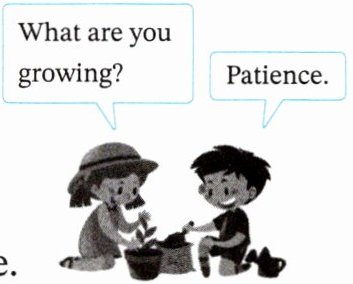
A.The boy feels it very easy to plant “patience”.
B.The boy thinks growing plants needs patience.
C.The girl believes they can grow the plant very well.
D.The girl knows the reason why “patience” is grown here.
B
) 3. What can we know from the picture on the right?A.The boy feels it very easy to plant “patience”.
B.The boy thinks growing plants needs patience.
C.The girl believes they can grow the plant very well.
D.The girl knows the reason why “patience” is grown here.
答案:3.B
解析:
【分析】本题是图片对话类阅读理解题,解题思路为:1. 先理解图片中的对话内容:女孩询问男孩在种什么,男孩回答“Patience(耐心)”;2. 结合种植物的语境,分析每个选项是否符合对话含义,排除错误选项,选出正确答案。
【解析】首先解读图片对话:女孩问“What are you growing?”,男孩答“Patience.”。结合种植物的场景,男孩说种“耐心”,实际是表达种植物需要耐心,对应选项B。A选项中“very easy”对话未提及,排除;C选项女孩“相信种好植物”的想法在对话中无体现,排除;D选项女孩“知道种耐心的原因”也未体现,排除。因此正确答案为B。
【答案】B
【知识点】英语阅读理解(图片对话理解)
【点评】本题考查对图片对话的理解,需结合语境分析选项,难度适中,属于基础题型。
【难度系数】0.6
【解析】首先解读图片对话:女孩问“What are you growing?”,男孩答“Patience.”。结合种植物的场景,男孩说种“耐心”,实际是表达种植物需要耐心,对应选项B。A选项中“very easy”对话未提及,排除;C选项女孩“相信种好植物”的想法在对话中无体现,排除;D选项女孩“知道种耐心的原因”也未体现,排除。因此正确答案为B。
【答案】B
【知识点】英语阅读理解(图片对话理解)
【点评】本题考查对图片对话的理解,需结合语境分析选项,难度适中,属于基础题型。
【难度系数】0.6
(
—. I'll water them on time.
A.Come on
B.Take it easy
C.With pleasure
D.You're welcome
C
)4. —Could you look after my plants while I'm away on business, please?—. I'll water them on time.
A.Come on
B.Take it easy
C.With pleasure
D.You're welcome
答案:4.C
解析:
【分析】
本题考查情景交际用语,需结合对话语境选择合适的答语。问句是请求对方帮忙照看植物,答语后半句“我会按时浇水”表明答应了请求,需逐一分析选项的适用场景。
【解析】
根据对话语境,上文是请求帮忙照看植物,下文“我会按时浇水”说明答应了请求。逐一分析选项:
A. Come on意为“加油;快点”,不符合请求帮忙的语境;
B. Take it easy意为“别紧张”,与请求帮忙无关;
C. With pleasure意为“乐意效劳”,用于答应别人的请求,符合语境;
D. You're welcome意为“不客气”,用于回应感谢,不符合此处语境。
因此选C。
【答案】
C
【知识点】
情景交际;日常用语
【点评】
本题考查基础情景交际用语,需掌握不同交际用语的使用场景,难度较低。
【难度系数】
0.8
本题考查情景交际用语,需结合对话语境选择合适的答语。问句是请求对方帮忙照看植物,答语后半句“我会按时浇水”表明答应了请求,需逐一分析选项的适用场景。
【解析】
根据对话语境,上文是请求帮忙照看植物,下文“我会按时浇水”说明答应了请求。逐一分析选项:
A. Come on意为“加油;快点”,不符合请求帮忙的语境;
B. Take it easy意为“别紧张”,与请求帮忙无关;
C. With pleasure意为“乐意效劳”,用于答应别人的请求,符合语境;
D. You're welcome意为“不客气”,用于回应感谢,不符合此处语境。
因此选C。
【答案】
C
【知识点】
情景交际;日常用语
【点评】
本题考查基础情景交际用语,需掌握不同交际用语的使用场景,难度较低。
【难度系数】
0.8
二、阅读理解
Can plants talk? Modern research has found something amazing: they do communicate with each other.
It has been known for some time that plants use chemicals to communicate with each other. This happens when a plant gets attacked by insects. The plant gives out chemicals from the leaves that are being eaten. This is like a warning, or a call for help: I’m being attacked! These chemicals can’t be noticed by people but can be picked up by other plants. When another plant gets the chemicals, it starts to give out its own different chemicals. Some of these chemicals drive insects away. Others attract the
wasps (黄蜂)! The wasps kill the insects that are eating the plants. That is why the first plant is usually found hurt while the neighbours stay well.
More surprisingly, plants also use sound to communicate. People can’t hear these sounds, but plants are making them. Some plants make noises with their roots. Some trees make clicking noises when there is not enough water.
Most surprisingly, plants have an amazing system of communication that can connect nearly every plant in a forest. Scientists call this system the “wood wide web”. The wood wide web is connected underground by fungi (真菌). It connects the roots of different plants to each other. It is in some ways similar to the internet we use. Using the wood wide web, plants can share information and even food with each other. However, it can lead to bad effects. Plants can use it to steal food from each other, or spread chemicals to attack other plants. Perhaps one day scientists will learn how to create a “firewall” to help prevent these attacks within the wood wide web.
Scientists are learning more every day about the secret ways in which plants talk to each other. Maybe one day we will know enough about plant communication to be able to talk with them ourselves.
(
A. They will kill the insects by themselves.
B. They will control the wasps to kill the insects.
C. They will let their neighbours know what is happening.
D. They will produce chemicals to drive the insects away.
(
A. The plants in a forest are connected by the internet we use.
B. The “wood wide web” is built by joining the roots of the plants.
C. The “wood wide web” can be both helpful and harmful to the connected plants.
D. Scientists hope to make a “firewall” to protect the system from being attacked by insects.
(
A. To encourage people to talk to plants.
B. To give people hope for further studies.
C. To praise scientists for their great achievements.
D. To call on people to do deeper research on nature.
(
A. How plants give warnings
B. The secret language of plants
C. Why scientists do research about plants
D. The study about the plant warning system
Can plants talk? Modern research has found something amazing: they do communicate with each other.
It has been known for some time that plants use chemicals to communicate with each other. This happens when a plant gets attacked by insects. The plant gives out chemicals from the leaves that are being eaten. This is like a warning, or a call for help: I’m being attacked! These chemicals can’t be noticed by people but can be picked up by other plants. When another plant gets the chemicals, it starts to give out its own different chemicals. Some of these chemicals drive insects away. Others attract the
wasps (黄蜂)! The wasps kill the insects that are eating the plants. That is why the first plant is usually found hurt while the neighbours stay well.
More surprisingly, plants also use sound to communicate. People can’t hear these sounds, but plants are making them. Some plants make noises with their roots. Some trees make clicking noises when there is not enough water.
Most surprisingly, plants have an amazing system of communication that can connect nearly every plant in a forest. Scientists call this system the “wood wide web”. The wood wide web is connected underground by fungi (真菌). It connects the roots of different plants to each other. It is in some ways similar to the internet we use. Using the wood wide web, plants can share information and even food with each other. However, it can lead to bad effects. Plants can use it to steal food from each other, or spread chemicals to attack other plants. Perhaps one day scientists will learn how to create a “firewall” to help prevent these attacks within the wood wide web.
Scientists are learning more every day about the secret ways in which plants talk to each other. Maybe one day we will know enough about plant communication to be able to talk with them ourselves.
(
C
) 1. What will plants do when they are being attacked by insects according to the passage?A. They will kill the insects by themselves.
B. They will control the wasps to kill the insects.
C. They will let their neighbours know what is happening.
D. They will produce chemicals to drive the insects away.
(
C
) 2. What do we know about the system of communication of plants in a forest?A. The plants in a forest are connected by the internet we use.
B. The “wood wide web” is built by joining the roots of the plants.
C. The “wood wide web” can be both helpful and harmful to the connected plants.
D. Scientists hope to make a “firewall” to protect the system from being attacked by insects.
(
B
) 3. What is the writer’s purpose of the last paragraph?A. To encourage people to talk to plants.
B. To give people hope for further studies.
C. To praise scientists for their great achievements.
D. To call on people to do deeper research on nature.
(
B
) 4. Which of the following would be the best title for the passage?A. How plants give warnings
B. The secret language of plants
C. Why scientists do research about plants
D. The study about the plant warning system
答案:1.C 2.C 3.B 4.B
解析:
【分析】
做这类英语阅读理解题,需先读题干,带着关键词回原文定位对应段落,再对比选项与原文内容,排除干扰项选出答案。具体到本题,4道题分别考查细节理解、主旨归纳和推理判断,需精准定位原文信息,理解文章核心内容。
【解析】
1. 细节理解题:根据第二段,植物被昆虫攻击时会释放化学信号,被其他植物接收,让邻居知晓情况。A项“自行杀死昆虫”与原文不符;B项“控制黄蜂”错误,原文是黄蜂被吸引来杀虫,并非植物控制;D项“产生化学物质驱赶昆虫”片面,核心是传递信息给邻居,故选C。
2. 细节理解题:根据第四段,“木网”由真菌连接,而非人类互联网,A错;是真菌连接植物根,不是直接连根,B错;该系统既可以分享信息和食物,也存在偷取食物、互相攻击的弊端,故C正确;原文“防火墙”是防植物间攻击,不是防昆虫,D错,故选C。
3. 推理判断题:最后一段指出科学家不断了解植物交流秘密,未来可能实现与植物交流,意在表达对未来研究的希望。A项是对原文的误解;C项偏离段落意图;D项过于宽泛,故选B。
4. 主旨大意题:全文围绕植物间的交流秘密展开,包括化学信号、声音、“木网”系统等。A项仅涉及警告,片面;C项偏离主题;D项仅涉及警告系统,片面,故选B。
【答案】
1.C 2.C 3.B 4.B
【知识点】
英语阅读理解、细节理解题、主旨大意题
【点评】
本文是科普类英语阅读理解,介绍植物间的交流方式,考查学生细节定位、主旨归纳和推理判断能力,需准确把握原文信息,区分干扰项。
【难度系数】
0.6
做这类英语阅读理解题,需先读题干,带着关键词回原文定位对应段落,再对比选项与原文内容,排除干扰项选出答案。具体到本题,4道题分别考查细节理解、主旨归纳和推理判断,需精准定位原文信息,理解文章核心内容。
【解析】
1. 细节理解题:根据第二段,植物被昆虫攻击时会释放化学信号,被其他植物接收,让邻居知晓情况。A项“自行杀死昆虫”与原文不符;B项“控制黄蜂”错误,原文是黄蜂被吸引来杀虫,并非植物控制;D项“产生化学物质驱赶昆虫”片面,核心是传递信息给邻居,故选C。
2. 细节理解题:根据第四段,“木网”由真菌连接,而非人类互联网,A错;是真菌连接植物根,不是直接连根,B错;该系统既可以分享信息和食物,也存在偷取食物、互相攻击的弊端,故C正确;原文“防火墙”是防植物间攻击,不是防昆虫,D错,故选C。
3. 推理判断题:最后一段指出科学家不断了解植物交流秘密,未来可能实现与植物交流,意在表达对未来研究的希望。A项是对原文的误解;C项偏离段落意图;D项过于宽泛,故选B。
4. 主旨大意题:全文围绕植物间的交流秘密展开,包括化学信号、声音、“木网”系统等。A项仅涉及警告,片面;C项偏离主题;D项仅涉及警告系统,片面,故选B。
【答案】
1.C 2.C 3.B 4.B
【知识点】
英语阅读理解、细节理解题、主旨大意题
【点评】
本文是科普类英语阅读理解,介绍植物间的交流方式,考查学生细节定位、主旨归纳和推理判断能力,需准确把握原文信息,区分干扰项。
【难度系数】
0.6