【应用】
(1)用所给单词的适当形式填空
①Everyone in my class
②
(2)完成句子或对话
①你做有趣的事情了吗?
Did you do
②你和别人出去了吗?
Did you go out with
③没有人在这里。每个人都去度假了。
④——你买了什么特别的东西吗?
——是的,我给我爸爸买了东西。/不,我什么也没有买。
—Did you buy
—Yes, I bought
(1)用所给单词的适当形式填空
①Everyone in my class
has
(have) a desk drawer.②
Is
(be) everyone here?(2)完成句子或对话
①你做有趣的事情了吗?
Did you do
anything
interesting
?②你和别人出去了吗?
Did you go out with
anyone
?③没有人在这里。每个人都去度假了。
No
one
was here. Everyone
was on vacation.④——你买了什么特别的东西吗?
——是的,我给我爸爸买了东西。/不,我什么也没有买。
—Did you buy
anything
special
?—Yes, I bought
something
for my father./ No, I bought nothing
.答案:(1)①has ②Is
(2)①anything interesting
②anyone ③No one; Everyone
④anything special; something; nothing
(2)①anything interesting
②anyone ③No one; Everyone
④anything special; something; nothing
解析:
【分析】本题考查不定代词的用法及主谓一致规则,解题思路:1. everyone作主语时,一般现在时谓语动词用第三人称单数;2. 疑问句常用anything,肯定句用something,否定句用no one/nothing;3. 不定代词修饰形容词时,形容词需后置;4. everyone作主语时be动词用is。
【解析】(1)①主语everyone是第三人称单数,一般现在时谓语动词用have的第三人称单数形式has,故填has;②everyone作主语,be动词用is,句首首字母大写,故填Is。
(2)①一般疑问句中“有趣的事情”用anything,形容词interesting修饰不定代词需后置,故填anything interesting;②一般疑问句中“别人”用anyone,故填anyone;③“没有人”是No one,“每个人”是Everyone,句首首字母大写,故填No one; Everyone;④一般疑问句中“特别的东西”用anything special;肯定句中“某物”用something;否定句中“什么也没有”用nothing,故依次填anything special; something; nothing。
【答案】(1)①has ②Is (2)①anything interesting ②anyone ③No one; Everyone ④anything special; something; nothing
【知识点】不定代词的用法;主谓一致
【点评】本题为英语基础题型,聚焦不定代词的基本用法及主谓一致的核心规则,考查学生对基础知识点的掌握与应用,难度适中。
【难度系数】0.6
【解析】(1)①主语everyone是第三人称单数,一般现在时谓语动词用have的第三人称单数形式has,故填has;②everyone作主语,be动词用is,句首首字母大写,故填Is。
(2)①一般疑问句中“有趣的事情”用anything,形容词interesting修饰不定代词需后置,故填anything interesting;②一般疑问句中“别人”用anyone,故填anyone;③“没有人”是No one,“每个人”是Everyone,句首首字母大写,故填No one; Everyone;④一般疑问句中“特别的东西”用anything special;肯定句中“某物”用something;否定句中“什么也没有”用nothing,故依次填anything special; something; nothing。
【答案】(1)①has ②Is (2)①anything interesting ②anyone ③No one; Everyone ④anything special; something; nothing
【知识点】不定代词的用法;主谓一致
【点评】本题为英语基础题型,聚焦不定代词的基本用法及主谓一致的核心规则,考查学生对基础知识点的掌握与应用,难度适中。
【难度系数】0.6
二、一般过去时
1. 一般过去时的构成
| 类型 | 构成 |
| --- | --- |
| 含be动词 | 主语+was/were+其他. 主语+was/were not+其他.
Was/Were+主语+其他? 特殊疑问词+was/were+主语+其他?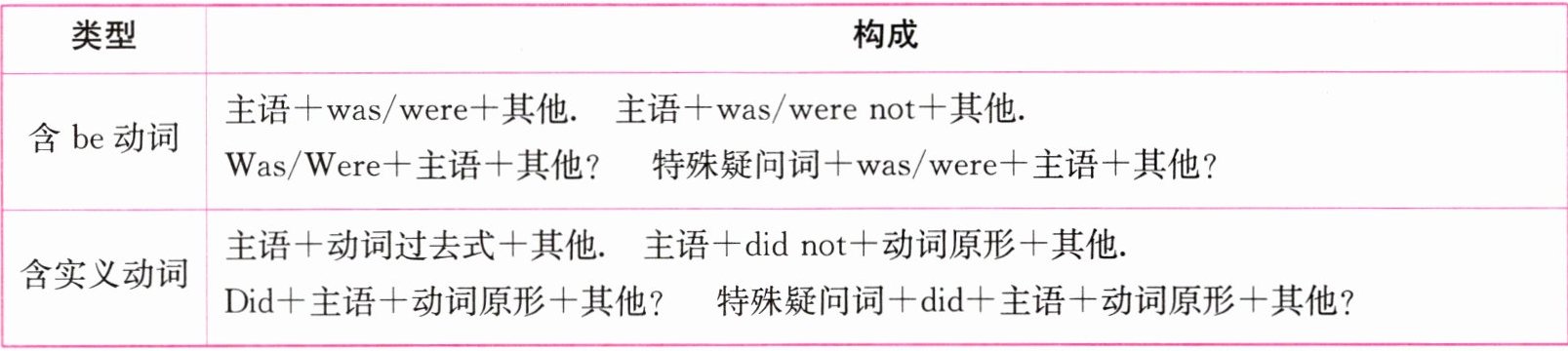 |
|
| 含实义动词 | 主语+动词过去式+其他. 主语+did not+动词原形+其他.
Did+主语+动词原形+其他? 特殊疑问词+did+主语+动词原形+其他? |
2. 动词的过去式
(1)规则动词过去式的构成方法
| 类别 | 构成方法 | 示例 |
| --- | --- | --- |
| 一般情况 | 加-ed | help—helped play—played |
| 以不发音的字母e结尾 | 加-d | live—lived hope—hoped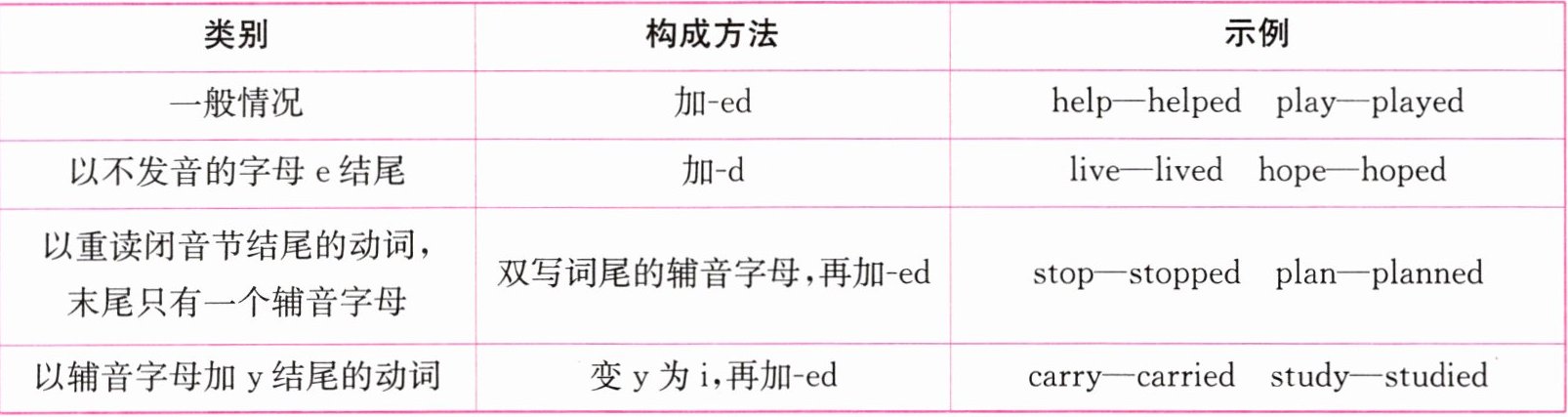 |
|
| 以重读闭音节结尾的动词,末尾只有一个辅音字母 | 双写词尾的辅音字母,再加-ed | stop—stopped plan—planned |
| 以辅音字母加y结尾的动词 | 变y为i,再加-ed | carry—carried study—studied |
(2)不规则动词的过去式
没有统一的规律,但有一部分动词的过去式有相同的变化形式。
| 类别 | 构成 |
| --- | --- |
| 改变元音字母 | become—became come—came begin—began
get—got forget—forgot give—gave |
| 字母组合ee变化 | feel—felt sweep—swept keep—kept |
| 部分以ow/aw结尾的词,把ow/aw变为ew | know—knew draw—drew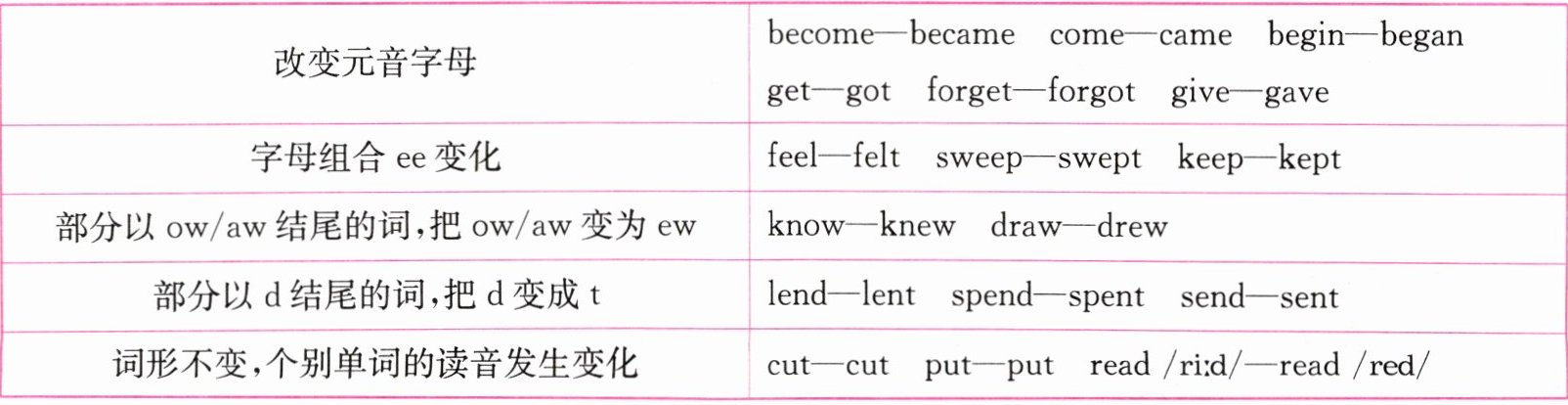 |
|
| 部分以d结尾的词,把d变成t | lend—lent spend—spent send—sent |
| 词形不变,个别单词的读音发生变化 | cut—cut put—put read /riːd/—read /red/ |
【应用】
(1)用所给单词的适当形式填空
①However, we
②I
③Wang Wei
④I
⑤The children
(2)按要求完成下列各题
①Amy went to the mountains on vacation.
(对画线部分提问)
②They watered the flowers in the garden yesterday.(对画线部分提问)
③They visited the science museum last weekend.(改为否定句)
They
④They moved to Shanghai in 2010.(改为一般疑问句)
1. 一般过去时的构成
| 类型 | 构成 |
| --- | --- |
| 含be动词 | 主语+was/were+其他. 主语+was/were not+其他.
Was/Were+主语+其他? 特殊疑问词+was/were+主语+其他?
|| 含实义动词 | 主语+动词过去式+其他. 主语+did not+动词原形+其他.
Did+主语+动词原形+其他? 特殊疑问词+did+主语+动词原形+其他? |
2. 动词的过去式
(1)规则动词过去式的构成方法
| 类别 | 构成方法 | 示例 |
| --- | --- | --- |
| 一般情况 | 加-ed | help—helped play—played |
| 以不发音的字母e结尾 | 加-d | live—lived hope—hoped
|| 以重读闭音节结尾的动词,末尾只有一个辅音字母 | 双写词尾的辅音字母,再加-ed | stop—stopped plan—planned |
| 以辅音字母加y结尾的动词 | 变y为i,再加-ed | carry—carried study—studied |
(2)不规则动词的过去式
没有统一的规律,但有一部分动词的过去式有相同的变化形式。
| 类别 | 构成 |
| --- | --- |
| 改变元音字母 | become—became come—came begin—began
get—got forget—forgot give—gave |
| 字母组合ee变化 | feel—felt sweep—swept keep—kept |
| 部分以ow/aw结尾的词,把ow/aw变为ew | know—knew draw—drew
|| 部分以d结尾的词,把d变成t | lend—lent spend—spent send—sent |
| 词形不变,个别单词的读音发生变化 | cut—cut put—put read /riːd/—read /red/ |
【应用】
(1)用所给单词的适当形式填空
①However, we
lost
(lose) everything in the fire and only had the clothes we were wearing.②I
gave
(give) Eric a book as his birthday gift last year.③Wang Wei
played
(play) tennis with his friends yesterday.④I
studied
(study) hard for my tests in the library last term.⑤The children
spent
(spend) their free time together this afternoon, and they enjoyed themselves.(2)按要求完成下列各题
①Amy went to the mountains on vacation.
(对画线部分提问)
Where
did
Amy go on vacation?②They watered the flowers in the garden yesterday.(对画线部分提问)
What
did
they do in the garden yesterday?③They visited the science museum last weekend.(改为否定句)
They
didn't
visit
the science museum last weekend.④They moved to Shanghai in 2010.(改为一般疑问句)
Did
they move
to Shanghai in 2010?答案:(1)①lost ②gave ③played
④studied ⑤spent
(2)①Where did ②What did
③didn't visit ④Did; move
④studied ⑤spent
(2)①Where did ②What did
③didn't visit ④Did; move
解析:
【分析】首先明确本题考查一般过去时的应用,需结合一般过去时的用法、动词过去式的变化规则以及一般过去时的句型转换规则解题。对于(1)的填空题,需根据句中过去的时间状语确定使用动词的过去式,同时区分规则动词和不规则动词的过去式变化;对于(2)的句型转换题,需掌握一般过去时中实义动词的疑问句、否定句的构成规则:变疑问句或否定句时需借助助动词did,后面动词用原形,特殊疑问句则根据画线内容选择合适的疑问词后加did引导的一般疑问句语序。
【解析】(1) ①句中时间状语为过去发生的火灾相关表述,需用lose的过去式lost;②时间状语为last year,give的过去式为gave;③时间状语为yesterday,play为规则动词,直接加-ed得played;④时间状语为last term,study以辅音字母+y结尾,变y为i加-ed得studied;⑤由后半句enjoyed可知为过去时,spend的过去式为spent。
(2) ①画线部分是地点,用疑问词where,一般过去时特殊疑问句需借助did,故为Where did;②画线部分是做的事情,用疑问词what,借助did,故为What did;③一般过去时实义动词的否定句,借助didn't,后面动词用原形visit,故为didn't visit;④一般过去时的一般疑问句,借助Did,后面动词用原形move,故为Did; move。
【答案】(1)①lost ②gave ③played ④studied ⑤spent (2)①Where did ②What did ③didn't visit ④Did; move
【知识点】一般过去时、动词过去式变化、一般过去时句型转换
【点评】本题围绕一般过去时的核心考点命题,涵盖动词过去式的正确形式(规则与不规则变化)及一般过去时的各类句式转换,是初中英语基础语法的典型考查题型,需熟练掌握相关规则才能准确作答。
【难度系数】0.6
【解析】(1) ①句中时间状语为过去发生的火灾相关表述,需用lose的过去式lost;②时间状语为last year,give的过去式为gave;③时间状语为yesterday,play为规则动词,直接加-ed得played;④时间状语为last term,study以辅音字母+y结尾,变y为i加-ed得studied;⑤由后半句enjoyed可知为过去时,spend的过去式为spent。
(2) ①画线部分是地点,用疑问词where,一般过去时特殊疑问句需借助did,故为Where did;②画线部分是做的事情,用疑问词what,借助did,故为What did;③一般过去时实义动词的否定句,借助didn't,后面动词用原形visit,故为didn't visit;④一般过去时的一般疑问句,借助Did,后面动词用原形move,故为Did; move。
【答案】(1)①lost ②gave ③played ④studied ⑤spent (2)①Where did ②What did ③didn't visit ④Did; move
【知识点】一般过去时、动词过去式变化、一般过去时句型转换
【点评】本题围绕一般过去时的核心考点命题,涵盖动词过去式的正确形式(规则与不规则变化)及一般过去时的各类句式转换,是初中英语基础语法的典型考查题型,需熟练掌握相关规则才能准确作答。
【难度系数】0.6