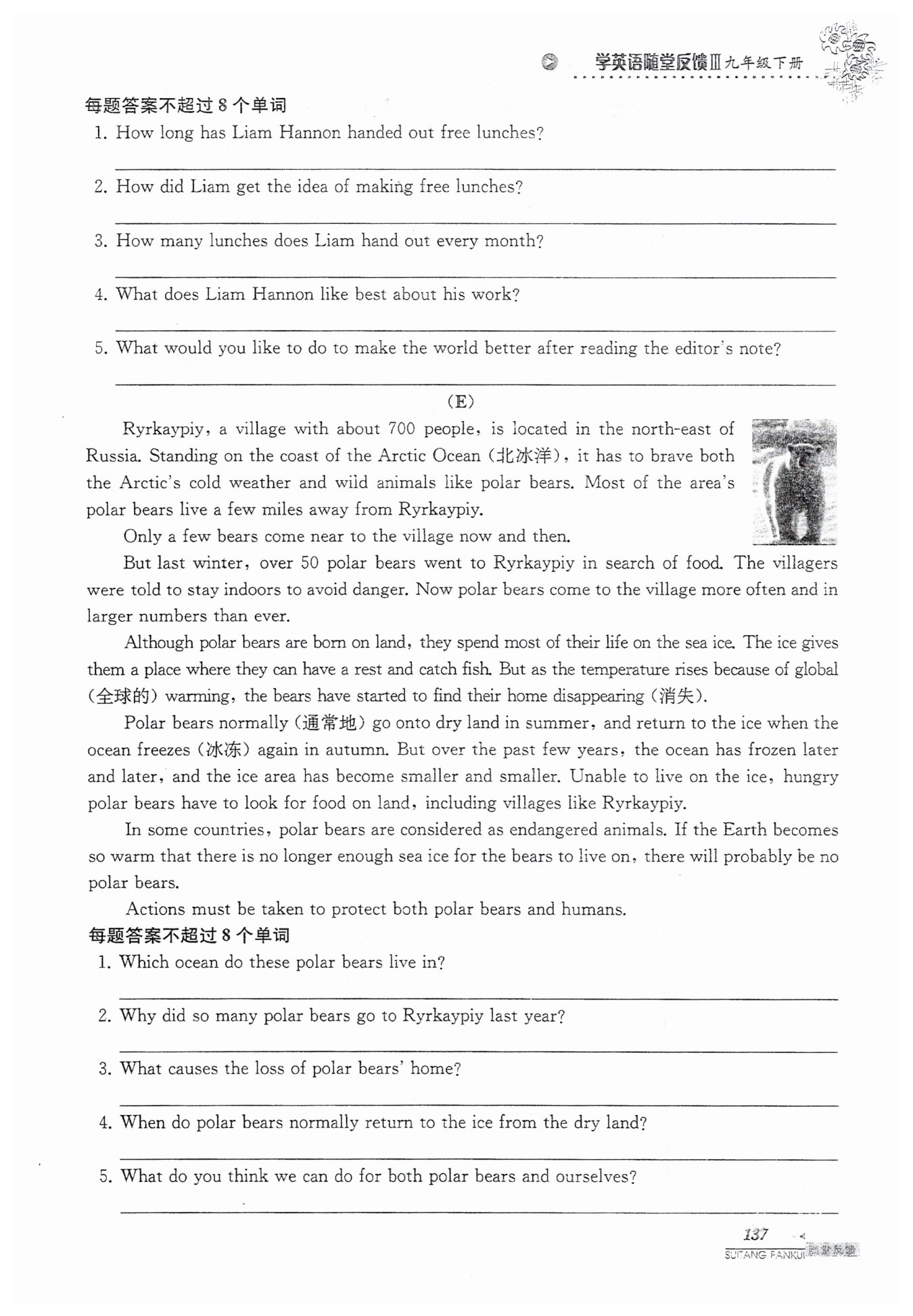
第137页

信息发布者:
For four years.
By doing an online treasure-hunt programme.
225 to 300 lunches.
Meeting the people.
Donate old clothes to poor children./Visit the old people's home./Help clean the local parks.
The Arctic Ocean.
To search for food.
The global warming.
In autumn.
We should live a green life.
【分析】
这是一篇任务型阅读题,解题思路如下:
1. 前4道为细节题,需带着问题到原文对话部分定位关键信息,提取符合“不超过8个单词”要求的内容;
2. 第1题找时间相关表述,从Liam回答里的“Four summers ago”转换为对应时长;
3. 第2题定位产生想法的来源,抓取参与线上寻宝项目的相关内容;
4. 第3题结合每次分发数量和每月次数,通过简单计算得出每月总量范围;
5. 第4题直接提取回答里对应“best part”的内容;
6. 第5题是开放性题目,结合编者按“小善举也能让世界更好”的理念,想出合理公益行为即可。
【解析】
1. 从Liam的回答“Four summers ago”可知,他已经分发免费午餐四年,得出答案For four years.
2. 根据回答里的“I did an online treasure-hunt programme...and I got the idea of making them lunch”,可知想法来自参与线上寻宝项目,得出答案By doing an online treasure-hunt programme.
3. 原文提到每次分发75到100份,每月3次,计算可得75×3=225,100×3=300,得出每月分发225 to 300 lunches.
4. 针对“What's the best part”的问题,Liam回答“I'd say meeting the people”,直接提取该内容作为答案。
5. 结合编者倡导的小善举,列举如捐赠旧衣物、看望老人、打扫公园等合理行为,答案不唯一,符合要求即可。
【答案】
1. For four years.
2. By doing an online treasure-hunt programme.
3. 225 to 300 lunches.
4. Meeting the people.
5. Donate old clothes to poor children./Visit the old people's home./Help clean the local parks.
【知识点】
细节信息提取,简单计算应用,开放性表达
【点评】
本文围绕青少年公益行为展开,既考查学生从文本中提取细节信息的能力,又通过开放性题目引导学生践行“小善举改变世界”的理念,题目设置贴合文本,能有效锻炼学生的信息处理和实践思考能力。
【难度系数】
0.7
【分析】
1. 第1题:题目询问北极熊生活的海洋,需定位原文中关于北极熊生存环境的地点描述,从第一段找到对应海洋名称即可。
2. 第2题:询问大量北极熊前往村庄的原因,直接查找原文中描述该事件的句子,提取目的信息。
3. 第3题:要找北极熊家园消失的原因,需关注原文中解释环境变化的段落,找到导致海冰消失的根源因素。
4. 第4题:询问北极熊返回冰面的时间,定位原文中关于北极熊季节活动的描述,提取对应的时间点。
5. 第5题:需结合文章主题(全球变暖影响北极熊),提出符合环保、同时保护人类和北极熊的合理做法,注意控制字数在8词以内。
【解析】
1. 根据第一段“Standing on the coast of the Arctic Ocean, it has to brave both the Arctic's cold weather and wild animals like polar bears.”可知,这些北极熊生活在北冰洋。
2. 根据第三段“But last winter, over 50 polar bears went to Ryrkaypiy in search of food.”可知,大量北极熊前往该村是为了觅食。
3. 根据第四段“But as the temperature rises because of global warming, the bears have started to find their home disappearing.”可知,全球变暖导致了北极熊家园的丧失。
4. 根据第五段“Polar bears normally go onto dry land in summer, and return to the ice when the ocean freezes again in autumn.”可知,北极熊通常在秋天从陆地返回冰面。
5. 结合文章中全球变暖的背景,我们可以通过过绿色生活来减少碳排放,既保护北极熊也保护人类,因此回答“We should live a green life.”
【答案】
1. The Arctic Ocean.
2. To search for food.
3. The global warming.
4. In autumn.
5. We should live a green life.
【知识点】
细节理解题、环保类阅读、观点表达题
【点评】
本文围绕全球变暖导致北极熊生存危机、入侵人类村庄展开,题目以细节考查为主,侧重学生提取原文关键信息的能力,最后一题引导学生关注环境问题,培养环保意识。
【难度系数】
0.6