一、方框选词。
care,loud,uncomfortable,stand,could,advice,on,although,do,different
Etiquette is not the same in every culture,or in every situation. For example, 1 very close to the person you are talking with is quite common in some Asian countries. However,if you do this in Europe,some people might feel 2. Even in China,we all know that etiquette is not the same in all situations. Perhaps we think that talking 3 in our own homes is fine,but there are other places where talking loudly is not allowed. For example,most people would agree that talking loudly in a library,a museum,or a movie theatre is impolite.
If we see someone breaking the rules of etiquette,we may politely give them some 4. Perhaps one of the most polite ways is to ask someone,“Would you mind doing this?” or “Would you mind not doing that?” For example,if someone cut in front of you in line,you could ask them,“Sorry,would you mind joining the line?” If someone is smoking 5 the bus,you could ask,“Excuse me, 6 you please put out that cigarette?” People don’t usually like to be criticized(批评),so we have to be 7 how we do this.
8 rules of etiquette can often be 9,some rules are the same almost everywhere in the world! For example,dropping litter is almost never allowed. If you see someone you know 10 this,you can ask him,“Would you mind picking it up?”
care,loud,uncomfortable,stand,could,advice,on,although,do,different
Etiquette is not the same in every culture,or in every situation. For example, 1 very close to the person you are talking with is quite common in some Asian countries. However,if you do this in Europe,some people might feel 2. Even in China,we all know that etiquette is not the same in all situations. Perhaps we think that talking 3 in our own homes is fine,but there are other places where talking loudly is not allowed. For example,most people would agree that talking loudly in a library,a museum,or a movie theatre is impolite.
If we see someone breaking the rules of etiquette,we may politely give them some 4. Perhaps one of the most polite ways is to ask someone,“Would you mind doing this?” or “Would you mind not doing that?” For example,if someone cut in front of you in line,you could ask them,“Sorry,would you mind joining the line?” If someone is smoking 5 the bus,you could ask,“Excuse me, 6 you please put out that cigarette?” People don’t usually like to be criticized(批评),so we have to be 7 how we do this.
8 rules of etiquette can often be 9,some rules are the same almost everywhere in the world! For example,dropping litter is almost never allowed. If you see someone you know 10 this,you can ask him,“Would you mind picking it up?”
答案:1. standing 2. uncomfortable 3. loudly 4. advice 5. on 6. could 7. careful 8. Although 9. different 10. doing
解析:
【分析】
做这类方框选词类完形填空题,首先第一步要先通读备选的10个单词,明确每个词的词性和基本含义;第二步通读整篇短文,把握文章核心主题是不同文化、不同场景下的礼仪规则差异,理清整体行文逻辑;第三步逐空分析,先判断空格处所需的词性,再结合上下文语义、固定搭配从剩余备选词中筛选合适的词,同时根据语法要求对单词进行正确的形式变形,排除已经选用过的词汇,最后将所有答案代入全文通读,验证语义和语法是否通顺。
【解析】
1. 空处在句中作主语,谓语是后面的is,需要用动名词形式,结合语义“和交谈对象站得很近在部分亚洲国家很常见”,将stand变为动名词standing。
2. 空前feel是系动词,后面需接形容词作表语,前文提到欧洲人不适应交谈时距离过近,因此会感到不舒服,填uncomfortable。
3. 空处修饰动词talking,需要用副词,结合后文“talking loudly is not allowed”的提示,将loud变为副词loudly,语义为“在自己家大声说话是没问题的”。
4. 空前some修饰名词,结合语义“如果看到有人违反礼仪规则,我们可以礼貌地给他们一些建议”,advice是不可数名词,符合要求。
5. 表示“在公交车上”是固定搭配on the bus,填介词on。
6. 此处是委婉请求的固定句式“could you please do sth.”,表示“麻烦你可以把烟灭掉吗”,填情态动词could。
7. 空前是be动词,后面需接形容词,结合语义“人们通常不喜欢被批评,所以我们要注意行事的方式”,将care变为形容词careful。
8. 此处引导让步状语从句,语义为“尽管礼仪规则通常是不一样的,但有些规则几乎在全世界都通用”,句首首字母大写,填Although。
9. 空处位于be动词之后作表语,结合前文“不同文化礼仪不一样”的表述,填形容词different。
10. 此处是固定结构see sb. doing sth.,表示“看到某人正在做某事”,将do变为动名词doing。
【答案】
1. standing 2. uncomfortable 3. loudly 4. advice 5. on 6. could 7. careful 8. Although 9. different 10. doing
【知识点】
词性转换,固定搭配,让步状语从句
【点评】
本题以跨文化礼仪为主题,既考查学生对名词、动词、形容词、副词等不同词性的判断能力,也覆盖了初中阶段常见的固定句式、非谓语动词用法等考点,上下文有多处相互提示的线索,学生需要把握全文主旨再解题,避免脱离语境错选,同时也能帮助学生掌握日常委婉提醒他人的交际用语。
【难度系数】
0.6
做这类方框选词类完形填空题,首先第一步要先通读备选的10个单词,明确每个词的词性和基本含义;第二步通读整篇短文,把握文章核心主题是不同文化、不同场景下的礼仪规则差异,理清整体行文逻辑;第三步逐空分析,先判断空格处所需的词性,再结合上下文语义、固定搭配从剩余备选词中筛选合适的词,同时根据语法要求对单词进行正确的形式变形,排除已经选用过的词汇,最后将所有答案代入全文通读,验证语义和语法是否通顺。
【解析】
1. 空处在句中作主语,谓语是后面的is,需要用动名词形式,结合语义“和交谈对象站得很近在部分亚洲国家很常见”,将stand变为动名词standing。
2. 空前feel是系动词,后面需接形容词作表语,前文提到欧洲人不适应交谈时距离过近,因此会感到不舒服,填uncomfortable。
3. 空处修饰动词talking,需要用副词,结合后文“talking loudly is not allowed”的提示,将loud变为副词loudly,语义为“在自己家大声说话是没问题的”。
4. 空前some修饰名词,结合语义“如果看到有人违反礼仪规则,我们可以礼貌地给他们一些建议”,advice是不可数名词,符合要求。
5. 表示“在公交车上”是固定搭配on the bus,填介词on。
6. 此处是委婉请求的固定句式“could you please do sth.”,表示“麻烦你可以把烟灭掉吗”,填情态动词could。
7. 空前是be动词,后面需接形容词,结合语义“人们通常不喜欢被批评,所以我们要注意行事的方式”,将care变为形容词careful。
8. 此处引导让步状语从句,语义为“尽管礼仪规则通常是不一样的,但有些规则几乎在全世界都通用”,句首首字母大写,填Although。
9. 空处位于be动词之后作表语,结合前文“不同文化礼仪不一样”的表述,填形容词different。
10. 此处是固定结构see sb. doing sth.,表示“看到某人正在做某事”,将do变为动名词doing。
【答案】
1. standing 2. uncomfortable 3. loudly 4. advice 5. on 6. could 7. careful 8. Although 9. different 10. doing
【知识点】
词性转换,固定搭配,让步状语从句
【点评】
本题以跨文化礼仪为主题,既考查学生对名词、动词、形容词、副词等不同词性的判断能力,也覆盖了初中阶段常见的固定句式、非谓语动词用法等考点,上下文有多处相互提示的线索,学生需要把握全文主旨再解题,避免脱离语境错选,同时也能帮助学生掌握日常委婉提醒他人的交际用语。
【难度系数】
0.6
二、(2025·连云港市海州区期末)首字母填空。
There is going to be a talk on visiting manners. The purpose of the talk is to teach students r 1 for visiting.
Good visiting manners make your experiences h 2. Whether(无论) visiting museums,places of interest,or friends’ homes,it’s important to f 3 proper rules.
When visiting museums,remember three rules. First,many places have p 4 signs saying “No touching” or “No photos”—follow these instructions. Second,keep your v 5 down. Just enjoy art and history quietly. Third,never run or shout as it troubles others.
When visiting a friend’s home,bring a small g 6 like flowers or chocolates. You are e 7 to take off shoes in some families. Never t 8 private(私人的) things if the host doesn’t agree.
For group visits like school trips,stay with your group and listen c 9 to guides. Put up your hand for questions i 10 of shouting out.
As the saying goes,“Good manners will open doors that the best education cannot.” Let’s all be polite visitors.
There is going to be a talk on visiting manners. The purpose of the talk is to teach students r 1 for visiting.
Good visiting manners make your experiences h 2. Whether(无论) visiting museums,places of interest,or friends’ homes,it’s important to f 3 proper rules.
When visiting museums,remember three rules. First,many places have p 4 signs saying “No touching” or “No photos”—follow these instructions. Second,keep your v 5 down. Just enjoy art and history quietly. Third,never run or shout as it troubles others.
When visiting a friend’s home,bring a small g 6 like flowers or chocolates. You are e 7 to take off shoes in some families. Never t 8 private(私人的) things if the host doesn’t agree.
For group visits like school trips,stay with your group and listen c 9 to guides. Put up your hand for questions i 10 of shouting out.
As the saying goes,“Good manners will open doors that the best education cannot.” Let’s all be polite visitors.
答案:1. rules 2. happy 3. follow 4. public 5. voice(s) 6. gift 7. expected 8. touch 9. carefully 10. instead
解析:
【分析】
首先通读全文,明确本文主题是介绍不同场景下的参观礼仪相关内容,整体语境围绕礼仪规则展开。解题时逐句结合上下文语义、给出的首字母提示,同时联系初中阶段常见的固定搭配、词性要求推导对应单词,推导完成后代入全文通读校验,确保语义通顺、逻辑连贯。具体思考路径:1. 先明确全文核心是讲参观的规则礼仪,对应第一空的提示;2. 结合生活常识,好的礼仪会带来好的体验,对应第二空;3. 后文多次提到要遵守规则,对应第三空的搭配follow rules;4. 博物馆里的公示标识是公共标识,对应第四空;5. 后文提到要安静,对应压低声音的固定搭配;6. 去朋友家做客带小礼物是常识,对应第六空;7. 做客时被要求脱鞋是常见场景,对应固定搭配be expected to do;8. 未经允许不能碰私人物品符合礼仪常识;9. 修饰动词listen要用副词,认真听导游讲解符合语境;10. 固定搭配instead of表示“而不是”,符合举手提问不要大喊的逻辑。
【解析】
1. 第一空:前文提到讲座主题是参观礼仪,后文多次出现"proper rules"的表述,说明讲座目的是教学生参观的规则,首字母r,填rules。
2. 第二空:句意是好的参观礼仪会让你的体验很愉快,结合首字母h,填形容词happy作宾语补足语。
3. 第三空:句意是遵守合适的规则很重要,固定搭配follow rules表示“遵守规则”,空前是不定式符号to,用动词原形,首字母f,填follow。
4. 第四空:博物馆里写着“禁止触摸”“禁止拍照”的是公共标识,固定搭配public signs表示“公共标识”,首字母p,填public。
5. 第五空:后文提示要安静地欣赏艺术和历史,固定搭配keep one's voice/voices down表示“压低声音”,首字母v,填voice(s)。
6. 第六空:去朋友家做客,带花或者巧克力这类小礼物符合生活常识,首字母g,填gift。
7. 第七空:句意是在一些家庭里你会被要求脱鞋,固定搭配be expected to do sth.表示“被期望/要求做某事”,这里是被动语态,首字母e,填expected。
8. 第八空:句意是如果主人不同意,绝对不要触碰私人物品,首字母t,否定祈使句用动词原形,填touch。
9. 第九空:句意是集体出行时要和队伍待在一起,认真听导游讲解,修饰动词listen要用副词,首字母c,填carefully。
10. 第十空:句意:有问题举手示意而不是大喊出来,固定搭配instead of表示“而不是”,首字母i,填instead。
【答案】
1. rules 2. happy 3. follow 4. public 5. voice(s) 6. gift 7. expected 8. touch 9. carefully 10. instead
【知识点】
首字母填空、固定短语搭配、词性转换
【点评】
本题以参观礼仪为主题,贴合学生日常出行、做客的真实生活场景,考点侧重上下文语境理解和初中高频固定搭配的积累,大部分空都有明确的前后文线索提示,兼顾对词性变化的基础考察,能有效检验学生的语篇理解能力和词汇运用能力。
【难度系数】
0.7
首先通读全文,明确本文主题是介绍不同场景下的参观礼仪相关内容,整体语境围绕礼仪规则展开。解题时逐句结合上下文语义、给出的首字母提示,同时联系初中阶段常见的固定搭配、词性要求推导对应单词,推导完成后代入全文通读校验,确保语义通顺、逻辑连贯。具体思考路径:1. 先明确全文核心是讲参观的规则礼仪,对应第一空的提示;2. 结合生活常识,好的礼仪会带来好的体验,对应第二空;3. 后文多次提到要遵守规则,对应第三空的搭配follow rules;4. 博物馆里的公示标识是公共标识,对应第四空;5. 后文提到要安静,对应压低声音的固定搭配;6. 去朋友家做客带小礼物是常识,对应第六空;7. 做客时被要求脱鞋是常见场景,对应固定搭配be expected to do;8. 未经允许不能碰私人物品符合礼仪常识;9. 修饰动词listen要用副词,认真听导游讲解符合语境;10. 固定搭配instead of表示“而不是”,符合举手提问不要大喊的逻辑。
【解析】
1. 第一空:前文提到讲座主题是参观礼仪,后文多次出现"proper rules"的表述,说明讲座目的是教学生参观的规则,首字母r,填rules。
2. 第二空:句意是好的参观礼仪会让你的体验很愉快,结合首字母h,填形容词happy作宾语补足语。
3. 第三空:句意是遵守合适的规则很重要,固定搭配follow rules表示“遵守规则”,空前是不定式符号to,用动词原形,首字母f,填follow。
4. 第四空:博物馆里写着“禁止触摸”“禁止拍照”的是公共标识,固定搭配public signs表示“公共标识”,首字母p,填public。
5. 第五空:后文提示要安静地欣赏艺术和历史,固定搭配keep one's voice/voices down表示“压低声音”,首字母v,填voice(s)。
6. 第六空:去朋友家做客,带花或者巧克力这类小礼物符合生活常识,首字母g,填gift。
7. 第七空:句意是在一些家庭里你会被要求脱鞋,固定搭配be expected to do sth.表示“被期望/要求做某事”,这里是被动语态,首字母e,填expected。
8. 第八空:句意是如果主人不同意,绝对不要触碰私人物品,首字母t,否定祈使句用动词原形,填touch。
9. 第九空:句意是集体出行时要和队伍待在一起,认真听导游讲解,修饰动词listen要用副词,首字母c,填carefully。
10. 第十空:句意:有问题举手示意而不是大喊出来,固定搭配instead of表示“而不是”,首字母i,填instead。
【答案】
1. rules 2. happy 3. follow 4. public 5. voice(s) 6. gift 7. expected 8. touch 9. carefully 10. instead
【知识点】
首字母填空、固定短语搭配、词性转换
【点评】
本题以参观礼仪为主题,贴合学生日常出行、做客的真实生活场景,考点侧重上下文语境理解和初中高频固定搭配的积累,大部分空都有明确的前后文线索提示,兼顾对词性变化的基础考察,能有效检验学生的语篇理解能力和词汇运用能力。
【难度系数】
0.7
三、(2025·南京市建邺区新城中学期末)任务型阅读。
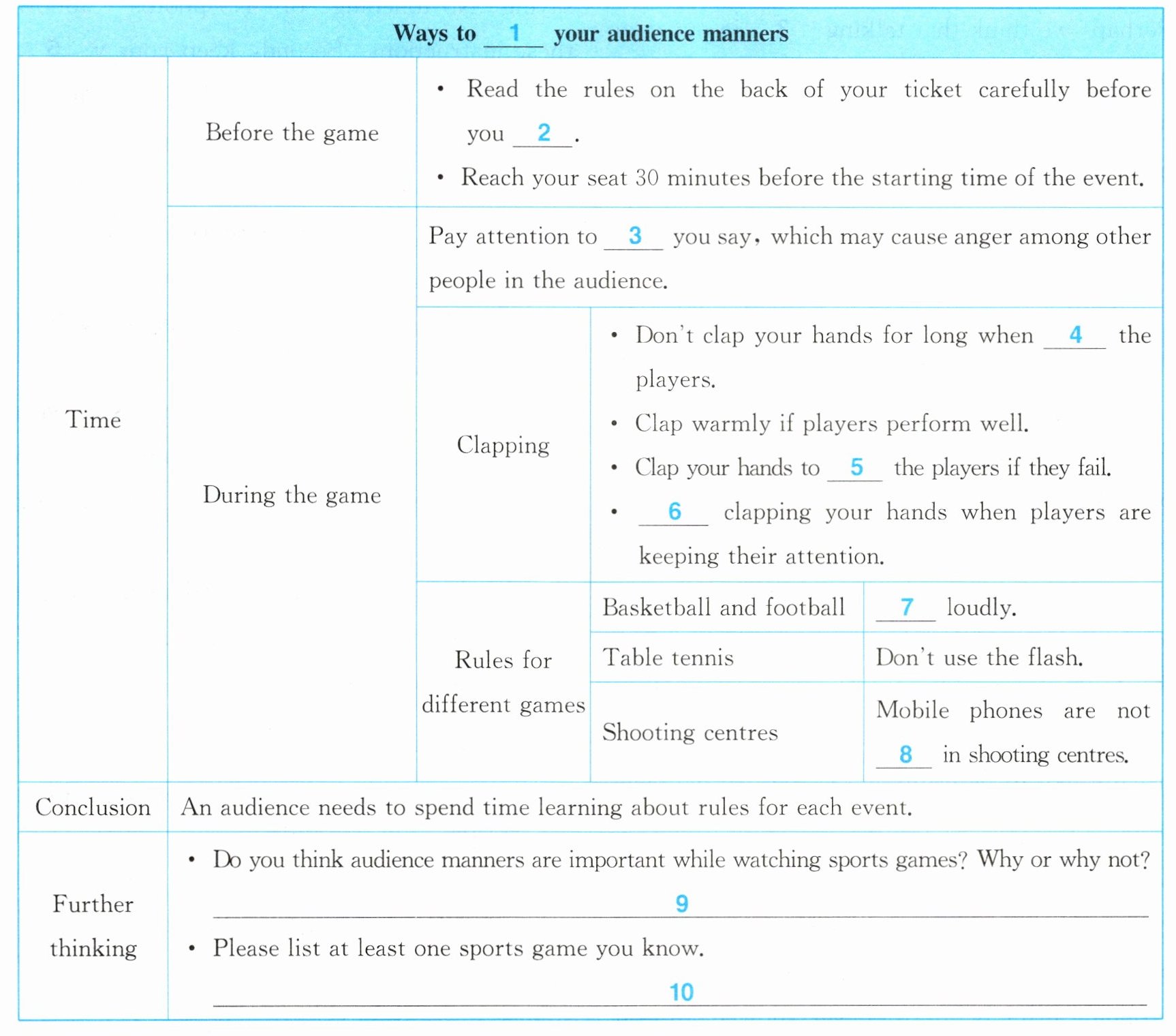
Lots of people enjoy watching sports games in the world. But first of all,you need to know about audience manners.
Actually,most sporting arenas(竞技场) have rules for the audience written on the back of the tickets. Read your ticket carefully before your arrival. Try to reach your seat half an hour before the start of the event.
When the games begin,try to control yourself. Don’t say bad words about the players’ and coaches’ performance. Be careful with your words because some of them may make others angry.
Clapping is a special form of body language you can use to communicate with players,but you should do it properly. When players first appear,clap your hands together to welcome them,but don’t go on for too long. After an excellent performance,clap warmly. If someone fails,your clapping will help them feel better. Clapping is not welcome,however,while players need to keep their attention.
Different sports have different rules for the audience. Enjoy artistic gymnastics in silence. But lots of cheering can really help basketball and football players. When you watch table tennis games,you can’t use your flash photography. Don’t use mobile phones in shooting centres,either.
To be a better audience,you should spare time to learn about the rules and the culture of each event.
Lots of people enjoy watching sports games in the world. But first of all,you need to know about audience manners.
Actually,most sporting arenas(竞技场) have rules for the audience written on the back of the tickets. Read your ticket carefully before your arrival. Try to reach your seat half an hour before the start of the event.
When the games begin,try to control yourself. Don’t say bad words about the players’ and coaches’ performance. Be careful with your words because some of them may make others angry.
Clapping is a special form of body language you can use to communicate with players,but you should do it properly. When players first appear,clap your hands together to welcome them,but don’t go on for too long. After an excellent performance,clap warmly. If someone fails,your clapping will help them feel better. Clapping is not welcome,however,while players need to keep their attention.
Different sports have different rules for the audience. Enjoy artistic gymnastics in silence. But lots of cheering can really help basketball and football players. When you watch table tennis games,you can’t use your flash photography. Don’t use mobile phones in shooting centres,either.
To be a better audience,you should spare time to learn about the rules and the culture of each event.
答案:1. improve 2. arrive 3. what 4. welcoming 5. encourage 6. Avoid/Stop 7. Cheer 8. allowed 9. Yes, I think audience manners are important. Because good manners can show respect for players and coaches.(答案不唯一,言之有理即可) 10. The Olympic Games and FIFA World Cup.(答案不唯一,言之有理即可)
解析:
【分析】
这是一篇介绍体育赛事观众礼仪的任务型阅读题,解题时可以按照以下思路推进:1. 先通读全文,明确文章核心主题是讲解成为文明观众的相关行为准则。2. 逐空对照表格内容,回到原文定位对应的语句,匹配空缺处的语义要求:如果原文给出对应名词,要根据句子结构转换为动词等合适形式;如果是语义推导类的空,结合上下文逻辑匹配恰当的动词。3. 最后两道开放性问题按照题干要求,结合常识写出符合逻辑、语义通顺的回答即可。
【解析】
1. 第1空:全文围绕规范、提升观众礼仪展开,标题含义为“提升观众礼仪的方法”,to后接动词原形,故填improve。
2. 第2空:定位原文第二段“Read your ticket carefully before your arrival”,表格中空格前主语是you,此处需要填入谓语动词,将名词arrival转换为动词arrive,故填arrive。
3. 第3空:定位原文第三段“Be careful with your words because some of them may make others angry”,句意为“注意你所说的内容,这些内容可能引发其他观众的不满”,what引导宾语从句作say的宾语,故填what。
4. 第4空:定位原文第四段“When players first appear,clap your hands together to welcome them,but don’t go on for too long”,此处when后接现在分词作时间状语,将动词welcome变为welcoming,故填welcoming。
5. 第5空:定位原文第四段“If someone fails,your clapping will help them feel better”,可知选手失利时鼓掌是为了鼓励选手,to后接动词原形,故填encourage。
6. 第6空:定位原文第四段“Clapping is not welcome,however,while players need to keep their attention”,可知选手集中注意力时不要鼓掌,祈使句用动词原形开头,可填Avoid/Stop。
7. 第7空:定位原文第五段“But lots of cheering can really help basketball and football players”,可知篮球和足球赛事中可以大声欢呼,祈使句用动词原形,故填Cheer。
8. 第8空:定位原文第五段“Don’t use mobile phones in shooting centres,either”,可知手机在射击场馆是不被允许的,此处为被动语态,填allowed。
9. 第9空为开放性问题,回答需明确表态,说明理由,言之有理即可。
10. 第10空为开放性问题,列举至少一个体育赛事即可。
【答案】
1. improve 2. arrive 3. what 4. welcoming 5. encourage 6. Avoid/Stop 7. Cheer 8. allowed 9. Yes, I think audience manners are important. Because good manners can show respect for players and coaches.(答案不唯一,言之有理即可) 10. The Olympic Games and FIFA World Cup.(答案不唯一,言之有理即可)
【知识点】
任务型阅读细节定位,词形转换,宾语从句
【点评】
本题难度适中,大部分空缺都可以通过原文细节定位找到对应线索,少量空需要结合句子结构进行词性转换,最后两道开放题兼顾考察学生的常识积累和英语表达能力,能有效锻炼学生的信息提取和语言输出能力。
【难度系数】
0.7
这是一篇介绍体育赛事观众礼仪的任务型阅读题,解题时可以按照以下思路推进:1. 先通读全文,明确文章核心主题是讲解成为文明观众的相关行为准则。2. 逐空对照表格内容,回到原文定位对应的语句,匹配空缺处的语义要求:如果原文给出对应名词,要根据句子结构转换为动词等合适形式;如果是语义推导类的空,结合上下文逻辑匹配恰当的动词。3. 最后两道开放性问题按照题干要求,结合常识写出符合逻辑、语义通顺的回答即可。
【解析】
1. 第1空:全文围绕规范、提升观众礼仪展开,标题含义为“提升观众礼仪的方法”,to后接动词原形,故填improve。
2. 第2空:定位原文第二段“Read your ticket carefully before your arrival”,表格中空格前主语是you,此处需要填入谓语动词,将名词arrival转换为动词arrive,故填arrive。
3. 第3空:定位原文第三段“Be careful with your words because some of them may make others angry”,句意为“注意你所说的内容,这些内容可能引发其他观众的不满”,what引导宾语从句作say的宾语,故填what。
4. 第4空:定位原文第四段“When players first appear,clap your hands together to welcome them,but don’t go on for too long”,此处when后接现在分词作时间状语,将动词welcome变为welcoming,故填welcoming。
5. 第5空:定位原文第四段“If someone fails,your clapping will help them feel better”,可知选手失利时鼓掌是为了鼓励选手,to后接动词原形,故填encourage。
6. 第6空:定位原文第四段“Clapping is not welcome,however,while players need to keep their attention”,可知选手集中注意力时不要鼓掌,祈使句用动词原形开头,可填Avoid/Stop。
7. 第7空:定位原文第五段“But lots of cheering can really help basketball and football players”,可知篮球和足球赛事中可以大声欢呼,祈使句用动词原形,故填Cheer。
8. 第8空:定位原文第五段“Don’t use mobile phones in shooting centres,either”,可知手机在射击场馆是不被允许的,此处为被动语态,填allowed。
9. 第9空为开放性问题,回答需明确表态,说明理由,言之有理即可。
10. 第10空为开放性问题,列举至少一个体育赛事即可。
【答案】
1. improve 2. arrive 3. what 4. welcoming 5. encourage 6. Avoid/Stop 7. Cheer 8. allowed 9. Yes, I think audience manners are important. Because good manners can show respect for players and coaches.(答案不唯一,言之有理即可) 10. The Olympic Games and FIFA World Cup.(答案不唯一,言之有理即可)
【知识点】
任务型阅读细节定位,词形转换,宾语从句
【点评】
本题难度适中,大部分空缺都可以通过原文细节定位找到对应线索,少量空需要结合句子结构进行词性转换,最后两道开放题兼顾考察学生的常识积累和英语表达能力,能有效锻炼学生的信息提取和语言输出能力。
【难度系数】
0.7