Ⅲ. 做客礼仪
Millie 邀请 Edward 到家里吃饭,Edward 答应了。这是他第一次登门拜访中国同学,他打算带些礼物送给 Millie 的家人,但是他不知道应该送什么,也不了解中国的做客礼仪。我们一起来帮帮他吧!(有两项多余)
Chinese love to invite friends to their homes for dinner. For foreigners, they often need to learn something about some special manners after receiving the invitations.
A gift is necessary when one is invited to visit friends in China. 1.
While eating, the elders will use chopsticks to pick up food for guests as a tradition and ask them to eat more. 3.
4.
A. After dinner, tea and fruits are usually served.
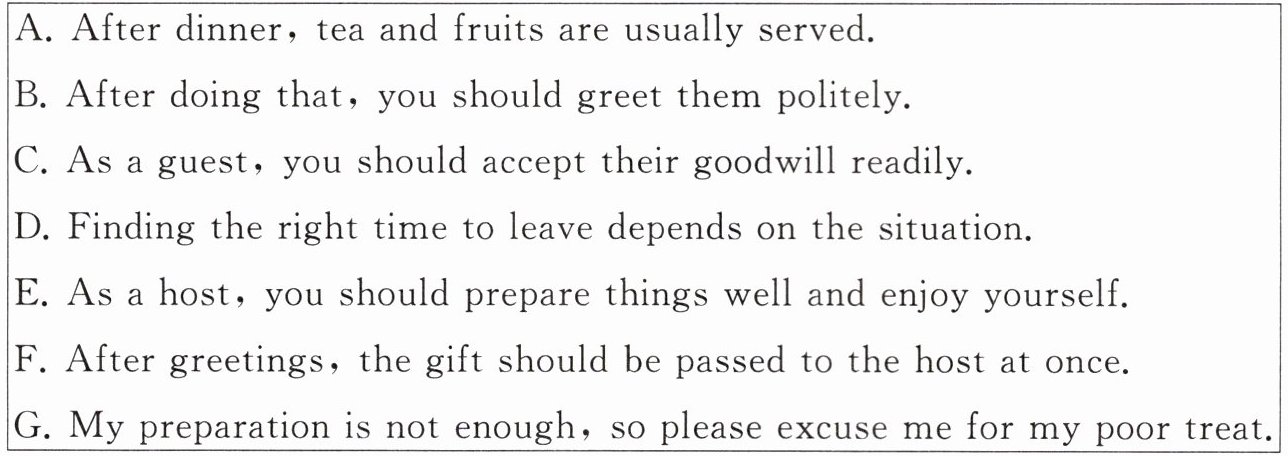
B. After doing that, you should greet them politely.
C. As a guest, you should accept their goodwill readily.
D. Finding the right time to leave depends on the situation.
E. As a host, you should prepare things well and enjoy yourself.
F. After greetings, the gift should be passed to the host at once.
G. My preparation is not enough, so please excuse me for my poor treat.
新考法 情境化设问
Questions: If you are one of Edward's classmates...
1. What gifts would you advise him to give?
2. What Chinese manners do you think Edward must know before going to Millie's home?
Millie 邀请 Edward 到家里吃饭,Edward 答应了。这是他第一次登门拜访中国同学,他打算带些礼物送给 Millie 的家人,但是他不知道应该送什么,也不了解中国的做客礼仪。我们一起来帮帮他吧!(有两项多余)
Chinese love to invite friends to their homes for dinner. For foreigners, they often need to learn something about some special manners after receiving the invitations.
A gift is necessary when one is invited to visit friends in China. 1.
F
Remember that usually Chinese people will not open the gift in front of the person who gives it. To show respect, it may be necessary to explain what the gift is. Bringing some nutrients and tonics(补品) to the elders in the family is a good idea. You can also prepare some small gifts for the kids of the host. The host usually makes full preparations by carefully tidying up the house and cooking a lot of delicious dishes. Although the meal is well prepared, the host may say to the guest politely, "2. G
" As a guest, you should make the host believe that there is plenty to eat by praising the food.While eating, the elders will use chopsticks to pick up food for guests as a tradition and ask them to eat more. 3.
C
But nowadays the younger people do the traditional way less.4.
A
When the guests are ready to leave, the host may still politely ask them to stay. They don't have to take it seriously. And they can try to find a good time to leave. This doesn't mean that leaving early is always a good idea as the host may feel that the guests are not satisfied with the treat. 5. D
A. After dinner, tea and fruits are usually served.
B. After doing that, you should greet them politely.
C. As a guest, you should accept their goodwill readily.
D. Finding the right time to leave depends on the situation.
E. As a host, you should prepare things well and enjoy yourself.
F. After greetings, the gift should be passed to the host at once.
G. My preparation is not enough, so please excuse me for my poor treat.
新考法 情境化设问
Questions: If you are one of Edward's classmates...
1. What gifts would you advise him to give?
Something Millie likes and some fruits for her family.(言之有理即可)
2. What Chinese manners do you think Edward must know before going to Millie's home?
He should arrive at Millie's home on time.(言之有理即可)
答案:1 - 5 FG CAD
【语篇解读】本文是一篇说明文,主要介绍了有关去中国家庭做客的一些礼仪。
1. F 解析:根据"Remember that usually Chinese people will not open the gift in front of the person who gives it."可知,此处应提到"礼物",F 选项"问候之后,礼物应立即递给主人。"符合,故选 F。
2. G 解析:根据"Although the meal is well prepared, the host may say to the guest politely"可知,此处应是主人说的礼貌性的话语,G 选项"我准备得不够充分,请原谅我招待得不好。"符合,故选 G。
3. C 解析:根据"While eating, the elders will use chopsticks to pick up food for guests as a tradition and ask them to eat more."可知,此处提到了长辈给客人夹菜的习惯,C 选项"作为客人,你应该欣然接受他们的好意。"符合,故选 C。
4. A 解析:根据"While eating, the elders will use chopsticks to pick up food for guests as a tradition and ask them to eat more."及"When the guests are to leave, the host may still politely ask them to stay."可知,此处应提到的是饭后到离开之前所做的事情,A 选项"晚饭后,通常端上茶和水果。"符合,故选 A。
5. D 解析:根据"This doesn't mean that leaving early is always a good idea as the host may feel that the guests are not satisfied with the treat."可知,此处应提到应该什么时候离开,D 选项"找到合适的时间离开取决于具体情况。"符合,故选 D。
Questions: 1. Something Millie likes and some fruits for her family.(言之有理即可)
2. He should arrive at Millie's home on time.(言之有理即可)
【语篇解读】本文是一篇说明文,主要介绍了有关去中国家庭做客的一些礼仪。
1. F 解析:根据"Remember that usually Chinese people will not open the gift in front of the person who gives it."可知,此处应提到"礼物",F 选项"问候之后,礼物应立即递给主人。"符合,故选 F。
2. G 解析:根据"Although the meal is well prepared, the host may say to the guest politely"可知,此处应是主人说的礼貌性的话语,G 选项"我准备得不够充分,请原谅我招待得不好。"符合,故选 G。
3. C 解析:根据"While eating, the elders will use chopsticks to pick up food for guests as a tradition and ask them to eat more."可知,此处提到了长辈给客人夹菜的习惯,C 选项"作为客人,你应该欣然接受他们的好意。"符合,故选 C。
4. A 解析:根据"While eating, the elders will use chopsticks to pick up food for guests as a tradition and ask them to eat more."及"When the guests are to leave, the host may still politely ask them to stay."可知,此处应提到的是饭后到离开之前所做的事情,A 选项"晚饭后,通常端上茶和水果。"符合,故选 A。
5. D 解析:根据"This doesn't mean that leaving early is always a good idea as the host may feel that the guests are not satisfied with the treat."可知,此处应提到应该什么时候离开,D 选项"找到合适的时间离开取决于具体情况。"符合,故选 D。
Questions: 1. Something Millie likes and some fruits for her family.(言之有理即可)
2. He should arrive at Millie's home on time.(言之有理即可)
解析:
【分析】
这是一篇介绍中国家庭做客礼仪的说明文,解题时需结合上下文语境,通过前后句的逻辑关系来匹配合适的句子:
1. 第1空:前文提到做客带礼物是必要的,后文讲中国人不会当面拆礼物,所以要选和礼物递送相关的句子,锁定提到“gift”的选项。
2. 第2空:前文说主人虽准备充分,但会礼貌说一些自谦的话,需选主人的礼貌用语。
3. 第3空:前文讲吃饭时长辈给客人夹菜的传统,需选客人对应的回应方式。
4. 第4空:前文是用餐时的礼仪,后文是离开的相关内容,需选衔接用餐后到离开前的环节的句子。
5. 第5空:前文讨论离开时间的问题,提到早走不一定合适,需选关于离开时间的总结性句子。
对于问答部分,要结合文中提到的礼仪内容,给出符合中国做客礼仪的合理答案即可。
【解析】
1. 第1空:根据前文“A gift is necessary when one is invited to visit friends in China.”和后文“Remember that usually Chinese people will not open the gift in front of the person who gives it.”可知,此处围绕礼物的递送展开,F选项“After greetings,the gift should be passed to the host at once.”(问候之后,礼物应立即递给主人。)符合语境,故选F。
2. 第2空:根据前文“Although the meal is well prepared, the host may say to the guest politely”可知,此处是主人说的自谦礼貌语,G选项“My preparation is not enough,so please excuse me for my poor treat.”(我准备得不够充分,请原谅我招待得不好。)符合语境,故选G。
3. 第3空:根据前文“While eating, the elders will use chopsticks to pick up food for guests as a tradition and ask them to eat more.”可知,此处是客人对长辈好意的回应,C选项“As a guest,you should accept their goodwill readily.”(作为客人,你应该欣然接受他们的好意。)符合语境,故选C。
4. 第4空:前文讲用餐时的礼仪,后文讲客人准备离开的相关内容,此处需衔接用餐后到离开前的环节,A选项“After dinner,tea and fruits are usually served.”(晚饭后,通常端上茶和水果。)符合语境,故选A。
5. 第5空:根据前文“This doesn't mean that leaving early is always a good idea as the host may feel that the guests are not satisfied with the treat.”可知,此处是关于离开时间的总结,D选项“Finding the right time to leave depends on the situation.”(找到合适的时间离开取决于具体情况。)符合语境,故选D。
问答部分:
1. 可结合文中提到的给长辈带补品、给孩子准备小礼物,或者送主人喜欢的东西、水果等,给出合理答案,比如“Something Millie likes and some fruits for her family.”
2. 可从做客的基本礼仪出发,比如准时到达、礼貌问候、欣然接受主人的招待等,比如“He should arrive at Millie's home on time.”
【答案】
1-5:FG CAD
Questions:
1. Something Millie likes and some fruits for her family.(言之有理即可)
2. He should arrive at Millie's home on time.(言之有理即可)
【知识点】
中国做客礼仪;语境推理;情景交际
【点评】
本文以情景化设问的方式,考查学生对中国做客礼仪的理解,同时考查根据上下文语境匹配句子的能力,以及情景问答的语言运用能力,帮助学生了解跨文化交际中的礼仪规范,提升跨文化交际意识。
【难度系数】
0.6
这是一篇介绍中国家庭做客礼仪的说明文,解题时需结合上下文语境,通过前后句的逻辑关系来匹配合适的句子:
1. 第1空:前文提到做客带礼物是必要的,后文讲中国人不会当面拆礼物,所以要选和礼物递送相关的句子,锁定提到“gift”的选项。
2. 第2空:前文说主人虽准备充分,但会礼貌说一些自谦的话,需选主人的礼貌用语。
3. 第3空:前文讲吃饭时长辈给客人夹菜的传统,需选客人对应的回应方式。
4. 第4空:前文是用餐时的礼仪,后文是离开的相关内容,需选衔接用餐后到离开前的环节的句子。
5. 第5空:前文讨论离开时间的问题,提到早走不一定合适,需选关于离开时间的总结性句子。
对于问答部分,要结合文中提到的礼仪内容,给出符合中国做客礼仪的合理答案即可。
【解析】
1. 第1空:根据前文“A gift is necessary when one is invited to visit friends in China.”和后文“Remember that usually Chinese people will not open the gift in front of the person who gives it.”可知,此处围绕礼物的递送展开,F选项“After greetings,the gift should be passed to the host at once.”(问候之后,礼物应立即递给主人。)符合语境,故选F。
2. 第2空:根据前文“Although the meal is well prepared, the host may say to the guest politely”可知,此处是主人说的自谦礼貌语,G选项“My preparation is not enough,so please excuse me for my poor treat.”(我准备得不够充分,请原谅我招待得不好。)符合语境,故选G。
3. 第3空:根据前文“While eating, the elders will use chopsticks to pick up food for guests as a tradition and ask them to eat more.”可知,此处是客人对长辈好意的回应,C选项“As a guest,you should accept their goodwill readily.”(作为客人,你应该欣然接受他们的好意。)符合语境,故选C。
4. 第4空:前文讲用餐时的礼仪,后文讲客人准备离开的相关内容,此处需衔接用餐后到离开前的环节,A选项“After dinner,tea and fruits are usually served.”(晚饭后,通常端上茶和水果。)符合语境,故选A。
5. 第5空:根据前文“This doesn't mean that leaving early is always a good idea as the host may feel that the guests are not satisfied with the treat.”可知,此处是关于离开时间的总结,D选项“Finding the right time to leave depends on the situation.”(找到合适的时间离开取决于具体情况。)符合语境,故选D。
问答部分:
1. 可结合文中提到的给长辈带补品、给孩子准备小礼物,或者送主人喜欢的东西、水果等,给出合理答案,比如“Something Millie likes and some fruits for her family.”
2. 可从做客的基本礼仪出发,比如准时到达、礼貌问候、欣然接受主人的招待等,比如“He should arrive at Millie's home on time.”
【答案】
1-5:FG CAD
Questions:
1. Something Millie likes and some fruits for her family.(言之有理即可)
2. He should arrive at Millie's home on time.(言之有理即可)
【知识点】
中国做客礼仪;语境推理;情景交际
【点评】
本文以情景化设问的方式,考查学生对中国做客礼仪的理解,同时考查根据上下文语境匹配句子的能力,以及情景问答的语言运用能力,帮助学生了解跨文化交际中的礼仪规范,提升跨文化交际意识。
【难度系数】
0.6