一)完形填空(10分)
Chinese scientists said they had developed robotic fish that could “ eat ” micro plastics.
Researchers say the robots could be 1 in cleaning up plastic pollution in oceans.
The project was 2 by a team at Sichuan University in South−western China.The
researchers said the robots had already done well in shallow(浅的)water and that they planned
to caT r rh yeo tue tamm osr aei dte th ste sri on bot i 3 c fis wh act oe url.d be 4 by light.Turning on and off the near−infrared
light laser(近红外激光)causes the fish's tail to move and stop.It can swim at a 5 of about
3.5 cm per second.
Wang Yuya n was a member of Sichuan University's research team.She told Reuters that
the small robotic fish were being used to 6 micro plastics for research purposes now.But
Wang added that the team wouldn't stop improving the robotic fish 7 it could help clear
away “ m Th ice r or pol bao st tii ccs f if sr hom can de tea pke oc in ead n if afer ere ans.t kinds of micro plastics and even 8 itself when it
is broken,” the researchers said.“ And if a robotic fish is eaten by a real fish,the real fish can
9 digest(消化)the material.So it does no harm."
Wang said similar robots could be developed to be placed inside human bodies to take away
10 materials.And there is still much to be improved for the robots.
( ) 1. A. serious B. dangerous C. helpful D. interested
( ) 2. A. depended on B. given up C. put off D. set up
( ) 3. A. cold B. clean C. deep D. hot
( ) 4. A. controlled B. developed C. recorded D. destroyed
( ) 5. A. number B. price C. speed D. cost
( ) 6. A. separate B. collect C. operate D. produce
( ) 7. A. though B. when C. until D. after
( ) 8. A. wash B. repair C. enjoy D. relax
( ) 9. A. safely B. carelessly C. especially D. hardly
( )10. A. special B. important C. common D. harmful
Chinese scientists said they had developed robotic fish that could “ eat ” micro plastics.
Researchers say the robots could be 1 in cleaning up plastic pollution in oceans.
The project was 2 by a team at Sichuan University in South−western China.The
researchers said the robots had already done well in shallow(浅的)water and that they planned
to caT r rh yeo tue tamm osr aei dte th ste sri on bot i 3 c fis wh act oe url.d be 4 by light.Turning on and off the near−infrared
light laser(近红外激光)causes the fish's tail to move and stop.It can swim at a 5 of about
3.5 cm per second.
Wang Yuya n was a member of Sichuan University's research team.She told Reuters that
the small robotic fish were being used to 6 micro plastics for research purposes now.But
Wang added that the team wouldn't stop improving the robotic fish 7 it could help clear
away “ m Th ice r or pol bao st tii ccs f if sr hom can de tea pke oc in ead n if afer ere ans.t kinds of micro plastics and even 8 itself when it
is broken,” the researchers said.“ And if a robotic fish is eaten by a real fish,the real fish can
9 digest(消化)the material.So it does no harm."
Wang said similar robots could be developed to be placed inside human bodies to take away
10 materials.And there is still much to be improved for the robots.
( ) 1. A. serious B. dangerous C. helpful D. interested
( ) 2. A. depended on B. given up C. put off D. set up
( ) 3. A. cold B. clean C. deep D. hot
( ) 4. A. controlled B. developed C. recorded D. destroyed
( ) 5. A. number B. price C. speed D. cost
( ) 6. A. separate B. collect C. operate D. produce
( ) 7. A. though B. when C. until D. after
( ) 8. A. wash B. repair C. enjoy D. relax
( ) 9. A. safely B. carelessly C. especially D. hardly
( )10. A. special B. important C. common D. harmful
答案:一、1.C 2.D 3.C 4.A 5.C 6.B 7.C 8.B 9.A 10.D
解析:
【分析】
这是一篇介绍能“吃”微塑料的机器鱼的科普完形填空。解题思路如下:首先通读全文,整体把握文章大意,了解机器鱼的功能、研发团队、运作方式及应用前景;然后针对每个空,结合上下文语境、词义辨析、短语搭配和固定句式来逐一分析选择:
1. 第1题:前文提到机器鱼能“吃”微塑料,由此推断它对清理海洋塑料污染是有作用的,需选表示“有帮助的”词汇;
2. 第2题:结合语境,这里指项目由四川大学团队开展,要选符合“开展、设立”含义的短语;
3. 第3题:前文说机器鱼在浅水域表现良好,后文提到海洋,可知是计划把它们投入海洋,需选表示“投入、放入”的短语;
4. 第4题:后文提到开关近红外激光可控制鱼尾动作,说明机器鱼是由光控制的,选“控制”相关词汇;
5. 第5题:“3.5 cm per second”是速度单位,所以要选表示“速度”的名词;
6. 第6题:语境表明机器鱼目前被用于研究,需要收集微塑料,选“收集”含义的动词;
7. 第7题:句子表达“团队不会停止改进,直到机器鱼能帮助清理微塑料”,需用“not...until”这个固定搭配;
8. 第8题:后文提到“when it is broken”,可知机器鱼坏了之后能自我修复,选“修复”相关词汇;
9. 第9题:前文说“it does no harm”,所以真鱼能安全地消化这种材料,选“安全地”副词;
10. 第10题:语境是类似机器人放入人体,目的是带走有害材料,选“有害的”形容词。
【解析】
1. 第1题:
选项词义:A. serious(严肃的);B. dangerous(危险的);C. helpful(有帮助的);D. interested(感兴趣的)
分析:根据前文“robotic fish that could ‘eat’ micro plastics”,可知机器鱼对清理海洋塑料污染有帮助,故选C。
2. 第2题:
选项短语含义:A. depend on(依赖);B. give up(放弃);C. put off(推迟);D. set up(设立、开展)
分析:此处指该项目由四川大学团队开展,故选D。
3. 第3题:
选项短语含义:A. come on(加油);B. give up(放弃);C. put into(投入、放入);D. take off(起飞、脱掉)
分析:前文提到机器鱼在浅水域表现好,计划将其投入海洋,故选C。
4. 第4题:
选项词义:A. controlled(控制);B. developed(发展);C. recorded(记录);D. destroyed(破坏)
分析:根据后文“Turning on and off the near-infrared light laser causes the fish's tail to move and stop”,可知机器鱼由光控制,故选A。
5. 第5题:
选项词义:A. number(数字);B. price(价格);C. speed(速度);D. cost(花费)
分析:“3.5 cm per second”是速度单位,故选C。
6. 第6题:
选项词义:A. stand(站立);B. collect(收集);C. open(打开);D. pass(通过)
分析:语境表明机器鱼目前被用于收集微塑料做研究,故选B。
7. 第7题:
选项连词含义:A. when(当…时);B. because(因为);C. until(直到);D. if(如果)
分析:“not...until”是固定搭配,意为“直到…才”,符合“团队直到机器鱼能帮助清理微塑料才停止改进”的语境,故选C。
8. 第8题:
选项词义:A. catch(抓住);B. repair(修复);C. enjoy(享受);D. lead(带领)
分析:根据“when it is broken”,可知机器鱼损坏后能自我修复,故选B。
9. 第9题:
选项副词含义:A. safely(安全地);B. quickly(快速地);C. easily(容易地);D. hardly(几乎不)
分析:前文提到“it does no harm”,说明真鱼能安全消化这种材料,故选A。
10. 第10题:
选项形容词含义:A. soft(柔软的);B. popular(受欢迎的);C. common(普通的);D. harmful(有害的)
分析:语境是类似机器人放入人体,目的是带走有害材料,故选D。
【答案】
1.C 2.D 3.C 4.A 5.C 6.B 7.C 8.B 9.A 10.D
【知识点】
词义辨析、短语辨析、固定搭配(not...until)
【点评】
这篇完形填空围绕前沿科技——能处理微塑料的机器鱼展开,科普性较强。题目着重考查学生对词汇、短语的辨析能力,以及结合上下文语境和常识解题的能力,既帮助学生了解科技热点,又能提升其英语语言运用水平。
【难度系数】
0.6
这是一篇介绍能“吃”微塑料的机器鱼的科普完形填空。解题思路如下:首先通读全文,整体把握文章大意,了解机器鱼的功能、研发团队、运作方式及应用前景;然后针对每个空,结合上下文语境、词义辨析、短语搭配和固定句式来逐一分析选择:
1. 第1题:前文提到机器鱼能“吃”微塑料,由此推断它对清理海洋塑料污染是有作用的,需选表示“有帮助的”词汇;
2. 第2题:结合语境,这里指项目由四川大学团队开展,要选符合“开展、设立”含义的短语;
3. 第3题:前文说机器鱼在浅水域表现良好,后文提到海洋,可知是计划把它们投入海洋,需选表示“投入、放入”的短语;
4. 第4题:后文提到开关近红外激光可控制鱼尾动作,说明机器鱼是由光控制的,选“控制”相关词汇;
5. 第5题:“3.5 cm per second”是速度单位,所以要选表示“速度”的名词;
6. 第6题:语境表明机器鱼目前被用于研究,需要收集微塑料,选“收集”含义的动词;
7. 第7题:句子表达“团队不会停止改进,直到机器鱼能帮助清理微塑料”,需用“not...until”这个固定搭配;
8. 第8题:后文提到“when it is broken”,可知机器鱼坏了之后能自我修复,选“修复”相关词汇;
9. 第9题:前文说“it does no harm”,所以真鱼能安全地消化这种材料,选“安全地”副词;
10. 第10题:语境是类似机器人放入人体,目的是带走有害材料,选“有害的”形容词。
【解析】
1. 第1题:
选项词义:A. serious(严肃的);B. dangerous(危险的);C. helpful(有帮助的);D. interested(感兴趣的)
分析:根据前文“robotic fish that could ‘eat’ micro plastics”,可知机器鱼对清理海洋塑料污染有帮助,故选C。
2. 第2题:
选项短语含义:A. depend on(依赖);B. give up(放弃);C. put off(推迟);D. set up(设立、开展)
分析:此处指该项目由四川大学团队开展,故选D。
3. 第3题:
选项短语含义:A. come on(加油);B. give up(放弃);C. put into(投入、放入);D. take off(起飞、脱掉)
分析:前文提到机器鱼在浅水域表现好,计划将其投入海洋,故选C。
4. 第4题:
选项词义:A. controlled(控制);B. developed(发展);C. recorded(记录);D. destroyed(破坏)
分析:根据后文“Turning on and off the near-infrared light laser causes the fish's tail to move and stop”,可知机器鱼由光控制,故选A。
5. 第5题:
选项词义:A. number(数字);B. price(价格);C. speed(速度);D. cost(花费)
分析:“3.5 cm per second”是速度单位,故选C。
6. 第6题:
选项词义:A. stand(站立);B. collect(收集);C. open(打开);D. pass(通过)
分析:语境表明机器鱼目前被用于收集微塑料做研究,故选B。
7. 第7题:
选项连词含义:A. when(当…时);B. because(因为);C. until(直到);D. if(如果)
分析:“not...until”是固定搭配,意为“直到…才”,符合“团队直到机器鱼能帮助清理微塑料才停止改进”的语境,故选C。
8. 第8题:
选项词义:A. catch(抓住);B. repair(修复);C. enjoy(享受);D. lead(带领)
分析:根据“when it is broken”,可知机器鱼损坏后能自我修复,故选B。
9. 第9题:
选项副词含义:A. safely(安全地);B. quickly(快速地);C. easily(容易地);D. hardly(几乎不)
分析:前文提到“it does no harm”,说明真鱼能安全消化这种材料,故选A。
10. 第10题:
选项形容词含义:A. soft(柔软的);B. popular(受欢迎的);C. common(普通的);D. harmful(有害的)
分析:语境是类似机器人放入人体,目的是带走有害材料,故选D。
【答案】
1.C 2.D 3.C 4.A 5.C 6.B 7.C 8.B 9.A 10.D
【知识点】
词义辨析、短语辨析、固定搭配(not...until)
【点评】
这篇完形填空围绕前沿科技——能处理微塑料的机器鱼展开,科普性较强。题目着重考查学生对词汇、短语的辨析能力,以及结合上下文语境和常识解题的能力,既帮助学生了解科技热点,又能提升其英语语言运用水平。
【难度系数】
0.6
二、阅读理解(16分)
(A)
Let's Make the World Green!
China hopes to realize carbon neutrality (碳中和) by 2060. This goal fits in with global efforts to control climate change, as rising temperatures and serious weather events have brought great dangers to ecosystems. Everyone should try their best to achieve this goal—small daily actions, when put together, can help a lot to cut carbon footprints.
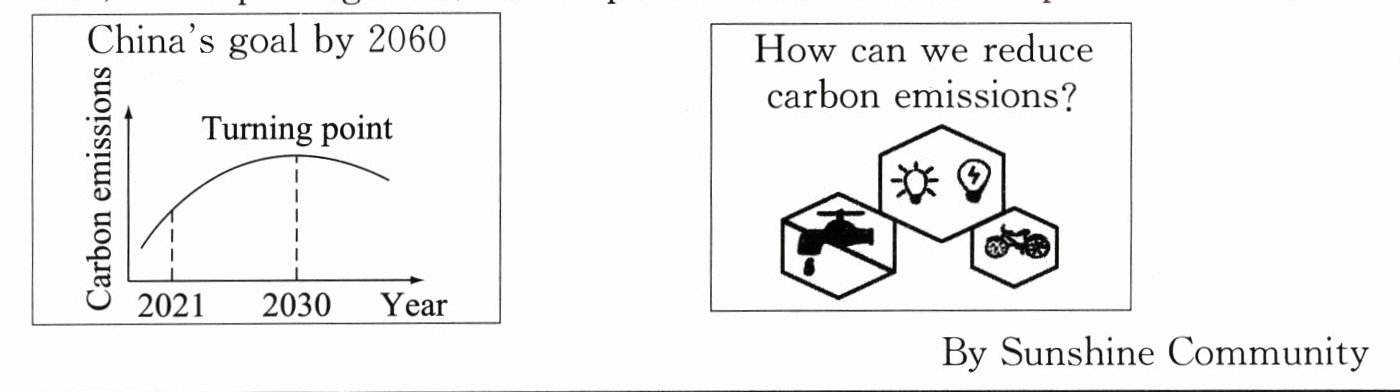
( )1. Which year marks the turning point of carbon emissions?
A. 2021. B. 2025. C. 2030. D. 2060.
( )2. According to the pictures above,what can we do to reduce carbon emissions?
① Ride more. ② Don't waste water. ③ Save electricity. ④ Save food.
A. ①②③ B. ①②④ C. ①③④ D. ②③④
( )3. The text is probably a ______.
A. poster B. notice C. diary D. poem
(A)
Let's Make the World Green!
China hopes to realize carbon neutrality (碳中和) by 2060. This goal fits in with global efforts to control climate change, as rising temperatures and serious weather events have brought great dangers to ecosystems. Everyone should try their best to achieve this goal—small daily actions, when put together, can help a lot to cut carbon footprints.
( )1. Which year marks the turning point of carbon emissions?
A. 2021. B. 2025. C. 2030. D. 2060.
( )2. According to the pictures above,what can we do to reduce carbon emissions?
① Ride more. ② Don't waste water. ③ Save electricity. ④ Save food.
A. ①②③ B. ①②④ C. ①③④ D. ②③④
( )3. The text is probably a ______.
A. poster B. notice C. diary D. poem
答案:二、1.C 2.A 3.A
解析:
【分析】
1. 第1题:题目询问碳排放的转折点年份,需结合题目相关信息定位对应内容,通过选项匹配可知2030年为碳排放转折点,进而确定答案。
2. 第2题:要依据配图内容判断减碳行动,逐一核对选项:①多骑车、②不浪费水、③节约用电均是配图中体现的减碳方式,④节约食物未在配图中涉及,因此选择包含①②③的选项。
3. 第3题:判断文本类型,文章以醒目的环保呼吁标题开头,配有插图且由社区发布,符合海报的宣传特征,而通知、日记、诗歌的形式均与文本不匹配,因此确定为海报。
【解析】
1. 第1题:根据题目信息,碳排放的转折点年份为2030年,对应选项C。
2. 第2题:结合配图内容,骑车出行、节约用水、节约用电均属于可实施的减碳措施,节约食物未在配图中体现,因此正确选项为A(①②③)。
3. 第3题:文本以“Let's Make the World Green!”为主题,搭配插图,目的是呼吁大众参与环保,这种形式符合海报的特点,故选A。
【答案】
二、1.C 2.A 3.A
【知识点】
细节信息提取、文本类型判断
【点评】
本题围绕环保减碳的热点主题,考查学生对细节信息的抓取能力和文本体裁的判断能力,内容贴近生活,能引导学生关注日常环保行动。
【难度系数】
0.7
1. 第1题:题目询问碳排放的转折点年份,需结合题目相关信息定位对应内容,通过选项匹配可知2030年为碳排放转折点,进而确定答案。
2. 第2题:要依据配图内容判断减碳行动,逐一核对选项:①多骑车、②不浪费水、③节约用电均是配图中体现的减碳方式,④节约食物未在配图中涉及,因此选择包含①②③的选项。
3. 第3题:判断文本类型,文章以醒目的环保呼吁标题开头,配有插图且由社区发布,符合海报的宣传特征,而通知、日记、诗歌的形式均与文本不匹配,因此确定为海报。
【解析】
1. 第1题:根据题目信息,碳排放的转折点年份为2030年,对应选项C。
2. 第2题:结合配图内容,骑车出行、节约用水、节约用电均属于可实施的减碳措施,节约食物未在配图中体现,因此正确选项为A(①②③)。
3. 第3题:文本以“Let's Make the World Green!”为主题,搭配插图,目的是呼吁大众参与环保,这种形式符合海报的特点,故选A。
【答案】
二、1.C 2.A 3.A
【知识点】
细节信息提取、文本类型判断
【点评】
本题围绕环保减碳的热点主题,考查学生对细节信息的抓取能力和文本体裁的判断能力,内容贴近生活,能引导学生关注日常环保行动。
【难度系数】
0.7