1.如图,在$△ ABC$中,$AC=2AB$,$AD$平分$∠ BAC$交$BC$于点$D$,$E$是$AD$上一点,且$EA=EC$,求证:$EB⊥ AB$.
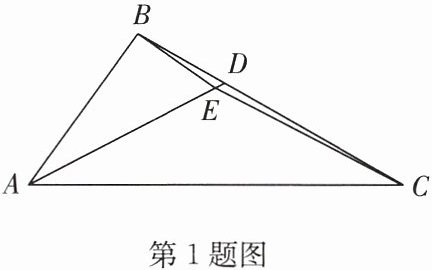
答案:
1.证明:如答图,过点E作$EF⊥ AC$于点F.
$\because EA=EC,\therefore AF=FC=\frac{1}{2}AC.$
$\because AC=2AB,\therefore AF=AB.$
$\because AD$平分$∠ BAC,\therefore ∠ BAD=∠ CAD.$
在$△ ABE$和$△ AFE$中,$\begin{cases} AB=AF, \\ ∠ BAE=∠ FAE, \\ AE=AE, \end{cases}$
$\therefore △ ABE≌△ AFE(\mathrm{SAS}),\therefore ∠ ABE=∠ AFE=90°,$
$\therefore EB⊥ AB.$
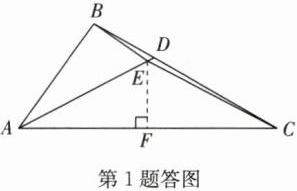
1.证明:如答图,过点E作$EF⊥ AC$于点F.
$\because EA=EC,\therefore AF=FC=\frac{1}{2}AC.$
$\because AC=2AB,\therefore AF=AB.$
$\because AD$平分$∠ BAC,\therefore ∠ BAD=∠ CAD.$
在$△ ABE$和$△ AFE$中,$\begin{cases} AB=AF, \\ ∠ BAE=∠ FAE, \\ AE=AE, \end{cases}$
$\therefore △ ABE≌△ AFE(\mathrm{SAS}),\therefore ∠ ABE=∠ AFE=90°,$
$\therefore EB⊥ AB.$
解析:
【分析】
要证明$EB⊥AB$,本质是证明$∠ ABE=90°$。我们可以从已知条件入手推导:首先已知$EA=EC$,说明$△ EAC$是等腰三角形,等腰三角形优先考虑用“三线合一”作辅助线,因此过$E$作$EF⊥ AC$于$F$,可直接得到$AF=\frac{1}{2}AC$;结合$AC=2AB$的条件,可推出$AF=AB$;再结合$AD$平分$∠ BAC$得到的等角、公共边$AE$,即可通过SAS判定$△ ABE$和$△ AFE$全等,将$∠ AFE=90°$转化为$∠ ABE=90°$,就能得到最终结论。
【解析】
证明:如答图,过点$E$作$EF⊥ AC$于点$F$。
$\because EA=EC$,$△ EAC$为等腰三角形,由等腰三角形三线合一的性质可得:
$AF=FC=\frac{1}{2}AC$。
$\because AC=2AB$,$\therefore AF=\frac{1}{2}AC=AB$。
$\because AD$平分$∠ BAC$,由角平分线的定义可得:$∠ BAD=∠ CAD$。
在$△ ABE$和$△ AFE$中:
$\begin{cases} AB=AF, \\ ∠ BAE=∠ FAE, \\ AE=AE, \end{cases}$
$\therefore △ ABE≌△ AFE(\mathrm{SAS})$,由全等三角形对应角相等可得:$∠ ABE=∠ AFE=90°$,
$\therefore EB⊥ AB$。
【答案】
证明:如答图,过点E作$EF⊥ AC$于点F.
$\because EA=EC,\therefore AF=FC=\frac{1}{2}AC.$
$\because AC=2AB,\therefore AF=AB.$
$\because AD$平分$∠ BAC,\therefore ∠ BAD=∠ CAD.$
在$△ ABE$和$△ AFE$中,$\begin{cases} AB=AF, \\ ∠ BAE=∠ FAE, \\ AE=AE, \end{cases}$
$\therefore △ ABE≌△ AFE(\mathrm{SAS}),\therefore ∠ ABE=∠ AFE=90°,$
$\therefore EB⊥ AB.$
【知识点】
等腰三角形的性质,角平分线的定义,全等三角形的判定与性质
【点评】
本题是等腰三角形辅助线应用的典型题型,解题关键是利用等腰三角形“三线合一”的性质作辅助线构造全等三角形,将已知的线段、角的条件和待证的垂直结论建立关联,侧重考查几何基础性质的综合运用能力。
【难度系数】
0.7
要证明$EB⊥AB$,本质是证明$∠ ABE=90°$。我们可以从已知条件入手推导:首先已知$EA=EC$,说明$△ EAC$是等腰三角形,等腰三角形优先考虑用“三线合一”作辅助线,因此过$E$作$EF⊥ AC$于$F$,可直接得到$AF=\frac{1}{2}AC$;结合$AC=2AB$的条件,可推出$AF=AB$;再结合$AD$平分$∠ BAC$得到的等角、公共边$AE$,即可通过SAS判定$△ ABE$和$△ AFE$全等,将$∠ AFE=90°$转化为$∠ ABE=90°$,就能得到最终结论。
【解析】
证明:如答图,过点$E$作$EF⊥ AC$于点$F$。
$\because EA=EC$,$△ EAC$为等腰三角形,由等腰三角形三线合一的性质可得:
$AF=FC=\frac{1}{2}AC$。
$\because AC=2AB$,$\therefore AF=\frac{1}{2}AC=AB$。
$\because AD$平分$∠ BAC$,由角平分线的定义可得:$∠ BAD=∠ CAD$。
在$△ ABE$和$△ AFE$中:
$\begin{cases} AB=AF, \\ ∠ BAE=∠ FAE, \\ AE=AE, \end{cases}$
$\therefore △ ABE≌△ AFE(\mathrm{SAS})$,由全等三角形对应角相等可得:$∠ ABE=∠ AFE=90°$,
$\therefore EB⊥ AB$。
【答案】
证明:如答图,过点E作$EF⊥ AC$于点F.
$\because EA=EC,\therefore AF=FC=\frac{1}{2}AC.$
$\because AC=2AB,\therefore AF=AB.$
$\because AD$平分$∠ BAC,\therefore ∠ BAD=∠ CAD.$
在$△ ABE$和$△ AFE$中,$\begin{cases} AB=AF, \\ ∠ BAE=∠ FAE, \\ AE=AE, \end{cases}$
$\therefore △ ABE≌△ AFE(\mathrm{SAS}),\therefore ∠ ABE=∠ AFE=90°,$
$\therefore EB⊥ AB.$
【知识点】
等腰三角形的性质,角平分线的定义,全等三角形的判定与性质
【点评】
本题是等腰三角形辅助线应用的典型题型,解题关键是利用等腰三角形“三线合一”的性质作辅助线构造全等三角形,将已知的线段、角的条件和待证的垂直结论建立关联,侧重考查几何基础性质的综合运用能力。
【难度系数】
0.7
2.如图,在$△ ABC$中,$AB=AC$,点$P$从点$B$出发沿线段$BA$移动(点$P$不与点$A,B$重合),同时,点$Q$从点$C$出发沿线段$AC$的延长线移动,已知点$P,Q$移动的速度相同,$PQ$与直线$BC$相交于点$D$.
(1)求证:$PD=QD$;
(2)过点$P$作直线$BC$的垂线,垂足为$E$,点$P,Q$在移动过程中,线段$BE,DE,CD$中是否存在长度保持不变的线段?请说明理由.
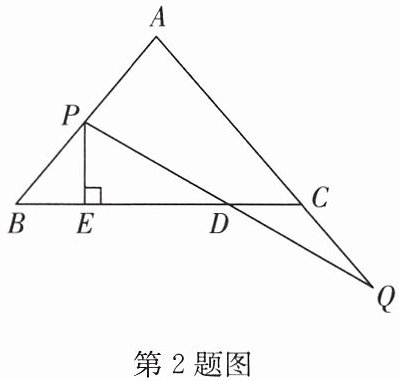
(1)求证:$PD=QD$;
(2)过点$P$作直线$BC$的垂线,垂足为$E$,点$P,Q$在移动过程中,线段$BE,DE,CD$中是否存在长度保持不变的线段?请说明理由.
答案:
2.(1)证明:如答图,过点P作$PF// AC$交BC于点F.
$\because$点P和点Q同时出发,且速度相同,$\therefore BP=CQ.$
$\because PF// AQ,\therefore ∠ PFB=∠ ACB,∠ DPF=∠ DQC.$
又$\because AB=AC,\therefore ∠ B=∠ ACB,\therefore ∠ B=∠ PFB,$
$\therefore BP=PF,\therefore PF=CQ.$
在$△ PFD$与$△ QCD$中,$\begin{cases} ∠ PDF=∠ QDC, \\ ∠ DPF=∠ DQC, \\ PF=QC, \end{cases}$
$\therefore △ PFD≌△ QCD(\mathrm{AAS}),\therefore PD=QD.$
(2)解:存在,ED是长度保持不变的线段,理由如下:
由(1)得$△ PFD≌△ QCD,BP=PF$,
$\therefore DF=CD,\therefore FD=\frac{1}{2}FC.$
$\because PE⊥ BC,\therefore BE=EF,\therefore EF=\frac{1}{2}BF,$
$\therefore ED=FD+EF=\frac{1}{2}FC+\frac{1}{2}BF=\frac{1}{2}BC,$
$\therefore ED$是长度保持不变的线段.
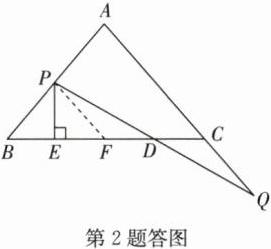
2.(1)证明:如答图,过点P作$PF// AC$交BC于点F.
$\because$点P和点Q同时出发,且速度相同,$\therefore BP=CQ.$
$\because PF// AQ,\therefore ∠ PFB=∠ ACB,∠ DPF=∠ DQC.$
又$\because AB=AC,\therefore ∠ B=∠ ACB,\therefore ∠ B=∠ PFB,$
$\therefore BP=PF,\therefore PF=CQ.$
在$△ PFD$与$△ QCD$中,$\begin{cases} ∠ PDF=∠ QDC, \\ ∠ DPF=∠ DQC, \\ PF=QC, \end{cases}$
$\therefore △ PFD≌△ QCD(\mathrm{AAS}),\therefore PD=QD.$
(2)解:存在,ED是长度保持不变的线段,理由如下:
由(1)得$△ PFD≌△ QCD,BP=PF$,
$\therefore DF=CD,\therefore FD=\frac{1}{2}FC.$
$\because PE⊥ BC,\therefore BE=EF,\therefore EF=\frac{1}{2}BF,$
$\therefore ED=FD+EF=\frac{1}{2}FC+\frac{1}{2}BF=\frac{1}{2}BC,$
$\therefore ED$是长度保持不变的线段.
解析:
【分析】
(1) 要证明PD=QD,可通过证明两条线段所在的三角形全等实现。已知点P、Q移动速度相同,因此BP=CQ,结合△ABC中AB=AC的等腰条件,过点P作PF//AC交BC于点F:一方面可利用平行线的性质得到相等的角,另一方面可推出△BPF为等腰三角形,得到PF=BP=CQ,即可用AAS判定△PFD≌△QCD,进而证得PD=QD。
(2) 探究长度不变的线段时,结合(1)的全等结论和PE⊥BC的条件推导:由全等可得DF=CD,由等腰△BPF三线合一的性质可得BE=EF,因此DE可转化为EF+DF,整理后可得DE的长度为BC的一半,BC是定值,因此DE长度保持不变。
【解析】
(1) 证明:如答图,过点P作$PF// AC$交BC于点F。
∵点P和点Q同时出发,且移动速度相同,$\therefore BP=CQ$。
$\because PF// AQ$,$\therefore ∠ PFB=∠ ACB$,$∠ DPF=∠ DQC$。
又$\because AB=AC$,$\therefore ∠ B=∠ ACB$,$\therefore ∠ B=∠ PFB$,
$\therefore BP=PF$,$\therefore PF=CQ$。
在$△ PFD$与$△ QCD$中,
$\begin{cases} ∠ PDF=∠ QDC, \\ ∠ DPF=∠ DQC, \\ PF=QC, \end{cases}$
$\therefore △ PFD≌△ QCD(\mathrm{AAS})$,$\therefore PD=QD$。
(2) 解:存在长度保持不变的线段,该线段是ED,理由如下:
由(1)得$△ PFD≌△ QCD$,且$BP=PF$,
$\therefore DF=CD$,即$FD=\frac{1}{2}FC$。
$\because PE⊥ BC$,△BPF为等腰三角形,根据等腰三角形三线合一的性质,$\therefore BE=EF$,即$EF=\frac{1}{2}BF$。
$\therefore ED=FD+EF=\frac{1}{2}FC+\frac{1}{2}BF=\frac{1}{2}(FC+BF)=\frac{1}{2}BC$,
∵BC是△ABC的固定边,长度为定值,$\therefore ED$的长度保持不变。
【答案】
(1) 证明成立,$PD=QD$;
(2) 存在长度保持不变的线段,为$DE$,长度恒等于$\frac{1}{2}BC$。
【知识点】
等腰三角形的性质、全等三角形的判定与性质、平行线的性质
【点评】
本题是等腰三角形与全等三角形的综合应用题,解题的关键是通过作平行线构造全等三角形和等腰三角形,将动点带来的变化边转化为可推导的等量关系,能有效锻炼辅助线构造能力和几何逻辑推理能力。
【难度系数】
0.65
(1) 要证明PD=QD,可通过证明两条线段所在的三角形全等实现。已知点P、Q移动速度相同,因此BP=CQ,结合△ABC中AB=AC的等腰条件,过点P作PF//AC交BC于点F:一方面可利用平行线的性质得到相等的角,另一方面可推出△BPF为等腰三角形,得到PF=BP=CQ,即可用AAS判定△PFD≌△QCD,进而证得PD=QD。
(2) 探究长度不变的线段时,结合(1)的全等结论和PE⊥BC的条件推导:由全等可得DF=CD,由等腰△BPF三线合一的性质可得BE=EF,因此DE可转化为EF+DF,整理后可得DE的长度为BC的一半,BC是定值,因此DE长度保持不变。
【解析】
(1) 证明:如答图,过点P作$PF// AC$交BC于点F。
∵点P和点Q同时出发,且移动速度相同,$\therefore BP=CQ$。
$\because PF// AQ$,$\therefore ∠ PFB=∠ ACB$,$∠ DPF=∠ DQC$。
又$\because AB=AC$,$\therefore ∠ B=∠ ACB$,$\therefore ∠ B=∠ PFB$,
$\therefore BP=PF$,$\therefore PF=CQ$。
在$△ PFD$与$△ QCD$中,
$\begin{cases} ∠ PDF=∠ QDC, \\ ∠ DPF=∠ DQC, \\ PF=QC, \end{cases}$
$\therefore △ PFD≌△ QCD(\mathrm{AAS})$,$\therefore PD=QD$。
(2) 解:存在长度保持不变的线段,该线段是ED,理由如下:
由(1)得$△ PFD≌△ QCD$,且$BP=PF$,
$\therefore DF=CD$,即$FD=\frac{1}{2}FC$。
$\because PE⊥ BC$,△BPF为等腰三角形,根据等腰三角形三线合一的性质,$\therefore BE=EF$,即$EF=\frac{1}{2}BF$。
$\therefore ED=FD+EF=\frac{1}{2}FC+\frac{1}{2}BF=\frac{1}{2}(FC+BF)=\frac{1}{2}BC$,
∵BC是△ABC的固定边,长度为定值,$\therefore ED$的长度保持不变。
【答案】
(1) 证明成立,$PD=QD$;
(2) 存在长度保持不变的线段,为$DE$,长度恒等于$\frac{1}{2}BC$。
【知识点】
等腰三角形的性质、全等三角形的判定与性质、平行线的性质
【点评】
本题是等腰三角形与全等三角形的综合应用题,解题的关键是通过作平行线构造全等三角形和等腰三角形,将动点带来的变化边转化为可推导的等量关系,能有效锻炼辅助线构造能力和几何逻辑推理能力。
【难度系数】
0.65
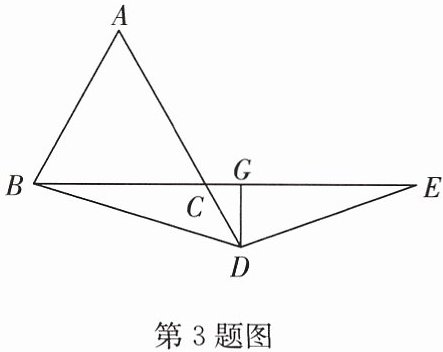
3. 如图,在等边$△ ABC$中,$D$为边$AC$延长线上一点,延长$BC$至点$E$,使$CE=AD$,$DG\bot BC$,交$BC$的延长线于点$G$,求证:$BG=EG$.
答案:
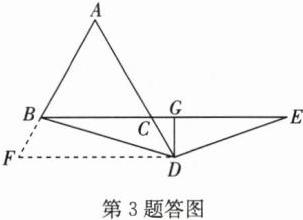
3. 证明:过点D作$DF// BC$交AB的延长线于点F.
$\because △ ABC$是等边三角形,
$\therefore AB=AC=BC,∠ ABC=∠ ACB=∠ AFD=∠ ADF=∠ A=60°,$
$\therefore △ ADF$是等边三角形,$\therefore AD=DF=AF,\therefore CD=BF.$
又$\because AD=CE,\therefore FD=CE.$
又$\because ∠ DCE=∠ ACB=60°,\therefore ∠ DFB=∠ DCE.$
在$△ BFD$和$△ DCE$中,$\begin{cases} BF=DC, \\ ∠ DFB=∠ ECD, \\ FD=CE, \end{cases}$
$\therefore △ BFD≌△ DCE(\mathrm{SAS}),\therefore DB=DE.$
$\because DG⊥ BC,\therefore BG=EG.$
3. 证明:过点D作$DF// BC$交AB的延长线于点F.
$\because △ ABC$是等边三角形,
$\therefore AB=AC=BC,∠ ABC=∠ ACB=∠ AFD=∠ ADF=∠ A=60°,$
$\therefore △ ADF$是等边三角形,$\therefore AD=DF=AF,\therefore CD=BF.$
又$\because AD=CE,\therefore FD=CE.$
又$\because ∠ DCE=∠ ACB=60°,\therefore ∠ DFB=∠ DCE.$
在$△ BFD$和$△ DCE$中,$\begin{cases} BF=DC, \\ ∠ DFB=∠ ECD, \\ FD=CE, \end{cases}$
$\therefore △ BFD≌△ DCE(\mathrm{SAS}),\therefore DB=DE.$
$\because DG⊥ BC,\therefore BG=EG.$
解析:
【分析】
要证明$BG=EG$,已知$DG⊥ BC$,根据等腰三角形“三线合一”的性质,只需证明$BD=DE$,即证$△ BDE$为等腰三角形,可通过证明含$BD$、$DE$的两个三角形全等推导。结合题中等边$△ ABC$、$CE=AD$的条件,过点$D$作$DF// BC$交$AB$延长线于$F$,先利用平行线性质和等边三角形判定得到$△ ADF$是等边三角形,即可得到全等需要的相等线段和角,证明三角形全等得到$BD=DE$,最终推出结论。
【解析】
证明:过点D作$DF// BC$交AB的延长线于点F.
$\because △ ABC$是等边三角形,
$\therefore AB=AC=BC,∠ ABC=∠ ACB=∠ AFD=∠ ADF=∠ A=60°,$
$\therefore △ ADF$是等边三角形,$\therefore AD=DF=AF,\therefore CD=BF.$
又$\because AD=CE,\therefore FD=CE.$
又$\because ∠ DCE=∠ ACB=60°,\therefore ∠ DFB=∠ DCE.$
在$△ BFD$和$△ DCE$中,$\begin{cases} BF=DC, \\ ∠ DFB=∠ ECD, \\ FD=CE, \end{cases}$
$\therefore △ BFD≌△ DCE(\mathrm{SAS}),\therefore DB=DE.$
$\because DG⊥ BC,\therefore BG=EG.$
【答案】
证明:过点D作$DF// BC$交AB的延长线于点F.
$\because △ ABC$是等边三角形,
$\therefore AB=AC=BC,∠ ABC=∠ ACB=∠ AFD=∠ ADF=∠ A=60°,$
$\therefore △ ADF$是等边三角形,$\therefore AD=DF=AF,\therefore CD=BF.$
又$\because AD=CE,\therefore FD=CE.$
又$\because ∠ DCE=∠ ACB=60°,\therefore ∠ DFB=∠ DCE.$
在$△ BFD$和$△ DCE$中,$\begin{cases} BF=DC, \\ ∠ DFB=∠ ECD, \\ FD=CE, \end{cases}$
$\therefore △ BFD≌△ DCE(\mathrm{SAS}),\therefore DB=DE.$
$\because DG⊥ BC,\therefore BG=EG.$
【知识点】
等边三角形的判定与性质,全等三角形的判定与性质,等腰三角形三线合一
【点评】
本题是三角形性质的综合应用题,解题的核心是通过作平行线构造等边三角形和全等三角形,将待证的线段相等问题转化为等腰三角形三线合一的应用,熟练掌握这类辅助线的作法可以快速找到几何证明题的突破口。
【难度系数】
0.6
要证明$BG=EG$,已知$DG⊥ BC$,根据等腰三角形“三线合一”的性质,只需证明$BD=DE$,即证$△ BDE$为等腰三角形,可通过证明含$BD$、$DE$的两个三角形全等推导。结合题中等边$△ ABC$、$CE=AD$的条件,过点$D$作$DF// BC$交$AB$延长线于$F$,先利用平行线性质和等边三角形判定得到$△ ADF$是等边三角形,即可得到全等需要的相等线段和角,证明三角形全等得到$BD=DE$,最终推出结论。
【解析】
证明:过点D作$DF// BC$交AB的延长线于点F.
$\because △ ABC$是等边三角形,
$\therefore AB=AC=BC,∠ ABC=∠ ACB=∠ AFD=∠ ADF=∠ A=60°,$
$\therefore △ ADF$是等边三角形,$\therefore AD=DF=AF,\therefore CD=BF.$
又$\because AD=CE,\therefore FD=CE.$
又$\because ∠ DCE=∠ ACB=60°,\therefore ∠ DFB=∠ DCE.$
在$△ BFD$和$△ DCE$中,$\begin{cases} BF=DC, \\ ∠ DFB=∠ ECD, \\ FD=CE, \end{cases}$
$\therefore △ BFD≌△ DCE(\mathrm{SAS}),\therefore DB=DE.$
$\because DG⊥ BC,\therefore BG=EG.$
【答案】
证明:过点D作$DF// BC$交AB的延长线于点F.
$\because △ ABC$是等边三角形,
$\therefore AB=AC=BC,∠ ABC=∠ ACB=∠ AFD=∠ ADF=∠ A=60°,$
$\therefore △ ADF$是等边三角形,$\therefore AD=DF=AF,\therefore CD=BF.$
又$\because AD=CE,\therefore FD=CE.$
又$\because ∠ DCE=∠ ACB=60°,\therefore ∠ DFB=∠ DCE.$
在$△ BFD$和$△ DCE$中,$\begin{cases} BF=DC, \\ ∠ DFB=∠ ECD, \\ FD=CE, \end{cases}$
$\therefore △ BFD≌△ DCE(\mathrm{SAS}),\therefore DB=DE.$
$\because DG⊥ BC,\therefore BG=EG.$
【知识点】
等边三角形的判定与性质,全等三角形的判定与性质,等腰三角形三线合一
【点评】
本题是三角形性质的综合应用题,解题的核心是通过作平行线构造等边三角形和全等三角形,将待证的线段相等问题转化为等腰三角形三线合一的应用,熟练掌握这类辅助线的作法可以快速找到几何证明题的突破口。
【难度系数】
0.6