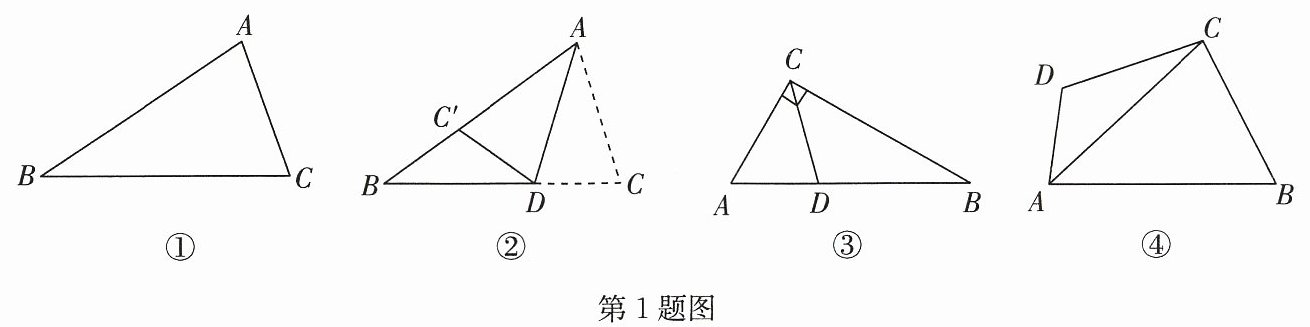
1. 阅读与理解:折纸,常常能为证明一个命题提供思路和方法,例如,如图①,在$△ ABC$中,$AB>AC$,怎样证明$∠C>∠B$呢?
分析:如图②,把$AC$沿$∠A$的平分线$AD$翻折,因为$AB>AC$,所以点$C$落在$AB$上的点$C'$处,即$AC=AC'$,根据以上操作,易证明$△ ACD≌ AC'D$,所以$∠AC'D=∠C$,又因为$∠AC'D>∠B$,所以$∠C>∠B$.
感悟与应用:
(1)如图③,在$△ ABC$中,$∠ACB=90°,∠B=30°,CD$平分$∠ACB$,试判断$AC$和$AD$,$BC$之间的数量关系,并说明理由.
(2)如图④,在四边形$ABCD$中,$AC$平分$∠DAB,AC=4,AD=2,CD=BC=3$.
①求证:$∠B+∠D=180°$;
②求$AB$的长.
分析:如图②,把$AC$沿$∠A$的平分线$AD$翻折,因为$AB>AC$,所以点$C$落在$AB$上的点$C'$处,即$AC=AC'$,根据以上操作,易证明$△ ACD≌ AC'D$,所以$∠AC'D=∠C$,又因为$∠AC'D>∠B$,所以$∠C>∠B$.
感悟与应用:
(1)如图③,在$△ ABC$中,$∠ACB=90°,∠B=30°,CD$平分$∠ACB$,试判断$AC$和$AD$,$BC$之间的数量关系,并说明理由.
(2)如图④,在四边形$ABCD$中,$AC$平分$∠DAB,AC=4,AD=2,CD=BC=3$.
①求证:$∠B+∠D=180°$;
②求$AB$的长.
答案:
1. (1)解:$AC+AD=BC$.理由如下:
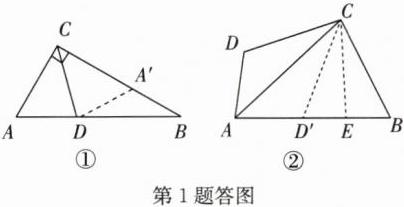
如答图①,把$AC$沿$∠ACB$的平分线$CD$翻折,点$A$落在$BC$上的点$A'$处,连接$A'D$.
$\because ∠ACB=90°,∠B=30°$,
$\therefore ∠A=90°-∠B=60°$.
由折叠的性质可知,$CA'=CA$,$A'D=AD$,$∠CA'D=∠A=60°$.
$\because ∠B=30°$,$\therefore ∠A'DB=∠CA'D-∠B=30°$,
$\therefore ∠A'DB=∠B$,
$\therefore A'D=A'B$,$\therefore AD=A'B$,
$\therefore BC=CA'+A'B=AC+AD$.
(2)①证明:如答图②,将$AD$沿$AC$翻折,使点$D$落在$AB$上的点$D'$处,连接$CD'$,
则$△ ADC≌△ AD'C$,
$\therefore CD=CD'=BC$,$∠D=∠AD'C$,
$\therefore ∠B=∠BD'C$.
$\because ∠BD'C+∠AD'C=180°$,
$\therefore ∠B+∠D=180°$.
②解:如答图②,作$CE⊥AB$于点$E$.
$\because CD'=BC$,$CE⊥AB$,
$\therefore BE=D'E$.
设$BE=D'E=x$,由①知$AD'=AD=2$,$\therefore AE=2+x$.
在$\mathrm{Rt}△ ACE$中,$AC^2-AE^2=CE^2$,
在$\mathrm{Rt}△ BCE$中,$BC^2-BE^2=CE^2$,
$\therefore AC^2-AE^2=BC^2-BE^2$,即$4^2-(x+2)^2=3^2-x^2$,
解得$x=\frac{3}{4}$,$\therefore AB=2+\frac{3}{4}×2=\frac{7}{2}$.
1. (1)解:$AC+AD=BC$.理由如下:
如答图①,把$AC$沿$∠ACB$的平分线$CD$翻折,点$A$落在$BC$上的点$A'$处,连接$A'D$.
$\because ∠ACB=90°,∠B=30°$,
$\therefore ∠A=90°-∠B=60°$.
由折叠的性质可知,$CA'=CA$,$A'D=AD$,$∠CA'D=∠A=60°$.
$\because ∠B=30°$,$\therefore ∠A'DB=∠CA'D-∠B=30°$,
$\therefore ∠A'DB=∠B$,
$\therefore A'D=A'B$,$\therefore AD=A'B$,
$\therefore BC=CA'+A'B=AC+AD$.
(2)①证明:如答图②,将$AD$沿$AC$翻折,使点$D$落在$AB$上的点$D'$处,连接$CD'$,
则$△ ADC≌△ AD'C$,
$\therefore CD=CD'=BC$,$∠D=∠AD'C$,
$\therefore ∠B=∠BD'C$.
$\because ∠BD'C+∠AD'C=180°$,
$\therefore ∠B+∠D=180°$.
②解:如答图②,作$CE⊥AB$于点$E$.
$\because CD'=BC$,$CE⊥AB$,
$\therefore BE=D'E$.
设$BE=D'E=x$,由①知$AD'=AD=2$,$\therefore AE=2+x$.
在$\mathrm{Rt}△ ACE$中,$AC^2-AE^2=CE^2$,
在$\mathrm{Rt}△ BCE$中,$BC^2-BE^2=CE^2$,
$\therefore AC^2-AE^2=BC^2-BE^2$,即$4^2-(x+2)^2=3^2-x^2$,
解得$x=\frac{3}{4}$,$\therefore AB=2+\frac{3}{4}×2=\frac{7}{2}$.
解析:
【分析】
(1) 可参考题干给出的翻折思路,已知CD是∠ACB的平分线,因此将AC沿CD翻折到BC边上,构造全等三角形,把AC、AD转化为BC边上的线段,再结合三角形外角性质和等角对等边推导线段数量关系。
(2) ①已知AC是∠DAB的平分线,同样利用翻折构造全等,将AD翻折到AB边上,把∠D转化为与∠B共顶点的邻补角,即可证明两角和为180°;②翻折后得到等腰三角形CD'B,作底边上的高,利用等腰三角形三线合一得到等线段,再结合勾股定理列方程求出未知线段长度,进而计算AB的长。
【解析】
(1) $AC+AD=BC$,理由如下:
如答图①,把$AC$沿$∠ACB$的平分线$CD$翻折,点$A$落在$BC$上的点$A'$处,连接$A'D$。
$\because ∠ACB=90°,∠B=30°$,
$\therefore ∠A=90°-∠B=60°$。
由折叠的性质可知:$CA'=CA$,$A'D=AD$,$∠CA'D=∠A=60°$。
$\because ∠CA'D$是$△ A'BD$的外角,$\therefore ∠A'DB=∠CA'D-∠B=60°-30°=30°$,
$\therefore ∠A'DB=∠B$,
$\therefore A'D=A'B$,即$AD=A'B$,
$\therefore BC=CA'+A'B=AC+AD$。
(2) ①证明:
如答图②,将$AD$沿$AC$翻折,使点$D$落在$AB$上的点$D'$处,连接$CD'$。
$\because AC$平分$∠DAB$,$\therefore ∠DAC=∠D'AC$,
又$\because AC=AC$,$AD=AD'$,
$\therefore △ ADC≌△ AD'C(\mathrm{SAS})$,
$\therefore CD=CD'$,$∠D=∠AD'C$。
$\because CD=BC$,$\therefore CD'=BC$,
$\therefore ∠B=∠BD'C$。
$\because ∠BD'C+∠AD'C=180°$,
$\therefore ∠B+∠D=180°$。
②解:
如答图②,过点$C$作$CE⊥AB$于点$E$。
$\because CD'=BC$,$CE⊥AB$,
$\therefore$ 根据等腰三角形三线合一,得$BE=D'E$。
设$BE=D'E=x$,由翻折性质知$AD'=AD=2$,
$\therefore AE=AD'+D'E=2+x$。
在$\mathrm{Rt}△ ACE$中,由勾股定理得:$CE^2=AC^2-AE^2$,
在$\mathrm{Rt}△ BCE$中,由勾股定理得:$CE^2=BC^2-BE^2$,
$\therefore AC^2-AE^2=BC^2-BE^2$,代入数值得:
$4^2-(x+2)^2=3^2-x^2$,
展开计算得$16-x^2-4x-4=9-x^2$,
化简解得$x=\frac{3}{4}$。
$\therefore AB=AD'+D'E+BE=2+2×\frac{3}{4}=\frac{7}{2}$。
【答案】
1. (1)解:$AC+AD=BC$.理由如下:
如答图①,把$AC$沿$∠ACB$的平分线$CD$翻折,点$A$落在$BC$上的点$A'$处,连接$A'D$.
$\because ∠ACB=90°,∠B=30°$,
$\therefore ∠A=90°-∠B=60°$.
由折叠的性质可知,$CA'=CA$,$A'D=AD$,$∠CA'D=∠A=60°$.
$\because ∠B=30°$,$\therefore ∠A'DB=∠CA'D-∠B=30°$,
$\therefore ∠A'DB=∠B$,
$\therefore A'D=A'B$,$\therefore AD=A'B$,
$\therefore BC=CA'+A'B=AC+AD$.
(2)①证明:如答图②,将$AD$沿$AC$翻折,使点$D$落在$AB$上的点$D'$处,连接$CD'$,
则$△ ADC≌△ AD'C$,
$\therefore CD=CD'=BC$,$∠D=∠AD'C$,
$\therefore ∠B=∠BD'C$.
$\because ∠BD'C+∠AD'C=180°$,
$\therefore ∠B+∠D=180°$.
②解:如答图②,作$CE⊥AB$于点$E$.
$\because CD'=BC$,$CE⊥AB$,
$\therefore BE=D'E$.
设$BE=D'E=x$,由①知$AD'=AD=2$,$\therefore AE=2+x$.
在$\mathrm{Rt}△ ACE$中,$AC^2-AE^2=CE^2$,
在$\mathrm{Rt}△ BCE$中,$BC^2-BE^2=CE^2$,
$\therefore AC^2-AE^2=BC^2-BE^2$,即$4^2-(x+2)^2=3^2-x^2$,
解得$x=\frac{3}{4}$,$\therefore AB=2+\frac{3}{4}×2=\frac{7}{2}$.
【知识点】
翻折变换的性质,全等三角形的判定与性质,勾股定理
【点评】
本题是方法渗透类的几何综合题,以题干给出的“角平分线+翻折构造全等”的思路为核心,综合考查了三角形外角性质、等腰三角形的性质、勾股定理的应用,解题时要注意运用转化思想,将分散的角、线段通过翻折集中到同一个图形中求解。
【难度系数】
0.3
(1) 可参考题干给出的翻折思路,已知CD是∠ACB的平分线,因此将AC沿CD翻折到BC边上,构造全等三角形,把AC、AD转化为BC边上的线段,再结合三角形外角性质和等角对等边推导线段数量关系。
(2) ①已知AC是∠DAB的平分线,同样利用翻折构造全等,将AD翻折到AB边上,把∠D转化为与∠B共顶点的邻补角,即可证明两角和为180°;②翻折后得到等腰三角形CD'B,作底边上的高,利用等腰三角形三线合一得到等线段,再结合勾股定理列方程求出未知线段长度,进而计算AB的长。
【解析】
(1) $AC+AD=BC$,理由如下:
如答图①,把$AC$沿$∠ACB$的平分线$CD$翻折,点$A$落在$BC$上的点$A'$处,连接$A'D$。
$\because ∠ACB=90°,∠B=30°$,
$\therefore ∠A=90°-∠B=60°$。
由折叠的性质可知:$CA'=CA$,$A'D=AD$,$∠CA'D=∠A=60°$。
$\because ∠CA'D$是$△ A'BD$的外角,$\therefore ∠A'DB=∠CA'D-∠B=60°-30°=30°$,
$\therefore ∠A'DB=∠B$,
$\therefore A'D=A'B$,即$AD=A'B$,
$\therefore BC=CA'+A'B=AC+AD$。
(2) ①证明:
如答图②,将$AD$沿$AC$翻折,使点$D$落在$AB$上的点$D'$处,连接$CD'$。
$\because AC$平分$∠DAB$,$\therefore ∠DAC=∠D'AC$,
又$\because AC=AC$,$AD=AD'$,
$\therefore △ ADC≌△ AD'C(\mathrm{SAS})$,
$\therefore CD=CD'$,$∠D=∠AD'C$。
$\because CD=BC$,$\therefore CD'=BC$,
$\therefore ∠B=∠BD'C$。
$\because ∠BD'C+∠AD'C=180°$,
$\therefore ∠B+∠D=180°$。
②解:
如答图②,过点$C$作$CE⊥AB$于点$E$。
$\because CD'=BC$,$CE⊥AB$,
$\therefore$ 根据等腰三角形三线合一,得$BE=D'E$。
设$BE=D'E=x$,由翻折性质知$AD'=AD=2$,
$\therefore AE=AD'+D'E=2+x$。
在$\mathrm{Rt}△ ACE$中,由勾股定理得:$CE^2=AC^2-AE^2$,
在$\mathrm{Rt}△ BCE$中,由勾股定理得:$CE^2=BC^2-BE^2$,
$\therefore AC^2-AE^2=BC^2-BE^2$,代入数值得:
$4^2-(x+2)^2=3^2-x^2$,
展开计算得$16-x^2-4x-4=9-x^2$,
化简解得$x=\frac{3}{4}$。
$\therefore AB=AD'+D'E+BE=2+2×\frac{3}{4}=\frac{7}{2}$。
【答案】
1. (1)解:$AC+AD=BC$.理由如下:
如答图①,把$AC$沿$∠ACB$的平分线$CD$翻折,点$A$落在$BC$上的点$A'$处,连接$A'D$.
$\because ∠ACB=90°,∠B=30°$,
$\therefore ∠A=90°-∠B=60°$.
由折叠的性质可知,$CA'=CA$,$A'D=AD$,$∠CA'D=∠A=60°$.
$\because ∠B=30°$,$\therefore ∠A'DB=∠CA'D-∠B=30°$,
$\therefore ∠A'DB=∠B$,
$\therefore A'D=A'B$,$\therefore AD=A'B$,
$\therefore BC=CA'+A'B=AC+AD$.
(2)①证明:如答图②,将$AD$沿$AC$翻折,使点$D$落在$AB$上的点$D'$处,连接$CD'$,
则$△ ADC≌△ AD'C$,
$\therefore CD=CD'=BC$,$∠D=∠AD'C$,
$\therefore ∠B=∠BD'C$.
$\because ∠BD'C+∠AD'C=180°$,
$\therefore ∠B+∠D=180°$.
②解:如答图②,作$CE⊥AB$于点$E$.
$\because CD'=BC$,$CE⊥AB$,
$\therefore BE=D'E$.
设$BE=D'E=x$,由①知$AD'=AD=2$,$\therefore AE=2+x$.
在$\mathrm{Rt}△ ACE$中,$AC^2-AE^2=CE^2$,
在$\mathrm{Rt}△ BCE$中,$BC^2-BE^2=CE^2$,
$\therefore AC^2-AE^2=BC^2-BE^2$,即$4^2-(x+2)^2=3^2-x^2$,
解得$x=\frac{3}{4}$,$\therefore AB=2+\frac{3}{4}×2=\frac{7}{2}$.
【知识点】
翻折变换的性质,全等三角形的判定与性质,勾股定理
【点评】
本题是方法渗透类的几何综合题,以题干给出的“角平分线+翻折构造全等”的思路为核心,综合考查了三角形外角性质、等腰三角形的性质、勾股定理的应用,解题时要注意运用转化思想,将分散的角、线段通过翻折集中到同一个图形中求解。
【难度系数】
0.3